Why Fez Hospital Effluent Needs a Dedicated Treatment Train
Hospital wastewater in Fez is roughly twice as strong as domestic sewage on a BOD basis and carries a pharmaceutical footprint that municipal plants were not designed to remove. The Tahiri 2012 baseline at Al Ghassani hospital reports BOD5 of 192 ± 8.62 mg/L and COD of 245 ± 9.15 mg/L, giving a BOD5:COD ratio of 0.77 — a clearly biodegradable profile but one laden with medicine residues, chemical reagents, antiseptics, and detergents that are partially refractory to conventional secondary treatment. The same study identified pathogenic microorganisms at concentrations that make any direct discharge to Wadi Sebou a public-health concern.
Regulatory pressure is real and local. Until 2013, Fez's combined collection system discharged more than 38 million m³/yr of untreated sewage into Wadi Sebou, contributing an estimated 40% of the river's total pollution load (Waterleau). The Fez municipal WWTP now treats the city's sewage on an activated-sludge basis for 1.3 million inhabitants, but the plant was sized for municipal — not hospital — loading. A new hospital seeking a permit under Morocco's Loi 12-06 and current Secrétariat d'État chargé de l'Environnement guidance is now expected to install dedicated pre-treatment, biological, and disinfection steps upstream of any municipal connection or reuse loop. The 2012 Tahiri dataset remains the only Fez-specific hospital characterization in the public domain and is still referenced in 2024 reviews, but the design practice around it has moved 14 years forward.
Influent Characterization: What Comes Out of a Fez Hospital
For a 2026 mass balance, anchor on the Al Ghassani numbers and layer in typical hospital ranges so the design holds across peak shifts and seasonal variation. Per-bed water demand in Moroccan hospitals typically falls in the 200–400 L/bed/day range, with 70–80% emerging as effluent — a 100-bed facility therefore generates 14–32 m³/day baseline, rising to 40–80 m³/day once laundry, sterilization, and laboratory streams are included. Diurnal peaking factors of 1.5–2.5× during morning shifts are the rule, which is why equalization is non-negotiable upstream of any biological stage.
| Parameter | Al Ghassani 2012 (Tahiri) | Typical hospital range | Design implication |
|---|---|---|---|
| BOD5 | 192 ± 8.62 mg/L | 150–300 mg/L | High-strength biodegradable load; biological stage required |
| COD | 245 ± 9.15 mg/L | 220–500 mg/L | BOD:COD ≈ 0.5–0.78; secondary treatment viable |
| TSS | not reported in Tahiri | 80–250 mg/L | Pre-screening + primary clarification |
| NH3-N | not reported in Tahiri | 20–60 mg/L | Nitrification needed if discharge to sensitive receiver |
| Total coliforms | not reported in Tahiri | 106–107 CFU/100 mL | Mandatory disinfection ≥4-log E. coli reduction |
| pH | not reported in Tahiri | 6.5–8.5 | Equalization for pH spikes from disinfectant wash-water |
| Pharmaceutical micropollutants | qualitative (medicine residues) | μg/L range (Verlicchi review) | Advanced secondary or oxidative polishing |
The Verlicchi Springer review on hospital wastewaters documents antibiotics, iodinated contrast media, and cytotoxics at μg/L concentrations in hospital effluents — a load that conventional activated sludge only partially removes. Fez-specific micropollutant data does not exist in the public domain, so design conservatism is appropriate.
2026 Process Flow for Hospital Wastewater Treatment in Fez
A workable 2026 train for a Fez hospital runs in six blocks. The first line of defense is a rotary mechanical bar screen with 2–3 mm openings, sized at 1.5× peak flow to protect downstream pumps and membranes from gauze, wipes, and surgical swabs that routinely arrive in hospital sewage. The screened flow then drops into an equalization/buffer tank with 8–12 h hydraulic retention, fitted with submersible mixers; this damps the 1.5–2.5× diurnal peaks and neutralizes pH spikes from disinfectant wash-water and sterilization discharges.
From equalization, flow enters the biological stage. For footprint-constrained Fez sites, an MBR membrane bioreactor system is the default: F/M ratio of 0.05–0.10 kg BOD/kg MLSS·d, HRT 4–6 h, and MLSS held at 8,000–12,000 mg/L. A conventional activated-sludge alternative is acceptable (F/M 0.15–0.25, HRT 6–10 h) where land is available and reuse-quality permeate is not required. The MBR membrane stage uses submerged PVDF flat-sheet or hollow-fibre modules at 0.1–0.4 μm pore size, operating at a sustainable flux of 15–25 L/m²·h to deliver near-reuse-quality permeate.
Disinfection follows, with a chlorine dioxide generator dosed at 1–2 mg/L and a CT of ≥15 mg·min/L to deliver ≥4-log E. coli reduction without forming the trihalomethanes that liquid chlorine produces when it contacts pharmaceutical residue. Sludge from the bioreactor is thickened in a lamella clarifier and dewatered on a plate-and-frame filter press to ≥20% dry solids for off-site disposal.
| Stage | Equipment | Key design parameter | 2026 value |
|---|---|---|---|
| 1. Fine screening | Rotary mechanical bar screen | Opening / sizing | 2–3 mm, 1.5× peak flow |
| 2. Equalization | Buffer tank + mixers | HRT | 8–12 h |
| 3. Biological | MBR (preferred) or CAS | HRT / MLSS | 4–6 h, 8,000–12,000 mg/L (MBR) |
| 4. Membrane | PVDF submerged | Pore / flux | 0.1–0.4 μm, 15–25 L/m²·h |
| 5. Disinfection | ClO2 (primary) or UV | Dose / CT | 1–2 mg/L, CT ≥15 mg·min/L |
| 6. Sludge | Lamella + filter press | Output DS | ≥20% DS |
Disinfection Comparison: ClO2 vs Chlorine vs Ozone vs UV
Disinfection is where the hospital-versus-municipal distinction is sharpest. Pharmaceutical residues and iodinated contrast media react with free chlorine to form trihalomethanes and iodinated disinfection byproducts that municipal permits increasingly flag; the choice of agent is therefore not a preference but a regulatory argument.
| Agent | Typical dose | Contact time | E. coli / virus log reduction | Byproducts | OPEX signature |
|---|---|---|---|---|---|
| Chlorine dioxide (ClO2) | 1–2 mg/L | 15–30 min | 4–5 log E. coli / 3–4 log virus | Minimal THMs at typical dose; chlorite residual | Moderate (precursor + ClO2 generator) |
| Liquid chlorine (NaOCl) | 2–5 mg/L free Cl2 | 30 min | 3–4 log E. coli / 2–3 log virus | THM risk with pharmaceutical residue | Low chemical, but compliance risk |
| Ozone | 5–10 mg/L | 5–15 min | 5–6 log E. coli / 4–5 log virus | No THMs; bromate risk if bromide present | High CAPEX, no residual |
| UV (254 nm) | 30–40 mJ/cm² | Instantaneous | 3–4 log E. coli / 2–3 log virus | None | Low OPEX, no residual protection |
For Fez hospital projects, ClO2 is the primary recommendation on the combined strength of cost, log-reduction, and low THM formation. UV at 30–40 mJ/cm² is the right polishing step where chemical-free operation is mandated by the receiving environment or by a reuse permit, or where a residual disinfectant is not required downstream of the plant.
Equipment Sizing Example: 100-Bed Fez Hospital, 80 m³/day
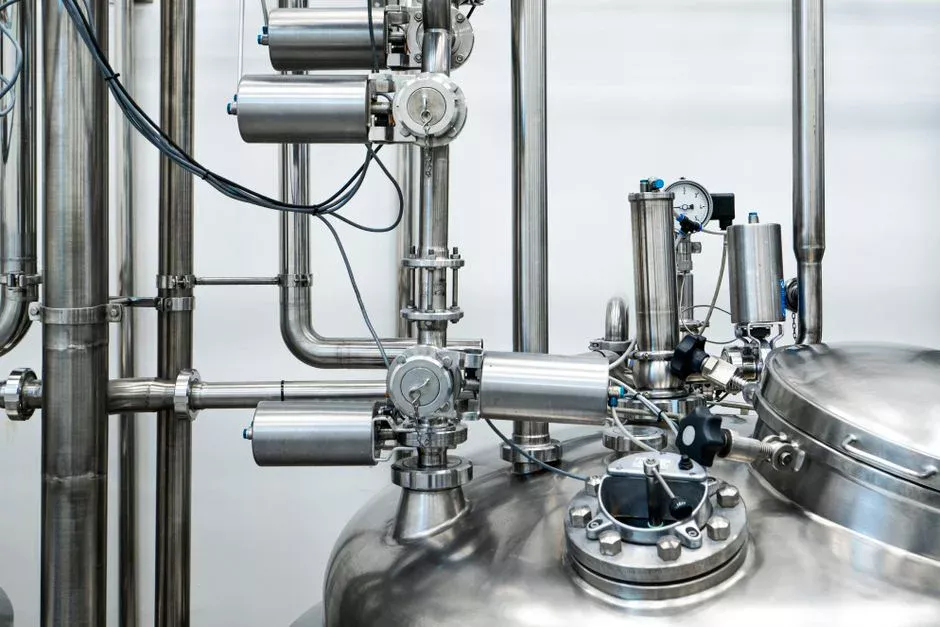
The worked example uses 100 beds × 250 L/bed/day × 0.8 wastewater fraction = 20,000 L/day average, multiplied by a 2.0 peaking factor to land at 40 m³/day average and 80 m³/day design — a realistic envelope for a Moroccan regional hospital. The equalization tank at 12 h HRT on the average flow is 40 m³, fitted with two submersible mixers at ~0.5 kW each.
The MBR membrane bioreactor system handles 80 m³/day ÷ 24 h = 3.3 m³/h on a continuous basis. At a sustainable flux of 18 L/m²·h, the required membrane area is roughly 185 m², which fits comfortably in a two-train PVDF flat-sheet skid with online backwash. The chlorine dioxide generator is sized for 2 mg/L × 80 m³/day ≈ 160 g/h demand, so a 200 g/h unit with 25% margin is the standard selection. Sludge production at 0.4 kg TSS/m³ removed is 32 kg DS/day; a 5 m² plate-and-frame filter press running 8 h/day handles this with cycles of 2–3 hours. An upstream lamella clarifier thickens waste activated sludge to 2–3% before the press, and an automatic chemical dosing system delivers coagulant and the ClO2 precursor on flow-proportional control.
2026 CAPEX and OPEX Benchmarks for Fez Hospital Projects
Procurement needs an envelope tied to bed count, not a single point estimate. The 2026 reference ranges below reflect a packaged MBR + ClO2 train, locally fabricated carbon-steel tanks, and an eight-month installation schedule typical of Moroccan hospital projects. Locally fabricated skids reduce CAPEX 15–25% versus fully imported European systems, which is the cost band a Moroccan supplier like us packages for export.
| Hospital size | Design flow (m³/day) | CAPEX (MAD) | CAPEX (USD) | OPEX (MAD/m³) | Dominant OPEX line |
|---|---|---|---|---|---|
| 50 beds | 30–50 | 1.2–1.8 M | $120k–$180k | 22–28 | Aeration energy (35–45%) |
| 100 beds | 60–100 | 1.8–2.6 M | $180k–$260k | 20–26 | Chemical dosing (ClO2 + coagulant, 15–25%) |
| 250 beds | 150–250 | 3.5–5.5 M | $350k–$550k | 18–24 | Sludge hauling (10–15%) |
| 500 beds | 300–450 | 6.5–9.5 M | $650k–$950k | 18–22 | Labor (15–20%) + membrane reserve (5–8%/yr) |
Across all bands, the OPEX split is consistent: aeration 35–45%, chemical dosing 15–25%, sludge hauling 10–15%, labor 15–20%, and a membrane-replacement reserve of 5–8% per year. A 100-bed facility at MAD 22/m³ treats 80 m³/day for an annual OPEX around MAD 640,000 — useful for the operating-budget conversation with hospital finance. For a deeper dive into system economics, the MBR systems in Morocco — cost and compliance reference covers membrane lifecycle and ROI in detail, and pharmaceutical residue removal in wastewater maps the case for oxidative polishing where a reuse permit is in play.
Frequently Asked Questions
What are typical BOD and COD values for hospital wastewater in Fez?
The Tahiri 2012 Al Ghassani dataset — still the only Fez-specific public characterization — reports BOD5 of 192 ± 8.62 mg/L and COD of 245 ± 9.15 mg/L, giving a BOD5:COD of 0.77. These are 1.5–2× typical domestic sewage strength and form the design basis for any 2026 Fez hospital project.
Is a separate hospital WWTP required, or can effluent go to the Fez municipal plant?
Direct discharge to the Fez municipal WWTP is technically possible but regulatorily discouraged under Loi 12-06 and current Secrétariat d'État à l'Environnement guidance, because pharmaceutical residues, contrast media, and cytotoxics pass through conventional activated sludge only partially. A dedicated pre-treatment + biological + disinfection train is now the expected baseline for new hospital permits.
Which disinfection is best for hospital effluent in Morocco?
Chlorine dioxide at 1–2 mg/L with a CT of ≥15 mg·min/L delivers 4–5 log E. coli and 3–4 log virus reduction without the THM formation that liquid chlorine produces when it contacts pharmaceutical residue. UV at 30–40 mJ/cm² is the right polishing option for chemical-free or reuse-quality applications.
How much does a 100-bed hospital wastewater plant cost in 2026?
A packaged MBR + ClO2 train for a 100-bed Fez hospital sized at 80 m³/day falls in the MAD 1.8–2.6 M (USD $180k–$260k) CAPEX range, with OPEX of MAD 20–26/m³ dominated by aeration energy and ClO2 precursor dosing.
What sludge handling is needed?
Waste activated sludge is thickened on a lamella clarifier to 2–3% DS and dewatered on a plate-and-frame filter press to ≥20% DS for off-site disposal. A 5 m² press running 8 h/day handles the 32 kg DS/day produced by an 80 m³/day hospital plant.