Why Petrochemical Wastewater Treatment in Mexico Faces a 2026 Compliance Crunch
Mexico's industrial discharge rules tightened materially when NOM-001-SEMARNAT-2021 replaced the 1996 standard, and the new monthly-average limits define the engineering envelope every refinery and petrochemical complex must hit. Operators discharging to rivers, dams, or coastal waters now face 60 mg/L COD, 20 mg/L BOD, 15 mg/L oil & grease, 20 mg/L TSS, and 2 mg/L total residual chlorine as monthly-average ceilings (per NOM-001-SEMARNAT-2021, Tabla 2). On top of that, CONAGUA is tightening Title 4 concessions under the Ley de Aguas Nacionales in overexploited aquifers — Valle de México, Monterrey, and Comarca Lagunera — so a 500 m³/day user that historically discharged to sewer is now paying real money per cubic meter for both extraction and disposal.
For context, Frost & Sullivan's 2013 study pegged Mexico's industrial water-and-wastewater chemical market at USD 342.9M with growth to USD 473.1M by 2017 (source: Frost & Sullivan, 2013). In 2026 the capex has migrated: roughly two-thirds now lands on packaged skids — DAF, MBR, RO — rather than on commodity chemicals, because monthly-average compliance cannot be hit with chemistry alone. PEMEX's flagship clusters sit in the regulatory crosshairs: Coatzacoalcos / Cosoleacaque (Veracruz), Ciudad Madero (Tamaulipas), Salamanca (Guanajuato), and Tula (Hidalgo), each generating 500–5,000 m³/day of process wastewater and oily condensate per complex. A SEMARNAT audit walks the same checklist every time, so the design has to anticipate it.
Typical Influent Profile from Mexican Refineries and Petrochemical Plants
Mexican refinery wastewater is a mix of desalter brine overhead, sour-water stripper bottoms, cracked-product wash water, and once-through cooling side-streams. Designers should plan around the following envelopes, which are typical for the sector:
| Parameter | Typical range (refinery) | Typical range (petrochemical) | Design envelope |
|---|---|---|---|
| TSS | 200–1,500 mg/L | 150–800 mg/L | ≤ 2,000 mg/L (peak) |
| Oil & grease | 50–500 mg/L | 30–200 mg/L | ≤ 800 mg/L (peak) |
| COD | 800–3,000 mg/L | 600–2,200 mg/L | ≤ 4,000 mg/L (peak) |
| BOD | 250–900 mg/L | 200–700 mg/L | — |
| Sulfides (S²⁻) | 5–50 mg/L | 2–20 mg/L | ≤ 100 mg/L |
| Phenols | 5–100 mg/L | 2–40 mg/L | ≤ 200 mg/L |
| NH₃-N | 20–200 mg/L | 10–80 mg/L | ≤ 300 mg/L |
| Temperature | 35–45 °C | 30–40 °C | ≤ 50 °C (equalization limit) |
| pH | 6.5–8.5 | 6.0–9.0 | 5.0–10.0 (emergency) |
Two characteristics drive equipment selection. First, stabilized emulsions from overhead condensate and cracked-product streams will not break in a gravity API separator alone — they require a chemical demulsifier plus dissolved air flotation, which is why legacy API units across Coatzacoalcos and Madero have been progressively converted. Second, catalyst carryover from hydrocrackers and reformers contributes chromium, nickel, and vanadium at low mg/L levels, and occasional BTX carryover from aromatic units pushes COD spikes well above the design envelope. Equalization is therefore sized for at least 12–18 hours of residence, not the 4–6 hours common in municipal design (HydropureWater field data, 2026).
The Standard 2026 Treatment Train: DAF to Biological to Polishing
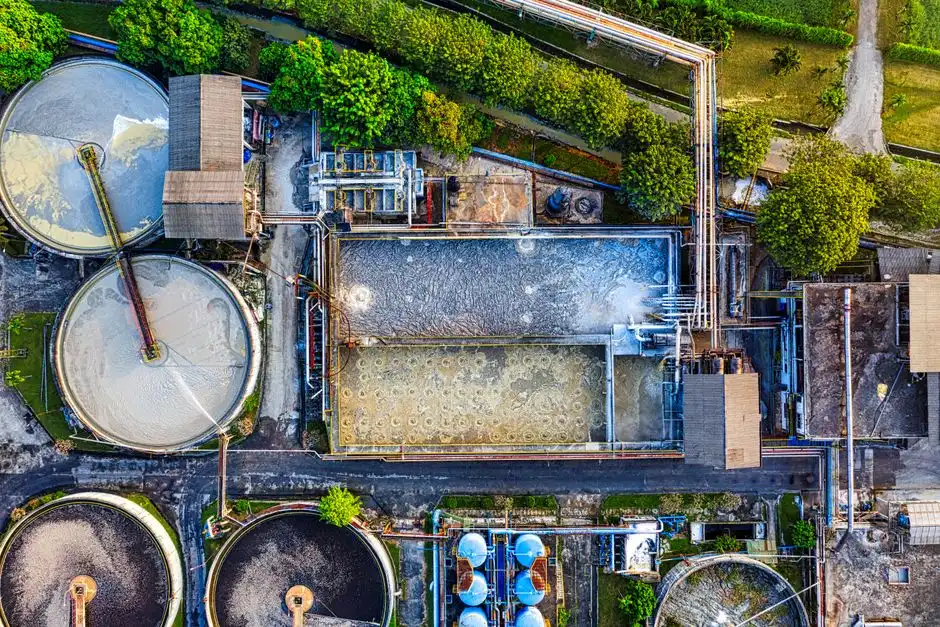
A compliant 2026 train for a Mexican refinery stacks four stages. Each stage exists because the prior one cannot hit the next limit alone.
Stage 1 — Dissolved air flotation. A DAF system for refinery oil and grease removal operating at 4–300 m³/h with a 4–6 bar saturation pressure and an air-to-solids (A/S) ratio of 0.3–0.5 achieves 90–95% oil & grease removal and 60–80% TSS removal in a single pass. DAF replaces the legacy API separator in most Mexican retrofits because it handles emulsified oil that gravity cannot resolve and operates in roughly 1/4 the footprint.
Stage 2 — Equalization and neutralization. A 12–18 hour equalization basin with mechanical mixing absorbs hydraulic and contaminant surges from upstream unit upsets; pH correction to 6.5–8.0 with caustic or HCl is done here. Coagulant (typically PAC at 50–150 mg/L) and flocculant (cationic polyacrylamide at 1–5 mg/L) are dosed just ahead of DAF to maximize oil droplet agglomeration. This is also where sulfide oxidation with hydrogen peroxide or NaOCl is sometimes applied to protect downstream biology.
Stage 3 — Biological treatment. A MBR system for petrochemical secondary treatment at mixed-liquor suspended solids of 8,000–12,000 mg/L degrades 80–95% of soluble COD and oxidizes ammonia to nitrate. The membrane barrier holds biomass at high concentration, delivering effluent turbidity below 1 NTU regardless of clarifier upset. MLSS and dissolved oxygen are trimmed against influent phenols and sulfides, with toxic-shock recovery measured in hours rather than the days required for conventional activated sludge.
Stage 4 — Tertiary polishing. An RO polishing for cooling-tower make-up reuse array cuts conductivity to below 500 µS/cm and total dissolved solids to under 50 mg/L, meeting the Langelier Saturation Index (LSI between −0.5 and +0.5) required for stable cooling-tower operation. For non-reuse discharge, an anthracite/sand multimedia filter at 10–15 m/h typically suffices to meet the 20 mg/L TSS monthly average. PLC/SCADA automation in 2026 is baseline — remote monitoring to a central control room reduces operator presence on the treatment pad to roughly 2–4 hours per shift.
Choosing Between MBR, MBBR, and Conventional Activated Sludge for Your Plant
The biological stage is the single biggest capex and opex line, so the choice must be defensible to procurement and to SEMARNAT. The table below compares the three realistic options for a 500 m³/day Mexican refinery duty:
| Criterion | MBR | MBBR | CAS (conventional activated sludge) |
|---|---|---|---|
| Footprint (relative) | ~40% of CAS | ~70% of CAS | 100% (baseline) |
| MLSS tolerance | 8,000–12,000 mg/L | 3,000–5,000 mg/L (carriers) | 2,000–4,000 mg/L |
| Effluent turbidity | < 1 NTU | 5–15 NTU (post-sed) | 5–20 NTU (post-sed) |
| Effluent TSS | < 5 mg/L | 15–30 mg/L | 15–30 mg/L |
| OPEX (USD/m³) | 0.45–0.75 | 0.30–0.55 | 0.25–0.50 |
| Toxic-shock recovery | Hours (membrane retains biomass) | Days (carrier retention) | Days (sludge washout risk) |
| Membrane replacement | Every 5–7 years, USD 80–150/m² | N/A | N/A |
| Sludge yield | 0.2–0.3 kg/kg COD | 0.3–0.4 kg/kg COD | 0.4–0.5 kg/kg COD |
For Mexican refinery service the operational difference is the toxic-shock profile. An MBBR recovers from a phenol or sulfide spike in 2–4 days, MBR in 4–12 hours; CAS can lose 30–50% of biomass in the same event. MBR's higher OPEX is recovered in three places: smaller civil works, no tertiary clarifier, and reuse-quality water that offsets freshwater concession fees. Downstream, the waste activated sludge is typically co-thickened with DAF float in a filter press (20–25% dry solids) before landfill or co-incineration, a chain that works on every Mexican refinery site that has been audited in the last 24 months (HydropureWater field data, 2026).
2026 CAPEX and OPEX Benchmarks for a 500 m³/day Mexican Refinery Train
Numbers below are for a turnkey DAF + equalization + MBR + RO train sized to 500 m³/day, skid-mounted, with a containerized control room. The 15–25% Mexican import premium over Chinese ex-works covers IVA, customs (IGI/IVA under a pedimento), and last-mile integration in site.
| Cost line | Low (USD) | High (USD) | Notes |
|---|---|---|---|
| CAPEX — DAF + EQ + MBR + RO skids | 1,800,000 | 4,500,000 | Includes installation, civil works, electrification |
| OPEX — total, per m³ treated | 0.45 | 0.95 | Electricity, chemicals, membranes, labor |
| Electricity (CFE industrial tariff) | MXN 1.8/kWh | MXN 2.4/kWh | Tariff HM / GDMTH, 2026 |
| Chemicals (coagulant, biocide, anti-scalant) | 0.05 USD/m³ | 0.12 USD/m³ | PAC + HCl + CIP chemicals |
| Membrane replacement (annualized) | 0.04 USD/m³ | 0.10 USD/m³ | MBR + RO, 5–7 year cycle |
| Freshwater concession (avoided cost) | MXN 28/m³ | MXN 45/m³ | Title 4, 2026 industrial tariff |
| Avoided discharge fee | MXN 18/m³ | MXN 30/m³ | Municipal + CONAGUA components |
| Payback period (reuse project) | 3.5 years | 6.0 years | 500 m³/day reuse; depends on concession tariff |
The OPEX stack is dominated by electricity at roughly 40–55% of the total. A typical MBR + RO train draws 2.5–3.5 kWh/m³, so at MXN 2.0/kWh that is around MXN 5–7/m³ of electrical cost before any chemical or membrane spend. For a 500 m³/day duty, avoided freshwater plus avoided discharge fees together come to MXN 23,000–37,500 per day, which is what makes a 3.5–6 year payback realistic in 2026. Mexican financing is available through Banobras and FIRA green-loan lines specifically targeted at industrial water-reuse retrofits, with tenor up to 10 years at soft rates. For a deeper line-by-line cost model, see this OPEX breakdown per cubic meter for Mexican plants.
Frequently Asked Questions
What are the NOM-001-SEMARNAT-2021 effluent limits for petrochemical plants in Mexico? Monthly-average ceilings for industrial discharges to surface water are 60 mg/L COD, 20 mg/L BOD, 15 mg/L oil & grease, 20 mg/L TSS, and 2 mg/L total residual chlorine, with stricter limits (e.g., 30 mg/L COD, 10 mg/L BOD) for discharges to reservoirs used as drinking-water sources (NOM-001-SEMARNAT-2021, Tabla 2).
What is the best first stage for refinery wastewater with high oil and grease? Dissolved air flotation at 4–6 bar saturation with a coagulant dose of 50–150 mg/L PAC, achieving 90–95% oil & grease removal in a single pass and reducing TSS by 60–80% — a level an API separator cannot match on emulsified feed.
How much does a 500 m³/day petrochemical wastewater treatment plant cost in Mexico in 2026? A turnkey DAF + equalization + MBR + RO train runs USD 1.8M–4.5M CAPEX and USD 0.45–0.95/m³ OPEX, with a 15–25% import premium on skids and payback of 3.5–6 years where reuse displaces freshwater at MXN 28–45/m³.
Can refinery wastewater be reused for cooling towers? Yes — after MBR + RO polishing, conductivity should drop below 500 µS/cm, TDS below 50 mg/L, and the Langelier Saturation Index held between −0.5 and +0.5; CONAGUA Title 4 reuse rules require a registered reuse concession before commissioning.
Does PEMEX require additional treatment beyond NOM-001? PEMEX's internal Disposición 7 standards and individual CFE-grid discharge contracts often impose tighter parameters (typically 10–20% below NOM-001 on COD, oil & grease, and phenols) and require 24-hour composite sampling plus online TOC and conductivity meters at the discharge point, so a plant designed only to NOM-001 ceiling is rarely sufficient for a PEMEX-adjacent site (HydropureWater field data, 2026).