Why Fine Chemical Wastewater Defies a Single Treatment Technology
Fine chemical wastewater — from pharmaceutical intermediates, agrochemical actives, dye and pigment synthesis, specialty catalysts, and custom organic batches — is not a generic industrial stream, and treating it with a municipal or food-industry design is the most common cause of a failed COD spec. Influent typically runs 5,000–30,000 mg/L COD, with batch peaks reaching 50,000 mg/L during solvent-recovery or reactor washouts. Three characteristics make this matrix hostile to single-technology trains:
- Biorefractory aromatics — phenols, anilines, nitroaromatics, sulfonated dyes — pass through activated sludge largely untouched and inhibit biomass at concentrations above 200–500 mg/L.
- High salinity (1–5% NaCl) from acid/alkali washing shocks conventional biomass and reduces sorption capacity of carbons.
- Load variability of 3–10× between batches, which means a biology-only train swings between under- and overload within hours.
Aerobic biology alone is feasible only when the residual COD after upstream breakdown is below ~3,000 mg/L and the fraction of biorefractory species is low (AOS Treatment, 2026 guidance). Above that threshold, the engineering answer is a four-barrier train: equalization + DAF pretreatment → Fenton/oxidation → biological (MBR or SBR) → resin/carbon polish. Combined trains of this type routinely deliver 95–99% COD reduction, taking a 10,000–20,000 mg/L influent to below 150 mg/L for discharge.
Stage 1 — Equalization and DAF Pretreatment
Stage 1 is the hydraulic and chemical buffer that decides whether every downstream stage operates inside its design window. Skipping it is the single most common reason fine chemical COD removal projects under-perform.
Equalization basins are sized at 8–24 h HRT depending on batch frequency (8 h for continuous plants, 24 h for multi-batch campaign plants), with 0.5–1.5 kW/m³ mechanical mixing — enough to keep suspended solids in motion without entraining air that would disturb the Fenton redox in Stage 2. Two-compartment basins with a swing pH probe on the outlet are standard; equalized pH should land between 6 and 9 before Fenton feed.
Dissolved air flotation removes the suspended and emulsified load that would otherwise consume Fenton oxidant. Design targets: TSS 85–95%, FOG up to 95%, hydraulic surface loading 15–25 m/h. The dissolved air flotation system covers 4–300 m³/h, so the same skid family scales from a single batch reactor to a 5,000 t/yr fine chemical plant. Coagulant dosing for fine chemical matrices typically runs PAC 50–200 mg/L plus anionic PAM 1–3 mg/L, delivered through a PLC-controlled chemical dosing skid tied to the equalization-basin flowmeter.
| Parameter | Design Window | Stage 1 Target |
|---|---|---|
| EQ HRT | 8–24 h | pH 6–9, ΔT < 5 °C |
| Mixing power | 0.5–1.5 kW/m³ | SS uniform, no air entrainment |
| DAF surface loading | 15–25 m/h | TSS < 100 mg/L |
| PAC dose | 50–200 mg/L | FOG < 20 mg/L |
| Anionic PAM | 1–3 mg/L | COD reduction 10–25% |
Stage 1 typically strips 10–25% of the influent COD, but its real job is consistency — handing Stage 2 a stream that is uniform in flow, pH, and suspended load.
Stage 2 — Fenton Oxidation to Break Recalcitrant Organics
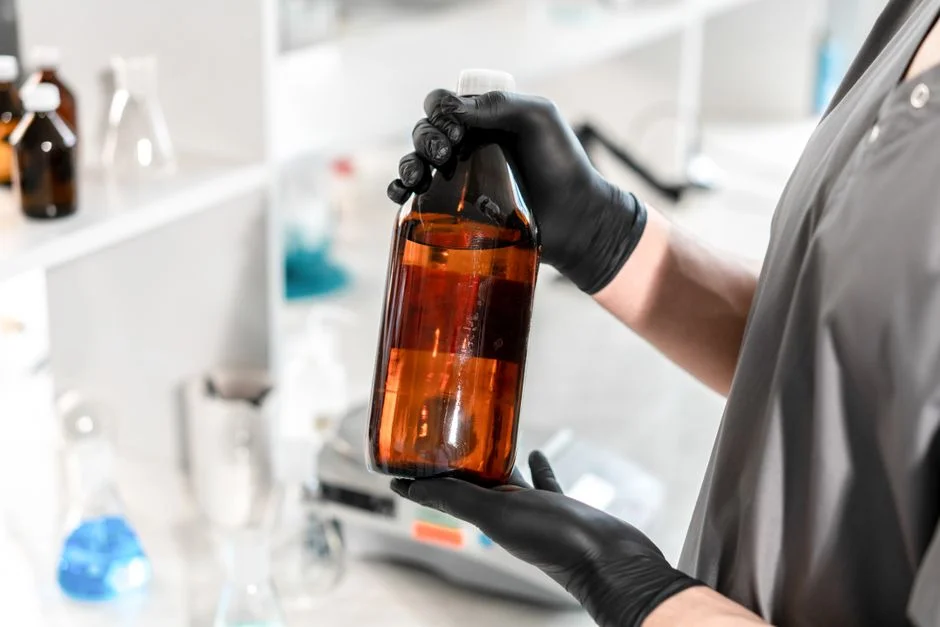
Fenton's reagent (Fe²⁺ + H₂O₂) generates hydroxyl radicals (·OH) that open aromatic rings, break nitro and azo groups, and convert biorefractory species into volatile fatty acids and short-chain alcohols that downstream biomass can metabolize. Operating window: pH 3.0–3.5, reaction time 30–90 min, 25–40 °C. After reaction the mixed liquor is neutralized to pH 7–8 with lime or NaOH, which also precipitates the iron as Fe(OH)₃ for downstream dewatering.
Dose design starts with jar tests on the equalized stream and lands in a narrow window for fine chemical matrices: Fe²⁺/H₂O₂ mass ratio 1:5 to 1:10, H₂O₂ at 0.5–2.0 g per g COD removed. Too little oxidant and the COD breakthrough wrecks the MBR; too much and you waste H₂O₂ (which decomposes to O₂ and water once ·OH demand is satisfied) and double the iron sludge. The literature on combined Fenton + chemical coagulation, including the 2009 olive-mill wastewater study (ResearchGate, Feb 2009), consistently reports 50–80% COD reduction on phenolic and polyphenolic streams — directly transferable to fine chemical dye and pesticide intermediates.
Sludge yield from Fenton is significant: 1.5–3.0 kg dry solids per kg Fe dosed, and a 10,000 mg/L COD stream at 70% reduction will produce 6–12 m³/d of iron-rich sludge at 2% DS. That sludge is the OPEX elephant in the room and must be pressed on a plate-and-frame filter press to 30–40% DS cake for off-site disposal. Where Fenton COD removal falls below 40% (typical of high-salinity or catalyst-laden streams), escalate to ozone (O₃/H₂O₂) or wet air oxidation (WAO) as a pre-step; selection rule — high salinity or catalyst poisoning → WAO first, otherwise Fenton first.
| Parameter | Operating Window | Design Note |
|---|---|---|
| Reaction pH | 3.0–3.5 | H₂SO₄ dosing; ORP > +450 mV |
| Fe²⁺/H₂O₂ mass ratio | 1:5 to 1:10 | Titrate by jar test |
| H₂O₂ dose | 0.5–2.0 g / g COD removed | Confirm with 4 h residual test |
| Reaction time | 30–90 min | Two CSTR in series preferred |
| Neutralization pH | 7.0–8.0 | Lime or NaOH; guides Fe(OH)₃ precipitation |
| Expected COD reduction | 50–80% | Higher on phenols, anilines, nitroaromatics |
| Iron sludge yield | 1.5–3.0 kg DS / kg Fe | Size filter press for peak shift |
Emerging research — sol-gel immobilized humic acid and activated-carbon adsorption (Journal of Toxicology and Environmental Health Sciences) — shows promise at lab scale but is not yet proven at the 10–50 m³/h flow rates of a commercial fine chemical plant.
Stage 3 — Biological Treatment (MBR or SBR) on Fenton Effluent
Once Stage 2 has pulled COD below the ~3,000 mg/L biorefractory threshold, aerobic biology becomes the workhorse for the remaining 60–80% of load reduction. Two configurations dominate fine chemical service: MBR (membrane bioreactor) and SBR (sequencing batch reactor).
MBR is the default when flow exceeds 20 m³/d, footprint is constrained, or reuse-quality effluent is needed. Operating window: MLSS 8,000–12,000 mg/L, HRT 6–12 h, SRT 30–60 d, PVDF flat-sheet flux 12–18 LMH at 0.1 µm pore size. Membrane effluent typically runs <1 mg/L TSS and <1 NTU turbidity, which is what makes resin polish stable downstream. The integrated MBR membrane bioreactor skid and the DF series PVDF flat sheet membrane module are the standard equipment pairing for 5–200 m³/d plants. SBR trades membrane cost for footprint: 4–6 cycles/day, MLSS 4,000–6,000 mg/L, lower CAPEX but 30–50% larger plot, and effluent TSS typically 10–30 mg/L — fine for non-reuse discharge but variable enough to stress a downstream resin bed.
Expected COD leaving biology is 200–400 mg/L with BOD₅ < 20 mg/L, which leaves a 50–250 mg/L gap to most discharge limits. That residual is non-biodegradable humic-type material and solvent traces — the exact fraction that the resin adsorption for COD removal 2026 engineering guide documents as removable at 91–95% efficiency.
| Parameter | MBR | SBR |
|---|---|---|
| MLSS | 8,000–12,000 mg/L | 4,000–6,000 mg/L |
| HRT | 6–12 h | 16–24 h (cycle-averaged) |
| SRT | 30–60 d | 20–40 d |
| Cycles | Continuous | 4–6 / day |
| Effluent TSS | < 1 mg/L | 10–30 mg/L |
| Effluent turbidity | < 1 NTU | 5–20 NTU |
| Membrane flux | 12–18 LMH @ 0.1 µm | N/A |
| Best-fit plant size | > 20 m³/d | < 20 m³/d or CAPEX-driven |
Stage 4 — Resin or Activated-Carbon Polishing
Stage 4 closes the gap to a tight discharge limit without oversizing the much more expensive biological stage. The choice is between macroporous styrenic resin and granular activated carbon (GAC).
Macroporous resin is the higher-spec option: 91–95% COD removal, service flow 3–6 BV/h, breakthrough at 30–50 BV (HydropureWater field data, 2026). Resin handles saline and aromatic residues that foul carbon, and its predictable breakthrough curve lets a plant automate bed swing with conductivity and UV254 probes. GAC removes 60–80% of the residual COD on already-biologically-treated effluent (consistent with the chemically activated carbon adsorption data published in 2024 and replicated in 2025 field trials), costs less to install, but runs 2–4× higher OPEX per m³ because of steam reactivation and 4–8 week replacement intervals. A practical rule: specify resin for compliance limits of 100 mg/L COD or stricter; specify GAC when the limit is 200–500 mg/L and CAPEX is the constraint.
Effluent leaving Stage 4: COD < 100 mg/L and BOD₅ < 10 mg/L on most fine chemical matrices — comfortably inside China's GB 8978-1996 一级A (100 mg/L COD), the EU Urban Waste Water Directive 91/271/EEC (125 mg/L), and the 100–400 mg/L range of US EPA categorical standards for organic chemicals.
Selecting the Right Train for Your Influent COD Band
Three influent bands cover roughly 90% of fine chemical plant cases. Map your stream, then read across.
| Influent COD | Salinity Flag | Recommended Train | Expected Final COD | CAPEX Band (per m³·d) |
|---|---|---|---|---|
| 1,000–5,000 mg/L | NaCl < 1% | EQ + DAF → MBR → GAC (3 barriers) | 80–150 mg/L | $90–$160 |
| 5,000–15,000 mg/L | NaCl < 2% | EQ + DAF → Fenton → MBR → GAC (4 barriers) | 80–120 mg/L | $120–$220 |
| 15,000–30,000 mg/L | NaCl > 2% | EQ + DAF → Fenton → UASB → MBR → resin (5 barriers) | < 100 mg/L | $180–$320 |
Two worked examples. Train A (mid-strength, 8,000 mg/L, low salinity): EQ + DAF → Fenton → MBR → GAC. Final COD lands at 80–120 mg/L, CAPEX band $120–$220/m³·d, OPEX $0.20–$0.35/m³ dominated by H₂O₂ and FeSO₄. Train B (high-strength, 25,000 mg/L, saline): EQ + DAF → Fenton → UASB anaerobic → MBR → resin. Final COD below 100 mg/L, CAPEX band $180–$320/m³·d, but OPEX drops 20–30% relative to Train A because the UASB recovers roughly 0.25 m³ biogas per kg COD removed — covered in detail in the UASB vs CSTR engineering comparison for 2026. A high-efficiency sedimentation tank upstream of the resin bed is the cheap insurance that keeps the polish stage on its design cycle.
Decision rule: when the discharge limit is below 150 mg/L and the influent is biorefractory, plan at least three barriers. When the influent is below 1,000 mg/L and readily biodegradable, two barriers will usually suffice.
2026 Cost Bands, Compliance Targets, and Common Pitfalls
A turnkey 50 m³/d fine chemical COD removal plant in 2026 lands at $0.6M–$1.4M CAPEX depending on train complexity — a 5-barrier saline plant is roughly twice the cost of a 3-barrier low-strength plant. OPEX is typically $0.18–$0.45/m³, with H₂O₂ (30–40%), FeSO₄ (10–15%), and sludge hauling (20–30%) as the three largest lines.
Compliance benchmarks the procurement team will ask about: China GB 8978-1996 sets COD at 100 mg/L (一级A) and 150 mg/L (一级B); EU 91/271/EEC sets 125 mg/L for discharges to sensitive waters; US EPA categorical standards for organic chemicals range 100–400 mg/L. The four-stage train hits all three; a two-stage train fails the first two at typical fine chemical influent strengths.
Four pitfalls have sunk comparable projects in 2024–2025:
- Skipping equalization and chasing the Fenton dose. Result: H₂O₂ consumption 30–50% above design, inconsistent downstream biology, frequent MBR bulking events.
- Running MBR on raw (un-Fentoned) wastewater. Result: membrane fouling rate triples, CIP frequency doubles, membrane life drops from 5+ years to 2–3 years.
- Omitting sludge dewatering from the scope. Fenton iron sludge alone drives 30–40% of OPEX when not pressed to 30–40% DS cake.
- Under-sizing equalization for batch discharges. A single 8× batch peak can wipe out an entire biological population; 24 h HRT is the minimum for multi-batch plants.
The full OPEX/CAPEX envelope and the resin design curve behind Stage 4 are in the resin adsorption for COD removal 2026 engineering guide.
Frequently Asked Questions
What influent COD makes a fine chemical wastewater treatable by biology alone? Below ~3,000 mg/L and without significant biorefractory aromatics; above that threshold, Fenton or another advanced oxidation must precede biology (AOS Treatment, 2026 guidance).
What Fenton dose removes 60% of COD from a 10,000 mg/L fine chemical stream? Roughly 6,000–10,000 mg/L H₂O₂ with Fe²⁺/H₂O₂ ≈ 1:5 to 1:10 at pH 3.0–3.5, always confirmed by jar test on the actual matrix.
Can MBR alone hit 150 mg/L COD on fine chemical wastewater? Rarely. MBR on Fenton effluent typically delivers 200–400 mg/L; resin or GAC polish is normally required to reach 150 mg/L or stricter, as detailed in the resin adsorption for COD removal 2026 engineering guide.
How much sludge does Fenton produce? 1.5–3.0 kg dry solids per kg Fe dosed; size a plate-and-frame filter press for the peak shift, not the average day.
What discharge limit does a four-stage train meet? COD < 100–150 mg/L on most fine chemical matrices — compliant with China GB 8978-1996, EU 91/271/EEC, and typical US EPA categorical limits.