Why Phosphorus in Paint and Coating Wastewater Is Hard to Treat
A waterborne-coating plant discharging 150 m³/d with 35 mg/L total phosphorus (TP) influent can hit 2 mg/L effluent with a single FeCl3 dose, but the same influent through a municipal EBPR train will leave 15–20 mg/L in the effluent — the gap comes from how coating wastewater is built. Total phosphorus in waterborne paint, ink, and latex plants typically runs 5–150 mg/L, with 30–80% present as orthophosphate after pigment dissolution and the remainder locked in organic and polyphosphate complexes (HydropureWater field data, 2026). Conventional biological treatment removes only 50% or less of P from this matrix, which is well short of the >90% removal needed to reach <1 mg/L discharge limits enforced under China GB 8978-1996, US EPA 40 CFR 433, and EU IED 2010/75/EU (Duncan et al., 1984 — Springer chapter DOI 10.1007/978-1-4899-2510-7_10).
Two features of coating effluent defeat a generic P-removal playbook. First, pigment-bound P — TiO2 extenders, zinc phosphate anticorrosion pigments, and trace phosphate surfactants — partitions a large fraction of the load into colloidal and particulate ranges that resist biological uptake. Second, the matrix itself is hostile to biomass: COD runs 1,000–25,000 mg/L with a BOD/COD ratio below 0.3, so dissolved carbon is mostly non-biodegradable resin, glycol ether, and dispersant. Surfactant-stabilized emulsions further push phosphorus into colloidal fractions and disrupt floc structure in any downstream clarifier. For engineers selecting equipment, the practical message is that industrial suspended-solids removal guide coverage of TSS alone is not enough — P chemistry must be specified separately from the start.
Chemical Precipitation: FeCl3, Al2(SO4)3, and Lime Dosing
Chemical precipitation is the 2026 workhorse for paint and coating wastewater because it absorbs influent swings that would destabilize any biological train. Three reagents dominate: ferric chloride (FeCl3), aluminum sulfate (alum, Al2(SO4)3), and lime (Ca(OH)2). Each targets orthophosphate through a different metal-phosphate solid, and each leaves a different fingerprint on sludge volume, pH, and downstream equipment.
FeCl3 precipitation uses a stoichiometric Fe:P molar ratio of 1.5:1 to 3:1, with an optimum pH of 5.0–8.0 (target 6.5–7.5) and typically drives 20–150 mg/L influent down to 1–3 mg/L effluent — a 95–98% removal range in the operating window. Alum precipitation runs at an Al:P molar ratio of 1.2:1 to 2.5:1, pH 6.0–7.5, hits the same 95–98% removal band, and produces lower sludge volume than lime — but at 2–3× the reagent cost per kg P removed in 2026 industrial procurement (HydropureWater field data, 2026). Lime dosing at 100–400 mg/L as CaO lifts pH to 9.5–11, drops effluent TP to 0.5–2 mg/L, and generates 5–8 kg dry solids per kg P removed — the highest sludge of the three but the lowest reagent unit cost. The OPEX driver across all three is sludge yield: Fe-based precipitation settles at 4–6 kg DS per kg P removed, which is the industry benchmark and the line item that sets up the later CAPEX/OPEX discussion (industry benchmark, 2026). The historical disadvantages — excess sludge, pH swing, high chemical cost — were first documented by Shoda et al. (1980) and remain the trade-offs engineers accept for process robustness.
| Reagent | Dose (molar ratio or mg/L) | Optimum pH | Effluent TP (mg/L) | Sludge yield (kg DS/kg P) | 2026 cost index |
|---|---|---|---|---|---|
| FeCl3 | Fe:P 1.5:1–3:1 | 6.5–7.5 (5.0–8.0 window) | 1–3 | 4–6 | Medium |
| Al2(SO4)3 (alum) | Al:P 1.2:1–2.5:1 | 6.0–7.5 | 1–3 | 3–5 | High (2–3× FeCl3) |
| Lime Ca(OH)2 | 100–400 mg/L as CaO | 9.5–11 | 0.5–2 | 5–8 | Low |
For dose control on a 2026 retrofit, most plants specify a PLC-controlled coagulant dosing skid tied to inline orthophosphate and pH probes, because the Fe:P ratio must shift with influent variability that a coating line generates shift-to-shift.
Enhanced Biological Phosphorus Removal (EBPR) in Coating Effluent
Enhanced biological phosphorus removal uses polyphosphate-accumulating organisms (PAOs) — Acinetobacter, Pseudomonas, and related genera — that take up orthophosphate as polyphosphate under alternating anaerobic and aerobic conditions. In municipal sewage, EBPR routinely exceeds 90% removal and pushes effluent below 1 mg/L TP (Duncan et al., 1984, Springer DOI 10.1007/978-1-4899-2510-7_10). In coating wastewater, the same mechanism can be engineered through an MBR-integrated train, but the matrix dictates the boundary conditions.
Two findings from the 2022 literature are directly relevant to coating effluent. First, Pseudomonas strains show a clear advantage for simultaneous nitrogen and phosphorus removal — useful where ammonia is also regulated (Dai et al., 2022, ScienceDirect S0048969722025025). Second, non-conventional PAO strains in biofilm filters have demonstrated 90.0–95.6% TP removal at 30–55 °C and pH 6.0–8.0 using Chromobacterium LEE-38 on calcined loess-ball media (Springer, Biotechnology and Bioprocess Engineering). These data confirm that >90% removal is biologically reachable, but with strain and carrier choices that municipal EBPR does not require. The reason EBPR struggles in a generic coating plant is that surfactant and pigment dispersants upset floc structure, and the high-COD, low-biodegradability fraction drives glycogen-accumulating organisms (GAOs) that outcompete PAOs for the volatile fatty acid substrate. The practical result: an MBR-integrated wastewater treatment train only delivers on its P-removal claim when the upstream influent has been equalized and surfactant load is controlled.
DAF Polishing and the Hybrid Precipitation + DAF Train
Dissolved air flotation does not precipitate dissolved orthophosphate — it floats already-formed flocs and colloidal P. That single fact defines how DAF fits into a 2026 coating-plant train: always after coagulant dosing, never as a standalone P step. The mechanism is micro-bubble flotation, with bubble diameters typically 20–80 µm entraining metal-phosphate precipitates and flocculated colloids for surface skimming.
Quantitatively, the polishing effect of a hybrid FeCl3 + DAF train is what makes the <1 mg/L discharge target achievable. Precipitation alone typically settles at 2–3 mg/L TP and 30–80 mg/L TSS; adding a properly sized DAF drops TP to 0.3–0.8 mg/L and TSS below 10 mg/L — the level needed for direct discharge to a sensitive water body or as feed to a downstream RO polish for water reuse. Operating window for a DAF on coating wastewater is surface loading 5–20 m/h with air bubble density 6,000–9,000 ppm, covering 4–300 m³/h per unit (HydropureWater field data, 2026). The dissolved air flotation system specification is the workhorse polishing unit in most 2026 paint-plant retrofits, sized off the upstream coagulation pH and floc size rather than off influent TP alone.
Process Comparison: Chemical, EBPR, and Hybrid Trains
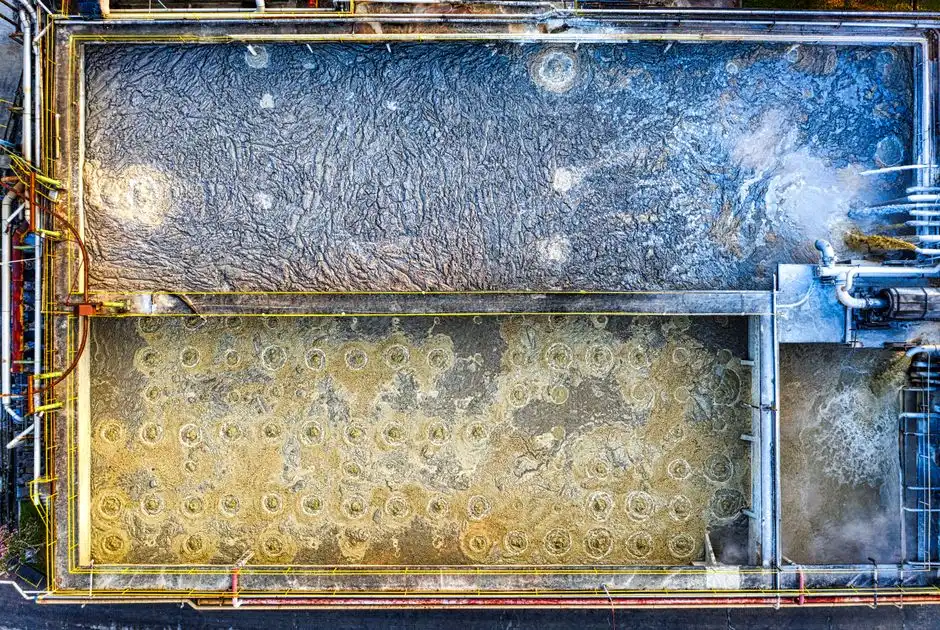
The single most useful artifact in a paint-plant P-removal selection is a six-column head-to-head matrix the engineer can hand to procurement. The table below scores each train on the parameters that drive a 5–500 m³/d equipment decision.
| Process train | Influent TP tolerance | Effluent TP achievable | Reagent / energy cost index | Sludge yield (kg DS/kg P) | Footprint | Best-fit flow rate |
|---|---|---|---|---|---|---|
| FeCl3 chemical precipitation (alone) | 5–150 mg/L, high variability | 1–3 mg/L | $0.08–0.18/kg P removed | 4–6 | Small | 5–200 m³/d |
| EBPR (PAO-MBR) | 5–40 mg/L, low variability | <1 mg/L | $0.03–0.07/m³ | 1–2 (biomass) | Medium | >200 m³/d, stable BOD |
| Lime precipitation (alone) | 10–150 mg/L | 0.5–2 mg/L | Lowest reagent, highest sludge handling | 5–8 | Medium | 50–500 m³/d where sludge disposal is cheap |
| Hybrid FeCl3 + DAF polishing | 5–150 mg/L, high variability | 0.3–0.8 mg/L, TSS <10 mg/L | $0.12–0.25/m³ | 4–6 (Fe) + floated skimmings | Medium-large | 5–500 m³/d, compliance-safe default |
Three patterns come out of the matrix. First, 95–99% TP removal is achievable across all three trains when each is correctly specified — the 95.49–99.43% removal range reported for constructed-wetland P removal and the 90.0–95.6% biofilm-filter range both confirm that the ceiling is high; the differentiator is influent consistency, not theoretical ceiling. Second, chemical precipitation with FeCl3 is the 2026 default for variable influent at 5–500 m³/d because it absorbs the swings that crash EBPR. Third, EBPR is the lowest-OPEX option above 200 m³/d once the influent is equalized and surfactant load is controlled — the OPEX gap recovers the MBR CAPEX in 2–3 years on a typical 250 m³/d waterborne-coating plant (typical industrial benchmark, 2026 — not a vendor quote).
2026 Compliance Map: Discharge Limits by Region
Process selection only matters when it hits a number. The table below translates the three process trains into the regional TP limits a 2026 paint-plant EHS manager must clear.
| Region / framework | Standard / directive | TP limit for paint, ink, coating discharge | Process trains that reliably hit the limit |
|---|---|---|---|
| China — direct discharge | GB 8978-1996, second-class | ≤ 1.0 mg/L | FeCl3 + DAF, lime + DAF, EBPR (with equalization) |
| China — reused water | GB 30485-2020 (COD, ammonia focus) | Tighter indirect-discharge TP target, project-specific | Hybrid FeCl3 + DAF + RO polish |
| United States — direct discharge | EPA Metal Finishing, 40 CFR 433 | Daily max 4.68 mg/L, monthly avg 1.0 mg/L | FeCl3 alone (monthly avg), hybrid for daily-max |
| United States — POTW pretreatment | EPA Metal Finishing, 40 CFR 433 categorical | Local limits, often 5–10 mg/L | FeCl3 alone typically sufficient |
| European Union | IED 2010/75/EU, Surface Treatment BREF using organic solvents | 0.1–2 mg/L depending on receiving-water sensitivity | Hybrid FeCl3 + DAF, EBPR + DAF |
The universal engineering target behind all three regional frameworks is the one Duncan et al. (1984) state explicitly: >90% P removal is required to reach <1 mg/L. That single percentage is the bridge between the process matrix above and the compliance map here — every train on the matrix clears it in the right influent conditions, and every limit in the table derives from it.
Selecting the Right Train: A 5-Step Decision Framework
Engineers do not pick a P-removal train from a matrix alone; they walk a sequence of decisions that filters the options down to one. The five steps below reproduce that logic.
Step 1 — Characterize the influent. Measure TP, COD, BOD, surfactant load, and flow variability across at least two production campaigns. If TP exceeds 50 mg/L and COD exceeds 5,000 mg/L, chemical precipitation is the default front end because EBPR flocs will not hold. Step 2 — Set the effluent target. Direct discharge at <1 mg/L (China, EU sensitive waters), POTW pretreatment at <5 mg/L, or RO reuse at <0.3 mg/L — the target dictates whether DAF polishing or EBPR is mandatory. Step 3 — Match the flow regime. Below 50 m³/d, chemical + DAF is the lowest CAPEX; above 200 m³/d, EBPR or a hybrid train recovers the OPEX gap within 2–3 years. Step 4 — Confirm sludge handling. Fe-based precipitation at 4–6 kg DS per kg P removed drives the need for a filter press for chemical P-precipitation sludge or a decanter centrifuge, plus a lamella clarifier for chemical P-removal if the upstream reactor is oversized. Step 5 — Validate with jar tests and pilot DAF/EBPR. Pilot data, not vendor brochures, sets the final reagent dose, HRT, and bubble density. Use the sludge dewatering cost reduction strategies as a cross-check on Step 4 OPEX, and the lamella clarifier troubleshooting reference if the lamella effluent carries suspended floc into the DAF feed.
Frequently Asked Questions
What is the best chemical for phosphorus removal in paint wastewater? FeCl3 at an Fe:P molar ratio of 1.5:1–3:1 and pH 6.5–7.5 is the 2026 default for waterborne coating effluent; alum is the second choice where iron is restricted in sludge disposal under the local waste code (HydropureWater field data, 2026).
Can biological treatment alone hit the 1 mg/L TP limit? Generally no for coating wastewater — conventional biological systems remove ~50% of P, and surfactant upset makes EBPR unstable unless preceded by physico-chemical pretreatment that equalizes flow and strips dispersants (Duncan et al., 1984, Springer DOI 10.1007/978-1-4899-2510-7_10).
How much sludge does FeCl3 phosphorus precipitation generate? 4–6 kg dry solids per kg P removed, which requires a dedicated filter press or decanter centrifuge dewatering train (industry benchmark, 2026).
Is DAF sufficient as a standalone P-removal step? No — DAF removes floated flocs and colloids but does not precipitate dissolved orthophosphate; it must follow coagulant dosing and a flash-mix stage to be effective on coating wastewater.
What TP limit applies to paint manufacturers in China? GB 8978-1996 second-class standard sets TP ≤ 1.0 mg/L for paint, ink, and coating effluent; GB 30485-2020 sets tighter indirect-discharge targets for reused water in industrial parks.