What Counts as a Qualified Sewage Treatment Plant Supplier in Abu Dhabi?
A qualified sewage treatment plant supplier in Abu Dhabi is an OEM manufacturer, regional EPC integrator, or authorised distributor that holds an ECAS product certificate, can stamp ADCD-compliant P&IDs, and has commissioned at least three STP references in the UAE or wider GCC within the last 36 months. Trading companies that re-export European or Chinese packaged units without local engineering accountability do not meet this baseline, even if their catalogue lists the same SKUs. The Abu Dhabi 100% Treated Sewage Effluent (TSE) reuse mandate is the gating criterion: any supplier whose biological design cannot repeatedly hit <10 mg/L BOD, <10 mg/L TSS, and <0.5 NTU turbidity is not viable for projects that will tie into the irrigation or district cooling reuse network.
Three supplier archetypes operate in the Abu Dhabi market, each with different risk profiles. Direct OEMs — typically Chinese, Indian, or European manufacturers with a regional office in Jebel Ali or Mussafah — carry full process warranty and own the biological design liability. Regional EPC integrators buy skids, add civil and electrical scope, and act as the single point of contact for the client, which simplifies contract administration but adds 15–25% to the equipment cost. Trading houses offer the lowest ex-works price but cannot usually issue a performance guarantee with liquidated damages, and their after-sales response is limited to email-based remote support from the origin factory.
Mandatory credentials to verify before shortlisting: a valid ECAS product certificate from MOIAT, ISO 9001:2015 and ISO 14001:2015 certifications, ADCD pre-approved standard drawings (or a documented track record of successful drawing approval submissions), and at least one reference plant in a high-TDS, high-ambient-temperature climate. Listings on general industrial portals such as DirectIndustry or Alibaba are not qualification evidence — most of these vendors cannot produce ADCD-stamped hydraulic calculation sheets or arrange EAD witness testing.
Abu Dhabi Regulatory Framework Buyers Must Navigate in 2026
Abu Dhabi has at least four approval bodies that touch an STP project, and any one of them can halt commissioning if the documentation is incomplete. The Abu Dhabi City Municipality (ADCD) reviews and approves STP drawings for plots above 5,000 m², requires hydraulic and biological design calcs in the submission package, and issues the final completion certificate after a site inspection. The Environment Agency – Abu Dhabi (EAD) sets the effluent quality limits and aligns industrial reuse parameters with federal MoEEC Cabinet Decision No. 21 of 2023, covering TDS, BOD, COD, TSS, residual chlorine, and faecal coliform. Inside the ADNOC oil and gas concession, ADNOC OCES applies — it demands SS316L wetted parts, ATEX-rated electrical panels, and sour-service-tolerant biological design. The Department of Energy (DoE) audits TSE reuse compliance for any STP that discharges into the irrigation grid or cooling tower make-up network.
Domestic sewage in Abu Dhabi typically arrives at the treatment plant at 250 mg/L BOD, 400 mg/L COD, 250 mg/L TSS, 45 mg/L TKN, and 8–12 mg/L total phosphorus (per ADCD design manual averages, 2025 edition). Unrestricted TSE reuse requires the treated effluent to clear <10 mg/L BOD, <10 mg/L TSS, <0.5 NTU turbidity, <1,000 mg/L TDS (potable irrigation routes are stricter at <500 mg/L), and <2.2 CFU/100 mL faecal coliform. Industrial reuse routes allow higher TDS up to 1,500 mg/L for cooling tower make-up per EAD Technical Guideline 2024-03.
| Authority | Scope | Key Submission / Limit |
|---|---|---|
| ADCD (Abu Dhabi City Municipality) | Building permit, STP drawing approval, final inspection | Hydraulic + biological calcs; P&IDs; for plots >5,000 m² |
| EAD (Environment Agency – Abu Dhabi) | Discharge & reuse permit, effluent quality | <10 mg/L BOD, <10 mg/L TSS, <1,000 mg/L TDS for unrestricted reuse |
| ADNOC OCES | Oil & gas concession sites | SS316L wetted parts, ATEX panels, sour-service biological design |
| DoE (Department of Energy) | TSE reuse network audits | Connection approval, ongoing compliance sampling |
| MoEEC Cabinet Decision 21/2023 | Federal industrial reuse framework | Reference standard for cross-emirate projects |
Matching STP Technology to Abu Dhabi Influent Conditions
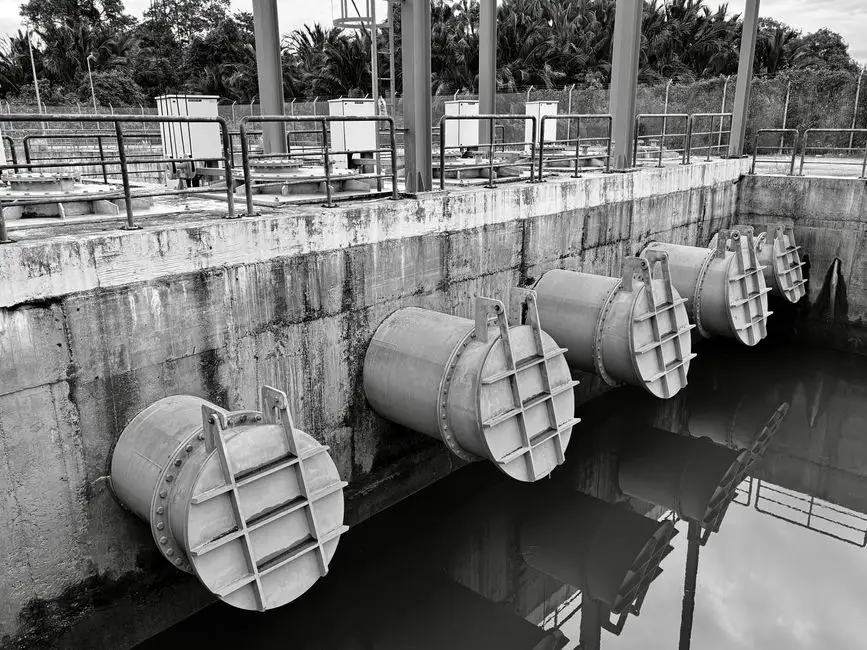
Process selection in Abu Dhabi is driven by influent strength, required reuse quality, and footprint — not by the supplier's preferred product line. For domestic sewage from residential compounds, hotels, and schools, packaged anoxic/oxic (A/O) biological contact oxidation with sedimentation and chlorination handles 1–80 m³/h, runs buried or skid-mounted, and needs no full-time operator once commissioned. Where kitchens or food courts push fats, oils, and grease (FOG) into the stream — typical in labour camps, hospitals, and mall food courts — a DAF pre-treatment system rated 4–300 m³/h is required upstream of the biological stage to protect biomass and membranes.
When the treated stream must feed a cooling tower, landscape irrigation, or toilet flush network, an MBR membrane bioreactor system with PVDF submerged membranes delivers sub-1 μm effluent, occupies 60% less footprint than conventional activated sludge, and is rated 10–2,000 m³/day. Industrial mixed sewage containing hydrocarbons or heavy metals needs MBR plus RO polishing, with RO recovery up to 95% for closed-loop reuse. For hospitals and clinical effluent, a dedicated medical wastewater system with 99%+ ozone disinfection, 0.5 m² footprint, and zero chemical dosing handles the pathogen load without the chlorine handling burden. For low-rise compounds and labour camps where burial is feasible, a WSZ underground packaged STP reduces visible plant footprint to a manhole cover and grass lid.
Material specification is non-negotiable in the Gulf. Specify SS304 as the minimum wetted steel, SS316L for any ADNOC concession site or where chlorides exceed 200 mg/L in the feed, and design for 50°C ambient with skid insulation for any outdoor installation. Biological kinetics must be derated for influent temperatures of 28–34°C common in summer holding tanks, and the blowers and diffusers should be sized for the higher oxygen demand that comes with elevated MLSS in MBR tanks operating at 8,000–12,000 mg/L.
| Application | Recommended Process | Capacity Range | Effluent Target |
|---|---|---|---|
| Residential / hotel / school | Packaged A/O contact oxidation + chlorination | 1–80 m³/h | <30 mg/L BOD (discharge) / <10 mg/L BOD (TSE) |
| Mall / hospital / labour camp kitchen | DAF pre-treatment + A/O biological | 4–300 m³/h | <20 mg/L BOD pre-RO |
| Cooling tower / irrigation reuse | MBR (PVDF submerged membranes) | 10–2,000 m³/day | <5 mg/L BOD, <0.5 NTU |
| Industrial mixed sewage | MBR + RO polishing | 50–5,000 m³/day | <500 mg/L TDS (boiler feed) / <1,000 mg/L (cooling) |
| Hospital / clinical effluent | Medical wastewater + ozone | 0.5–50 m³/day | 99.99% pathogen reduction, zero residual chlorine |
| Compound / labour camp (buried) | WSZ underground packaged STP | 5–500 m³/day | <20 mg/L BOD (irrigation reuse) |
2026 CAPEX and OPEX Benchmarks for STPs in Abu Dhabi
For 2026, expect turnkey equipment-only CAPEX of USD 350–1,200 per m³/day for packaged A/O underground STPs in the 50–500 m³/day band typical of Abu Dhabi labour camps and residential compounds, excluding civil works. Containerized MBR systems in the 100–2,000 m³/day band run USD 900–2,500 per m³/day, with the premium driven by membrane replacement reserves — PVDF membranes typically last 5–7 years at USD 30–60 per m² of membrane area. An industrial pre-treatment chain (DAF + lamella clarifier + chemical dosing) adds USD 150–400 per m³/day for FOG and TSS polishing. Sludge handling is a separate line item; a plate and frame filter press with 1–500 m² filtration area handles cake dewatering at OPEX of AED 80–150 per m³ of wet cake, dominated by polymer dosing and cake disposal. An automatic chemical dosing system sized for the target flow keeps coagulant and pH correction on setpoint without operator intervention.
OPEX in Abu Dhabi is dominated by power. At AED 0.35–0.55 per kWh (industrial tariff, 2026 estimate from DoE schedule), power accounts for 60–70% of total OPEX for an MBR plant. Chemical OPEX typically runs USD 0.02–0.08 per m³ treated depending on whether the design uses chlorination, UV, or ozone for disinfection. Labour is one part-time operator per 500 m³/day of installed capacity. Always budget 8–12% of equipment CAPEX as a soft cost line for ADCD drawing review resubmissions, EAD commissioning witness testing, and DoE reuse connection fees — these are routinely underestimated by first-time UAE buyers and erode the contingency if not ringfenced early.
| System Type | Capacity Band | 2026 CAPEX (USD per m³/day, equipment-only) | Main OPEX Driver |
|---|---|---|---|
| Packaged A/O (WSZ buried) | 50–500 m³/day | 350–1,200 | Power (aeration blowers) |
| Containerized MBR | 100–2,000 m³/day | 900–2,500 | Membrane replacement (5–7 yr cycle) |
| DAF + lamella pre-treatment | 20–1,000 m³/h | 150–400 (add-on) | Polymer dosing |
| MBR + RO polishing (industrial) | 50–5,000 m³/day | 1,800–3,500 | RO membrane replacement + power |
| Plate & frame filter press | 1–500 m² area | 40,000–350,000 (per unit) | Cake disposal (AED 80–150/m³ wet) |
Supplier Evaluation Scorecard for Abu Dhabi Projects

A weighted scorecard converts the technical and commercial noise of an STP quotation into a defensible ranking. Apply these weights: ADCD and EAD compliance documentation 25%, documented UAE or GCC reference projects 20%, membrane or biological process warranty terms 15%, lead time and shipping terms (ex-works vs CIF Jebel Ali) 15%, after-sales response model (resident engineer vs remote support) 15%, and price 10%. Pricing low in a buyer's weighting forces focus on risk-adjusted total cost of ownership rather than headline ex-works price.
Red flags that warrant automatic disqualification: missing or expired ECAS certificate, generic Alibaba catalogue pictures in the technical proposal, CE marking claims without a notified body number, refusal to provide a process performance guarantee with liquidated damages, and no named UAE or GCC reference plant visit offered. Green flags that justify shortlisting: in-house membrane manufacturing (not just assembly), an authorised regional distributor letter from the OEM, a resident commissioning crew in the UAE, willingness to issue a performance bond, and prior ADCD drawing approval reference numbers that can be cross-checked with the municipality. Always request a pilot or skid visit at the supplier's facility before PO release — qualified Chinese and Indian OEMs routinely host UAE buyers at their works for a Factory Acceptance Test, and the cost is usually absorbed into the supplier's bidding overhead.
| Criterion | Weight | What to Score |
|---|---|---|
| ADCD / EAD compliance documentation | 25% | ECAS certificate, prior drawing approval refs, EAD sampling protocol experience |
| UAE / GCC reference projects (last 36 mo) | 20% | Min. 3 commissioned STPs in high-TDS, high-ambient climates |
| Process warranty terms | 15% | Membrane warranty ≥5 yr, biological performance guarantee with LDs |
| Lead time & shipping terms | 15% | CIF Jebel Ali vs ex-works, 40 ft HC fit, customs docs ready |
| After-sales response | 15% | Resident engineer in UAE vs remote-only, 24/7 call-out SLA |
| Price (risk-adjusted TCO) | 10% | Equipment + 7-yr membrane reserve + commissioning + soft costs |
Logistics, Installation, and Commissioning in the UAE
Containerized STPs ship 40 ft high-cube from most Asian OEMs, with 4–6 weeks sea freight to Jebel Ali and approximately one week for customs clearance provided the ECAS certificate, country-of-origin certificate, and commercial invoice are complete. Site delivery assumes a concrete plinth or ring beam foundation is already cured; underground WSZ units require excavation, anti-floatation design in high water-table zones like Reem Island and Saadiyat, and dewatering during installation. Commissioning runs 2–4 weeks including seed sludge acclimatisation, EAD sampling protocol (three consecutive valid samples within seven days of stable operation), and ADCD final inspection. Plan a 10% time contingency on the supplier's stated commissioning period — temperature shocks above 45°C ambient in June through August frequently extend biological start-up and can delay the first valid EAD sampling window by a week or more. For projects in Dubai, the parallel Dubai wastewater treatment plant manufacturer guide covers DM and DEWA submission differences, and the Muscat wastewater treatment plant guide covers Haya Water equivalent approvals if the EPC scope crosses into Oman.
Frequently Asked Questions
What is the typical CAPEX for a packaged STP in Abu Dhabi in 2026? Equipment-only CAPEX runs USD 350–1,200 per m³/day for packaged A/O systems in the 50–500 m³/day band and USD 900–2,500 per m³/day for containerized MBR in the 100–2,000 m³/day band, excluding civil works, ADCD resubmission fees, and EAD commissioning witness testing (HydropureWater field data, 2026).
Which authority issues the discharge permit for an STP in Abu Dhabi? EAD (Environment Agency – Abu Dhabi) sets the effluent quality limits and issues the discharge or reuse permit. ADCD handles the building permit and drawing approval, DoE audits TSE reuse connections, and ADNOC OCES governs any plant inside the oil and gas concession.
What effluent limits apply for TSE reuse in Abu Dhabi? Unrestricted TSE reuse requires <10 mg/L BOD, <10 mg/L TSS, <0.5 NTU turbidity, <1,000 mg/L TDS (potable irrigation routes are stricter at <500 mg/L), and <2.2 CFU/100 mL faecal coliform, per the EAD Technical Guideline 2024-03 alignment with MoEEC Cabinet Decision 21/2023.
How long does commissioning take for an STP imported into the UAE? 2–4 weeks from delivery on site, including seed sludge acclimatisation, EAD sampling protocol (three valid samples within seven days of stable operation), and ADCD final inspection. Add 10% contingency for summer ambient temperatures above 45°C that extend biological start-up.
Can an MBR system handle high-TDS industrial sewage in Abu Dhabi? Yes — an MBR with PVDF submerged membranes handles up to 2,000 mg/L TDS in the feed, but for closed-loop reuse above 80% recovery an RO polishing stage is required, with the RO typically recovering 90–95% of the MBR permeate. The SBR vs AAO process comparison and the MBBR media replacement cost analysis cover the cost trade-offs when sizing the biological stage upstream of the membranes.
Related Equipment
- on-site chlorine dioxide generator — specifications, capacity range, and technical data