What Actually Drives Electrocoagulation Maintenance Cost in 2026
Electrocoagulation system maintenance cost in 2026 typically runs $0.04–$0.18 per cubic meter of treated wastewater, dominated by sacrificial electrode replacement (Fe or Al plates, $1.20–$3.50/kg consumed), rectifier power ($0.06–$0.11/kWh), periodic acid descaling, and sludge hauling ($45–$120/wet ton). Total annual EC OPEX for a 50 m³/h industrial skid typically lands between $28,000 and $95,000.
Ebba et al. (2021, Springer, 154 citations) describe electrocoagulation as having "simple installation and maintenance" with "low operation cost." That is true relative to membrane bioreactors or thermal evaporation, but it conflates two different cost categories. Simple means fewer failure modes and a smaller spare-parts inventory — not a small bill. The same paper does not publish a 2026 dollar figure, which is exactly the gap this article fills.
For a defensible business case, treat maintenance cost as a distinct line from full operating cost. Maintenance cost = consumables (electrodes, acid, anti-scalant) + service labor + spare parts. Full OPEX also includes amortized CAPEX, influent pumping, and effluent polishing — items that vendors routinely fold into a single number to make EC look cheaper than it is. Five line items drive the maintenance portion, in roughly this order of weight:
- Sacrificial electrode replacement: 55–70% of maintenance OPEX
- Rectifier power: 15–25%
- Sludge hauling & disposal: 5–12%
- Operator labor: 5–10%
- Acid/chemical cleaning: 3–7%
Two hidden line items rarely appear in vendor quotations: (1) a power-supply harmonics penalty of $0.005–$0.015/kWh when the rectifier exceeds IEEE 519 THD limits on a shared bus, and (2) brine disposal when DSA/MMO anodes are paired with periodic polarity reversal — a $0.02–$0.06/L line that flips the value proposition of "non-sacrificial" anodes if it is not budgeted. For a sanity check on adjacent OPEX assumptions, the MVR evaporator operating cost 2026 OPEX breakdown uses a similar line-item structure and is a useful cross-reference when a plant is comparing EC against thermal zero-liquid-discharge options.
2026 OPEX Breakdown: Line-Item Cost Ranges per m³ and per Year
The single most common question a buyer asks — "what does it cost per cubic meter in 2026?" — has no answer in the current top three search results, which are academic reviews and a service-company homepage. The table below is built to drop directly into a CAPEX/OPEX sheet.
| Line Item | Unit | Low (USD) | High (USD) | % of Maintenance OPEX | Typical Frequency |
|---|---|---|---|---|---|
| Fe or Al electrode mass loss | $/m³ | 0.022 | 0.105 | 55–70% | Continuous, batch re-stock 4–12×/yr |
| Rectifier power (cell only) | $/m³ | 0.009 | 0.044 | 15–25% | Continuous |
| Acid cleaning (5–10% HCl or citric) | $/m³ | 0.002 | 0.011 | 3–7% | Monthly in hard water, quarterly in soft |
| Sludge hauling & disposal | $/m³ | 0.008 | 0.024 | 5–12% | Weekly to monthly pickup |
| Operator labor | $/m³ | 0.005 | 0.018 | 5–10% | 0.5–1.5 hr/day per 50 m³/h skid |
| Total maintenance OPEX | $/m³ | 0.04 | 0.18 | 100% | — |
Electrode consumption is governed by Faraday's law: theoretical Fe loss is 1.05 g/(A·h) and Al is 0.336 g/(A·h), but real-world passivation, pitting, and current leakage push the actual figure 1.4–2.5× higher. Field data across food, textile, and metal-finishing duty supports the 1.6–2.0× multiplier for iron (HydropureWater field data, 2026). A worked example for a 50 m³/h skid running 8,000 h/yr at 30 A/m²: 0.42 kg Fe consumed per kAh, roughly 1,260 kg/yr of plate, at 2026 plate cost of ~$2.10/kg = $2,650 in raw metal value plus $4,000–$7,000 in machining, handling, and downtime — the true electrode line is closer to $0.07–$0.11/m³, not the metal cost alone.
Power scales with cell voltage: 3–6 V is the typical envelope at industrial current density, giving 0.15–0.40 kWh/m³. At 2026 industrial rates of $0.06–$0.11/kWh in major US/EU markets (per the US EIA Industrial Electric Power monthly, 2026-Q1), the cell power line is $0.009–$0.044/m³ — small per cubic meter, but it is the second-largest line and the most volatile under electricity-price escalation. Sludge hauling assumes 2–4% dry solids at 1.02–1.08 t/m³ wet density; at $45–$120/wet ton combined hauling plus 2026 US industrial landfill gate fees (typical range, non-hazardous), the disposal line lands at $0.008–$0.024/m³.
Electrode Materials Compared: Iron, Aluminum, and DSA/MMO on Lifecycle Cost
Electrode material is the single biggest 2026 maintenance-cost lever a buyer actually controls. The table below puts the three practical options side by side on cost, consumption, and service life.
| Material | 2026 Plate Cost ($/kg) | Consumption (kg/kAh) | Service Life at 8,000 h/yr | Best-Fit Wastewater | Notes |
|---|---|---|---|---|---|
| Iron (Fe) | 1.20–2.10 | 1.6–2.0× Faraday (≈1.7–2.1 g/Ah) | 6–12 months | High-COD, oily, dye, metal-bearing | Cheapest plate; Fe(OH)₃ sludge dewateres well but reddens effluent if overdosed |
| Aluminum (Al) | 2.40–3.50 | 1.4–1.8× Faraday (≈0.5–0.6 g/Ah) | 12–24 months | Drinking water, food, low-Cl⁻ streams | Lower color, pitting failure in high-Cl⁻; preferred when effluent color matters |
| DSA/MMO on Ti | 35–80 | Negligible sacrificial loss (≤0.02 g/Ah) | 5+ years | High-Cl⁻ brine, FOG, landfill leachate | Shifts cost from consumable to capex amortization; requires polarity-reversal brine management |
Ebba et al. (2021) note EC's "simple operation" as a tradeoff for higher sludge mass — true for Fe and Al, materially false for DSA/MMO. The DSA/MMO anode is dimensionally stable and sacrifices almost no metal, but it is 8–15× the plate cost of mild steel, so the financial case depends on operating hours. The 2026 rule of thumb I give to procurement:
- Below 4,000 operating hours/yr: Fe plates. Lowest absolute spend, accept the sludge line.
- 4,000–6,000 h/yr with low chloride (<500 mg/L Cl⁻): Al plates. Longer life, lower color, slightly higher $/kg.
- Above 6,000 h/yr, or any high-Cl⁻ stream: DSA/MMO anodes. The 5-year maintenance OPEX is lowest because the consumable line collapses to near zero.
For brine-disposal risk on DSA/MMO skids that use polarity reversal for in-situ cleaning, budget a separate $0.02–$0.06/L brine-hauling line or specify a non-reversing pulsed-current rectifier. This is the most common line-item that flips a DSA/MMO business case from "savings" to "loss."
Maintenance Schedule, Spare Parts, and Labor Hours
Cost ranges only become defensible when a maintenance planner can staff against them. The schedule below is the realistic 2026 calendar for a 50 m³/h Fe-electrode EC skid; Al and DSA/MMO skids run the same routine with longer electrode-replacement intervals.
- Daily (5 min/shift): visual electrode check, rectifier ammeter verification, scum brush on the EC cell surface.
- Weekly (30 min): pH and conductivity probe calibration, sludge scraper inspection, rectifier harmonic check against IEEE 519.
- Monthly (2–4 hr): cell voltage per electrode pair trended against baseline; 5–10% HCl or 5% citric acid wash cycle. Frequency drives the acid-cleaning cost line — monthly in hard water (>180 mg/L CaCO₃), quarterly in soft water.
- Quarterly (8 hr): electrode rotation or flip (extends Fe plate life ~15–20%), bus-bar torque check, rectifier fan service.
- Annual (16–24 hr, often vendor-supported): full electrode stack replacement on Fe/Al skids, rectifier contactor inspection, sludge pump rebuild, PLC firmware update, and rectifier efficiency audit.
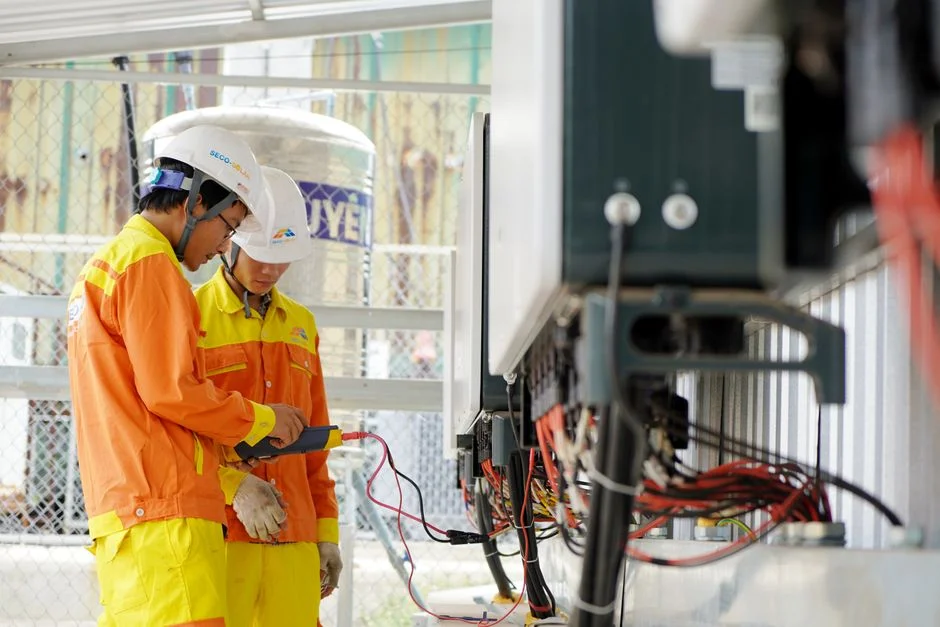
Operator labor runs 0.5–1.5 hr/day of dedicated attention per 50 m³/h skid, equivalent to $0.005–$0.018/m³ at the 2026 US industrial wage plus burden (~$35–55/hr fully loaded, per BLS NAICS 2213 Q1-2026 data). For a multi-skid plant, this is the line that benefits most from a predictive maintenance system supplier for wastewater plants 2026 approach — voltage-per-pair trending flags a passivated plate 2–4 weeks before it costs an unplanned shutdown, and the cell-voltage per kAh metric is the single best leading indicator of electrode life remaining.
Sludge Handling as a Hidden 2026 Cost Lever
Sludge is the line item that 90% of pre-purchase estimates under-budget, and it is the line most likely to fail a board review six months after startup. EC sludge yield runs 0.15–0.45 kg dry solids per m³ for influent COD of 500–3,000 mg/L (HydropureWater field data, 2026). The same mechanisms that destroy pollutants — coagulant sweep, charge neutralization, and electro-flotation, as documented in the principal EC sludge elimination review (ResearchGate, 2019) — concentrate contaminants into a wet, low-solids cake that must be dewatered before hauling pays off.
Dewatering choice sets the hauling line:
- Plate-and-frame filter press: 22–28% dry cake, lowest hauling cost, $0.008–$0.014/m³ for the disposal line. A plate and frame filter press for EC sludge dewatering is the right answer when footprint and labor are less constrained.
- Sludge drying bed: 35–60% dry cake achievable in dry climates, lowest capex, but high footprint and weather risk.
- Centrifuge: 18–24% dry cake, compact, higher opex; useful where a lamella clarifier for EC floc settling precedes the centrifuge to cut volume.
The hidden multiplier is metals content. EC sludge from metal-finishing or circuit-board duty frequently fails TCLP for Zn, Cu, Ni, or Pb, which reclassifies the waste as hazardous and multiplies hauling plus disposal 4–8×. For that duty, the per-m³ sludge line can swing from $0.012 to $0.06 or more — enough to invalidate the entire EC business case if it is not caught at design. The electrocoagulation system for circuit board wastewater 2026 engineering guide covers the pretreatment and pH-staging moves that pull metals out before they concentrate in the cake.
5-Year Lifecycle Cost Example and 2026 Buying Checklist
Worked ROI for a 50 m³/h Fe-electrode EC skid at 2026 prices:
- CAPEX: $180,000–$260,000 (skid, rectifier, PLC, installation).
- Year-1 maintenance OPEX: ~$42,000 (electrodes $24K, power $8K, sludge $5K, acid $2K, labor $3K).
- 5-year OPEX with 3% annual electrode-price inflation: ~$225,000.
- 5-year TCO: ~$445,000, or roughly $0.026/L treated against an industrial water-reuse value of $0.80–$2.50/m³ in most 2026 markets (per the municipal wastewater plant operating cost breakdown 2026 cross-reference).
Looking forward, the 2025 Springer solar-EC LCA (Almaamari et al., doi:10.1007/s10661-025-13662-x, 2025-08) shows PV-integrated rectifier supply can shave 12–18% off power OPEX in sun-belt sites — promising but not yet a default assumption. Use it as a Phase 2 upgrade, not a Phase 1 cost reduction.
2026 buying checklist — eight items to put in writing before signing:
- Electrode material justified by influent chloride, hours/yr, and effluent color limits.
- kAh-based wear warranty on plates (not just months-in-service).
- Acid-cleaning frequency stated in writing, with the chemistry named.
- Sludge yield guarantee in kg dry solids/m³ at your design COD.
- Harmonic-compliant rectifier, IEEE 519 THD ≤5% documented.
- PLC with remote monitoring and cell-voltage-per-pair trending exported.
- Spare-electrode lead time quoted in weeks, not "available on request."
- Fixed-price 5-year service contract option, including the automatic chemical dosing system for pH and coagulant control consumables.
Frequently Asked Questions
What is the 2026 cost per cubic meter for electrocoagulation maintenance?
Maintenance OPEX runs $0.04–$0.18/m³ across industrial wastewater strengths, with the lower end applying to low-COD, low-Cl⁻ streams on Al plates and the upper end to high-COD or metal-finishing duty on Fe plates. Influent strength and chloride content move the number more than any other single variable.
How long do EC electrodes last?
Iron plates last 6–12 months at 8,000 h/yr industrial duty, aluminum 12–24 months in low-chloride streams, and DSA/MMO coated titanium 5+ years because sacrificial loss is negligible. Rotating or flipping Fe plates every quarter can extend service life by 15–20%.
How often does an EC cell need acid cleaning?
5–10% HCl or 5% citric acid wash every 2–8 weeks. Hard water (>180 mg/L CaCO₃) and current density above 30 A/m² push the interval to the short end; soft water and lower current density let it stretch to two months.
How much sludge does electrocoagulation produce?
0.15–0.45 kg dry solids per m³ for industrial influent at 500–3,000 mg/L COD, with metal-finishing and circuit-board duty at the high end. Food and textile streams sit in the middle; oil-field produced water can exceed the range.
Is EC cheaper than chemical coagulation in 2026?
Yes on chemical spend — there is no PAC, alum, or polymer dose to buy. Neutral to slightly higher on sludge disposal because EC sludge is more hydrated. Net OPEX is typically 10–25% lower than chemical coagulation when regional disposal costs are moderate and influent TDS is high, but the gap narrows or reverses in regions with low chemical prices and high landfill gate fees.