Lyon’s Industrial Wastewater Treatment Requirements: 2025 Compliance Standards
Métropole de Lyon’s 2024 municipal ordinance mandates that industrial effluents discharged into the public sewerage system must not exceed a Chemical Oxygen Demand (COD) of 125 mg/L and a Biological Oxygen Demand (BOD₅) of 25 mg/L. These regulations ensure that the influx of industrial waste does not overwhelm municipal treatment capacities or compromise the ecological health of the Rhône and Saône rivers. For facility managers in Lyon’s chemical and pharmaceutical corridors, compliance is no longer a matter of periodic adjustment but of continuous, high-precision monitoring. Failure to meet these numeric thresholds results in heavy surcharges or the suspension of discharge permits under the strict oversight of the Direction de l'Eau de la Métropole.
Beyond standard organic loads, Lyon-based facilities must adhere to heavy metal thresholds defined by EU Directive 2010/75/EU. These limits are particularly stringent for the region's metal finishing and chemical manufacturing sectors. For instance, Hexavalent Chromium (Cr(VI)) must remain below 0.1 mg/L, while Lead (Pb) and Cadmium (Cd) are capped at 0.5 mg/L and 0.2 mg/L, respectively. Monitoring frequency is strictly regulated: flow and pH must be tracked continuously, while COD, BOD, and TSS require weekly sampling. For facilities handling hazardous substances, quarterly reporting on heavy metal concentrations is mandatory to remain in compliance with 2025 Lyon Métropole guidelines.
| Parameter | Standard Limit (Direct Discharge/Sewer) | Sector-Specific Requirement | Monitoring Frequency |
|---|---|---|---|
| Chemical Oxygen Demand (COD) | < 125 mg/L | Pharmaceuticals: APIs < 10 µg/L | Weekly |
| Biological Oxygen Demand (BOD₅) | < 25 mg/L | Food Processing: FOG < 15 mg/L | Weekly |
| Total Suspended Solids (TSS) | < 35 mg/L | Textiles: Color < 50 Pt-Co units | Weekly |
| pH Level | 6.5 – 8.5 | Chemical: Neutralization mandatory | Continuous |
| Mercury (Hg) | < 0.05 mg/L | Metal Finishing: Strict adherence | Quarterly |
Industrial dischargers in Lyon have three primary pathways for wastewater management: direct discharge to the municipal sewer (requiring secondary-level pretreatment), direct discharge to surface water (requiring advanced tertiary treatment), or off-site hauling for highly concentrated toxic waste. While off-site hauling eliminates on-site infrastructure needs, the escalating costs of hazardous waste transport in France make on-site treatment systems, such as DAF systems for Lyon food processing plants, the more sustainable long-term financial strategy.
How Lyon’s Municipal Plants Set the Bar for Industrial Systems
The Saint Fons modernization project managed by Veolia represents a €100 million investment designed to achieve 95% Total Suspended Solids (TSS) removal and a 90% reduction in COD for the Rhône river’s left bank. As one of France's largest municipal facilities, Saint Fons serves as a technical benchmark for industrial pretreatment. When an industrial facility in Lyon prepares its effluent for the municipal sewer, it is essentially competing for capacity within a system that is increasingly optimized for high-efficiency organic removal. If industrial pretreatment fails to meet the 95% TSS benchmark, the resulting municipal surcharges can exceed the annual operating cost of an in-house treatment system.
Similarly, the Aqualyon La Feyssine plant, which processes wastewater for approximately 300,000 population equivalents, has integrated a biomethane recovery unit producing 1.2 million Nm³/year. This shift toward circular economy models in municipal plants is driving new expectations for industrial sites. Lyon’s industrial facilities are now encouraged to adopt energy-efficient treatment technologies that target an energy consumption of less than 0.8 kWh/m³, aligning with the International Water Association (IWA) 2024 benchmarks. For instance, a Lyon-based textile factory recently achieved these targets by retrofitting its site with an MBR system, maintaining a Mixed Liquor Suspended Solids (MLSS) concentration of 8,000–12,000 mg/L and a design flux of 15–25 LMH to ensure pretreatment standards were consistently met before sewer discharge.
Industrial facilities aiming for direct surface water discharge must exceed these municipal benchmarks. While municipal plants are designed for broad-spectrum urban waste, industrial systems must provide 99% TSS removal and up to 99.9% pathogen removal if water reuse is intended, following WHO Guidelines for Drinking-water Quality. This level of purity requires specialized equipment that goes beyond the standard activated sludge processes used at Saint Fons, often necessitating the integration of aerobic vs anaerobic systems for industrial effluents depending on the raw waste's carbon-to-nitrogen ratio.
DAF vs MBR vs Chemical Dosing: Which System Fits Your Lyon Facility?
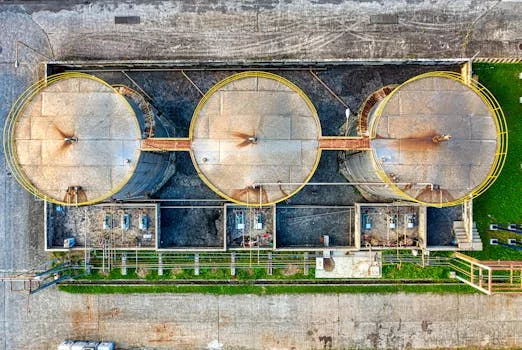
Dissolved Air Flotation (DAF) systems achieve 92–97% TSS removal in food processing applications by utilizing micro-bubbles to levitate hydrophobic particles like fats, oils, and grease (FOG) to the surface for mechanical skimming. In the context of Lyon's food processing sector—specifically slaughterhouses and dairy plants—the DAF system is the industry standard. These units offer a compact footprint of 0.5–2 m²/m³/h, making them ideal for existing facilities where floor space is at a premium. By targeting FOG removal rates of 95–99%, DAF systems for Lyon food processing plants prevent the common issue of sewer line blockages that trigger municipal fines.
For pharmaceutical and textile facilities in Lyon, where space is even more constrained and effluent contains complex synthetic organics, Membrane Bioreactor (MBR) systems provide a superior alternative. The DF series MBR modules combine biological degradation with membrane filtration, achieving 99.99% pathogen removal and 95–98% COD removal. Unlike traditional clarifiers, MBR systems for Lyon pharmaceutical facilities operate at higher biomass concentrations, allowing for a significantly smaller footprint while producing high-quality permeate suitable for process reuse or direct discharge to the Rhône. This technology is particularly effective at removing Active Pharmaceutical Ingredients (APIs) that standard municipal processes might miss.
Chemical dosing systems remain the most cost-effective solution for Lyon's metal finishing and heavy manufacturing sectors, where pH adjustment and heavy metal precipitation are the primary goals. These systems utilize automated sensors to inject coagulants (50–200 mg/L) and flocculants (1–5 mg/L) to aggregate dissolved metals into settleable solids. While chemical dosing for Lyon metal finishing plants is highly effective for inorganic removal, it generates a higher volume of chemical sludge, which must be managed using a sludge dewatering for Lyon industrial facilities to minimize disposal costs.
| Feature | DAF | MBR (DF Series) | Chemical Dosing |
|---|---|---|---|
| Primary Use Case | Food Processing, FOG removal | Pharma, Textiles, High-purity | Metal Finishing, pH control |
| COD Removal | 60–85% | 95–98% | 30–50% (Inorganic focus) |
| TSS Removal | 92–97% | > 99% | 80–90% |
| Footprint | Moderate (0.5–2 m²/m³/h) | Very Low | Low (Skid-mounted) |
| Energy Use | 0.2–0.4 kWh/m³ | 0.6–1.2 kWh/m³ | < 0.1 kWh/m³ |
| OPEX | Moderate (Power + Air) | High (Membrane cleaning) | Moderate (Chemical costs) |
Choosing the right technology requires a decision framework based on the specific effluent profile. If the effluent is high in suspended solids and grease, DAF systems for Lyon food processing plants are the logical choice. If the goal is high-quality water reuse in a small footprint, MBR systems for Lyon pharmaceutical facilities are preferred. For simple pH correction and metal removal, an chemical dosing for Lyon metal finishing plants provides the fastest ROI.
Cost Benchmarks for Industrial Wastewater Treatment in Lyon: 2025 Budget Ranges
Capital expenditure (CAPEX) for industrial wastewater treatment in Lyon typically ranges from €50,000 for basic dosing skids to over €1 million for high-capacity membrane bioreactor systems. For a standard 100 m³/h DAF system, Lyon-based facilities should budget between €150,000 and €300,000 depending on the degree of automation and material specifications (e.g., SS304 vs. SS316). MBR systems, while offering higher effluent quality, command a premium, with costs for a 500 m³/day plant often exceeding €450,000. These figures align with global benchmarks for DAF systems but are adjusted for the higher labor and integration costs found in the French market.
Operating expenditure (OPEX) is driven by three main factors: energy, chemicals, and sludge disposal. Energy costs in the Auvergne-Rhône-Alpes region currently fluctuate, but industrial systems should target an average consumption of 0.5–1.2 kWh/m³. Chemical costs for coagulation and flocculation typically range from €0.10 to €0.50 per cubic meter of treated water. Sludge disposal remains a significant OPEX burden in Lyon, with costs ranging from €50 to €150 per ton for transport and incineration at local facilities. Implementing a sludge dewatering for Lyon industrial facilities can reduce sludge volume by up to 75%, providing a direct reduction in these disposal fees.
| System Type | Capacity Range | Estimated CAPEX (2025) | Estimated OPEX (per m³) |
|---|---|---|---|
| DAF System | 4 – 300 m³/h | €50,000 – €300,000 | €0.15 – €0.35 |
| MBR System (DF) | 10 – 2,000 m³/day | €100,000 – €1,000,000 | €0.40 – €0.85 |
| Chemical Dosing | Custom Skids | €20,000 – €150,000 | €0.20 – €0.60 |
| Sludge Filter Press | 5 – 100 m² area | €15,000 – €80,000 | €0.05 – €0.15 |
The Return on Investment (ROI) for on-site treatment is often realized through the avoidance of municipal non-compliance penalties. For example, a Lyon food processing plant treating 100 m³/h with a DAF system (CAPEX €200,000) can save upwards of €50,000 per year in reduced sewer surcharges and lower water intake fees if reuse is implemented. SMEs in Lyon can apply for Métropole de Lyon grants, which may cover up to 30% of the project cost for systems that demonstrate significant environmental improvements. When compared to the cost of off-site hauling (€0.50–€2.00/m³), on-site treatment (€0.20–€1.00/m³) typically pays for itself within 24 to 42 months, reflecting global industrial wastewater treatment trends toward decentralized processing.
Step-by-Step Compliance Checklist for Lyon Industrial Facilities
The permitting process for new industrial wastewater discharge in Lyon requires a technical characterization report and typically involves a 3-to-6-month review period by Métropole de Lyon authorities. To ensure a successful application, facilities must provide a detailed wastewater characterization report, a treatment system design certified by an engineer, and a comprehensive emergency response plan. This checklist provides a technical roadmap for facility managers to ensure their systems meet all 2025 regulatory and operational requirements.
- Pre-treatment Optimization: Install 6 mm mechanical screening to protect downstream pumps and equalization tanks with 2–4 hours of retention time to dampen hydraulic surges.
- pH and Flow Stabilization: Integrate an chemical dosing for Lyon metal finishing plants to maintain pH between 6.5 and 8.5, ensuring continuous online monitoring linked to a discharge shut-off valve.
- Technology Selection: Verify that the selected system (DAF, MBR, or chemical) is sized for peak loading, not just average flow, to prevent breakthrough during high-production shifts.
- Sludge Management Strategy: Implement dewatering using a sludge dewatering for Lyon industrial facilities to reach at least 25-35% dry solids, significantly reducing disposal costs in the Lyon metropolitan area.
- Monitoring and Reporting: Set up automated samplers for weekly COD/BOD/TSS testing and maintain a digital logbook for monthly submission to Lyon Métropole authorities.
- Emergency Protocols: Develop a spill response plan including 24-hour notification procedures for the Lyon Métropole hotline and install bypass valves to prevent untreated discharge during system maintenance.
By following this structured approach, Lyon-based industrial sites can navigate the complexities of environmental regulation while optimizing their operational costs. The transition from a "compliance-only" mindset to an "efficiency-first" strategy allows facilities to treat wastewater as a resource rather than a liability, aligning with the broader sustainability goals of the Auvergne-Rhône-Alpes region.
Frequently Asked Questions
What are the penalties for non-compliance with Lyon’s industrial wastewater standards?
Under the 2024 municipal ordinance, facilities found in violation of effluent limits can face administrative fines of up to €150,000. Persistent non-compliance may lead to the revocation of discharge permits and mandatory facility shutdowns until a compliant treatment system is verified.
Can industrial facilities in Lyon discharge directly to surface water?
Yes, but direct discharge to the Rhône or Saône requires a specific permit and tertiary treatment. Effluent must meet much stricter standards than sewer discharge, often requiring 99% TSS removal and advanced disinfection, making MBR systems the preferred technical solution.
How much does an industrial water treatment system cost in Lyon?
For a mid-sized facility, costs range from €50,000 for basic chemical dosing to over €1,000,000 for high-capacity, fully automated MBR plants. Factors such as effluent complexity, required removal rates, and automation levels significantly impact the final price.
What are the most common problems with industrial wastewater treatment in Lyon?
Facility managers frequently report issues with FOG buildup in municipal sewers (leading to fines), heavy metal exceedances in older industrial zones, and insufficient equalization that leads to "shock loading" of treatment systems.
Are there grants available for industrial wastewater treatment upgrades in Lyon?
Yes, SMEs can access grants through the Métropole de Lyon and the French Water Agency (Agence de l'Eau), which can cover up to 30% of CAPEX for projects that reduce pollutant loads or implement water recycling technologies.
Further Reading
Explore these in-depth articles on related wastewater treatment topics: