
Establish the Controlling Discharge and Permit Path
Mining and metals plants near Kennewick meet sewer pretreatment limits through the indirect-discharge route: Clean Water Act §307(b), 40 CFR Part 403, and applicable categorical standards. Part 437 governs ore mining and dressing; Part 433 applies to metal finishing. The Kennewick POTW’s approved local limits, industrial user sewer permit, monitoring rules, and prohibited discharges control the design basis. Because the Kennewick Pretreatment Act text was not retrievable from the supplied research, every Kennewick numerical limit must remain unverified until the controlling authority supplies it in writing.
Start with the physical discharge route. A connection to a municipal sewer is an indirect discharge subject to the POTW pretreatment program, not a direct surface-water discharge governed by an NPDES permit. Mining or metals facilities may also have separate stormwater or surface-water outfalls requiring NPDES coverage, but those authorizations do not replace sewer-pretreatment requirements. This distinction is identified in the HydropureWater mining pretreatment research, undated in the supplied excerpt.
Next, classify the actual industrial process. Ore extraction, milling, washing, and related dressing operations require review against 40 CFR Part 437. Plating, pickling, anodizing, and other finishing operations require review under 40 CFR Part 433. The HydropureWater mining pretreatment research, undated in the supplied excerpt, identifies these as the relevant categorical frameworks, while the US EPA pretreatment guidance explains that local limits are site-specific and imposed at the industrial user’s point of connection.
The screening workflow for mining and metals plants should end with a request to the Kennewick POTW for the current Pretreatment Act, sewer-use rules, industrial user permit conditions, local limits, sampling and reporting requirements, prohibited discharges, approved reuse conditions, and enforcement provisions. The City of Kennewick code identifies Chapter 14.23 as the Kennewick Pretreatment Act, but the supplied Municode result was blocked by a 403 error; it cannot establish numerical limits.
Record each permit question with an owner and resolution date. The procurement file should not label an assumed number as a “Kennewick limit.” Until written terms are received, use “permit-dependent” and identify whether the proposed treatment train is an interim design, a reusable bid basis, or released for final sizing.
Turn the Permit Basis into Treatment Targets
The controlling design basis is the more stringent applicable combination of federal categorical limits and written Kennewick POTW local limits. The US EPA pretreatment guidance, undated in the supplied excerpt, states that POTW local limits are site-specific and apply at the industrial user’s point of connection; it also explains that they protect the POTW’s treatment processes, sludge handling, and receiving waters.
Do not import numerical limits from another municipality. The HydropureWater regional mining sewer-compliance research, undated in the supplied excerpt, provides Part 433 values only where metal finishing applies: copper at 3.38 mg/L daily maximum and 2.07 mg/L monthly average, and total chromium at 2.77 mg/L daily maximum and 1.71 mg/L monthly average. These are federal categorical values, not confirmed Kennewick limits. Other Part 437 values depend on the applicable subpart and process category.
Obtain representative wastewater data before calculating chemical demand or equipment capacity. The sampling program should cover normal production, peak discharge, startup, shutdown, and rainfall events and should separate streams where dilution would hide the controlling metal or solids load. Test flow, pH, metals, TSS, oil and grease, process-reagent residuals, conductivity or TDS, and other process-specific constituents.
Fill this matrix before releasing an industrial wastewater quotation:
| Design input | Required evidence | Responsible party | Use in equipment selection | Status |
|---|---|---|---|---|
| Permit basis | Current Kennewick Pretreatment Act, local limits, industrial user permit, applicable federal subpart, monitoring rules, prohibited discharges | Plant engineer with POTW confirmation | Defines final treatment targets and acceptance criteria | Unverified until supplied in writing |
| Wastewater characterization | Representative pH, metals, TSS, oil and grease, TDS, process residuals, and flow by operating condition | Plant personnel and qualified laboratory | Sets chemical dose, solids loading, separation needs, and sludge quantity | Required before final sizing |
| Peak flow | Continuous flow records, batch-discharge schedule, rainfall response, and operating envelope | Plant personnel | Determines equalization, pumping, clarification, filtration, and turndown | Required before final sizing |
| Reuse objective | Written quality target, recovery requirement, and concentrate-management route | Plant management | Determines whether UF or RO enters the train | Confirm whether reuse is in scope |
| Sludge route | Analytical characterization, receiving-site criteria, transport method, and disposal authorization | Sludge contractor and plant personnel | Sets dewatering target, storage volume, and final handling | Required before equipment award |
Jar testing should establish the pH setpoint and reagent dose for each stream. The HydropureWater mining pretreatment research, undated in the supplied excerpt, recommends staged reactors where influent pH swings exceed two units and describes controlled dosing within a ±0.2 pH band. Preserve those as design criteria only after confirming that the control strategy fits the actual wastewater chemistry.
Select DAF or Lamella from the Wastewater Profile
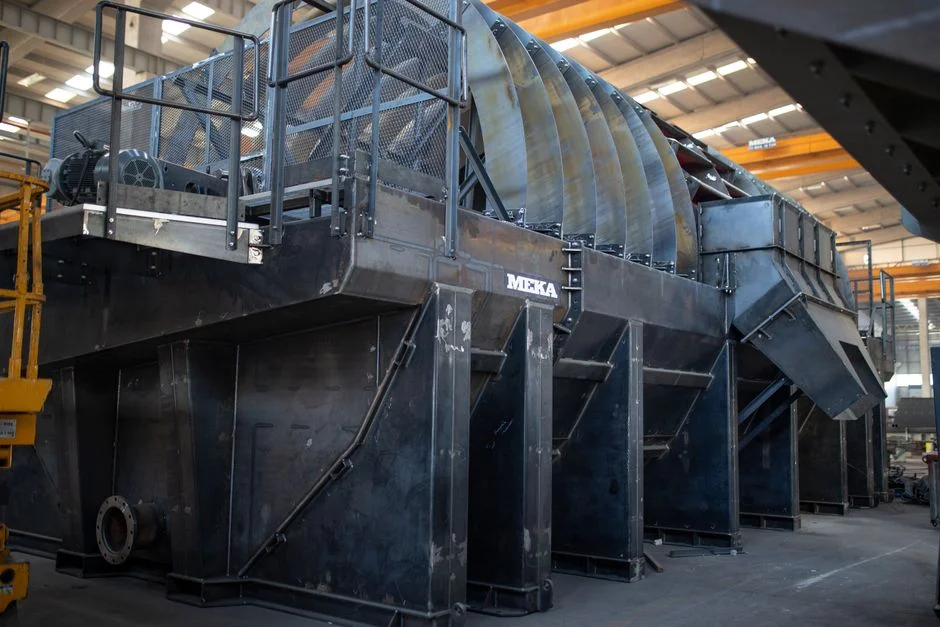
DAF is the better primary separator when oil, grease, floatable material, or fine colloidal metals are present; lamella clarification is the stronger choice when compact metal-hydroxide sludge separation and a constrained footprint drive the selection. Neither decision should be made from average flow alone, because the same flow can carry very different solids, colloid, and oil loads.
The supplied HydropureWater equipment catalog describes DAF systems for suspended solids, FOG, and colloidal matter across 4–300 m³/h in 13 models, with hydraulic loading of 5–25 m/h. These are equipment-selection values, not guaranteed project performance. A DAF system for mining solids and oil removal should therefore be evaluated against representative oil, colloid, and solids data, peak hydraulic loading, and expected floatable-sludge handling.
The supplied lamella catalog specifies surface loading of 20–40 m/h and up to 30% lower chemical consumption than the comparison basis. Those are catalog values, not an assurance that the selected clarifier will meet Kennewick’s permit. Bid comparison should also cover underflow concentration, floc carryover, sludge withdrawal, washdown, access, controls, operator workload, and available floor area. See the DAF versus lamella mining pretreatment comparison for the selection logic.
| Decision condition | Preferred primary separator | Required supporting evidence | Main procurement concern |
|---|---|---|---|
| Oil, grease, floatable solids, or buoyant floc is present | DAF | Oil and grease, floatable solids, colloid, TSS, and peak-flow data | Float removal, sludge withdrawal, recovered-oil or float handling |
| Primary solids are precipitated metal hydroxides and footprint is constrained | Lamella | Solids loading, settling test, chemical demand, and underflow data | Hydraulic loading, carryover, sludge concentration, access, and washdown |
| Both oily and metal-bearing solids are significant | DAF followed by a solids barrier, or a pilot-supported hybrid | Stream segregation and pilot/jar results | Capital, chemical use, sludge volume, and performance risk |
| Exceptional residual-metal target cannot be demonstrated by hydroxide precipitation | Evaluate hydroxide precipitation with sulfide polishing on a slipstream | Jar or pilot data, residual metals, reagent demand, and off-gas assessment | Additional controls, sealed reactors, and scrubbed H₂S vents |
The sulfide option requires a separate safety and operating case. The HydropureWater mining pretreatment research, undated in the supplied excerpt, reports sulfide residuals of 0.01–0.05 mg/L for copper, zinc, cadmium, and nickel, compared with 0.5–2.0 mg/L for hydroxide precipitation, while sulfide reagent cost is 2–4 times higher. Those comparisons apply only after jar or pilot testing confirms the required metals, pH, sulfide residual, and H₂S-generation rate.
Build a Treatment Train That Controls Peak Loads
Size the train around the controlling discharge event, not the annual average. Front the process with equalization sized to buffer batch discharges, then place pH correction, precipitation, coagulation or flocculation, solids separation, filtration, and monitored discharge behind it. The HydropureWater mining pretreatment research, undated in the supplied excerpt, specifies equalization of 8–24 hours of average daily flow; the separate regional research, also undated, recommends calculating peak hydraulic flow using a 1.5–2.0 peaking factor. Select the more conservative site-specific basis after reviewing flow records and operating schedules.
Use an PLC-controlled chemical dosing skid for pH adjustment and coagulant or flocculant feed. Continuous flow, pH, and conductivity records should support permit monitoring. The cited application maintains pH within a ±0.2 band, and the staged-reactor recommendation applies where influent pH changes exceed two units. Jar-test results must establish reagent concentration and dose before skid sizing.
Hydroxide precipitation should form separable metal-bearing solids, with sulfide polishing considered only for the residual target demonstrated in testing. DAF or lamella then removes the precipitated solids and any floatable material. Multimedia filtration provides the next solids barrier; the supplied service basis specifies 1–2 m/h filtration and residual TSS below 10 mg/L. Include differential-pressure monitoring, a defined backwash route, and treatment of backwash wastewater. UF is justified only where finer colloids must be removed before membranes or reuse duties.
Provide a managed sludge route from the outset. The supplied plate-and-frame filter press catalog covers filtration areas from 1 m² to 500 m² and manual, hydraulic, or fully automatic configurations. Acceptance should be tied to measured cake volume, dryness, cycle time, filtrate quality, and criteria imposed by the receiving site—not merely press model or filtration area. Filtrate disposition also requires approval because returning it upstream changes the hydraulic and metal mass balance.
For discharge routing, direct surface-water outfalls require separate NPDES review. The sewer route requires confirmation of the permitted sanitary sewer authority and any industrial user permit. The record should include separation valves, break-tank or equalization capacity where required, and controlled sample/control stations so that one treatment train can satisfy both the sewer authorization and any separate stormwater obligations without cross-connection.
Every process barrier should have a measurable purpose:
- Equalization controls hydraulic and batch variation.
- pH correction enables the selected precipitation chemistry.
- Coagulation and flocculation create separable particles.
- DAF or lamella removes solids and floatable material.
- Multimedia filtration captures residual solids and colloids.
- UF or RO is added only for a defined membrane-protection or reuse requirement.
- Sludge dewatering prepares the residue for its accepted destination.
Issue a Bid Package with Acceptance Criteria
A defensible industrial wastewater quotation compares bidders on the same operating basis and requires measurable evidence. Ask each bidder to state average and peak flow in m³/h, representative influent pH and metals, the controlling Kennewick limits for pH, metals, and TSS, chemical consumption, sludge generation, electrical load, footprint, controls, redundancy, sampling locations, bypass and upset procedures, and the sludge destination. Require a process flow diagram, mass balance, sampling plan, and performance guarantee tied to the written controlling permit condition.
Reject a proposal that gives only equipment nameplate capacity. The bidder must show how its design handles the controlling concentration and hydraulic peak, how sludge and filtrate are accounted for, and how the train responds to an upset without creating an unpermitted discharge. Define commissioning tests, instrument calibration, operator training, control narratives, spare parts, warranty boundaries, and documentary evidence required for acceptance.
The regional research supplied for this article, undated in the excerpt, places complete industrial-scale pretreatment systems at $250,000 to more than $2 million, with annual operating costs often equal to 15%–25% of initial capital expenditure. These are planning figures, not a Kennewick quotation. A bid comparison should separate equipment, civil work, chemical storage, controls, installation, commissioning, sludge handling, consumables, maintenance, and disposal assumptions. Ask bidders to provide a priced mass balance rather than an unsupported lifecycle percentage.
| Bid item | Required submission | Acceptance evidence | Owner of missing input |
|---|---|---|---|
| Permit basis | Applicable federal category and subpart, current Kennewick local limits, industrial user permit conditions, and prohibited discharges | Written documents confirmed by the POTW | POTW and plant compliance lead |
| Wastewater basis | Representative analyses by operating condition and stream | Laboratory reports with methods, dates, and quality-control information | Plant personnel and laboratory |
| Peak-load design | Flow model, equalization calculation, hydraulic and contaminant peaks, and turndown | Calculations checked against plant records | Plant engineer |
| Treatment equipment | DAF or lamella selection rationale, precipitation chemistry, filtration basis, controls, and redundancy | Sizing calculations, pilot or jar data where used, and factory tests | Equipment bidder |
| Performance guarantee | Permit-linked guarantee with sampling location, method, frequency, and acceptance condition | Commissioning test results and calibrated records | Bidder and plant operations team |
| Sludge handling | Sludge mass balance, dewatering basis, storage, transport, and receiving-site criteria | Representative cake results and written acceptance route | Sludge contractor |
| Commercial scope | Priced equipment, installation, controls, utilities, training, warranty, and exclusions | Supplier clarification and signed scope matrix | Procurement team |
Before award, close every unresolved permit question in writing. A future industrial wastewater quotation can remain a budgetary request if its exclusions identify assumed flow, chemistry, limits, civil interfaces, sludge acceptance, and utility connections. A purchasable equipment package should not be released until the controlling authority’s terms and representative wastewater data are attached to the procurement record.
Frequently Asked Questions
What should a mining plant request from the Kennewick POTW before selecting treatment equipment?
Request the current Pretreatment Act, local limits, industrial user sewer permit conditions, prohibited discharges, monitoring and reporting rules, sampling locations, reuse provisions, and enforcement contacts in writing. Do not treat the City of Kennewick code index or a numerical limit from another municipality as confirmation. Until the POTW responds, mark each numerical design target as permit-dependent.
Should a plant choose DAF or lamella clarification for mining wastewater?
Choose DAF when representative testing shows oil, grease, floatable material, or fine colloidal metals; choose lamella when metal-hydroxide sludge separation and footprint are the controlling constraints. Verify the decision with peak-flow, solids-loading, chemical-demand, and pilot or jar data. A nameplate flow comparison is not enough.
How much does industrial-scale mining pretreatment cost?
The supplied regional research gives a planning range of $250,000 to more than $2 million, with annual operating costs often equal to 15%–25% of initial capital expenditure; it is not a Kennewick price. Request itemized bids covering treatment equipment, civil work, controls, utilities, installation, commissioning, chemicals, maintenance, sludge dewatering, and disposal. Provide verified flow, wastewater analyses, permit limits, and sludge criteria before comparing prices.
What should a supplier include to demonstrate a compliant equipment proposal?
Require a process flow diagram, mass balance, peak-load sizing, chemical and sludge calculations, sampling plan, controls narrative, redundancy, upset and bypass procedures, utility demands, footprint, and a permit-linked performance guarantee. For supplier selection, verify that the proposed equipment addresses the identified stream characteristics and can produce acceptance evidence at the required control points. For sizing and delivery, require the bidder to identify manufacturing scope, lead time, site-interface assumptions, commissioning responsibilities, and post-commissioning support in the commercial offer.
When are UF, RO, or disinfection necessary rather than optional?
UF is warranted when residual colloids must be removed before membrane or reuse duties. RO is warranted when dissolved metals or salts remain above the sewer requirement or a defined reuse target, and its concentrate needs a controlled route. The supplied regional research reports greater than 99% rejection of dissolved metals and salts by RO, but that is not a site guarantee. Add disinfection only when written POTW conditions or a documented pathogen-control assessment require it.
Related Equipment
- DAF system for mining solids and oil removal — specifications, capacity range, and technical data