Start with the property's wastewater profile
A Kumasi hotel or resort generally needs an on-site treatment train comprising pretreatment, equalisation, biological treatment, disinfection and sludge handling, subject to verified sewer access and permit conditions. The supplied Ghana engineering guide uses 0.5 m³ per occupied room per day as a preliminary midpoint for full-service hotels with laundry and food service. Buried A/O, MBR and SBR systems each fit different discharge, reuse and operating requirements. Final sizing requires site sampling, an occupancy forecast and a supplier-specific design basis.
Begin by separating guest-room sewage from laundry wastewater, kitchen effluent, pool backwash, swimming-pool discharges and any non-domestic process flows. Record room count, forecast occupancy, laundry operating hours, kitchen covers, backwash frequency, pumping requirements and projected expansion. A shared sewer cannot safely be assumed to handle the combined load without confirmation from the relevant sewer authority.
The commercial guide Hotel & Resort Wastewater Treatment in Ghana: 2026 Engineering Guide reports preliminary influent characteristics of BOD 200–400 mg/L, TSS 200–350 mg/L and FOG 50–150 mg/L. These are preliminary design values, not substitutes for sampling the actual property. The same guide reports that on-site laundry generates 10–15% of total flow but 20–30% of BOD load, with lint capable of blinding membranes; provide a dedicated lint trap upstream of any membrane-based process.
Use a coarse screen before equalisation and the biological stage. The guide identifies a GX rotary bar screen with a 3–5 mm aperture as its minimum headworks standard; the rotary mechanical bar screen should therefore be assessed against the expected solids load. Route kitchen wastewater through appropriate FOG control rather than allowing it to enter the biological reactor untreated.
| Design-basis input | Record before selecting equipment | Reason for verification |
|---|---|---|
| Guest accommodation | Rooms, occupied rooms, seasonal occupancy and future expansion | Determines occupied-room wastewater flow |
| Laundry | On-site or outsourced, operating hours, lint loading and discharge connection | Controls lint trap and balancing requirements |
| Kitchen | Covers, meal periods, grease-trap condition and FOG sampling point | Protects downstream biological treatment |
| Pool and other flows | Backwash volume, frequency, chemicals and pumping arrangement | Prevents backwash and chemical slugs from overloading the plant |
| Influent quality | Representative BOD, TSS and FOG samples | Replaces preliminary values with site evidence |
Calculate average, peak and equalisation capacity
The supplied Ghana guide gives an occupied-room wastewater flow basis of 0.3–0.8 m³ per occupied room per day, with 0.5 m³/day as the working midpoint for a full-service hotel with laundry and food service. These factors provide a defensible preliminary calculation, but the final designer must reconcile them with measured flows, room-use patterns, kitchen loading, laundry operation, backwash, pumping and future expansion.
Calculate occupied rooms first, then apply the selected per-room factor. Apply the guide’s peak factor of 2.5–3.0 only after confirming that it represents the property’s morning shower and breakfast load. Likewise, apply the seasonal factor of 1.3–1.6 only where the occupancy forecast and operating records justify it. Peak and seasonal factors should not automatically be multiplied together without checking the resulting design event against the property’s operating profile.
For an 80-room property at 70% occupancy using the 0.5 m³ midpoint:
- Average flow: 80 × 0.70 × 0.5 = 28 m³/day.
- Working peak: 28 × 2.8 ≈ 78 m³/day, using the guide’s peak example.
- Equalisation storage: 6–8 hours of average flow, or approximately 10–12 m³, using the guide’s stated basis.
A second guide example covers 50 rooms at 70% occupancy and 0.5 m³ per occupied room: 50 × 0.70 × 0.5 = 17.5 m³/day average, with an approximately 50 m³/day working design point after applying its 2.8× peak. These calculations are preliminary examples, not equipment-selection rules by room count alone.
| Calculation field | Entry | Supplier or designer to complete |
|---|---|---|
| Total rooms | [enter number] | Confirm room count and occupancy limits |
| Average occupancy | [enter percentage] | Support with booking, conference and seasonal records |
| Occupied rooms | [enter calculation] | Total rooms × average occupancy |
| Per occupied-room flow | [enter m³/occupied room/day] | Select within the guide’s preliminary range and justify the choice |
| Average daily flow | [enter m³/day] | Occupied rooms × per occupied-room flow |
| Peak factor | [enter factor] | Confirm against the site’s diurnal pattern |
| Seasonal factor | [enter factor] | Confirm against forecast occupancy and event demand |
| Equalisation volume | [enter m³ and hours] | Include kitchen, laundry, backwash and retained-waste effects |
Match A/O, MBR or SBR to the discharge route
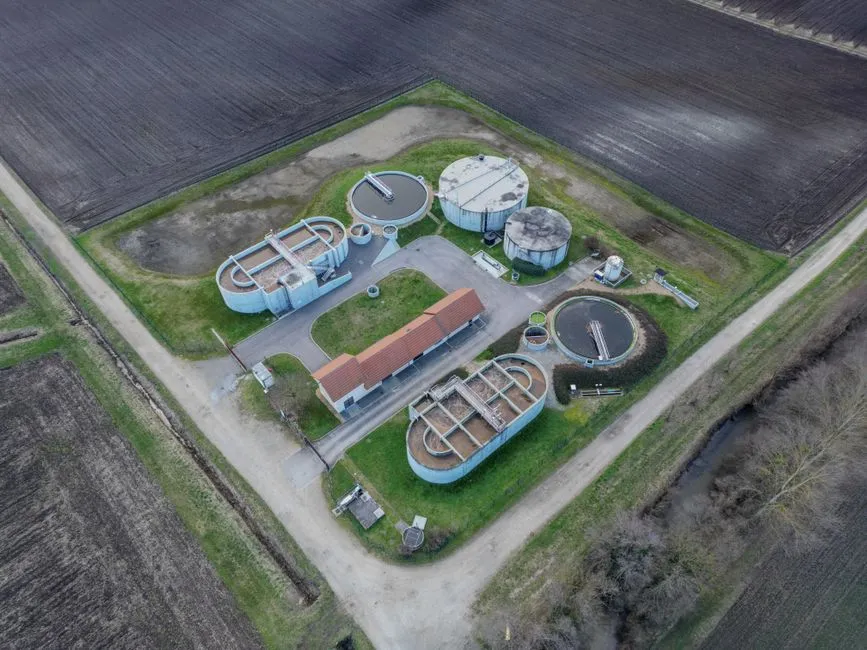
Choose a buried A/O package plant when limited surface area, no material reuse target and low operator involvement dominate the decision. The supplied 2026 commercial guide gives the underground WSZ A/O system a 1–80 m³/day envelope and an aeration demand of 0.3–0.5 kWh/m³. An underground A/O package wastewater treatment plant should be priced and specified against the verified average, peak and equalisation requirements.
Choose MBR when irrigation or toilet-flushing reuse is material enough to justify higher capital and operating requirements. The guide gives the MBR a 10–2,000 m³/day envelope, an aeration demand of 0.4–0.8 kWh/m³ and a footprint approximately 60% smaller than activated sludge. The MBR membrane bioreactor system should be assessed against the actual reuse demand, membrane pretreatment, disinfection route and operator capability. For a hotel-specific comparison, see A/O package plant versus MBR for hotel wastewater.
Choose a sequencing batch reactor where pronounced seasonal loading justifies batch control and the property can support civil tankage and a qualified operator. The guide presents SBR as suitable for larger properties and warns that it adds 8–12 weeks to the build. It is not simply a smaller or cheaper packaged unit.
Use the guide’s 2026 indicative factory-engineering ranges only for screening: USD 8,000–15,000 per m³/day for A/O, USD 12,000–25,000 per m³/day for MBR and USD 6,000–10,000 per m³/day for SBR, with the SBR figure excluding civil works. The guide also states that permits, inspection fees and grid upgrades may add 10–20%. These are commercial-guide figures, not a Kumasi quotation; freight, tax, duty, civils, electrical work, installation and site-specific work must be shown separately.
| Decision condition | Preferred route | Key procurement qualification |
|---|---|---|
| Limited footprint; no reuse target | Buried A/O package plant | Confirm peak/equalisation performance and local installation |
| Material irrigation or toilet-flushing reuse | MBR | Define reuse quality, pretreatment, controls and operator support |
| Severe seasonal variation; civil tankage and skilled operation available | SBR | Include civil works, operator competence and the stated longer build programme |
| Public sewer available and connection permitted | Confirm connection route before buying treatment equipment | Obtain written capacity, connection, pretreatment and tariff conditions |
Build pretreatment, disinfection and sludge handling into the scope
Screenings, laundry lint and kitchen FOG must be removed before equalisation and biological treatment. The supplied Ghana guide states BOD ≤50 mg/L, TSS ≤50 mg/L, FOG ≤10 mg/L and residual chlorine of 0.5–1.0 mg/L under Ghana EPA L.I. 1652. Treat these as design inputs subject to verification against the current permit and receiving authority; do not treat the supplied numerical targets as a substitute for a site-specific compliance assessment.
For a high-FOG restaurant load, evaluate dissolved air flotation as pretreatment or polishing. The DAF machine is listed for treatment capacities from 4–300 m³/h and for suspended solids, FOG, oil, grease and colloidal matter. Final selection requires actual kitchen flow and FOG characterization rather than restaurant covers alone.
The guide recommends on-site chlorine dioxide generation and gives a 0.5–1.0 mg/L residual under L.I. 1652. The chlorine dioxide generator must be matched to the selected chemical, dose, contact arrangement and receiving-point requirement confirmed with the approving authority.
Budget for sludge dewatering. The guide states that plate-and-frame pressing at 30–40% dry solids reduces sludge volume by roughly 80%. A plate-and-frame filter press also introduces cake handling, containment and licensed disposal obligations.
Any reuse proposal requires a defined exposure assessment. The 2008 CGSPace study of wastewater-irrigated vegetables in Accra, Kumasi and Tamale examined total and faecal coliforms, helminth eggs and pesticide residues. It supports controlling contamination pathways, but it does not establish a hotel reuse specification. Set the reuse quality basis through the approving authority and relevant water-quality requirements.
Turn the design basis into a procurement checklist
Make the supplier identify every responsibility in writing. The commercial guide identifies final three-phase electrical hookup and commissioning sign-off as a common gap. The purchase schedule should state who owns the design basis, process calculations, civil works, electrical connection, installation, training, commissioning, permit applications and Ghana EPA approval. This prevents the buyer from accepting an “installed” scope that leaves site interfaces undefined.
Require a line-item quotation separating equipment, freight, customs, installation, civils, permits, inspection fees, grid upgrades, commissioning, spares and O&M support. Apply the guide’s five-point supplier screen: a Ghana-approved design basis or local L.I. 1652 reference, an installation in the Greater Accra or Ashanti Region completed within the preceding 36 months, containerized or break-bulk-friendly equipment, English O&M documentation with electrical schematics and a two-year spares list, and remote monitoring. The local installation should be verifiable, not merely presented as a photograph.
Delivery is part of the critical path. The supplied 2026 guide states that sea freight from China to Tema takes 8–14 weeks and customs clearance adds 2–4 weeks. Require dated milestones for production, shipping, clearance, site delivery, electrical hookup, testing and permit approval, tied to the resort’s soft-opening date.
| Bid document | Supplier entry required | Acceptance evidence |
|---|---|---|
| Design basis | Occupied-room flow, peak, equalisation, influent and reuse calculations | Signed calculation with assumptions and site data |
| Scope allocation | Named responsibility for design, civils, electrical, installation, permits and commissioning | Responsibility matrix and priced exclusions |
| Performance test | Test protocol and acceptance values for BOD, TSS, FOG, disinfection residual, noise, odour and power | Witnessed test at agreed flow and loading |
| Controls and documentation | Automatic controls, electrical schematics, English O&M manual, spares and monitoring | Document handover and operator training record |
| Delivery plan | Production, freight, clearance, delivery, hookup and commissioning dates | Contractual milestones linked to opening date |
| Compliance | Permit and receiving-authority deliverables, including reuse performance where applicable | Permit references, inspection status and signed commissioning certificate |
Frequently Asked Questions
What wastewater flow should I use to size a hotel treatment plant in Kumasi?
Start with occupied rooms, not the total key count, and apply the property’s verified per-room flow. The supplied guide uses 0.3–0.8 m³ per occupied room per day, with 0.5 m³/day as its midpoint for a full-service hotel. Apply peak and seasonal factors only after checking occupancy records, then validate the result with influent sampling and engineering review.
How much should a Kumasi hotel wastewater treatment system cost?
Do not compare supplier headline prices without normalising the scope. The guide’s indicative 2026 ranges are USD 8,000–15,000 per m³/day for A/O, USD 12,000–25,000 for MBR and USD 6,000–10,000 for SBR excluding civil works, but these are not Kumasi quotations. Request itemised pricing for equipment, freight, customs, civils, installation, permits, inspections, grid work, commissioning and O&M support.
Which supplier should I select for a hotel wastewater package plant?
Require a site-specific design basis, a verifiable local installation completed within the preceding 36 months, English controls and O&M documentation, a spares commitment and named delivery responsibilities. Also request the supplier’s proposed acceptance protocol; a local reference or generic certificate alone does not demonstrate that the proposed train will meet the discharge or reuse requirement.
What delivery and compliance dates belong in the contract?
Include production, sea freight to Tema, customs clearance, electrical hookup, testing, permit approval and commissioning as separate critical-path dates. Verify the current Ghana EPA L.I. 1652 requirements and the relevant sewer or reuse authority’s conditions before freezing the acceptance criteria. For reuse, define the receiving use, exposure pathway and required effluent quality rather than assuming treated water is suitable for irrigation or toilet flushing.