Start with the site water balance, not the treatment catalogue
An Okara data center should separate sanitary wastewater, humidification or process drainage, and cooling-tower blowdown instead of blending them. Size sanitary treatment from flow and headcount; assess drainage with DAF or filtration before MBR or RO; and evaluate CTBD through filtration, chemical control and brackish RO, with controlled precipitation if higher recovery is justified. Conventional BWRO commonly reaches 75–80% recovery, while an industrial case achieved around 95%, but neither is an Okara guarantee. Final selection requires measured flows, feed chemistry, the confirmed discharge or reuse route, and written requirements from the relevant Punjab authority.
The treatment decision begins with a measured data center water balance, not installed IT load alone. Request the cooling technology, design scenarios, expected utilization and seasonal operating conditions. These inputs determine evaporation, blowdown and the demand for reused water. IT load may influence the balance, but it does not establish sanitary flow, drain chemistry or permissible discharge quantity.
IDE reported in 2026 that a 100 MW facility can require up to 2 million litres of water per day. That is an industry-scale reference, not an Okara estimate. The project engineer should instead reconcile make-up water, evaporation, blowdown, humidification or process drainage, sanitary flow, internal reuse and final discharge for each operating scenario.
| Required input | What it establishes | Responsible source |
|---|---|---|
| Cooling-system design and operating scenarios | Evaporation, blowdown and reuse demand | Mechanical designer and project engineer |
| Water and drain flow records | Measured sanitary, drainage and CTBD design flows | Owner or temporary metering campaign |
| Source-water and drain analyses | Treatment objectives, scaling risk and recovery limits | Accredited sampling program |
| Utilization and seasonal projections | Peak, average and off-peak equipment demand | Owner’s facility plan |
| Confirmed reuse or discharge route | Effluent targets and residual-handling route | Relevant Punjab and receiving authorities |
Where records do not exist, require temporary measurement across the proposed operating modes rather than substituting a catalogue flow. The bidder should reconcile every quoted flow to this balance. Compare data-center blowdown discharge and reuse options to frame the outlet question before treatment capacity is fixed.
Separate the streams before selecting equipment
Wastewater stream segregation determines whether each flow can be reused, discharged or must receive further treatment. Sanitary wastewater contains organic matter, nutrients and pathogens; drainage may contain suspended solids, corrosion products, biofilm carryover and potentially silica; CTBD contains accumulated dissolved salts, residual chemicals and possible solids. Blending these streams transfers contaminants to the largest flow and can make recovery less practical.
Route sanitary and cafeteria wastewater to a dedicated biological package sized from sanitary flow and occupied headcount, not IT load. A packaged anoxic/aerobic system with clarification and disinfection can be assessed against the site footprint and below-grade conditions; the underground integrated sewage-treatment package is one equipment option, not evidence that it meets Okara requirements. The supplier must identify the design flow, treatment stages, disinfection method and sludge-withdrawal arrangement.
Assess humidification and process drainage independently. Suspended solids can overload downstream membranes, while corrosion products and residual treatment chemicals affect pretreatment and reuse chemistry. HydropureWater’s 2026 Islamabad reference lists drainage silica at 5–30 mg/L and suspended solids at 10–50 mg/L. These are reference conditions for another location, not measured Okara values and not design limits for this project.
Treat CTBD as a concentrated stream, not diluted wastewater. Its acceptable recovery depends on source-water chemistry, cycles of concentration, residual chemicals, scaling species and the proposed reuse or discharge endpoint. A bidder claiming a fixed recovery without analyzing the Okara feed has not established a site performance basis.
| Stream | Typical contaminants to investigate | Sizing basis | Potential endpoint requiring confirmation |
|---|---|---|---|
| Sanitary and cafeteria wastewater | Organic matter, nutrients and pathogens | Sanitary flow and occupied headcount | Confirmed sewer, treatment route or permitted reuse |
| Humidification or process drainage | Suspended solids, biofilm, corrosion products and potentially silica | Separately metered drain flow and chemistry | Cooling make-up, process reuse or permitted discharge |
| Cooling-tower blowdown | Concentrated salts, scaling species, residual chemicals and possible solids | Cooling water balance, selected cycles of concentration and feed analysis | Cooling make-up, controlled discharge and, if applicable, concentrate treatment |
Do not transfer an Islamabad or industrial reference condition to Okara. The local source-water analysis, drain sampling and written outlet requirement become the controlling inputs.
Match each stream to its treatment and endpoint
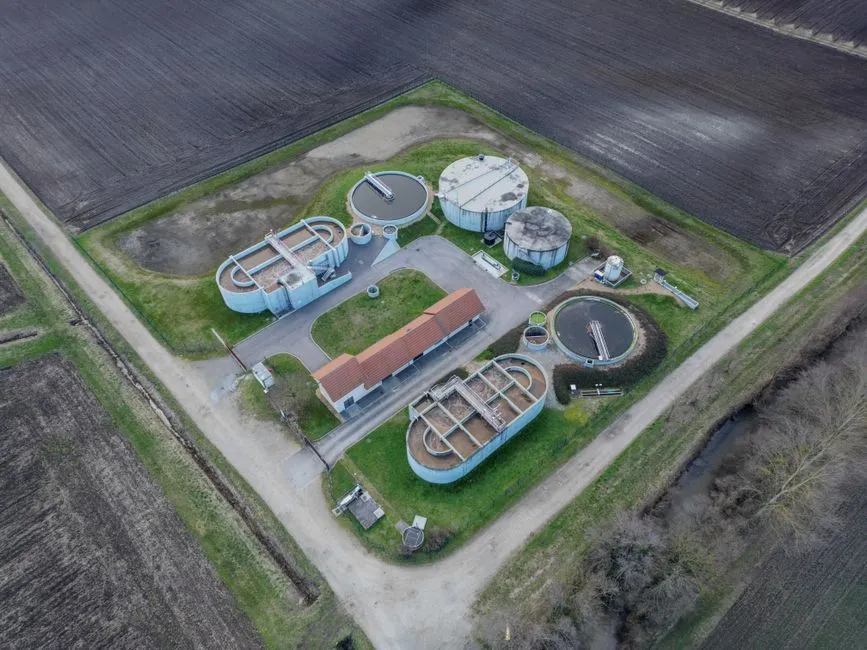
Each stream requires a treatment objective tied to its endpoint; an RO or zero-liquid-discharge train is not justified merely because more advanced treatment is available. For sanitary wastewater, use an anoxic/aerobic biological process, sedimentation and disinfection, then confirm effluent quality, sludge handling and the local outlet separately. For drainage, use DAF when suspended solids, colloids or oil require removal; consider an MBR wastewater treatment system where near-reuse quality and compact installation justify its operating complexity; and use multimedia filtration before RO where membrane protection is required.
HydropureWater’s 2026 Islamabad reference reports MBR performance of BOD below 10 mg/L, COD below 60 mg/L and TSS below 5 mg/L, with multimedia filtration used to hold SDI below 5. These values are reference performance, not guaranteed Okara drainage results. Bid acceptance criteria should specify the tested feed, sampling method and applicable endpoint. For sanitary treatment, the biological package must also address disinfection and sludge withdrawal.
For CTBD, begin with filtration, chemical control and a site-specific scaling assessment. Evaluate an industrial RO system where CTBD permeate has a defined cooling make-up or process-reuse destination. Without that destination, RO adds membranes, energy, concentrate handling and monitoring without establishing a necessary reuse benefit.
Controlled precipitation or crystallization should be considered only where a chemistry model, pilot support and a solid-waste route justify it. IDE’s 2026 industrial example combined cooling-tower blowdown, RO brine and process wastewater; it achieved around 95% recovery with approximately 1 mg/L permeate silica. This case demonstrates a possible design direction, not an Okara guarantee or a reason to specify the same process without feed testing.
| Stream and condition | Treatment sequence to evaluate | Bid requirement |
|---|---|---|
| Sanitary wastewater requiring biological treatment | Anoxic/aerobic treatment, sedimentation and disinfection | Design flow, headcount basis, effluent criteria, sludge route and disinfection method |
| Drainage with suspended solids or colloids | DAF pretreatment, followed by MBR or filtration where required | Feed characterization, solids removal basis, filtrate quality and downstream protection |
| CTBD with confirmed reuse destination | Filtration, chemical control and brackish RO | Site-specific recovery calculation, permeate chemistry, concentrate destination and membrane-cleaning strategy |
| CTBD requiring high recovery | Controlled precipitation or crystallization combined with membrane treatment | Chemistry model, pilot data, solids characterization and approved waste route |
The endpoint test is practical: if the permeate has no defined cooling or process use, and discharge is lawfully available, compare that simpler route with recovery. Compare data-center discharge and reuse options before asking bidders to price unnecessary treatment complexity.
Verify recovery, cost and compliance before selecting the train
A recovery target remains unverified until the CTBD feed has been analyzed and the proposed equipment has been evaluated against that chemistry. Require conductivity, silica, calcium, alkalinity, sulfate, hardness, chloride, pH, suspended solids and residual-treatment-chemical results before selecting brackish RO or a high-recovery process.
IDE reported in 2026 that conventional brackish RO commonly reaches 75–80% recovery before scaling becomes unmanageable. Its separate industrial case achieved around 95% recovery with approximately 1 mg/L permeate silica. Neither value should be inserted into an Okara guarantee. The recovery calculation must identify the selected cycles of concentration, feed flow, product flow, concentrate flow and chemistry constraints.
Cycles of concentration affect the outlet, but the arithmetic is often presented incorrectly. Genesis Water Technologies, as cited by HydropureWater in 2026, states that blowdown is 25% of make-up at 4 cycles and 20% at 6 cycles. Moving from 4 to 6 cycles therefore reduces blowdown by 20%, not 50%. Higher cycles also increase scaling and biological-control risk, so the operating strategy must be part of the bid.
Compare installed cost and operating cost as complete systems. Include energy, chemicals, membranes, labor, carbon, concentrate or precipitate disposal, civil works and local utilities. HydropureWater’s 2026 Islamabad guide gives a directional reference of $250,000–$500,000 installed CAPEX and $1.50–$3.00/kgal OPEX for a 50,000 GPD RO-polishing CTBD system. It is not an Okara quotation and should not be transferred into the project budget.
Obtain written confirmation of the outlet, applicable consent, discharge-quality basis, sampling method and monitoring plan from the relevant Punjab authority and receiving authority. If the receiving authority or route is not confirmed, describe the verification required rather than asserting compliance. The supplied research does not establish an Okara permit.
| Decision area | Information the buyer must obtain | Acceptable basis |
|---|---|---|
| CTBD recovery | Complete feed chemistry and site-specific water balance | Calculated and warranted recovery for the specified feed |
| Cost | Local civil works, freight, import, taxes, installation, utilities and waste handling | Itemized installed and operating costs with exclusions |
| Outlet | Written route and governing requirements | Named authority, consent basis, sampling method and monitoring plan |
| High-recovery option | Chemistry model, pilot evidence and solids route | Demonstrated performance with a defined precipitate destination |
For additional conceptual context, plan data-center cooling-blowdown treatment only as a reference framework; local measurements and the Okara outlet must control the final design.
Issue one fillable bid package with testable acceptance criteria
A comparable bid must contain the same measured design basis, treatment boundary, endpoint and acceptance tests. Give every bidder the water balance, stream analyses, operating scenarios and written outlet requirements. Require each bidder to return a measured-basis flow diagram, design flows, feed and permeate quality, recovery calculation, unit-by-unit equipment list, utility demand, chemicals, controls, redundancy and operator workload.
Ask bidders to identify the proposed outlet, concentrate destination, solid-waste route, FAT and SAT methods, warranty boundaries, commissioning requirements and every pricing exclusion. The bid should also state whether treatment equipment is intended for continuous operation, peak demand or standby duty. Unverified assumptions should be marked as assumptions rather than converted into guarantees.
Tie FAT and SAT to guaranteed flow, recovery, permeate chemistry, energy use and the verified Okara reuse or discharge endpoint. For CTBD pretreatment, request the equipment basis, cartridge or membrane life, cleaning strategy and replacement parts. For sanitary treatment, require the biological process stages, aeration arrangement, disinfection method and sludge-withdrawal details. Specify treatment parts, valves and filter media sufficiently for maintainability, including critical-spares availability and operator-access arrangements.
| Bid section | Fillable bidder response | Buyer’s acceptance check |
|---|---|---|
| Design basis | Design flows, operating scenarios, measured inputs and source-water analyses | Every value traces to the issued water balance or a stated sampling assumption |
| Treatment train | Unit-by-unit process description, equipment list and recovery calculation | Capacity and chemistry calculations reconcile with the selected stream |
| Endpoint | Reuse, discharge, concentrate and solids destinations | Routes are supported by written authority confirmation |
| Utilities and operations | Power, chemicals, waste handling, redundancy and operator workload | Loads and maintenance demands are priced |
| Performance tests | FAT, SAT, sampling methods and guaranteed values | Tests use the specified feed and identified endpoint |
| Commercial exclusions | All exclusions, assumptions, delivery terms and spare-parts boundaries | Bids can be normalized on the same scope |
The buyer should reject a bid that presents a recovery rate without feed analysis, an outlet without documentary confirmation, or a headline price with major local costs excluded.
Frequently Asked Questions
What wastewater and cooling-blowdown treatment does a data center in Okara, Pakistan need?
It needs separate treatment trains sized from measured sanitary flow and headcount, separately metered humidification or process drainage, and the cooling-water balance for CTBD. Sanitary wastewater normally follows biological treatment, sedimentation and disinfection; drainage may require DAF, filtration or MBR; CTBD requires filtration, chemistry control and brackish RO when reuse is confirmed. The final equipment and endpoint depend on Okara feed chemistry and the written Punjab and receiving-authority requirements.
What will the wastewater treatment system cost for an Okara data center?
Request a site-specific quotation rather than a unit-price estimate. HydropureWater’s 2026 Islamabad reference of $250,000–$500,000 installed CAPEX and $1.50–$3.00/kgal OPEX applies to a 50,000 GPD RO-polishing CTBD reference scope; it is not an Okara quotation. Ask bidders to price measured flow, pretreatment, RO, controls, civil works, local transport, import, taxes, installation, commissioning, energy, chemicals, membrane replacement, labor, carbon and concentrate or precipitate disposal, with every exclusion identified.
Why should a bidder not guarantee CTBD recovery from equipment capacity alone?
Membrane capacity does not establish the achievable recovery for a particular feed. IDE reported in 2026 that conventional brackish RO commonly reaches 75–80% recovery, while a separate industrial case achieved around 95%; both require chemistry-specific review. Require feed analysis, a site-specific water balance, a recovery calculation and pilot support for any high-recovery proposal. Higher recovery can increase scaling, chemical demand and residual-handling requirements.
Which documents should be obtained before selecting a treatment supplier?
Require a measured-basis flow diagram, stream-by-stream design flows, feed analyses, equipment list, recovery calculation, permeate and final-effluent quality, utilities, controls, redundancy, operator requirements, outlet and waste destinations, FAT/SAT criteria, and itemized pricing with exclusions. For CTBD, also request pretreatment basis, membrane or cartridge life, cleaning strategy and spare parts. For sanitary treatment, request process stages, disinfection and sludge withdrawal. The endpoint and acceptance tests should match the confirmed Okara route.