Separate the wastewater streams before selecting equipment
Cooling tower blowdown and sanitary sewage require separate flow estimates, treatment decisions and approval pathways. Blowdown is the principal process-wastewater stream where evaporative or hybrid cooling is used, while sanitary sewage follows a domestic route. Softener or RO backwash, equipment cleaning and air-handling condensate are additional streams that must be included in the site water balance. The data-center blowdown treatment train comparison provides the technical context, but Leeds route selection depends on local acceptance criteria and measured site conditions.
| Information to obtain | Why it changes the design | Provider | Status |
|---|---|---|---|
| Average and peak blowdown flow; operating hours | Sets hydraulic capacity, storage, equalisation and drain-down requirements | Cooling designer | Not supplied |
| Sanitary sewage flow and contributing fixtures | Keeps domestic wastewater separate from industrial pretreatment | Civil and mechanical designers | Not supplied |
| Make-up-water analysis and cycles of concentration | Defines expected blowdown concentration and the water-saving baseline | Cooling designer | Not supplied |
| Cooling chemical schedule and product data sheets | Identifies pH, biocide, corrosion-inhibitor and antiscalant constituents | Cooling-water specialist | Not supplied |
| Temperature and flow duration | Determines cooling, holding and discharge constraints | Cooling designer | Not supplied |
| RO or softener backwash, cleaning waste and condensate | Prevents omitted streams from distorting treatment sizing | Design and operations teams | Not supplied |
Compare sewer discharge, reuse and hybrid treatment
Sewer discharge is viable where the measured flow and chemistry fit the accepting authority’s requirements. The data-center reuse-or-discharge assessment outlines the need for local utility approval and an industrial user permit defining pollutant limits. Reuse reduces mains-water demand and wastewater volume, but requires a measured water balance, suitable recovered-water quality and a maintainable system. A hybrid route separates permeate or reuse flow from a residual concentrate that still needs an authorised route.
| Decision | Choose sewer pretreatment when | Choose reuse when | Choose hybrid when |
|---|---|---|---|
| Primary objective | Obtain acceptance for discharge after required pretreatment | Recover water for cooling make-up or another defined use | Maximise reuse while retaining a lawful residual-disposal route |
| Required evidence | Written acceptance criteria, permitted route and connection process | Feed analysis, water balance, reuse specification and modelling | Both sets of evidence, plus a quantified reject stream |
| Main treatment need | pH control, filtration, metal removal or other authority-specified treatment | Filtration, membrane treatment, RO and chemical control as feed analysis requires | Recovery train plus treatment or disposal of the remaining concentrate |
| Operational risk | Permit exceedance and pretreatment upset | Unstable reuse quality, membrane scaling and maintenance burden | Two discharge dependencies and greater control complexity |
| Leeds-specific unresolved item | Applicable sewer limits and monitoring requirements | Cooling-equipment compatibility and site water demand | Authority acceptance of both routes and the residual flow |
Recovery should be staged: establish the water balance, optimise make-up-water treatment, then model blowdown recovery using real feed data. AllWater Technologies states that recovery rate, membrane selection, pretreatment, reject management and monitoring depend on measured feedwater data. IDE Tech reports that conventional brackish-water RO generally reaches 75–80% recovery before scaling becomes a constraint; higher recovery rates require specialized arrangements. That application does not prove equivalent performance for a Leeds data center.
Match treatment steps to blowdown chemistry

The blowdown analysis determines the treatment train rather than a fixed equipment list. RSP Engineers identifies elevated TDS, chlorides, sulfates and phosphates, suspended solids, extreme pH, elevated temperature, residual biocides and metals such as copper and zinc as potential concerns. pH adjustment uses acid or caustic dosing, heavy-metal removal uses precipitation or ion exchange, and suspended-solids removal uses filtration. These examples are general engineering guidance, not Leeds acceptance limits.
| Measured condition | Potential treatment step | Design information required | Verification source |
|---|---|---|---|
| Extreme pH | Acid or caustic neutralisation | Raw and treated pH, flow range, chemical compatibility and target range | Measured sample and written sewer criterion |
| Suspended solids | Sedimentation or filtration | Turbidity or solids data, particle characteristics and filtrate specification | Measured sample |
| Copper, zinc or other metals | Precipitation, ion exchange or specialised filtration | Species, concentration and required removal performance | Accredited laboratory analysis and authority response |
| Residual biocides | Dechlorination or review of non-persistent alternatives | Active ingredient, dose, residual concentration and contact time | Chemical supplier, analysis and authority response |
| High TDS and dissolved salts | RO or another salt-removal process | Full ionic analysis, scaling assessment, recovery and reject route | Feedwater analysis and operational model |
| Silica, calcium carbonate and calcium sulfate | Antiscalant control or a salt-precipitation and high-recovery arrangement | Temperature-corrected saturation, membrane compatibility and concentrate handling | Modelling and pilot evidence |
Selecting the correct treatment train requires matching specific feed analysis with reject management and operational modelling. An industrial RO system for cooling blowdown recovery must be specified against measured feedwater and a defined reuse-water target. If chemical control is needed, an automatic dosing system for pH and chemical control requires defined dose ranges, interlocks, containment and fail-safe response.
Build a reusable and resilient treatment train
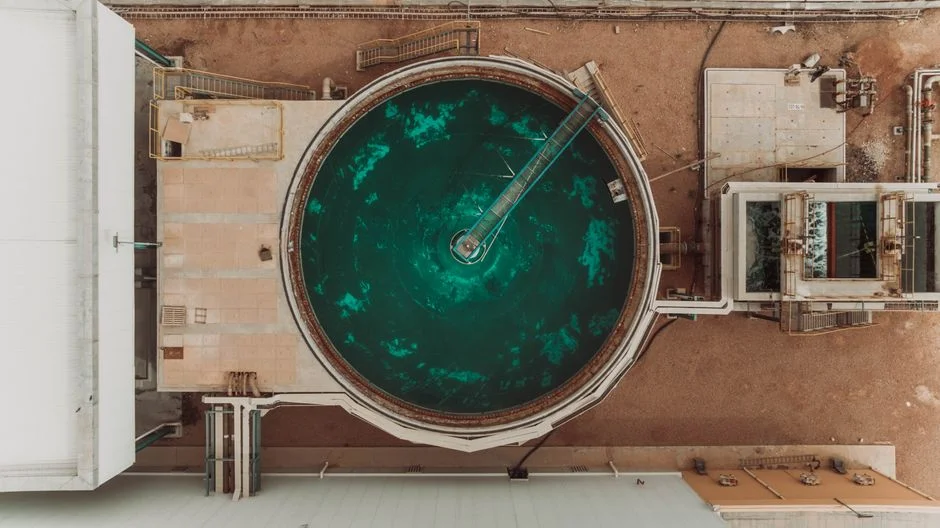
A treatment train functions only if pretreatment, storage, pumping, controls and residual-flow management are designed as a single system. RSP Engineers identifies tanks, pumps, chemical storage, control panels, spill containment, drainage, chemical-delivery access and maintenance space as necessary supporting infrastructure. A simple pH-neutralisation system may occupy a few hundred square feet, while filtration and chemical precipitation may require several thousand square feet.
The reuse train should be reviewed in this order:
- Establish flow equalisation and pretreatment requirements from representative samples.
- Define the recovered-water specification against cooling make-up chemistry and the cooling equipment’s treatment programme.
- Use the RO design criteria for blowdown treatment to set membrane, scaling control, recovery and reject assumptions.
- Size storage and distribution for variable demand, maintenance and continuity of cooling.
- Define monitoring, sampling, automatic interlocks, bypass arrangements and operator response.
The HydropureWater UF water treatment system handles 2,000–40,000 L/h, using 0.03 micron PVDF membranes with automatic backwash and air scour to remove bacteria, colloids and suspended solids. The industrial RO system is specified at recovery rates up to 95% with automated PLC control, though AllWater Technologies requires actual recovery to be based on measured feedwater data and operational modelling.
Operational resilience takes priority over theoretical water savings. Recovered water must be consistent, monitored, maintainable and compatible with the cooling equipment. Reserve capacity, storage, reject handling and a safe response to power, chemical or membrane faults should be included in the procurement specification.
Verify the Leeds approvals and design inputs
The Leeds discharge route must be confirmed in writing as the supplied research does not establish local acceptance criteria. The project team should request the permitted route, pollutant limits, connection process, monitoring duties, fee structure and available treatment capacity from the relevant sewer authority. A separate environmental-authority check is required if the proposed residual stream, direct discharge or abstraction route falls outside ordinary sewer connection.
| Holder of information | Written information to request | Decision affected |
|---|---|---|
| Cooling designer | Flows, water balance, cycles of concentration, make-up analysis, temperatures, hours and chemical programme | Treatment capacity, reuse yield and cooling compatibility |
| Leeds sewer authority | Acceptance criteria, connection process, permitted pretreatment, monitoring, fees and capacity | Whether sewer discharge remains viable |
| Environmental authority | Whether direct discharge, abstraction or the residual route requires a separate consent | Whether a hybrid route is lawful |
| Treatment supplier | Feedwater basis, sizing calculation, recovery assumptions, reject strategy, controls, monitoring, commissioning and validation criteria | Technical suitability and total-life cost |
| Operations team | Maintenance resources, sampling frequency, alarm response and cooling continuity requirements | Operability and resilience |
Anglian Water encourages large data centres in its region to consider alternative sources, including treated sewage effluent. While this does not set the rules for a specific Leeds project, it supports testing alternative supply and storage assumptions rather than assuming potable mains water is unconstrained. AllWater Technologies notes that UK cooling demand can peak during warmer, drier periods, when alternative sources may be least available; storage and supply resilience must be part of the route comparison.
Before issue for construction, close the matrix using three fields for every item: confirmed value, document owner and date, and design consequence. Unresolved sewer limits, feed chemistry, cooling compatibility or reject disposition should remain explicit hold points rather than assumptions hidden inside equipment sizing.
Frequently Asked Questions
What should a Leeds data-center wastewater supplier include in a total-cost quotation?
Request a total-life-cost breakdown covering equipment, membranes or media, chemicals, energy, sampling, maintenance, operator time, replacement and concentrate disposal. Require quotations to state exclusions, validity assumptions and the flow and chemistry basis used for sizing.
How should treatment capacity be sized for the data center?
Size from measured average and peak flows, flow duration, contaminant loads and required reuse quality, not IT capacity alone. Include average and peak blowdown, sanitary flow, treatment backwash, cleaning waste and condensate in the water balance. If these inputs are unavailable, request them from the cooling designer before selecting equipment.
What evidence should be required from a wastewater-treatment supplier?
Require feedwater analysis, sizing calculations, recovery assumptions, reject strategy, controls scope, monitoring provisions, commissioning support and validation criteria. A supplier claiming high recovery should show how silica, calcium carbonate, calcium sulfate, temperature and chemical concentrations affect membrane performance and cleaning frequency.
Can an industrial wastewater-treatment system be used for a Leeds data center?
It can form part of the route, but equipment compatibility does not establish approval. Ask the relevant sewer authority and environmental authority to confirm the proposed route and limits in writing. Permitting principles described in the provided sources are from other jurisdictions and should not be treated as Leeds standards.
How should recovered water be specified for cooling make-up?
Treat recovered water as a product with an agreed quality specification covering parameters relevant to the cooling tower and make-up treatment programme. Demonstrate compatibility through testing or modelling, define monitoring and reject-response arrangements, and include storage and maintenance access. The industrial RO operating-principle guide supports membrane-system review, but site-specific feed data and cooling acceptance criteria remain necessary.