Identify the permit that actually controls the discharge
Sewer discharge from a mining or metals plant near Colorado City is controlled by the receiving publicly owned treatment works (POTW) through Clean Water Act pretreatment requirements in 40 CFR Part 403, not by a surface-water discharge permit alone. Federal categorical standards establish the minimum framework, while the POTW’s current sewer-use ordinance, industrial discharge permit, monitoring requirements and approved discharge point determine the site-specific obligations. The supplied research identifies 40 CFR Part 437 for ore mining and dressing and 40 CFR Part 433 for metal finishing. No Colorado City-specific permit, ordinance or numerical sewer limit was supplied, so those requirements must be verified before equipment sizing.
Start by identifying the entity that owns or operates the receiving collection system and sewerage works. Request the current sewer-use ordinance, the plant’s industrial discharge permit or significant industrial user approval, all applicable categorical standards, monitoring and reporting conditions, slug-control requirements, approved sampling points, discharge-point restrictions and any best-management-practice provisions. Do this before freezing the equipment basis.
Keep direct discharge and indirect sewer discharge separate. The EPA’s mineral mining and processing effluent-guidelines page addresses 40 CFR Part 436 requirements incorporated into NPDES permits for mine drainage, mineral-processing wastewater and stormwater runoff. That is a different regulatory path from a mine-to-POTW sewer connection.
A useful decision artifact is the following compliance register. It distinguishes verified obligations from information still required; the pretreatment compliance decision path provides a related document-review method.
| Control item | What it establishes | Evidence required before quotation | Design status |
|---|---|---|---|
| Receiving POTW | Legal control authority and applicable local program | Written confirmation of authority, contact and jurisdiction | Unverified until confirmed |
| Current sewer-use ordinance | Local discharge restrictions, prohibited discharges and monitoring conditions | Effective ordinance and amendment history | Mandatory document |
| Industrial discharge permit | Site-specific limits, sampling point, frequency and reporting duties | Signed permit and all appendices or modifications | Mandatory document |
| Categorical applicability | Federal floor applicable to the classified operation | Applicable subcategory, production basis and current standard | Applicability must be confirmed |
| Slug and stormwater controls | Requirements for intermittent or contaminated discharges | Approved slug-control plan, containment and monitoring provisions | Include if applicable |
| Colorado City-area limit set | Local numerical targets and acceptance criteria | Current POTW-issued copy or written interpretation | Not supplied; verification required |
Build the wastewater blend and worst-case design basis
Mining wastewater treatment must be designed for the combined pollutant load, not for an isolated pit or workshop stream. The supplied 2026 mining pretreatment guide describes mining wastewater as a superposition of pit dewatering, concentrator slurry water, contact stormwater, acid mine drainage and finishing-shop rinsate, each with a different pollutant fingerprint. Before combining them, characterize flow, pH, total suspended solids, dissolved metals, sulfate, total dissolved solids, oil and grease, flotation reagents and the operating variability associated with ore grade, mill throughput and storms.
The chemistry can change the required equipment materially. The same research reports raw acid mine drainage at pH 2–4 and sulfate in the 1,000–5,000 mg/L range, with dissolved iron and elevated TDS. Those conditions do not establish the blend’s composition, but they identify parameters that need representative sampling. A single grab sample cannot characterize campaign discharges, stormwater flushes and ore-dependent changes.
Use a 24-hour composite sampler and online pH and conductivity monitoring at the headworks as the minimum defensible basis identified in the research. Composite testing should cover normal operations and relevant operating states; the resulting dataset must support both average and worst-case loads. Equalization should be provisionally based on 8–24 hours of average daily flow, as specified in the supplied 2026 mining pretreatment source, with the final volume selected after the plant’s flow and permit review.
Build the design composite from verified operating data rather than from an assumed “normal” stream. For each candidate unit operation, preserve the connection between the wastewater source, the contaminant fingerprint, the flow condition and the proposed removal duty.
| Stream | Characterization inputs | Potential operating condition | Required design evidence |
|---|---|---|---|
| Pit dewatering | pH, flow, TDS, sulfate, dissolved metals, TSS | Long-duration discharge with possible seasonal change | Composite and continuous monitoring record |
| Concentrator slurry water | Flow, TSS, pH, metals, flotation reagents | Mill-rate and ore-grade swings | Campaign composite and peak-flow record |
| Contact stormwater | Flow, TSS, metals, oil and grease | Event-driven high solids and flow | Representative wet-weather event sampling |
| Acid mine drainage | pH, acidity, metals, sulfate, TDS | Low-pH load that may upset treatment | Worst-case pH and constituent profile |
| Process brine | TDS, sulfate, metals, chemicals | Persistent salinity and precipitation demand | Maximum concentration and discharge frequency |
| Metal-finishing rinsate | Metals, cyanide where applicable, pH, TSS, O&G | Slug-like discharge or variable shop flow | Stream-segregation and slug-control review |
Match each pollutant to its treatment step
Equalization and controlled pH adjustment come first because flow, acidity and chemical demand vary across mining streams. The supplied 2026 pretreatment guidance gives a pH target of 6.5–9.0 and notes that copper begins precipitating near pH 6.5 and is fully removed by pH 8.5. Those values are design references, not confirmed Colorado City limits. Jar testing should establish the operating band for each blend because amphoteric metals may change solubility at higher pH.
Use hydroxide precipitation as the default primary metals-removal process. Properly controlled systems are cited at 85–95% total-metals removal in the supplied Fluence-based 2024-11 guidance. Reserve sulfide polishing for residuals that hydroxide cannot reliably meet. The same source cites sulfide residuals of 0.01–0.05 mg/L but also identifies higher reagent cost, hydrogen-sulfide generation when pH falls and the need for sealed equipment and gas control. The decision therefore depends on the confirmed metal limit, residual performance and operating risk.
DAF and lamella clarification solve different separation problems. Use a DAF system for oil, grease and colloidal solids when floatable material or fine colloids dominate the clarification duty. The supplied 2026 source cites DAF hydraulic loading of 5–25 m/h, TSS removal of 90–98% and oil-and-grease removal of 85–95%. Use a lamella clarifier for metal-hydroxide sludge when the principal solids are well-formed precipitate and hydraulic loading is the governing constraint. The cited lamella surface-loading range is 20–40 m/h.
Add multi-media filtration where the permit requires a solids buffer or downstream reuse protection requires lower residual TSS. The supplied filtration reference gives 1–2 m/h and residual TSS below 10 mg/L. Add disinfection only when the receiving POTW’s ordinance or collection-system risk assessment requires it; the cited chlorine-dioxide dose is 1–5 mg/L, not an automatic design requirement.
| Wastewater character | Assigned duty | Preferred equipment or method | Verification evidence |
|---|---|---|---|
| Variable flow and acidic influent | Buffer flow and chemical demand | Equalization plus staged pH adjustment | Headworks composite, online pH and conductivity |
| Dissolved Cu, Pb, Zn and other precipitated metals | Convert dissolved metals to separable solids | Controlled hydroxide precipitation | Jar tests and residual-metal results |
| Residual Pb, Hg or Cd below hydroxide capability | Lower residual dissolved metals | Sulfide polishing where justified | Permit target, residual data and H₂S-control review |
| Oil, grease or fine colloidal metals | Remove floatable and colloidal material | DAF | Oil-and-grease, TSS and floatability testing |
| High-flow metal-hydroxide sludge | Settle precipitated solids | Lamella clarification | Solids settleability and peak hydraulic load |
| Residual solids before discharge or reuse | Provide solids buffer | Multi-media filtration | TSS results and backwash-cycle design |
| Disinfection required by POTW | Meet collection-system requirement | UV or chlorine dioxide | Written ordinance condition and dose validation |
Size the train against local limits and operating uncertainty
Every stage should be sized against the worst-case composite and the controlling local limit, with any design margin documented rather than silently embedded. The supplied 2026 mining pretreatment guide describes 20–30% margins above permit limits as standard practice, but that is a design-practice reference, not a Colorado City requirement. Larger margins may be warranted where chemistry, flow or sludge separation is uncertain; the supplier should state which values are regulatory, which are design assumptions and which remain to be verified.
Stage pH dosing when influent pH swings exceed 2 pH units, according to the supplied 2026 pretreatment guidance. Online probes and PLC-controlled chemical feed should hold the selected operating band. An automatic chemical dosing system should therefore be specified around the control objective, reagent inventory, response sequence, probe redundancy and fail-safe behavior—not merely as a pump package.
Clarification capacity must reflect peak hydraulic loading, peak precipitated-solids production and upstream turndown conditions. For the comparison used in the supplied research, DAF is rated at 5–25 m/h hydraulic loading and lamella at 20–40 m/h surface loading. Those are equipment-selection references; final hydraulic area, polymer demand and solids inventory require the confirmed blend, flow record and settleability testing.
No Colorado City-specific permit, ordinance or numerical limit was supplied for this article. Consequently, final hydraulic values, chemical doses, filtration area and disinfection requirements must remain conditional on three items: the receiving POTW’s current requirements, the site’s permit and discharge authorization, and representative influent data. A provisional equipment quotation should therefore carry an explicit exclusions and verification schedule.
| Design question | Required input | Selection rule | Procurement deliverable |
|---|---|---|---|
| What effluent concentration must the train achieve? | Current POTW limit and applicable categorical requirement | Use the controlling approved limit, not an example value | Compliance basis register |
| What flow must equalization absorb? | Measured flow history and approved discharge pattern | Apply the selected detention basis to the relevant flow window | Equalization volume calculation |
| How much chemical is required? | Composite pH, alkalinity, metals and flow data | Establish demand by jar test and stoichiometric balance | Reagent consumption schedule |
| Which solids separator fits? | Oil, grease, colloid content, settleability and peak flow | DAF for floatable or colloidal material; lamella for metal-hydroxide sludge | Signed separator selection memorandum |
| What margin is allowed? | POTW review position and process uncertainty | Document the selected margin and its engineering basis | Design-basis and assumptions report |
Close the compliance plan with sludge, monitoring and reuse options
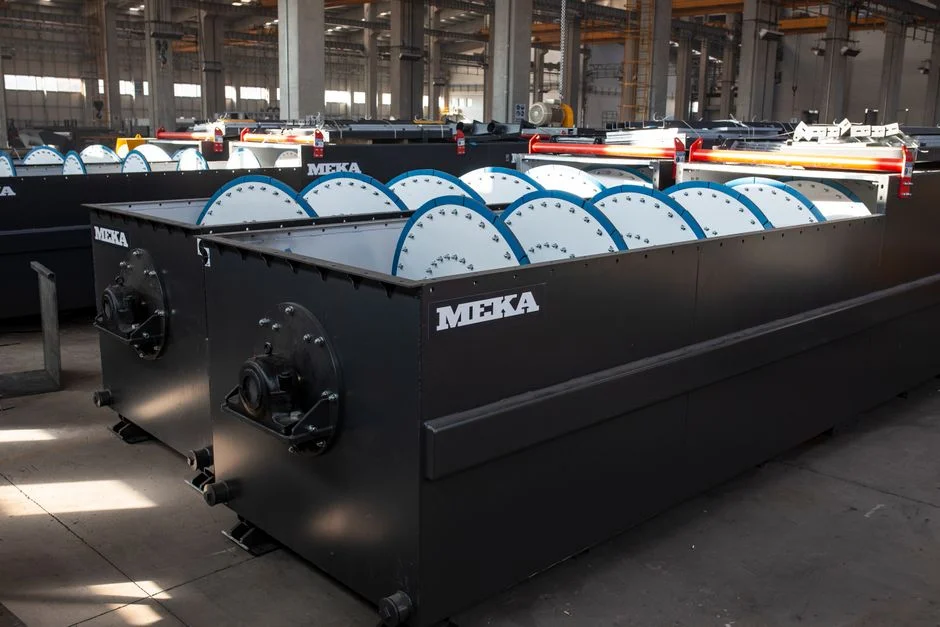
A treatment train is incomplete unless the residual solids have a destination. Include thickening, polymer conditioning and dewatering in the original package. The supplied sources cite plate-and-frame cake at 25–35% dry solids in one mining pretreatment source and 30–45% in another metals-sludge source; the applicable scope must be confirmed for the selected sludge and disposal route. Return filtrate to the headworks for retreatment. A plate-and-frame filter press should be selected against feed solids, polymer demand, cake handling and the receiving facility’s acceptance criteria.
Monitoring should close the control loop. Use online pH and conductivity at the headworks and establish trigger levels and chemical-dosing responses before startup. Metals, TSS and other permit analytes should be sampled under the POTW-required program. Sludge characterization also has to be addressed because residual TCLP testing can determine whether the cake requires a hazardous-waste route; sewer permission does not authorize unrestricted disposal.
Compare sewer pretreatment, partial reuse and full zero-liquid-discharge (ZLD) using the same boundary: POTW fees, incoming-water cost, chemical consumption, energy, residual disposal, monitoring and the expected trajectory of discharge restrictions. The supplied research provides a qualitative comparison rather than defensible project-specific dollar ranges. It identifies an MBR followed by RO as a partial-reuse path, with MBR solids below 5 mg/L and COD removal above 95%, while full ZLD carries the greatest energy and capital exposure. The DAF versus lamella decision guide should be read together with that disposal and reuse comparison.
| Decision package | Primary treatment route | Residual route | Buyer check |
|---|---|---|---|
| Pretreatment to sewer | Equalization, pH control, precipitation, solids removal and any required polishing | Thicken, condition and dewater; send cake to an authorized facility | Confirm POTW fees, permit limits, residual acceptance and future reissuance risk |
| Partial reuse | Pretreatment followed by MBR and RO where the reuse quality target requires it | Concentrate and sludge handling remain part of the design | Obtain quality, recovery, membrane-fouling and energy assumptions |
| Full ZLD | Concentration, evaporation and crystallization | Salts and concentrated residuals require an approved destination | Assess energy availability, air permitting, brine or salt handling and operating redundancy |
Frequently Asked Questions
Do federal categorical standards replace the Colorado City POTW permit?
No. The supplied research identifies 40 CFR Part 437 for ore mining and dressing and 40 CFR Part 433 for metal finishing, while indirect sewer discharge is enforced through the POTW under 40 CFR Part 403. No Colorado City-specific permit or numerical limit was supplied, so request the current ordinance, discharge permit and categorical applicability determination before treating any value as approved.
When should a mine select DAF instead of lamella clarification?
Select DAF when oil, grease or fine colloidal material makes up an important separation duty; the supplied source cites 5–25 m/h hydraulic loading and 90–98% TSS removal. Select lamella for high-flow metal-hydroxide sludge; its cited surface-loading range is 20–40 m/h. Confirm the choice with blend testing, settleability data and peak flow.
What should be included in a treatment-equipment supplier request?
Provide the current POTW requirements, site permit, stream-by-stream flow and analytical data, composite results, oil-and-grease testing, worst-case events, sludge characteristics, utility constraints and required delivery schedule. Require the supplier to separate regulatory inputs, measured site data and engineering assumptions; use the mining wastewater DAF and clarifier factory guide as a quotation checklist, not as a substitute for local approval.
How should the buyer compare sewer, reuse and ZLD costs?
Request an operating-cost comparison using confirmed POTW fees, incoming-water cost, chemical and energy use, residual disposal and monitoring. The supplied research provides no defensible project-specific dollar ranges, so do not accept a generic total-cost figure without its assumptions, boundary and price date. Include the commercial risk of tighter limits and permit reissuance in the comparison.