Define the Legal and Water-Use Constraints
The defensible approach for a Samsung semiconductor fab expansion in Mexico is to establish the receiving route and approval status before selecting a discharge, reuse or zero-liquid-discharge train. NOM-001-SEMARNAT-2021 sets concentration-based discharge limits for parameters including BOD₅, TSS, COD, oils and grease, total nitrogen, total phosphorus and specified heavy metals, with limits differentiated by river, reservoir, coastal and municipal-sewer receiving bodies (HydropureWater, “Samsung Mexico Plant Wastewater Requirements: 2026,” 2026). Sanitary discharge to a municipal sewer also requires screening against NOM-002-SEMARNAT-1996 or its current successor, including fecal-coliform requirements and restrictions on substances that interfere with downstream biological treatment (HydropureWater, “Samsung Mexico Plant Wastewater Requirements: 2026,” 2026).
Brownfield and greenfield projects have different regulatory paths. A brownfield may inherit valid NOM-001 and CONAGUA authorizations, subject to verification, while a greenfield requires the LGEEPA Manifestación de Impacto Ambiental and Licencia de Funcionamiento process, together with the applicable CONAGUA concession before lawful discharge (HydropureWater, “Samsung Mexico Plant Wastewater Requirements: 2026,” 2026). The state basin authority can add local limits, monitoring obligations and drought-trigger conditions, so the site location must be fixed before the ETP is designed.
Reuse is an approval decision as well as a process objective. The supplied 70% reuse baseline and 60–75% industrial reverse osmosis recovery are preliminary design criteria, not permit terms or confirmed site commitments (HydropureWater, “Samsung Mexico Plant Wastewater Requirements: 2026,” 2026). Samsung’s current site requirement, the applicable basin rules and CONAGUA registration of reuse volume, quality and end use must all be confirmed. This review sequence is also applied in the Mexico plant wastewater due-diligence guide and the broader semiconductor fab wastewater compliance guide.
Map Four Semiconductor Waste Streams
The treatment train must begin with four independently characterized streams because their chemistry determines whether they can share biological treatment. Scrubber and photoresist condensate contains fluoride, ammonia, IPA and photoresist residues and can kill MBR biomass if co-mingled; it therefore requires fluoride precipitation, metal recovery and IPA stripping before any biological stage (HydropureWater, “Samsung Mexico Plant Wastewater Requirements: 2026,” 2026). CMP slurry requires solids management for colloidal silica or alumina and trace metals. UPW blowdown and sanitary sewage can then follow separate routes toward controlled biological and polishing operations.
Sanitary sewage must be handled independently to ensure process stability. Sanitary sewage should remain separate through equalization. The preliminary basis for a 35 GWh/yr-equivalent fab is 1,000–2,000 m³/day of sanitary flow, with shift-change peaks of 1.5–2.0 times the daily average (HydropureWater, “Samsung Mexico Plant Wastewater Requirements: 2026,” 2026). Equalization must accommodate the combined hydraulic and contaminant peak rather than the daily average.
| Stream | Primary treatment requirement | Equipment selection trigger |
|---|---|---|
| UPW blowdown | Separate collection and characterization; controlled transfer to the selected polishing or reuse route. | Select after flow, conductivity and ionic contaminant data are available. |
| CMP slurry | Dense-solids capture and metal-bearing solids recovery. | Use lamella clarification where footprint is constrained; verify settling and filtration performance with slurry testing. |
| Wet-bench, scrubber and photoresist condensate | Dedicated fluoride precipitation, metal recovery and IPA stripping before biology. | Do not combine with sanitary sewage or route to MBR without documented pretreatment performance. |
| Sanitary sewage | Independent equalization, followed by biological treatment and final polishing. | Size equalization for shift-change peak and biological loading, not daily average alone. |
Before equipment sizing, request flow, pH, temperature, COD, BOD₅, TSS, FOG, fluoride, ammonia, silica and relevant metals data for each stream (HydropureWater, “Samsung Mexico Plant Wastewater Requirements: 2026,” 2026). These are the minimum characterization inputs for resolving hydraulic load, toxicity, nutrient demand and solids handling.
Select Pretreatment and Biological Treatment
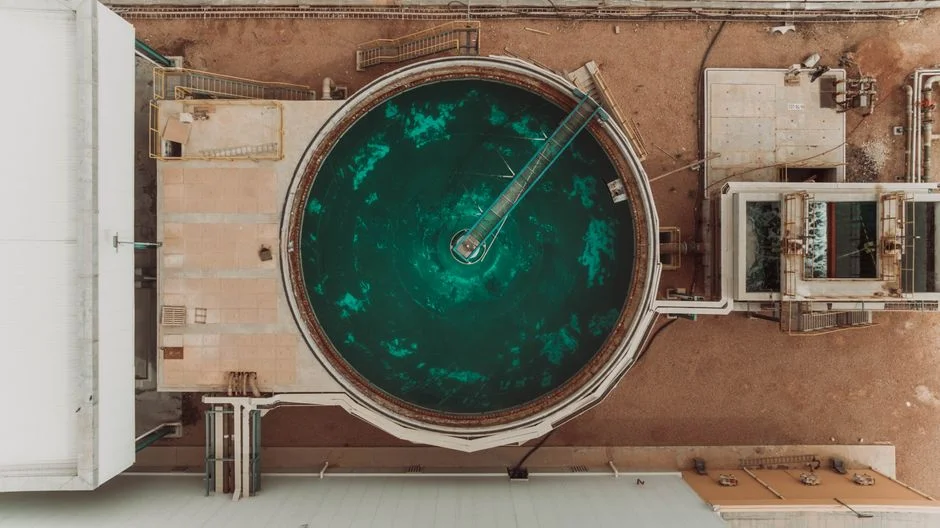
A continuous-duty rotary mechanical bar screen is the preliminary headworks selection because it removes packaging, wipes and fibrous debris before pumps or downstream biological treatment (HydropureWater, “Samsung Mexico Plant Wastewater Requirements: 2026,” 2026). The specified GX-type basis uses a 3–6 mm aperture (HydropureWater, “Samsung Mexico Plant Wastewater Requirements: 2026,” 2026). Equipment selection should follow the semiconductor fab wastewater compliance guide, but the final aperture and duty must be confirmed against the actual waste inventory.
For photoresist-bearing or high-FOG flows, the preliminary basis is DAF with 20–40 minutes of hydraulic retention time and 10–25 m³/m²·h of surface loading (HydropureWater, “Samsung Mexico Plant Wastewater Requirements: 2026,” 2026). Lamella clarification is the alternative for inorganic CMP solids where footprint is constrained. These values are design-envelope inputs rather than proven site capacities. The DAF equipment page should be evaluated against measured flow, FOG, TSS and solids settleability.
For low-solvent process water and sanitary sewage, the preliminary selection is an MBR with anoxic denitrification and aerobic nitrification. The supplied basis specifies 0.1 µm PVDF submerged flat-sheet membranes and MLSS of 8,000–12,000 mg/L (HydropureWater, “Samsung Mexico Plant Wastewater Requirements: 2026,” 2026). Its low-turbidity, low-SSD effluent makes it suitable as the upstream to reuse treatment. The integrated MBR membrane bioreactor should therefore be assessed on biological loading, membrane area, solids separation, controls and guaranteed final-water quality, rather than reactor volume alone.
A UV dosage of at least 40 mJ/cm² is the preliminary sewer-polish criterion in the supplied design basis; it is not evidence that a particular sewer will accept the discharge (HydropureWater, “Samsung Mexico Plant Wastewater Requirements: 2026,” 2026). Obtain acceptance criteria from the receiving authority before freezing this stage. The headworks configuration should also be checked through the rotary mechanical bar screen specifications against the confirmed incoming solids load.
Choose Sewer Discharge, Reuse or ZLD
The final treatment route should be selected only after the receiving body, sewer pretreatment requirements, reuse registration and corporate reuse target are known. Sewer discharge is appropriate only if the receiving system accepts the industrial waste and the applicable NOM-002 and local pretreatment conditions are met. Reuse is appropriate where CONAGUA registers the treated stream’s volume, quality and end use, with industrial RO used for cooling-tower make-up or toilet flushing where the water quality supports those uses. ZLD should be selected when basin restrictions, reuse-registration constraints or discharge limitations remove the other routes.
ZLD is not the unconditional default. The preliminary industrial RO recovery range is 60–75% (HydropureWater, “Samsung Mexico Plant Wastewater Requirements: 2026,” 2026), but recovery must be checked against feed salinity, temperature, membrane configuration and concentrate disposal. The industrial reverse osmosis system should be quoted against measured feed chemistry and the registered end-use quality. For a sewer route, the UV disinfection system remains conditional on authority acceptance.
| Final route | Select when | Do not select when |
|---|---|---|
| UV-assisted sewer discharge | The sewer accepts the industrial waste; applicable NOM-002 and local pretreatment requirements are satisfied. | Acceptance, discharge limits or downstream interference controls remain unresolved. |
| On-site reuse with industrial RO | CONAGUA registration can cover the specified volume, quality and end use, and treatment performance supports the intended reuse. | The proposed reuse is unregistered or required water quality cannot be demonstrated. |
| Evaporation and crystallization for ZLD | Discharge and reuse routes are legally or operationally unavailable and the residual concentrate can be managed. | It is being used as a default without resolving the reuse objective or concentrate route. |
Samsung’s disclosed DX Division water replenishment rate was 67.2% in 2025, while the DS Division objective is to replenish 100% of consumed water by 2030 (Samsung Electronics, “Samsung Electronics Releases 2026 Sustainability Report,” 2026-06-26). These are corporate performance indicators, not Mexican discharge limits. The selected train must explain how its reuse and residual-discharge balance supports the applicable division’s current water strategy without assuming that corporate targets replace site permits.
Convert the Design into a Procurement Checklist
Final equipment selection should close six inputs: greenfield or brownfield status; receiving body; CONAGUA reuse-registration status; four-stream characterization; Samsung’s current site reuse target; and state-basin or drought restrictions (HydropureWater, “Samsung Mexico Plant Wastewater Requirements: 2026,” 2026). Assign the environmental consultant to permit and receiving-route verification, Samsung or plant operations to the current corporate water target, an accredited laboratory to stream sampling, the equipment supplier to guaranteed process values, and the local authority to acceptance criteria. These roles should be named in the basis-of-design and procurement schedule.
Operational efficiency depends on managing the byproduct of the treatment process. For DAF float and MBR waste activated sludge, the preliminary sludge line is a plate-and-frame filter press with a dry-cake target of at least 22% dry solids, subject to sludge testing (HydropureWater, “Samsung Mexico Plant Wastewater Requirements: 2026,” 2026). The plate-and-frame filter press specification should therefore be checked against measured sludge rheology and cake performance. The wider sequence is covered in the fab ETP process design guide.
| Required input or guarantee | Responsible party | Evidence required before award |
|---|---|---|
| Site status and permit route | Environmental consultant and local authority | Valid permits or approval pathway; inherited authorization confirmed for brownfield. |
| Receiving route and reuse registration | Environmental consultant and plant owner | Written acceptance criteria and registered reuse volume, quality and end use. |
| Four-stream characterization | Accredited laboratory and plant operations | Flow and chemistry dataset covering average and peak conditions. |
| Equipment performance | Equipment supplier | Guarantees for final-water quality, recovery, solids separation, availability and treated-water reporting. |
| Sludge handling | Equipment supplier and plant operations | Sludge test results, feed basis, dry-cake target and disposal route. |
Performance guarantees should reference measured influent, final-use quality, applicable discharge limits, recovery rate, equipment availability and reporting. Nameplate flow capacity alone is not enough to demonstrate that the train can comply with the permitted route or meet Samsung’s site-specific reuse requirement.
Frequently Asked Questions
Are the 60–75% RO recovery and preliminary DAF and MBR values suitable for final equipment sizing?
No. They are preliminary criteria in HydropureWater’s 2026 Samsung Mexico design basis, not site-tested guarantees. The buyer should request the current permit, measured four-stream characterization, final equipment proposal and guaranteed process values before replacing these inputs with a procurement design basis.
What should be checked when selecting a wastewater-treatment supplier for the fab?
Compare suppliers on guaranteed recovery, final-water quality, treatment-stage sizing, controls, sludge handling and documentation. Require guarantees tied to measured influent
Frequently Asked Questions
What wastewater treatment train should a Samsung semiconductor fab use in Mexico?
A standard treatment train for a Samsung-class semiconductor facility in Mexico should utilize a multi-stage approach: equalization and pH neutralization, followed by chemical precipitation for heavy metal removal (targeting <0.1 mg/L for regulated metals like Cu, Ni, and Zn). This must be followed by advanced biological treatment, typically utilizing Membrane Bioreactor (MBR) technology to achieve BOD/COD removal, and a final polishing stage consisting of Reverse Osmosis (RO) or Ion Exchange (IX) to meet ultrapure water or discharge standards.
Should a new fab in Mexico reuse treated wastewater, discharge to a sewer or install ZLD?
Given the increasing water scarcity and strict regulatory environment in industrial hubs like Querétaro or Nuevo León, a Zero Liquid Discharge (ZLD) system is increasingly the baseline requirement for new fabs. While discharging to a municipal sewer is possible under NOM-002-SEMARNAT-1996, ZLD—utilizing brine concentrators and crystallizers—is the preferred strategy to recover 90-95% of process water and mitigate the risk of tightening environmental enforcement and local water utility surcharges.
How much does a semiconductor wastewater treatment system cost for a Mexican fab expansion?
Capital expenditure (CAPEX) for a full-scale wastewater treatment plant in a semiconductor context typically ranges from $15 million to $50 million USD, depending on the volume of daily throughput and the complexity of the influent stream. Operational expenditure (OPEX) should be estimated at $0.80 to $2.50 per cubic meter of treated water, accounting for high chemical consumption, membrane replacement cycles (typically every 3-5 years), and energy-intensive evaporation processes if ZLD is implemented.
How do I size an MBR and RO system for a Samsung-class fab in Mexico?
System sizing must be calculated based on the facility's specific water balance, typically ranging from 5,000 to 20,000 cubic meters per day. The MBR should be sized based on a Flux rate of 15-25 liters per square meter per hour (LMH) to account for organic loading variability, while the RO system must be sized for a flux of 12-18 LMH with a recovery rate of 75-85% for single-pass systems, or up to 95% if integrated into a ZLD circuit.
What permits and supplier documents should I require before buying wastewater equipment?
You must require a formal CONAGUA (Comisión Nacional del Agua) discharge permit compliance report and adherence to NOM-001-SEMARNAT-2021 regarding pollutants in water bodies. Supplier documentation must include a detailed Process Flow Diagram (PFD), a Piping and Instrumentation Diagram (P&ID), a complete mass balance analysis, and performance guarantees backed by a bond that specifies effluent quality metrics, membrane longevity, and energy consumption per cubic meter of treated water.