Start with the wastewater source and final destination
A Surrey, British Columbia data center generally needs a source-specific treatment train for cooling-tower blowdown and sanitary wastewater, not one universal system. Evaporative cooling leaves concentrated salts, metals, biocides, corrosion inhibitors and altered pH behind as water evaporates. The right design begins with source-water analysis, cooling chemistry, blowdown-flow calculation, sewer or discharge constraints and reuse goals. Treatment may require equalization, solids removal, pH and chemical control, membrane filtration, disinfection and monitoring; some streams may instead be sent to an approved off-site system. A 2026 LCA found that more energy-intensive reuse treatment can reduce blowdown and chemical use, so Surrey operators must compare water savings against carbon and operating costs.
Cooling-tower blowdown is the concentrated water intentionally removed to control accumulated minerals, scale, corrosion and biological growth. It is not simply incoming source water, because evaporation leaves dissolved constituents and treatment chemicals behind. Water Utility Report, last updated 2026-04-14, identifies concentrated total dissolved solids, metals, residual treatment chemicals, biocides, corrosion inhibitors and changed pH as potential constituents, depending on the source water and cooling chemical program.
Ask the cooling and facilities teams to inventory every outlet: cooling-loop blowdown, condenser or heat-exchanger drains, once-through cooling discharge if present, floor and process wastewater, and sanitary sewage. The engineering sequence is:
- Identify each outlet and its normal operating range.
- Determine whether it enters the municipal sewer, another receiving pathway, an on-site reuse loop or an off-site waste system.
- Characterize the source water, cooling chemicals and resulting blowdown.
- Set discharge or reuse objectives before selecting equipment.
Keep sanitary wastewater separate from cooling streams. Sanitary sewage requires a biological treatment and disinfection route; a blowdown package should not be assumed to accept sanitary flows. Likewise, do not assume reclaimed water requires less control. Water Utility Report states that recycled water changes the chemistry challenge and may increase pretreatment, corrosion-control, scaling-control and monitoring requirements. For the broader site-specific assessment, see this site-specific data-center wastewater assessment and this data-center cooling-blowdown treatment guide.
British Columbia and Surrey requirements must be established separately from U.S. examples. The University of Georgia Extension bulletin discusses the U.S. Clean Water Act and NPDES provisions; those are not Surrey rules and should not be used as the project’s legal basis.
Characterize the water before sizing a treatment train
Blowdown flow must come from the cooling-system water balance, not from server-rack count. The required inputs are evaporation rate, makeup-water volume, cycles of concentration, tower configuration, chemical program, operating schedule and intended water-reuse rate.
Request source-water and blowdown analyses covering the parameters below. The presence and concentration of each constituent depend on the source water, cooling program and operating conditions, so the table is a characterization checklist rather than an assumed limit schedule.
| Characterization item | Engineering question | Decision supported |
|---|---|---|
| pH and alkalinity | How much chemical adjustment or buffering is required? | Chemical control and corrosion risk |
| Conductivity or TDS | How concentrated is the blowdown, and how does it vary? | Water balance, reuse and discharge assessment |
| Hardness, chloride and sulfate | What scaling and corrosion risks apply? | Cooling chemistry and pretreatment |
| Metals | Which metals originate from source water, equipment or chemicals? | Discharge routing and treatment objectives |
| Residual oxidant or biocide | Is residual treatment chemical present at the discharge or reuse point? | Disinfection, safety and utility acceptance |
| Corrosion-inhibitor constituents | Which organics or other additives must be managed? | Reuse suitability and monitoring |
| Suspended solids; oil and grease where relevant | Is solids or hydrocarbon removal needed before polishing? | Equalization and pretreatment selection |
| Temperature | How will the stream affect receiving infrastructure? | Cooling, storage and routing |
Water Utility Report, updated 2026-04-14, states that blowdown can contain elevated salts, heavy metals, biocides, corrosion inhibitors and altered pH, but does not establish universal concentrations. It also warns that reclaimed water can change the chemistry challenge and increase pretreatment, corrosion control, scaling control and monitoring requirements. The engineer should use the site’s actual water analyses and cooling chemical program to define objectives, then link the treatment scope to treatment parts, valves and media.
Build a sampling plan for startup, stable operation and upset conditions. Use online conductivity, pH, turbidity and oxidant measurements where they support a defined control or acceptance decision; laboratory analysis remains necessary when the result depends on a specific constituent or regulatory parameter. Obtain the cooling supplier’s design data before calculating equipment flow. Without the water balance, evaporation rate and cycles of concentration, selecting a treatment flow would be guesswork.
Match each treatment objective to the right unit operation
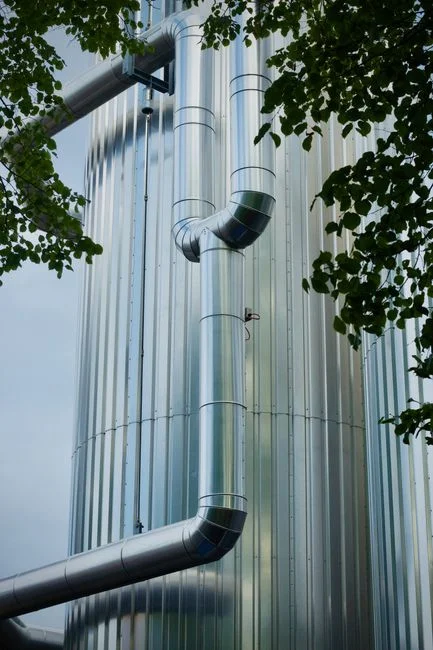
A treatment train should follow the contaminants and destination: segregated collection, equalization, chemical adjustment where required, solids or colloid removal, membrane or polishing filtration where justified, disinfection where required, and controlled reuse or authorized discharge.
For sanitary wastewater, select a biological treatment route rather than treating it as cooling blowdown. The integrated MBR wastewater treatment system combines activated sludge with submerged PVDF membrane filtration and is intended for municipal sewage, industrial process water and reuse projects from 10 to 2,000 m³/day. That range describes the product application; it does not establish the required Surrey design flow.
For fine suspended solids, colloids or reverse-osmosis pretreatment, hollow-fiber ultrafiltration may be appropriate. The hollow-fiber ultrafiltration pretreatment uses 0.03-micron PVDF membranes, operates from 2,000 to 40,000 L/h, accepts up to 300 ppm turbidity, and uses automatic backwash and air scour. These figures describe the supplied product specification, not a guaranteed site performance value.
For oils, floating solids or colloids, dissolved air flotation can be considered where testing demonstrates a fit. It is a solids-removal process and does not remove dissolved salts. Chlorine dioxide generation can support microbial control in industrial cooling loops and process wastewater, but disinfection must be selected for the target organisms, residual, chemistry and applicable utility or permit requirements.
| Objective or stream | Potential unit operation | What it addresses | Important limitation |
|---|---|---|---|
| Cooling-blowdown segregation and flow control | Segregation, equalization and chemical control | Variable flow, pH and treatment chemistry | Does not remove dissolved salts by itself |
| Floating solids, oil and colloids | Dissolved air flotation where demonstrated fit | Separable solids and oil | Not a dissolved-ion removal process |
| Fine solids and colloid protection | Hollow-fiber ultrafiltration | Fine suspended material before polishing | Requires source-water and operating-condition testing |
| Sanitary sewage | Biological treatment followed by membrane separation and disinfection | Organic load and solids | Should remain separate from the blowdown treatment package |
| Microbial control | Disinfection selected from target and residual requirements | Target organisms in defined applications | Does not replace solids removal or chemical management |
| Dissolved-ion reduction | Reverse osmosis or another polishing process | Dissolved salts and selected dissolved constituents | Requires pretreatment, concentrate management and energy review |
All treatment claims remain conditional on site testing. The research supports identifying constituent and process risks, but it does not establish a universal Surrey effluent limit or guarantee product performance.
Compare discharge, reuse and zero-discharge routes
The destination decision determines the treatment burden. Authorized discharge may require less on-site equipment, but it leaves the receiving utility exposed to the concentrated load; onsite recovery reduces freshwater demand but adds treatment and distribution infrastructure; concentrate management may be justified by discharge constraints but requires a site-specific mass balance.
For authorized discharge, obtain the utility’s acceptance criteria, sampling requirements, surcharge analysis and restrictions on metals, biocides and residual oxidants. Confirm whether the applicable route is sanitary sewer discharge, direct discharge or another receiving pathway. A sewer discharge acceptance criterion is not interchangeable with an engineering treatment target or an environmental authorization.
For onsite recovery and reuse, assess storage, distribution, pretreatment, monitoring and the operating effect on the cooling loop. Reclaimed water can support higher cycles of concentration, but its chemistry may require more control than potable water. Water Utility Report, updated 2026-04-14, specifically warns that recycling changes the chemistry challenge and can increase pretreatment, corrosion control, scaling control and monitoring.
For concentrate management or zero liquid discharge, prepare a complete water and salt balance, evaluate residual waste routes and confirm that off-site handling is available. The reverse-osmosis water purification system may form part of a polishing train, but membrane selection alone does not establish the final waste route.
| Route | On-site scope | Principal advantage | Principal risk or unresolved input |
|---|---|---|---|
| Authorized discharge | Equalization and treatment required by utility criteria | Generally lower on-site equipment burden | Utility limits, surcharges and cumulative loading |
| Onsite recovery and reuse | Treatment, storage, distribution, monitoring and cooling integration | Reduces freshwater demand and may reduce blowdown and chemical consumption | Reclaimed-water chemistry and pretreatment demand |
| Concentrate management | Polishing, evaporation or another concentration step, plus waste handling | May address restrictive discharge conditions | Site-specific mass balance, energy use and off-waste acceptance |
The 2026 LCA by Cartagena Vaca and colleagues provides a trade-off, not a Surrey sizing factor. Its wastewater scenario had about twice the global warming potential of the freshwater case, with treatment energy responsible for roughly 80% of the difference. In the UF+RO scenario, wastewater energy use grew to more than five times the freshwater case, while improved cycles of concentration reduced blowdown and chemical consumption. Under its fully decarbonized-grid sensitivity analysis, chemical production remained the main contributor. The LCA compares utility-supplied reclaimed municipal wastewater with freshwater for cooling; it does not establish Surrey data-center discharge rules.
Build monitoring, compliance and operational safeguards
Monitoring should be assigned by risk and tied to a control or acceptance decision. At minimum, define how flow, pH, conductivity, turbidity and residual disinfectant will be measured, together with every parameter required by the utility, permit, source-water profile or treatment equipment. Do not install instruments that do not support an operating decision.
Automatic interlocks should protect against unsuitable discharge or reuse conditions. Depending on the process, these can cover high conductivity, abnormal pH, high turbidity, chemical-dosing failure and loss of flow. The final control philosophy must identify which condition diverts water to equalization or off-site disposal, and what prevents an unauthorized discharge during power, instrument or communications failures.
Manage chemical inputs as part of the treatment train. Water Utility Report, updated 2026-04-14, identifies biocides, inhibitors and residual treatment chemicals as potential blowdown constituents. The 2026 LCA by CartagenaVacca and colleagues identifies chemical production as the main contributor under its fully decarbonized-grid sensitivity analysis. Track chemical dose, inventory and disposal arrangements rather than treating chemical control as an accessory.
| Control area | Minimum information to define | Record or action |
|---|---|---|
| Flow and water balance | Makeup, evaporation, blowdown, reuse and reject flows | Mass balance and loss reconciliation |
| Water quality | Parameters required by destination and process equipment | Online trend, laboratory result or both |
| Chemical management | Product, dose, residual and storage conditions | Inventory and operating log |
| Equipment condition | Filter, membrane, pump and dosing-system condition | Maintenance and cleaning record |
| Recovery performance | Recovered volume and rejected volume | Freshwater displacement calculation |
| Off-site waste | Characterization, destination and transport documentation | Waste manifest and acceptance record |
| Energy and carbon | Treatment and distribution electricity | Energy-use review against the selected route |
Use the automatic chemical dosing system only where controlled dosing belongs in the selected process. Dosing can support pH adjustment or other treatment controls, but it cannot correct an unsuitable source water or replace pretreatment. Confirm Surrey municipal requirements and applicable British Columbia obligations directly with the municipality and relevant provincial authority. The supplied research contains no Surrey permit threshold or site-specific acceptance-limit list, so none can be inferred from this guide.
Prepare the equipment and supplier selection brief
The request for proposal should give every bidder the same treatment objective, flow basis, destination and operating envelope. Include the source-water and blowdown analyses, water balance, cycles of concentration, recovery objective, discharge route, utility criteria, automation requirements and verification protocol. The British Columbia industrial wastewater treatment guide provides a broader local framework, but it does not replace project-specific confirmation with Surrey and the relevant provincial authority.
Require each supplier to state:
- Treatment objectives and acceptance criteria by parameter.
- Pretreatment requirements and the proposed treatment-train boundary.
- Design flow, operating envelope and intended reuse or discharge destination.
- Reject-water handling, redundancy and fail-safe provisions.
- Maintenance intervals and expected membrane or media condition.
- Energy consumption and included instrumentation.
- Commissioning, verification and local service support.
Separate base scope from conditional scope so ultrafiltration, reverse osmosis, biological treatment, disinfection and chemical storage are compared against the same flow and quality requirements. Otherwise, suppliers can quote different system boundaries while appearing commercially comparable. The automatic chemical dosing package should appear only where dosing is part of the selected train; precision dosing cannot compensate for unsuitable source water.
Make source-water data, pilot testing, utility acceptance and the final destination pathway preconditions to equipment sizing. The supplied research does not support a universal flow rate, footprint or capital-cost estimate for a Surrey data center. Those figures require a site-specific design basis and current supplier and utility quotations.
Frequently Asked Questions
What inputs are needed to size data-center cooling blowdown treatment in Surrey?
At minimum, request design flow, makeup and evaporation rates, cycles of concentration, source-water quality, target recovery rate and the final discharge or reuse pathway. The minimum treatment flow should follow the cooling supplier’s water balance and operating envelope. Do not select equipment from server count alone. Where chemical or biological treatment is involved, also obtain representative constituent analyses and the applicable receiving-system criteria.
How should a buyer select a wastewater treatment supplier?
Ask for parameter-specific performance evidence, a defined treatment-train boundary, reject-water handling, energy use, maintenance scope and local commissioning support. Require the supplier to identify pretreatment dependencies and measurement methods for each acceptance criterion. A general statement that equipment can treat cooling wastewater is not enough; the bid should identify what contaminant, at what concentration, under which operating condition the proposed unit removes or controls.
How can the project manage compliance risk before discharge is authorized?
Distinguish an engineering treatment target from an authorized discharge requirement. The project must obtain written confirmation from the relevant Surrey municipality and applicable British Columbia authority regarding the discharge route, monitoring, reporting and acceptance conditions. The 2026 LCA and the U.S.-based extension material provide design context, not Surrey permissions or limits. Do not commit to sewer discharge, direct discharge or reuse until the responsible authorities confirm the route.
Does reclaimed water reduce treatment and monitoring requirements?
No. Lower freshwater use does not remove the need for chemistry management, pretreatment or monitoring. Water Utility Report, updated 2026-04-14, states that recycled water changes the chemistry challenge and may increase pretreatment, corrosion control, scaling control and monitoring requirements. The supplier should therefore demonstrate compatibility with the proposed cooling chemistry and intended cycles of concentration, rather than assuming potable-water performance transfers directly to reclaimed water.