How Athens manufacturers build a high-COD treatment train
Athens manufacturers treat high-COD trade wastewater through a staged train: characterize the waste and control the source; equalize flow; remove suspended solids, oil, grease and colloids; apply biological treatment to biodegradable organics; and dewater the resulting sludge. The route for a factory depends on COD composition, hydraulic peaks, pH, toxicity, nutrients, FOG, solids and the discharge destination—not on COD alone. This decision chain also explains how an industrial DAF wastewater treatment system and an integrated MBR wastewater treatment system fit into a complete plant rather than isolated equipment purchases.
Start by segregating production, cleaning and uncontaminated stormwater streams. Define average and peak flows using hourly records, production shifts, batch discharges and cleaning cycles. Equalization should smooth both hydraulic and concentration shocks before downstream biological treatment.
Coarse solids removal precedes finer physical treatment. DAF is relevant where suspended solids, FOG, oil and grease or colloidal material could overload or inhibit biology. Biological treatment then addresses the biodegradable portion of the remaining load. MBR combines biological treatment with membrane separation where compact equipment, solids separation or reuse-oriented quality justifies the additional operating considerations.
Separated solids must enter a dedicated dewatering route. They can concentrate chemicals, COD and pathogens, so treating sludge as a negligible by-product creates a secondary bottleneck. The final selection must be checked against the actual permit, sewer agreement, receiving-water conditions or reuse specification.
Characterize the waste before choosing equipment
Industrial wastewater characterization must establish the soluble, colloidal, suspended and non-biodegradable fractions of the load before equipment is selected. The supplied research does not establish a universal Athens industrial COD threshold; COD is therefore a design input, not a stand-alone treatment trigger.
Request COD, BOD, TSS, pH, temperature, flow, conductivity, nutrients, oil and grease, toxicity and contaminants specific to the factory sector. Sampling must cover normal production, the highest-load batch, cleaning operations and any release that can upset the biological stage. A mechanical bar screen may address gross solids, while chemical dosing equipment requires a defined control objective and verified chemical demand.
| Parameter | Why it changes the process decision | Information needed before quotation |
|---|---|---|
| COD and BOD | Separates the potentially biodegradable load from the total chemical oxidant demand. | Representative concentration ranges, including batch peaks and load changes. |
| TSS and settleability | Indicates solids capture, clarification and sludge-management demands. | Suspended-solids profile, particle characteristics and expected chemical use. |
| FOG and oil and grease | Can interfere with biological activity and affect DAF performance. | Concentration range and the source of each discharge. |
| pH, temperature and toxicity | Determines biological feasibility and the need for equalization or inhibition control. | Daily variation, shock loads and toxicity test results. |
| Flow profile | Sets equalization and peak treatment requirements. | Hourly flow, production shifts, batch discharges and cleaning cycles. |
| Discharge destination | Defines the performance and compliance basis. | Permit, sewer acceptance conditions, receiving-water limits or reuse specification. |
The MDPI study on electrocoagulation provides one bounded example: researchers applied the process to mineral-processing wastewater with an initial COD of 424.29 mg/L from a Pb/Zn sulfide flotation plant (MDPI AG, 2026). It demonstrates a research context, not a universal sizing rule or Athens discharge threshold.
Confirm the destination before choosing the final process. A municipal sewer, direct receiving-water discharge and factory water reuse each create different operating and compliance obligations.
Remove oils, solids and colloids before biological treatment
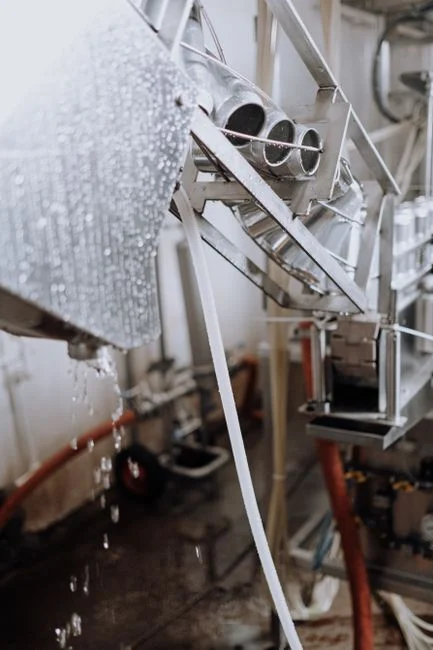
DAF is a physical separation step, not a substitute for biological treatment of biodegradable COD. It removes floatable and settleable material that could otherwise enter the biological system or interfere with sludge separation.
HydropureWater’s DAF systems cover 4–300 m³/h across 13 standard models and use micro-bubble technology with automatic skimming for suspended solids, FOG, oil and grease and colloidal matter (HydropureWater product literature, 2026). The product literature identifies food processing, pulp and paper, textile, metalworking and petrochemical applications as relevant sectors. Those are application areas, not evidence that every factory in those sectors requires DAF.
| Waste characteristic | Process implication | Equipment decision to verify |
|---|---|---|
| High FOG or free oil | Recovery or removal before biological treatment may be necessary. | DAF applicability, oil-recovery arrangement and resulting sludge volume. |
| High suspended or colloidal solids | Solids separation can reduce downstream organic and hydraulic loading. | DAF hydraulic capacity, solids capture and chemical-demand basis. |
| Batch concentration peaks | Equalization must buffer both flow and contaminant concentration. | Verified peak-flow treatment and equalization-volume assumptions. |
| Mineral-processing contaminants | Conventional DAF and biology may not address every non-biodegradable fraction. | Evaluation of electrocoagulation, specialist separation or polishing. |
Protect downstream biology by controlling hydraulic and organic shocks before selecting its reactor and aeration capacity. In parallel, evaluate sludge quantities, settleability and conditioning demand. A supplier should not present a universal COD-removal rate for DAF when the supplied evidence provides none for Athens industrial applications.
For mineral-processing wastewater, the MDPI electrocoagulation study should be considered as a technically investigated alternative or polishing route in its stated Pb/Zn sulfide flotation context. It should not be extrapolated into a guaranteed performance claim for unrelated factory effluent. A sedimentation tank may also enter the route where the waste profile and solids behavior justify gravity clarification.
Choose biological treatment and membrane separation for the final stage
Biological treatment should follow removal of solids, FOG and inputs that could inhibit the biological population. The reactor must be selected against the biodegradable COD load, hydraulic variability, footprint, operator capability and required effluent quality—not merely against total COD.
HydropureWater’s integrated MBR combines activated sludge with submerged PVDF membrane filtration, provides filtration below 1 µm and is marketed for capacities from 10 to 2,000 m³/day (HydropureWater product literature, 2026). These specifications identify the offered configuration and capacity range; they do not establish performance for every high-COD industrial stream.
Compare conventional activated sludge with MBR using several decision criteria:
- Footprint: confirm the installed arrangement and auxiliary equipment required for equalization, aeration, sludge handling and controls.
- Operation: evaluate membrane replacement, aeration demand, cleaning requirements and operator skill.
- Hydraulics: test whether the biological system can absorb documented batch flows and load peaks.
- End use: compare clarified or filtered effluent with the quality required by the sewer, receiving water or reuse specification.
For reuse, evaluate salinity, nutrients, residual treatment needs and transport economics together. In the Thessaloniki reuse scheme, secondary effluent was mixed with freshwater at a 1:5 ratio largely because of high salinity (MDPI, “Wastewater Recycling in Greece: The Case of Thessaloniki,” 2014). That study also records criteria for that mixed irrigation water: COD below 80 mg/L, BOD5 below 20 mg/L, suspended solids below 30 mg/L and pH from 6.5 to 8.5.
These Thessaloniki values must not be applied automatically to an Athens factory. They were tied to a specific municipal reuse scheme and mixed effluent, not established as universal industrial discharge limits. An Athens buyer should obtain the applicable permit or reuse specification instead. Where a project involves a modular membrane stage, an MBR membrane bioreactor module may be relevant to the equipment comparison.
Handle sludge and verify the final treatment route
DAF float and biological sludge must be characterized before selecting a dewatering method because their solids behavior and chemical-conditioning requirements differ. Failure to plan sludge handling can invalidate the capacity of the upstream treatment equipment.
HydropureWater’s plate and frame filter presses are available with filtration areas from 1 m² to 500 m² and manual, hydraulic or fully automatic PLC-controlled operation (HydropureWater product literature, 2026). The appropriate configuration depends on sludge volume, solids concentration, conditioning, filtrate quality, operating hours and cake-disposal arrangements.
For polishing or reuse, identify the residual risk that needs to be controlled. Suspended solids, colloids and pathogens require different treatment responses. A multi-media filtration system may be relevant where the specification requires further solids or turbidity control; disinfection should be selected only where pathogen control is part of the agreed use.
Final compliance must be judged against the actual Athens permit, sewer agreement or reuse specification. No supplied source establishes one universal Athens industrial effluent COD limit for 2026. Avoid converting a municipal irrigation criterion into an industrial assumption without written confirmation from the receiving authority or buyer’s environmental adviser.
Plan sampling points at the influent, after equalization, after physical pretreatment, after biological treatment, after any polishing stage and at final discharge. This permits stage-by-stage mass balances and verification against agreed operating and performance conditions rather than relying on a single final sample.
Compare equipment routes by waste profile and site constraints
Equipment selection should follow a conditional route from the measured waste profile to the discharge requirement. The table below links common factory constraints to candidate treatments and the evidence needed for comparison.
| If the waste profile shows… | Evaluate this treatment route | Key data for the supplier decision |
|---|---|---|
| High FOG, oil, suspended solids or colloids | Source segregation and equalization, followed by DAF and biological treatment; compare with more advanced pretreatment. | FOG and TSS ranges, peak flow, oil recovery, sludge volume and chemical demand. |
| High-solids mineral-processing wastewater | DAF or clarification plus biological treatment, with electrocoagulation included in the evaluation where relevant. | Mineralogy, toxicity, metals, settleability and the need for polishing. The MDPI study tested a Pb/Zn sulfide flotation stream at an initial COD of 424.29 mg/L (MDPI AG, 2026). |
| Compact site or reuse-oriented treatment | Compare conventional activated sludge with MBR and specified filtration. | Footprint, membrane maintenance, aeration demand, operator skill and end-use quality requirements. |
| Variable batch discharges | Equalization followed by treatment sized for verified peak flow and concentration. | Hourly flow, batch volumes, production calendar, equalization assumptions and downstream hydraulic capacity. |
| Final quality driven by filtration or reuse | DAF/biology/MBR followed by filtration or disinfection only where required. | Residual solids, colloid characteristics, pathogen risk, salinity, nutrients and transport costs. |
For DAF-led routes, request the DAF equipment basis and compare it with biological and dewatering options as one train. For compact or reuse-oriented installations, compare an integrated MBR route against conventional activated sludge plus filtration.
Require each supplier to state the peak-flow capacity, equalization assumptions, performance boundaries and sludge output used in its quotation. The electrocoagulation study proves feasibility in its stated research context; it is not a guaranteed removal percentage or universal commercial-performance claim. For mineral-processing projects, the related guide to filter press selection for mineral-processing wastewater illustrates why solids handling must be considered alongside the headworks and biological stage.
What Athens buyers should require from an equipment supplier
Athens buyers should require a documented design basis before comparing equipment prices. At minimum, state average flow, peak flow, COD range, TSS, FOG, pH, temperature, toxicity and any sector-specific contaminants. Without these inputs, neither DAF nor MBR capacity can be treated as a defensible commitment.
Request a complete process flow, utilities demand, footprint, control philosophy, sludge estimate and maintenance schedule. Require the supplier to explain how each unit handles the stated flow and load variation and where performance is measured. The commercial comparison should also cover membrane replacement, chemical consumption, sludge handling, operator attendance and site access.
Clarify every guarantee: does it cover inlet variability, the regulatory limit, the final reuse criterion, equipment availability, or all three? Ask what happens when a batch exceeds the characterized load and whether the guarantee remains valid. The Frankfurt high-COD treatment guide can serve as a comparison for how European factories frame process-specific treatment decisions.
Use market activity only as context. Trade.gov reported 12 wastewater plants operating and 23 under construction throughout Greece; that does not prove a particular supplier’s installation record or establish Athens-specific acceptance criteria. Make the final purchase decision around the complete treatment train, verified capacity, operating burden and permit risk—not a headline COD removal figure.
Frequently Asked Questions
What COD level requires DAF or MBR in Athens?
No universal COD threshold supplied by the research establishes when Athens factories must use DAF or MBR. Select DAF from evidence of suspended solids, FOG, oil and grease or colloidal material; consider MBR from the required solids separation, footprint and reuse quality. Submit the waste characterization and destination requirements for project-specific evaluation.
How much should an industrial wastewater treatment project cost?
Do not use a generic price as a procurement budget. Request a quotation covering the selected process train, civil works, utilities, controls, sludge dewatering, commissioning and maintenance. Require the supplier to identify the flow, load, disposal route, site conditions and performance guarantees on which the price depends, then compare offers on the same written scope.
Which data should be sent to a wastewater equipment supplier?
Send average and peak flow, production and batch schedules, COD and BOD, TSS, FOG, pH, temperature, conductivity, nutrients, toxicity, relevant sector contaminants and the discharge or reuse destination. Include the sampling method and period because an unrepresentative average can lead to undersized equalization, DAF or biological equipment.
Is COD below 80 mg/L sufficient for wastewater reuse in Greece?
Not as a general rule. The cited Thessaloniki study applied COD below 80 mg/L to mixed effluent in a specific irrigation scheme, alongside BOD5, suspended solids, pH, salinity, nutrient and microbiological criteria. Obtain the requirements for the proposed Athens reuse application rather than treating that municipal criterion as a universal industrial standard.
Should electrocoagulation replace DAF and biological treatment?
Not automatically. Include it in the route where the waste profile and research context support it, but require the supplier to explain which fractions it removes and which remain for biological or polishing treatment. The MDPI study applied electrocoagulation to a Pb/Zn sulfide flotation stream with an initial COD of 424.29 mg/L (MDPI AG, 2026); it does not establish replacement of DAF and biology for other industrial wastewaters.
Related Equipment
- industrial DAF wastewater treatment system — specifications, capacity range, and technical data