What the Shekhupura Site Must Treat
A data center in Shekhupura needs separate treatment trains for sanitary wastewater, humidification or process drains, and cooling-tower blowdown because the streams have different contaminants, flow profiles, reuse destinations, and permit controls. Sanitary and cafeteria flows require biological treatment and disinfection; humidification drains may require DAF or MBR followed by filtration; cooling-tower blowdown requires side-stream filtration and scale-controlled RO, with crystallisation when high recovery requires salt removal. The selected route should follow site flow and chemistry measurements, the cooling configuration, receiving-sewer or surface-water conditions, and a lifecycle comparison of discharge and reuse.
Start with a complete data center water balance. Separate sanitary and cafeteria wastewater, humidification or process drains, cooling-tower blowdown, maintenance wastewater, and accidental glycol-bearing drains. The 2026 Islamabad reference places sanitary and cafeteria flow outside the industrial treatment train and sizes that package from occupancy rather than IT load. Glycol drains should remain outside the ordinary CTBD balance: HOBI, 2026, describes glycol as normally contained but potentially high in oxygen demand if released, requiring leak detection, containment, and documented removal.
Cooling-tower blowdown is the principal industrial candidate for recovery. Evaporation leaves dissolved salts behind, while blowdown may also contain biocides, corrosion inhibitors, and corrosion-derived metals, as described by IDE and HOBI in 2026. Measure evaporation, drift, make-up additions, chemical dosing, and blowdown under normal and peak cooling operation. Request conductivity and TDS profiles, silica, calcium, sulfate, alkalinity, pH, suspended solids, temperature, BOD, COD, and residual chlorine.
IDE reported in 2026 that a 100 MW facility can demand up to 2 million litres of water per day, but that headline is not a Shekhupura sizing basis. Equipment must follow measured site flows and operating profiles. No reviewed source establishes Shekhupura’s exact industrial discharge limits or receiving-water conditions; confirm both with the relevant Punjab authority and receiving utility.
| Workstream | Principal design concern | Measurements required |
|---|---|---|
| Sanitary and cafeteria wastewater | Biological load and public-health control | Fixture-flow estimate, occupancy, flow profile, BOD, COD, suspended solids, temperature |
| Humidification or process drains | Suspended solids, biofilm carryover, corrosion products, and possible treatment chemicals | Flow, suspended solids, turbidity, conductivity, pH, temperature, metals where indicated, chemical inventory |
| Cooling-tower blowdown | Dissolved-salts concentration, scaling, corrosion, biocide and inhibitor residues | Flow, evaporation, conductivity, TDS, silica, calcium, sulfate, alkalinity, pH, temperature, residual chlorine |
| Maintenance wastewater | Variable composition and episodic discharge | Flow, source contaminants, chemicals used, approved disposal route |
| Glycol-bearing drains | Accidental release and oxygen demand | Glycol type and concentration, volume, containment, leak-detection records, disposal manifest |
The broader data center wastewater and cooling blowdown treatment guide provides a useful reference structure, but its site assumptions must not be transferred to Shekhupura without local measurement and regulatory review.
How Shekhupura Climate and Cooling Design Change the Duty
The Shekhupura treatment duty cannot be calculated from IT load alone because cooling configuration determines both wastewater quantity and the contaminant load reaching each train. An open evaporative cooling system generates evaporation, drift, concentrated circulating water, and CTBD. Hybrid systems may change between evaporative and mechanical operation. Chiller, air-cooled, and liquid-cooled arrangements have different water balances; hybrid operation can shift both flow and chemistry with ambient conditions.
Calculate blowdown from measured loop volume, evaporation, make-up additions, drift, chemical dosing, and the selected cycles of concentration. The 2026 Islamabad comparison reports that moving from four to six–eight cycles of concentration cuts make-up water by 30–50%, and DOE guidance cited by HOBI in 2026 reports that increasing cycles from three to six can reduce make-up water by about 20% and blowdown by about 50%. These are screening comparisons, not Shekhupura guarantees.
The cooling designer and wastewater engineer should then test the selected cycles against chemistry. Raising cycles concentrates silica, calcium carbonate, calcium sulfate, and other constituents, so a nominal water-saving change may create a treatment constraint. High recovery must be assessed against precipitation and membrane-fouling limits rather than assumed from the cooling model.
Temperature must be included in biological and membrane design. HydropureWater’s 2026 Islamabad reference applied 12–18% aeration oversizing and diffuser guarantees for 38–44°C conditions; no Shekhupura temperature derating value was supplied. Likewise, RO production and membrane flux must be checked at the verified site design water temperature. The high-salinity RO recovery options are useful for screening scale controls, not for assigning an unreported Shekhupura recovery rate.
Energy belongs in the same decision. Open Engineering Inc.’s 2026 life-cycle assessment found that the wastewater scenario had about twice the global-warming potential of the freshwater case, with treatment energy accounting for roughly 80% of that difference. The assessment is not Shekhupura-specific, but it establishes the need to compare net water savings against treatment energy and chemical demand.
| Cooling-design input | What the wastewater engineer must determine | Design consequence |
|---|---|---|
| Open evaporative cooling | Measured evaporation, drift, blowdown, and chemical additions | Quantify CTBD load and the need for filtration, RO, and potentially salt management |
| Hybrid cooling | Seasonal switching, operating frequencies, and blended water chemistry | Design for variable flow and contamination rather than one steady condition |
| Chiller, air cooling, or liquid cooling | Cooling-water demand and any drain chemistry | Reduce CTBD duty where applicable and reassess each drain independently |
| Selected cycles of concentration | Make-up reduction, scaling constituents, and achievable recovery | Set cooling chemistry and CTBD treatment as one integrated design |
| Verified design water temperature | Aeration capacity and membrane production at site conditions | Apply site-specific derating rather than catalog conditions |
Separate the Treatment Trains
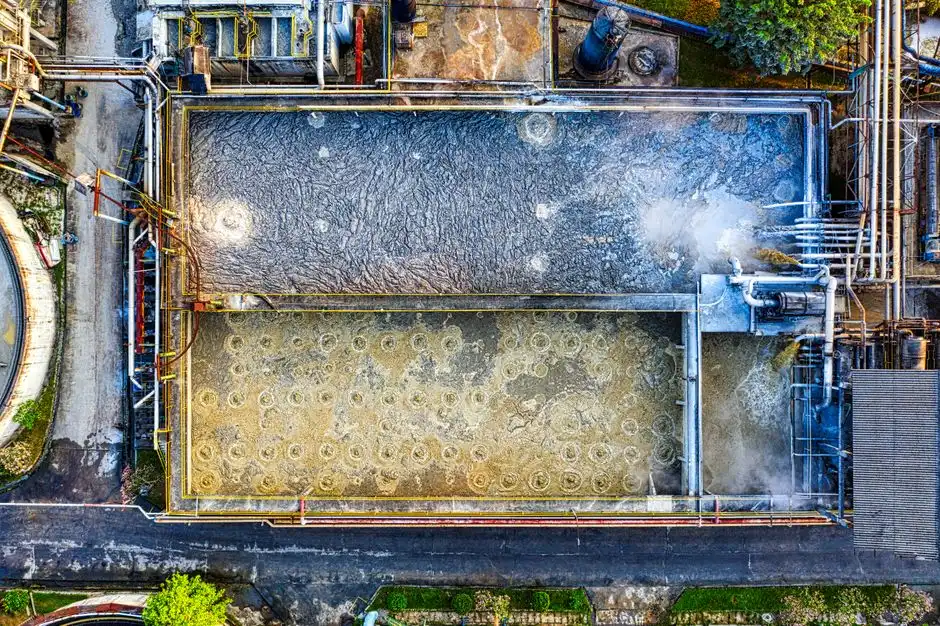
The defensible architecture keeps sanitary wastewater, data-hall or humidification drains, and CTBD as distinct workstreams until a permitted reuse or discharge point is established. Blending can be technically possible later, but it should not be the default basis for equipment sizing.
For sanitary and cafeteria wastewater, use a dedicated biological package sized from occupancy and fixture flows, followed by final disinfection. Do not route this flow through an industrial CTBD RO train merely because equipment can be installed on one skid. The 2026 Islamabad reference explicitly excludes sanitary flow from the industrial train.
For humidification or process drains, the initial concept is DAF for suspended solids and biofilm carryover, followed by MBR where near-reuse-quality effluent is required. HydropureWater’s 2026 reference reports MBR operation at MLSS 8,000–12,000 mg/L and HRT 8–14 hours, with BOD below 10 mg/L, COD below 60 mg/L, and TSS below 5 mg/L. Those values require reconfirmation against Shekhupura flow, temperature, loading, and reuse targets.
Downstream, use multi-media filtration to protect RO. The same reference uses this stage to hold SDI below 5; chemical dosing should respond to the characterised chemistry rather than become a default. Relevant equipment concepts include DAF pretreatment for suspended solids and an MBR membrane bioreactor for data-center wastewater.
For CTBD, use side-stream filtration before industrial RO and select recovery around silica, calcium carbonate, calcium sulfate, feed salinity, and temperature. IDE reported in 2026 that conventional brackish-water RO commonly plateaus at 75–80% recovery because scaling becomes unmanageable. An industrial RO system for cooling-tower blowdown therefore needs a chemistry-based recovery guarantee, not a generic percentage.
For higher recovery, evaluate controlled salt precipitation, crystallisation, or another validated brine-management route. IDE’s 2026 application operated at around 95% recovery and reduced permeate silica to about 1 mg/L, but that result was application-specific. It cannot be transferred to Shekhupura without testing the local feed and confirming a destination for recovered salts.
Where the treatment objective requires it, final disinfection can use an on-site chlorine dioxide disinfection system. Permit-critical monitoring should use a 24-hour composite sampler with refrigeration where required by the issuing authority. Multi-media filtration for RO protection completes the preliminary data-hall treatment sequence: DAF → MBR → multi-media filter → RO, with CTBD treated separately and a package biological plant serving sanitary wastewater.
| Stream | Preliminary treatment train | Selection conditions |
|---|---|---|
| Sanitary and cafeteria wastewater | Dedicated biological package plus final disinfection | Occupancy, fixture flows, biological loading, permit route, reuse destination |
| Humidification or process drains | DAF → MBR → multi-media filtration → RO where reuse quality is required | Suspended solids, SDI, organics, temperature, target water quality |
| Cooling-tower blowdown | Side-stream filtration → scale-controlled RO → brine management where justified | Silica, calcium, sulfate, alkalinity, TDS, temperature, recovery target, residual route |
| Glycol-bearing drains | Containment and documented removal | Glycol type, concentration, accidental-release plan, waste-acceptance documentation |
Choose Between Discharge, Partial Reuse, and High-Recovery Reuse
Shekhupura should compare four routes rather than defaulting to zero liquid discharge: compliant discharge after pretreatment, partial CTBD recovery using conventional RO, high-recovery treatment with salt precipitation or crystallisation, and zero liquid discharge only where the residual brine and solids have a verified destination. Each route should be tested against recoverability, scaling risk, energy, permit sensitivity, operator burden, and resilience during restricted freshwater periods.
HydropureWater’s 2026 Islamabad screening rule states that discharge may be considered below approximately 200 m³/day when reuse economics are weak and on-site operators are limited. The same reference says the threshold usually trips above roughly 5 MW of IT load. Both figures are directional: measured Shekhupura flows, freshwater conditions, tariffs, and receiving restrictions must replace them before a commercial decision.
Energy is a decision criterion, not an operating footnote. The Islamabad guide reports MBR energy use of 0.8–1.6 kWh/m³ and DAF-only use of 0.4–0.9 kWh/m³. Open Engineering Inc.’s 2026 LCA also found that UF-plus-RO used more than five times the energy of the freshwater case, although improved cycles of concentration reduced blowdown and chemical consumption. The same study identified an indirect upstream water penalty of approximately 0.93 L/m³, less than 0.1% of the direct freshwater-displacement benefit.
Use that trade-off in the site model: recovered water can reduce freshwater withdrawal while treatment adds electricity, chemical consumption, membrane cleaning, and residual management. A route that saves water but has no safe brine outlet may transfer environmental risk rather than remove it. Conversely, discharge may be the lower-complexity choice when flow is limited, reuse quality adds little operational value, and the receiving authority accepts the treated stream.
Do not label a route zero liquid discharge until evaporation, salt precipitation, sludge dewatering, and final residual-waste disposal are included. The RO design for high-TDS wastewater and regional data center wastewater treatment guide provide useful comparison frameworks, but their thresholds remain contextual.
| Route | Main benefit | Principal exposure | Decision evidence required |
|---|---|---|---|
| Compliant discharge after pretreatment | Lowest treatment complexity where discharge is permitted | Discharge volume, sewer or surface-water acceptance, permit exposure | Measured flow, receiving-route limits, pretreatment requirements, operator capability |
| Partial CTBD recovery with conventional RO | Reduces freshwater withdrawal and discharge | Recovery limited by scaling and membrane operation | Feed chemistry, temperature, recovery tests, make-up-water value, cleaning demand |
| High recovery with salt precipitation or crystallisation | Greater water recovery and lower blowdown | Capital complexity, solids handling, chemical control, residual destination | Precipitation study, salt balance, dewatering route, waste-acceptance evidence |
| Zero liquid discharge | No liquid discharge if the entire balance closes | Residual solids and site utilities remain critical | Complete mass balance, evaporation capacity, brine and sludge outlets, permit and lifecycle review |
Build the Permitted, Costed and Serviceable Design Basis
A Shekhupura procurement package must obtain written confirmation of the Punjab environmental authority, receiving sewer or surface-water route, permitted flow, pollutant limits, sampling method, monitoring frequency, and reuse conditions. The reviewed research establishes a Provincial SDU framework, but it does not establish a Shekhupura-specific permit.
Use the cross-walked Islamabad 2026 values only as a preliminary comparison envelope: BOD₅ ≤50 mg/L, COD ≤200 mg/L, TSS ≤50 mg/L, free chlorine below 1 mg/L, and total chromium ≤0.5 mg/L with 24-hour composite sampling. These are not confirmed Shekhupura limits and must not appear in an issued permit basis until local legal confirmation.
Develop two commercial cases: discharge to sewer and reuse. For the Islamabad 50,000 GPD RO-polishing CTBD reference, the 2026 guide gives directional installed CAPEX of US$250,000–500,000 and OPEX of US$1.50–3.00/kgal. Request a Shekhupura quotation against measured flow, chemistry, treatment objective, civil works, import logistics, power, membranes, chemicals, sludge handling, and residual disposal rather than transferring that budget directly.
Equipment selection should include filter press for treatment-plant sludge where dewatering is required and an automatic chemical dosing system for controlled pretreatment or pH correction. Specify critical spares for membranes, pumps, instruments, dosing skids, and control-system components. Define cleaning intervals, alarm thresholds, remote monitoring, and operator competency.
Require a 30–60-day representative characterisation campaign covering normal operation and peak cooling demand if feasible. Test the CTBD chemistry that constrains recovery, including silica, calcium, sulfate, alkalinity, TDS, conductivity, temperature, suspended solids, and treatment-chemical residues. The acceptance plan should then verify permeate quality, recovery, energy consumption, solids handling, disinfection residual, automatic controls, and fail-safe discharge routing.
| Procurement package | Required buyer input | Required supplier deliverable |
|---|---|---|
| Flow and water balance | Measured blowdown, evaporation, make-up, drainage, and occupancy flows | Phase-specific mass and water balance |
| Process guarantees | Feed chemistry, reuse target, recovery target, utilities | Treatment selection, performance guarantees, operating envelopes |
| Permit scope | Authority and receiving-route confirmation | Compliance matrix, monitoring plan, sampling and reporting responsibilities |
| Commercial model | Local power, water, chemical, labour, logistics, and civil-work inputs | Installed CAPEX and OPEX boundaries with exclusions|
| Operations and maintenance | Staff capability, remote-monitoring requirements, waste routes | Training plan, maintenance schedule, spares list, response procedures |
| Commissioning | Representative influent and acceptance criteria | Performance test, controls test, sampling plan, and handover records |
Frequently Asked Questions
How much does wastewater and cooling blowdown treatment cost for a data center in Shekhupura?
The reviewed 2026 Islamabad reference gives directional installed CAPEX of US$250,000–500,000 and OPEX of US$1.50–3.00/kgal for a 50,000 GPD RO-polishing CTBD system. A Shekhupura quote requires measured blowdown flow, feed chemistry, treatment objective, available utilities, civil works, import logistics, solids handling, and residual-disposal route. Request a priced equipment schedule and explicit exclusions rather than applying the Islamabad figures to an unknown Shekhupura flow.
Can one treatment plant handle sanitary wastewater and cooling-tower blowdown together?
Segregation is preferred because sanitary wastewater has a biological and public-health treatment requirement, while CTBD has concentrated dissolved salts, treatment chemicals, and scaling constituents. Their flow profiles, reuse destinations, and regulatory controls also differ. A final blended discharge may be possible, but it requires project-specific review of hydraulics, biological loading, salinity tolerance, permit limits, and receiving-plant capacity.
What measurements does a supplier need to size a Shekhupura CTBD system?
Request measured blowdown flow, evaporation and make-up rates, conductivity and TDS, silica, calcium, sulfate, alkalinity, pH, temperature, suspended solids, chemical inventory, target cycles of concentration, recovery target, and available power and water. Also require a representative campaign covering normal and peak cooling operation. An IT-load estimate cannot establish membrane area, pump capacity, chemical demand, or residual generation.
Is RO sufficient for cooling-tower blowdown in high-TDS conditions?
Not by itself. Side-stream filtration, scale control, and an appropriate recovery target are required. IDE reported in 2026 that conventional brackish-water RO commonly plateaus at 75–80% recovery as scaling becomes unmanageable. Salt precipitation, crystallisation, or another validated brine-management method becomes necessary when site chemistry and the recovery objective exceed that conventional operating range.
What permits and sampling does a Shekhupura data center need before discharging treated wastewater?
The answer depends on the Punjab authority, discharge route, receiving utility, and reuse destination. Obtain written confirmation of permitted flow, pollutant limits, sampling method, monitoring frequency, and reuse conditions. The 2026 Islamabad comparison values—BOD₅ ≤50 mg/L, COD ≤200 mg/L, TSS ≤50 mg/L, free chlorine below 1 mg/L, and total chromium ≤0.5 mg/L with 24-hour composite sampling—must not be treated as confirmed Shekhupura limits. The data center wastewater and cooling blowdown treatment guide and regional data center wastewater treatment guide are references for project planning, not substitutes for the issuing authority’s conditions.