Start with the wastewater and the receiving route
An effluent treatment plant in Buenos Aires should be selected from measured wastewater characteristics and the required receiving route—not from a generic product catalogue. Industrial buyers commonly compare DAF for suspended solids, oil and grease with MBR for biological treatment and advanced separation, then add dosing, disinfection or sludge handling where required. A southern Buenos Aires petrochemical example used two physical-mechanical oily-water trains rated at 25 m3/h each (Diagnosis-driven recovery of an oily wastewater treatment plant, AIMS Press, 2026). Published Buenos Aires cost benchmarks place medium-scale DAF, MBR and precipitation systems in broad, site-dependent ranges (HydropureWater, 2026). Final capacity, process selection and discharge compliance must be confirmed through influent testing, current permit conditions and a site-specific engineering proposal.
The first procurement document should be a design basis, not a process diagram. Obtain representative samples covering normal production, cleaning cycles, discharge peaks and variable concentrations. The minimum analytical package should include flow, COD or BOD, TSS, oil and grease, pH, metals and any contaminant specific to the operation. HydropureWater’s 2026 Buenos Aires material identifies COD/TSS/metals analysis and sludge-disposal manifests as procurement information, but those analyses do not replace wastewater characterization or a permit review.
Define the receiving objective before comparing suppliers:
| Receiving objective | Design question | Evidence to request |
|---|---|---|
| Municipal sewer pretreatment | Which pollutants must be removed before connection? | Current sewer agreement, authority approval and pretreatment limits |
| Permitted direct discharge | Which limits apply at the permitted discharge point? | Current permit, monitoring requirements and receiving-water conditions |
| Internal reuse | Which use and process-water quality criteria apply? | Reuse specification, end users, seasonal demand and change in quality |
For an oily petrochemical stream, the Buenos Aires case used gravity/centrifugal primary separation, sand-anthracite coalescing filtration and gas-stripping tertiary separation in two trains rated at 25 m3/h per train (AIMS Press, 2026). That arrangement is evidence for one industrial case, not a universal oily-water design.
Generic performance benchmarks cannot replace the current permit or sewer agreement. The Journal of Toxicology’s evaluation of hospital wastewater and sewage-treatment-plant effluent serving Buenos Aires considered toxicity and genotoxicity in April–September 2012, showing that broader impact can matter beyond COD and TSS (Journal of Toxicology, 2014). Before requesting a fixed-price proposal, record average and peak flow, operating shifts, future expansion, reuse target, storm or bypass conditions and every attachment to the current permit.
Compare the treatment processes by contaminant and operating objective
Process selection should follow the contaminant and required removal duty, not the most familiar equipment name. A buyer evaluating an industrial DAF system for oil, grease and suspended solids should ask for guaranteed outlet concentrations and the influent conditions on which they depend.
| Process | Primary objective | Evidence-led design context | Buyer challenge |
|---|---|---|---|
| DAF | Suspended solids, oil and grease and some colloidal material | HydropureWater’s 2026 Buenos Aires material reports 92–97% TSS removal and 85–95% FOG removal in one passage, but gives 85–95% for both TSS and FOG elsewhere | Require a stated guarantee, test method and test conditions |
| MBR | Biological treatment combined with membrane separation | The 2026 Buenos Aires example specifies 0.1 μm PVDF membranes, 10–20 L/m2·h flux, SRT of 15–30 days and permeate BOD no higher than 10 mg/L | These are example design values requiring validation, not universal guarantees |
| Chemical precipitation | Removal of a selected contaminant when precipitation is required by the treatment objective | HydropureWater’s 2026 material associates precipitation with filter presses and a cited 1–2-hour operating range | Define the target metal or contaminant, reaction conditions and sludge route |
| Nanofiltration | Advanced polishing for reuse objectives | University of Twente research identifies nanofiltration as a potential polishing step for agricultural or indirect potable objectives | Establish the required reuse quality before adding a polishing stage |
| Constructed wetlands | Research-supported polishing concept for micropollutants | Wageningen University and Research investigated this application in a thesis published on 23 September 2022 | Review footprint, seasonal performance and site suitability |
The published MBR values should appear in the request for quotation as a reference case. A supplier should either validate them against the site wastewater or explain the alternative flux, retention time and membrane configuration.
Equipment range is not the same as application suitability. HydropureWater’s product catalog describes 13 standard DAF models from 4 to 300 m3/h, with microbubble flotation, automatic skimming and applications including food processing, textile, metalworking and petrochemical pretreatment (HydropureWater product catalog, 2026). Its integrated MBR wastewater treatment system range covers 10–2,000 m3/day and uses submerged membranes with filtration below 1 μm (HydropureWater product catalog, 2026). These figures support shortlisting; they do not establish the selected duty, footprint or effluent guarantee.
For reuse, keep primary treatment and final polishing separate. Nanofiltration research supports evaluating a polishing stage, not assuming that every industrial effluent needs it (University of Twente, Direct nanofiltration of wastewater treatment plant effluent). Constructed wetlands also require engineering review rather than automatic inclusion (Wageningen University and Research, 2022).
Build the process train around the real treatment objective
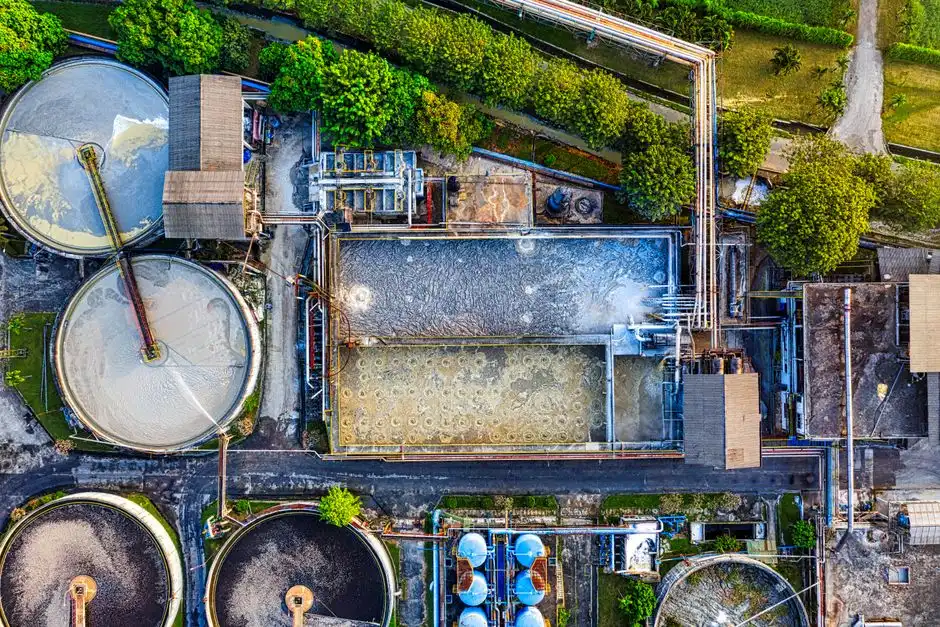
A defensible industrial ETP design arranges the stages in this order: equalization and screening, flow control, contaminant-specific pretreatment, main treatment, clarification or membrane separation, optional disinfection and sludge dewatering. Not every project needs every stage; the wastewater analysis, reuse or discharge objective and permit conditions determine the final train.
- Equalization and screening: protect downstream equipment from flow and load variation. A GX rotary mechanical bar screen can remove solids, rags, plastics and fibrous debris where continuous-duty screening is required (HydropureWater product catalog, 2026).
- Flow and load control: prevent equalization from masking short-duration discharges that exceed biological or separation capacity.
- Contaminant-specific pretreatment: remove free oil, suspended material or selected metals before biological treatment or membrane entry.
- Main treatment: apply DAF, MBR, precipitation or a combined train according to the agreed objective.
- Separation and polishing: clarify flotation sludge, retain membranes, or add polishing where reuse quality requires it.
- Disinfection: confirm target organisms, residual requirements and applicable rules before selecting UV or chlorine dioxide.
- Sludge handling: include thickening, storage and dewatering rather than treating sludge as an afterthought.
Where pH adjustment, coagulants or specialty chemicals are necessary, request PLC-controlled automatic dosing. The proposal should name the chemical, dose range, control signal, storage arrangement and expected consumption; manual dosing should not be accepted as the control basis for a variable industrial stream (HydropureWater, 2026).
For sludge dewatering, a plate and frame filter press provides filtration areas from 1 to 500 m2, with manual, hydraulic or automatic PLC operation (HydropureWater product catalog, 2026). The selected configuration should follow solids characteristics, cycle time, cake target and disposal route.
Disinfection remains a separate decision. A UV sterilizer provides chemical-free UV-C treatment, while chlorine dioxide is an alternative for on-site microbial control (HydropureWater product catalog, 2026). Neither should enter the base flow without a defined microbial objective and applicable requirement.
Size the plant from design data—not product flow alone
Nameplate throughput is not a sizing calculation. Biological and hydraulic stages require measured average and peak flow, pollutant or organic loading, operating duration and the selected removal duty. The supplier must demonstrate how those inputs determine each stage.
HydropureWater’s 2026 Buenos Aires material provides operating-hour references that can be used for initial screening: 2–4 hours for DAF, 6–12 hours for MBR and 1–2 hours for chemical precipitation. These references are not final dimensions and cannot replace a hydraulic and pollutant-load calculation.
| Plant area | Supplier calculation | Required proposal detail |
|---|---|---|
| Hydraulics | Average, peak and surge flow through equalization and treatment stages | Design flow, peak-flow response, bypass strategy, redundancy, retention time and operating envelope |
| DAF | Hydraulic loading, solids loading and flotation transfer duty | Recycle ratio, pressure design, solids loading and skimming performance |
| MBR | Organic and solids loading, membrane area and fouling margin | Design flux, recovery, cleaning method, fouling assumptions and replacement provision |
| Precipitation | Reaction capacity, solids generation and sludge dewatering | Chemical dose basis, pH control, mixing, settling or filtration and cake route |
| Whole plant | Contingency for flow, concentration and future expansion | Stated assumptions, worst-case case and expansion interfaces |
For DAF, HydropureWater’s 2026 material cites 4–6 bar operating pressure and a 10–20% recycle ratio as design context. Require the supplier to explain how those conditions apply to the measured solids and oil load; they are not universal guarantees.
For MBR, compare the proposal with the 0.1 μm PVDF, 10–20 L/m2·h example and 15–30-day SRT described by HydropureWater in 2026, while treating them as validation targets. Ask for membrane area, expected flux, recovery, cleaning chemistry and frequency, backup strategy and replacement provision.
No universal hydraulic sizing rule can be inferred from the supplied research. A defensible quotation must expose its assumptions and show the calculation from measured load to installed capacity, including peak response, bypass prevention, redundancy and future expansion.
Build the budget with separate equipment, operating and compliance costs
Published ranges are screening benchmarks, not project quotations. HydropureWater’s 2026 Buenos Aires article reports, for an industrial flow context of 50–500 m3/h, capital costs of $1.2M–$8M for DAF, $1.8M–$12M for MBR and $0.9M–$6M for chemical-precipitation systems combined with filter presses. It also reports operating costs of $0.80–$2.50/m3.
| Cost element | Published benchmark | What the quotation must clarify |
|---|---|---|
| DAF capital cost | $1.2M–$8M for the stated 50–500 m3/h industrial context (HydropureWater, 2026) | Included equipment, civil works, installation and scope exclusions |
| MBR capital cost | $1.8M–$12M for the stated context (HydropureWater, 2026) | Membrane quantity, aeration, controls and replacement assumptions |
| Precipitation plus filter press | $0.9M–$6M for the stated context (HydropureWater, 2026) | Reactor, dosing, filtration, controls and sludge handling |
| Operating cost | $0.80–$2.50/m3 (HydropureWater, 2026) | Energy, chemicals, sludge disposal, labour, media and membrane replacement |
The same 2026 source identifies energy, reagents and sludge disposal as major operating drivers. It also reports a 15% annual rise in sludge-disposal costs and states that energy, chemicals and sludge disposal represent 40%, 30% and 20% of operating cost respectively (HydropureWater, 2026). Those are market claims for comparison, not a local quotation or a guaranteed saving.
Request an itemized offer covering civil works, process equipment, membranes or media, controls, chemical storage, installation, commissioning, training, monitoring, sludge handling, utilities, energy consumption, reagent use and maintenance. State the currency, price basis, tax treatment, freight assumptions, civil exclusions, payment milestones and validity period because the published source does not establish those procurement terms.
Compare at least three scopes: municipal sewer pretreatment, permitted direct discharge and reuse polishing. The lowest treatment price may still produce the highest lifecycle or compliance cost if it omits sludge handling, monitoring, redundancy or required polishing.
Turn the proposal into a compliance and commissioning file
The selected process should become an auditable handover file, not only a set of equipment drawings. Require the design basis, wastewater characterization, process calculations, equipment data sheets, electrical and control drawings, chemical and safety information, commissioning plan, training plan and O&M manual as proposal deliverables.
Tie every instrument and monitoring frequency to the current permit, sewer agreement or reuse specification. No universal Buenos Aires discharge limit can be confirmed from the supplied research without the site permit. HydropureWater’s 2026 material discusses Provincial Decree 999/92 and ADA industrial-discharge requirements, while the AIMS Press 2026 case also identifies ADA’s industrial-discharge framework. Buyers must verify the current text, competent authority and site-specific conditions.
Require a sampling and analysis plan covering influent, treated effluent and sludge. Define sampling points, frequency, sample preservation, laboratory methods, acceptance criteria and who owns nonconformance (AIMS Press, 2026; HydropureWater, 2026). The acceptance test should demonstrate the promised effluent quality under agreed influent conditions rather than merely confirm startup.
Include failure modes and operating controls: bypass prevention, alarm response, spare-parts strategy, membrane cleaning, chemical inventory control, sludge manifests, maintenance access and emergency response. HydropureWater’s 2026 material identifies COD/TSS/metals analysis and sludge-disposal manifests under Law 24,051 as procurement and compliance information.
The high-COD trade-waste treatment approach illustrates why the compliance file must connect the treatment objective to a verified sampling method, while the belt-filter-press process-flow guide provides a useful model for documenting sludge-handling interfaces. Neither source replaces Buenos Aires permit verification.
Issue a supplier request that produces comparable proposals
A comparable tender starts with a common evidence package. Attach at least 12 representative influent analyses, peak-flow data, process descriptions, the current permit or sewer agreement, reuse target, operating schedule, expansion plan and required submission format.
Require each supplier to state:
- Process-selection rationale tied to measured contaminants and treatment objectives.
- Design flow, average and peak loads, treatment guarantees, test methods and acceptance conditions.
- Equipment scope, civil scope, utilities, exclusions, construction sequence and commissioning schedule.
- Operating-cost assumptions for energy, chemicals, sludge, labour, maintenance and replacement items.
- Controls, monitoring, alarm response, operator training and O&M documentation.
Request a process-flow diagram, P&ID, equipment list, control narrative, civil layout, utilities summary, commissioning plan, O&M plan and references for comparable duties. If a supplier proposes an alternative to DAF, MBR or precipitation, require the same contamination rationale. The DAF versus clarifier selection for petroleum wastewater provides a useful check on that reasoning.
Ask candidates to demonstrate comparable industrial conditions. The Buenos Aires petrochemical case involved a specific physical-mechanical oily-water train with two 25 m3/h trains (AIMS Press, 2026); that case is relevant only where the candidate can show similar oil, solids, flow and operating conditions. The broader structure of an effluent treatment plant buyer’s guide can be used to check whether each response contains the same technical and commercial fields.
Evaluate final bids on whole-life compliance, reliability and operability, not equipment price alone. A complete proposal should permit an engineer to trace every guarantee from wastewater characterization through calculation, equipment, controls and acceptance testing.
Frequently Asked Questions
What should an industrial effluent treatment plant in Buenos Aires cost?
HydropureWater’s 2026 Buenos Aires article publishes broad capital benchmarks of $1.2M–$8M for DAF, $1.8M–$12M for MBR and $0.9M–$6M for chemical precipitation with filter presses in a stated 50–500 m3/h industrial context, plus operating costs of $0.80–$2.50/m3. These are not quotations. Request an itemized offer stating flow basis, treatment duty, civil scope, utilities, sludge handling, taxes, freight, exclusions and validity period.
How should the plant be sized from flow and load data?
Ask the supplier to calculate each stage from measured average and peak hydraulic loads plus the relevant organic, solids or contaminant removal duty. HydropureWater’s 2026 operating-hour references—2–4 hours for DAF, 6–12 hours for MBR and 1–2 hours for chemical precipitation—are screening references, not universal tank dimensions. Require the proposal to show design flow, peak response, retention time, redundancy, bypass strategy and expansion assumptions.
How should a buyer select an ETP supplier?
Require a written process rationale, measured design basis, guaranteed treatment objectives, test methods, acceptance criteria, utilities, operating-cost assumptions, exclusions and comparable references. A process name or nameplate flow is insufficient. Check whether the supplier can demonstrate comparable industrial conditions and provide the process-flow diagram, P&ID, control narrative, commissioning plan and O&M documentation required for evaluation.
Can a generic Buenos Aires treatment benchmark satisfy the permit?
No. A generic benchmark can screen a process, but the current site permit, sewer agreement and applicable authority requirements determine the discharge or pretreatment limits. HydropureWater’s 2026 material identifies Provincial Decree 999/92 and ADA requirements as compliance context, while AIMS Press’s 2026 case also references ADA’s industrial-discharge framework. Verify the current rules and require sampling methods and acceptance criteria tied to the site-specific permit.
What additional treatment is needed for industrial effluent reuse?
Do not assume primary treatment alone produces reusable water. University of Twente research identifies nanofiltration as a potential polishing step for agricultural or indirect potable objectives, but the required quality determines whether polishing is necessary. First define the reuse end use, then test the primary effluent against that specification and evaluate additional membrane or other polishing duties as part of the whole-plant scope.