What treatment does a Tuxtla data center actually need?
A Tuxtla data center needs separate treatment decisions for sanitary wastewater and cooling-process water. Cooling-tower blowdown is the minimum discharge of recirculating water required to remove accumulated dissolved materials, so its volume and chemistry depend on the cooling configuration, make-up water, cycles of concentration, and operating conditions. The destination must be established first: sewer discharge, permitted surface-water discharge, internal reuse, or a combination. Sanitary flow, RO concentrate, softener reject, glycol-bearing maintenance wastewater, and drain-downs should also remain separate until their quality and destination are known.
Cooling, including evaporative towers, adiabatic sidecars, and humidification, typically accounts for 60–80% of hyperscale-campus water demand, according to HydropureWater’s 2026 US hyperscale reuse guide. That is a US reference, not a Tuxtla demand forecast. The supplied research does not establish a Tuxtla-specific treatment capacity, cost, or permit condition. Those outputs require a local water balance, source-water analysis, discharge characterization, and written acceptance from the competent authority.
| Stream | What must be characterized | Likely disposition decision |
|---|---|---|
| Sanitary wastewater | Flow, organic load, solids, wastewater characteristics | Municipal sewer or an approved onsite treatment route |
| Cooling-tower blowdown | Silica, hardness, alkalinity, conductivity, organics, suspended solids, residual biocide | Sewer, permitted discharge, internal reuse, or combined treatment |
| RO concentrate | Salt loading, scaling species, residual antiscalant | Blowdown blending, further treatment, or permitted residual discharge |
| Softener reject | Ionic composition, sodium, hardness, and flow | Blending, pretreatment, or authorized disposal |
| Glycol-bearing maintenance wastewater | Glycol concentration, pH, and contamination status | Separate collection and treatment or disposal |
| Periodic drain-downs | Volume, chemistry, and operational timing | Segregated reuse or disposal route |
The first design question is therefore not which treatment product to buy. It is where each stream will legally go and which water-quality parameters the receiving authority will accept. The data center wastewater and cooling blowdown treatment guide and cooling blowdown treatment decision guide provide useful stream-separation frameworks, but their site assumptions must not be transferred to Tuxtla.
Map the Tuxtla site water balance before selecting equipment
A project’s capacity decision depends on the cooling system’s measured water balance rather than a generic flow rule. Request the cooling-system configuration, evaporation rate, circulation flow, cycles of concentration, make-up-water source, continuous-blowdown arrangement, drain-down frequency, and peak summer operating conditions from the mechanical engineer. These inputs determine which streams are continuous, which are intermittent, and how much equalization or redundancy treatment requires.
Every unit of make-up water not removed by evaporation or another intended consumption may become wastewater, while evaporation concentrates the circulating water. HydropureWater’s 2026 reuse guide states that a freshwater site at 3–5 cycles of concentration may discharge roughly 1–2% of circulating flow per cycle, whereas a reclaimed-water site at 7–10 cycles is described as blowing down well under 1%. Those figures are comparative design relationships, not Tuxtla predictions.
The same guide describes a 1 MGD reuse skid operating at 80% RO recovery as producing roughly 0.8 MGD of make-up water and 0.2 MGD of RO concentrate. Use this only to structure the mass balance: it illustrates why permeate output, concentrate quantity, and residual bleed must be evaluated together. A Tuxtla skid cannot be sized from “MGD” alone.
| Front-end input | Procurement use | Acceptance record required |
|---|---|---|
| Cooling configuration and circulation flow | Establishes the base water balance | Approved mechanical drawings and operating envelopes |
| Evaporation rate and make-up source | Bounds wastewater generation and source-water quality | Seasonal water-balance calculation |
| Cycles of concentration | Defines the required blowdown-control range | Agreed normal, peak, and upset conditions |
| Continuous blowdown and drain-downs | Determines equipment and equalization demand | Flow duration, maximum rate, and containment provisions |
| Make-up and blowdown chemistry | Drives membrane, scaling, corrosion, and biocide controls | Representative analytical dataset with dates and methods |
| Reuse and residual-discharge destinations | Closes the water and pollutant mass balance | Utility or authority acceptance and route details |
Conduct side-by-side wastewater characterization during front-end engineering because discharge chemistry—not simply volume—may drive treatment and permit conditions, as the HydropureWater 2026 guide states. For a Tuxtla project, request measurements across representative operating conditions, not only one commissioning sample. The cooling blowdown sizing and treatment guide explains the general sizing logic; local flow and chemistry must replace its site assumptions.
Choose the discharge route before choosing the treatment train
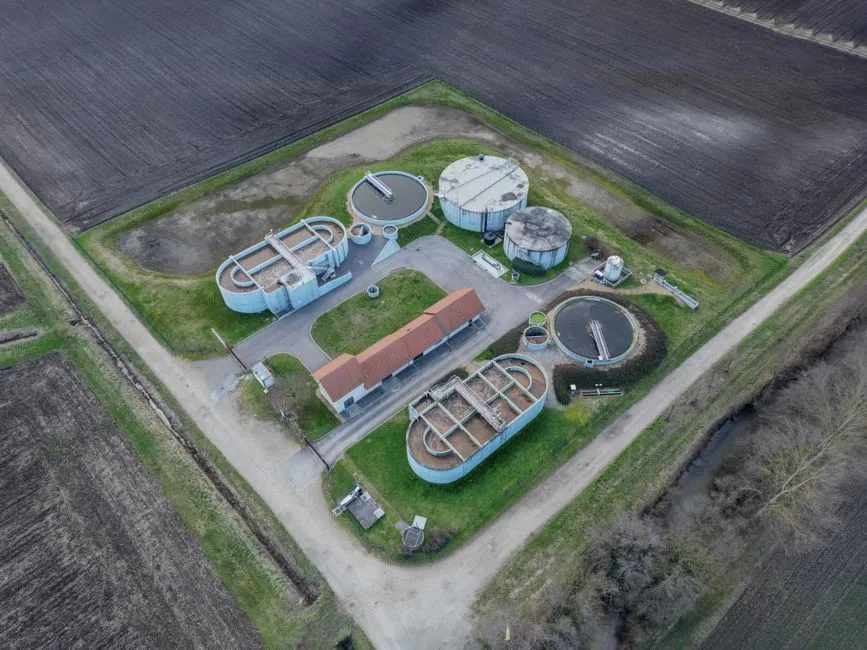
Sewer discharge should be evaluated first with the receiving publicly owned treatment works or municipal authority. Request its industrial-user requirements, local discharge limits, prohibited discharges, sampling rules, connection conditions, and written confirmation of average and peak capacity. Black Forge’s guide identifies dissolved solids, temperature, pH, and residual treatment chemicals—including biocides and scale or corrosion inhibitors—as typical discussion points for cooling blowdown, but it does not establish Tuxtla limits.
The Black Forge guide describes the pass-through and interference tests used in the US pretreatment framework: a discharge cannot cause pollutants to exit the treatment plant in violation of its permit or disrupt plant treatment or sludge handling. These are useful engineering tests, not substitutes for the requirements of the receiving Mexican authority. Black Forge also states that its 25,000-gallon-per-day significant-industrial-user process-wastewater count excludes sanitary, noncontact cooling, and boiler blowdown flows; classification can still arise through capacity or harm tests, and the local control authority makes the final determination. That US threshold must not be presented as a Tuxtla permit threshold.
| Route | Decision basis | Technical consequence |
|---|---|---|
| Municipal sewer discharge | Written local limits, prohibited discharges, sampling duties, and utility capacity | Characterization, equalization, and targeted pretreatment may be required |
| Surface-water discharge | Competent Mexican authority, receiving-water instrument, outfall assessment, and monitoring conditions | Treatment and residual-discharge design must match the actual authorization |
| Internal reuse | Cooling chemistry, make-up quality, stable demand, and concentrate fate | Filtration, membranes, disinfection, controls, and non-potable distribution may be required |
| Combined strategy | Permitted sewer route for residual flow and reuse for a defined portion | Needs a routing valve, standby capacity, and mass balance for every operating mode |
Do not assume that a generic US NPDES or state-permit framework applies in Mexico. Identify the competent Mexican federal, state, or municipal authority and obtain the applicable sewer or receiving-water instrument in writing. The 2025 wastewater permit checklist organizes permit questions, while the sewer-limits guide illustrates why local acceptance must be demonstrated rather than assumed.
Internal reuse is a water-resilience decision, not a permit shortcut. It can reduce freshwater demand and discharge volume, but it requires a stable cooling-loop balance and a managed concentrate or residual-discharge route. Sewer capacity, discharge cost, and authority limits may favor one route during part of the year, while water resilience may justify reuse elsewhere.
Compare practical treatment and reuse configurations
Treatment selection follows the destination and measured source chemistry. The comparison below separates four technically plausible configurations; none is a final Tuxtla design until the site data and authority requirements are confirmed.
| Option | Indicative train | Main advantage | Principal limitation |
|---|---|---|---|
| A — Sewer discharge | Characterization, equalization, and local pretreatment | Lower onsite process complexity | Depends on sewer capacity, local limits, and discharge fees |
| B — Internal blowdown reuse | Screening or media filtration, RO, optional activated carbon, disinfection | Reduces freshwater demand and discharge | Permeate requires controlled blending or chemistry adjustment |
| C — Advanced reclamation | DAF as required, UF, RO, activated carbon where justified, disinfection, concentrate management | Supports higher cycles of concentration | More equipment, controls, energy, and operator demand |
| D — High-recovery recovery | RO with controlled salt precipitation and residual-brine management | Potentially reduces concentrate and freshwater demand | Requires chemistry-specific design and a defined solid-waste route |
Option A is credible when the receiving authority accepts the characterized discharge and the sewer has confirmed capacity. Its limitation is not that sewer discharge is inherently wrong; it is that the project remains exposed to local limits, fees, and infrastructure constraints.
Option B should not be described simply as “RO reuse.” A proposed industrial RO water treatment system needs a defined feed envelope and a controlled permeate blend. The RO permeate changes the cooling-loop chemistry, so operators need defined conductivity, alkalinity, hardness, silica, corrosion-control, and biocide limits.
Option C adds solids removal and membrane protection. Where the feed contains oil, grease, colloids, or suspended solids, DAF may be required; a 0.03 μm PVDF ultrafiltration system is one documented UF configuration in the HydropureWater 2026 guide, with automatic backwash and air scour. HydropureWater’s research context reports a 40–70% blowdown reduction at 7–10 cycles relative to a freshwater baseline at 4 cycles for an advanced UF–RO train. That is a research result, not a guaranteed Tuxtla outcome.
Option D addresses the scaling barrier directly. IDE states that conventional brackish-water RO is commonly limited to 75–80% recovery and describes a Desalter application operating at around 95% recovery with permeate silica reduced to about 1 mg/L. These values apply to the cited technology context; they do not establish achievable recovery at the Tuxtla site. The brackish-water RO selection guide and the MBR comparison guide support technology review, but measured silica, hardness, alkalinity, conductivity, organics, suspended solids, and residual biocide concentrations must determine the train.
Build the recommended treatment process from pretreatment through reuse
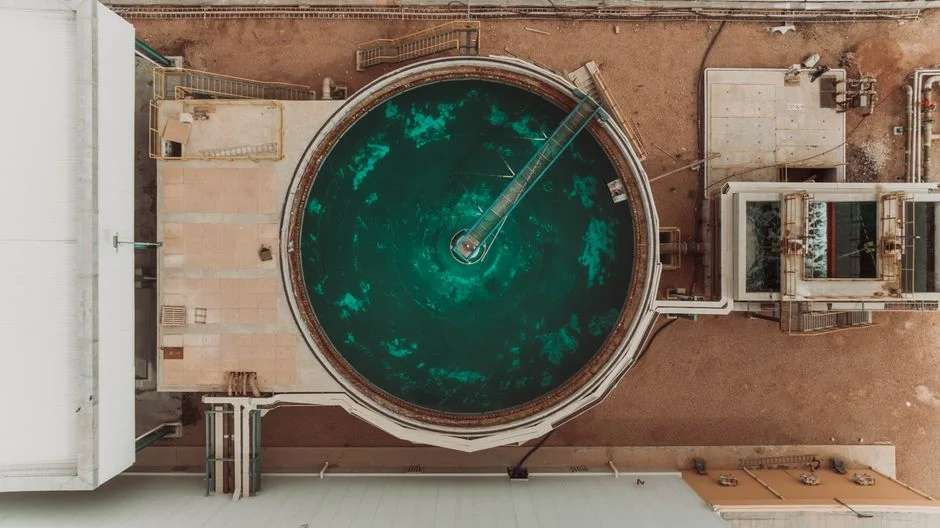
A practical reuse sequence starts with segregation, characterization, equalization, and protection of downstream equipment. It does not end at the treatment skid: a non-potable system also needs a physically separated, labelled non-potable distribution arrangement and cross-connection control. HydropureWater’s 2026 guide identifies dual-pipe distribution as a major capital item and reports lower unit costs when the second loop is installed during site grading.
- Segregate streams. Keep sanitary wastewater, cooling blowdown, RO concentrate, softener reject, glycol-bearing wastewater, and drain-downs in identified collection systems.
- Characterize and equalize. Provide flow measurement, sample points, and sufficient buffering for batch discharges and operating upsets.
- Remove solids and protect membranes. Apply screening, media filtration, or DAF according to feed risk; add UF with automatic backwash and air scour where RO protection requires it.
- Remove dissolved salts. Use RO with PLC operation, conductivity and ORP monitoring, antiscalant or alternative chemistry control, and a defined concentrate route.
- Disinfect and distribute. Provide an appropriate residual or UV backup. HydropureWater’s reference train describes a ClO₂ residual of 0.1–0.5 mg/L at the tower basin or UV backup of at least 40 mJ/cm²; final selection must suit the cooling chemistry and authority requirements.
- Control chemicals automatically. Meter pH, antiscalant, coagulant, flocculant, and biocide dosing rather than relying on manual adjustment.
| Process stage | Required engineering statement | Common procurement gap |
|---|---|---|
| Pretreatment | Feed envelope, contaminant removal basis, fouling strategy | Equipment selected without representative chemistry |
| UF or filtration | Filtrate quality, backwash method, redundancy, recovery | No membrane-protection or cleaning assumptions |
| RO | Average and peak duty, recovery basis, permeate quality, concentrate route | Recovery quoted without worst-case scaling analysis |
| Disinfection | Residual or UV basis, monitoring, contact provisions | No sustained microbial-control rationale |
| Controls | PLC logic, interlocks, alarms, chemical dosing, remote access | Manual operation accepted implicitly |
| Distribution | Separated pipework, labels, cross-connection controls, testing | Treatment skid priced without pipework and commissioning |
For sanitary wastewater, an MBR package or integrated biological treatment may be justified where the authority requires onsite treatment or sewer capacity is constrained. That choice still depends on the receiving sewer’s requirements and written approval. The 2026 UV disinfection guide provides supporting design context, but does not establish a Tuxtla process route.
Evaluate supplier proposals with site-specific acceptance criteria
A bid should demonstrate that the proposed system fits the measured site basis, not merely a reference project. Require each supplier to state design flow, operating flow, peak-flow handling, source-water chemistry envelope, and the governing recovery assumption. These inputs must agree with the mechanical engineer’s water balance.
| Supplier deliverable | Acceptance question | Evidence required |
|---|---|---|
| Design basis | Does it use the actual Tuxtla flow and chemistry? | Signed design-basis sheet and analytical dataset |
| Process guarantees | Are outlet parameters tied to the authority’s final limits or reuse target? | Permit or sewer-limit reference and guarantee conditions |
| Mass balance | Where does make-up water, permeate, concentrate, bleed, and disposal go? | Flow diagram with normal, peak, and shutdown cases |
| Recovery claim | Is recovery sustainable at worst-case silica, hardness, alkalinity, and conductivity? | Design calculation and sensitivity analysis |
| O&M assumptions | What are membrane replacement, cleaning, chemicals, energy, and downtime? | Lifecycle schedule with operating hours and demand |
| Controls and support | How are alarms handled, and who services the equipment? | Control narrative, training scope, service plan, and spares list |
| Performance evidence | Is the cited case comparable to the Tuxtla duty? | Source data or test reports distinguishing reference from guarantee |
Require source citations or test data for performance claims and distinguish a reference implementation from a guaranteed project result. IDE’s reported conventional BWRO limitation of 75–80% recovery shows why recovery must be chemistry-specific; it does not disqualify RO for Tuxtla.
Evaluate automatic controls, remote monitoring, alarm response, redundancy, operator training, local service capability, and spare-parts availability. The trade-waste treatment guide illustrates the value of tying equipment scope to actual waste chemistry. A supplier that omits concentrate, controls, utilities, maintenance, or permit-interface scope has not supplied a complete treatment package.
Confirm Tuxtla permits, costs and implementation schedule
Final approval should depend on a local responsibility matrix naming the municipal sewer or receiving-water authority, the competent Mexican environmental regulator, the mechanical engineer, water-treatment supplier, and client representatives. Each party should have a documented scope for discharge characterization, permit or sewer acceptance, treatment objectives, infrastructure interfaces, commissioning, and long-term monitoring.
Obtain written confirmation of average and peak sewer capacity, any dedicated infrastructure or cost-sharing requirement, sampling frequency, monitoring parameters, connection conditions, and the route for concentrate or residual flow. These records—not US assumptions—should determine the implementation schedule and notice to proceed.
Request local quotations in consistent units covering equipment, installation, membranes, chemicals, energy, sludge or concentrate handling, commissioning, and operator training. HydropureWater’s 2026 US reuse guide gives an installed advanced reuse-skid benchmark of $4.5–8.5 million per MGD, excluding intake and purple-pipe infrastructure. Use that only as a US comparative reference; it is not a Mexican quotation, and it excludes Tuxtla-specific intake and infrastructure.
Make approval conditional on verified discharge characterization, agreed treatment objectives, utility or authority acceptance, and a complete process mass balance. The domestic sewage treatment equipment guide can support specification questions, but its local requirements must not be presented as Tuxtla facts.
Frequently Asked Questions
What treatment does a data center in Tuxtla need?
Separate sanitary wastewater from cooling-tower blowdown, RO concentrate, softener reject, glycol-bearing maintenance wastewater, and periodic drain-downs. The legally permitted destination and measured chemistry determine each treatment train. Sewer pretreatment, internal blowdown reuse, UF–RO reclamation, and high-recovery salt management are different responses to different site conditions.
How much does treatment cost?
The research provides a US benchmark of $4.5–8.5 million per MGD installed for advanced reuse, but no verified Tuxtla price. Request a local bid based on measured average and peak flow, complete source chemistry, recovery, concentrate handling, utility requirements, non-potable distribution, commissioning, and operator training. Compare quotations using the same scope and units.
Are UF and RO necessary?
Not automatically. UF protects downstream membranes from suspended solids and colloids, while RO removes dissolved salts that affect cooling-loop chemistry. The need for each stage depends on source quality, target water quality, scaling risk, recovery, and concentrate fate. A lower-complexity filtration train may be sufficient for a sewer-discharge project with different objectives.
How should a treatment supplier be selected?
Require a measured-feed basis, complete mass balance, chemistry-specific recovery calculation, control philosophy, maintenance assumptions, reference performance, and a permit-compliance responsibility matrix. Reject any proposal whose recovery is not tested against the site’s worst-case silica, hardness, alkalinity, and conductivity, or whose concentrate route remains undefined.
What data should be tested during front-end engineering?
Request the cooling configuration, evaporation rate, circulation flow, cycles of concentration, make-up-water quality, blowdown flow, drain-down frequency, and peak summer conditions. Analyze blowdown for silica, hardness, alkalinity, conductivity, suspended solids, organics, temperature, pH, and residual treatment chemicals. Include sanitary, RO-concentrate, softener-reject, and glycol-bearing streams in separate characterization plans.