Start with Adachi's discharge route and water balance
An Adachi data center should select treatment only after confirming its authorized discharge route, measuring makeup, evaporation, and blowdown, and testing the cooling-water chemistry at the planned cycles of concentration. The preferred base train is side-stream filtration, PVDF ultrafiltration, and brackish-water reverse osmosis, with permeate reused as cooling makeup and concentrate sent only through an authorized route. If Adachi cannot accept concentrate, validated concentration management or zero-liquid-discharge treatment must be evaluated before equipment selection.
The first engineering deliverable is not a treatment-flow diagram; it is an auditable water balance tied to a lawful discharge point. Obtain current written requirements from the authority responsible for the proposed Adachi sewer or receiving-water route. A Tokyo regional guide is context, not proof of Adachi acceptance. The Japan data center blowdown treatment guide explains the decision sequence, but the buyer must obtain site-specific requirements covering the receiving authority, discharge point, constituent limits, monitoring, and authorized concentrate destination.
Document makeup flow, evaporation, blowdown, operating hours, planned cycles of concentration, and each proposed discharge point. Genesis Water Technologies (2026) gives the relationship blowdown ratio = 1/(CoC−1): blowdown is 25% of makeup at 4 CoC and 20% at 6 CoC. Moving from 4 to 6 CoC therefore reduces blowdown by five percentage points of makeup, not by 50%, while increasing scaling, fouling, biological-control, and chemical-accumulation constraints.
| Design input | Evidence or required measurement | Why it controls equipment selection |
|---|---|---|
| Peak blowdown flow | Measured across operating and upset conditions | Sets pretreatment and RO capacity |
| Required reuse rate | Permit objective and cooling-water demand | Determines how much permeate must enter service |
| Planned CoC | 25% blowdown at 4 CoC; 20% at 6 CoC, per Genesis Water Technologies (2026) | Controls concentrate chemistry and chemical demand |
| Guaranteed recovery | Bidder-defined operating envelope | Determines residual concentrate volume |
| Authorized route | Current written Adachi acceptance conditions | Determines whether partial reuse, high recovery, or ZLD is viable |
Size the treatment train from peak blowdown flow, required reuse, planned CoC, and guaranteed recovery—not from facility megawatt capacity alone. Reusable permeate does not remove the concentrate obligation, so the water balance must end with an authorized destination for every residual liquid stream.
Identify the contaminant that limits reuse
Reuse capacity is set by the constituent that reaches its scaling, fouling, toxicity, or discharge limit first, rather than by TDS alone. Test actual Adachi makeup and circulating water for calcium, magnesium, silica, sulfate, alkalinity, chloride, TDS, conductivity, pH, TSS, turbidity, residual biocide, and the specific cooling-tower chemical products used. These results should be compared with the multi-media filtration pretreatment basis and any subsequent ultrafiltration design guidance.
Genesis Water Technologies (2026) gives CTBD screening benchmarks of 1,200–6,000 mg/L TDS at 4–8 CoC and 10–50 mg/L suspended solids with basin filtration. These are not Adachi design values. Use them to frame sampling and mass balances, then replace them with site measurements.
| Measured parameter | Design question | Required action |
|---|---|---|
| Calcium, magnesium, alkalinity and sulfate | Will hardness or scale limit RO recovery? | Calculate concentrate saturation and evaluate softening and antiscalant |
| Silica | Will silica control recovery? | Project concentration at the planned CoC and perform bench testing |
| TDS and conductivity | What osmotic pressure and concentrate loading apply? | Set RO feed and recovery assumptions |
| TSS, turbidity and residual biocide | What can foul UF or damage RO? | Define filtration, backwash, neutralization, and cleaning duties |
| Cooling chemical products | What constituents accumulate in concentrate? | Include them in permit and membrane-compatibility review |
Compare circulating-water and makeup-water concentrations to verify actual CoC. A stated CoC is not evidence if it has not been reconciled against conductivity or another dissolved-solids tracer. Then calculate constituent concentrations in the RO concentrate, including the contribution from treatment chemicals.
Where silica, hardness, or sulfate may constrain recovery, run a pre-engineering bench test using Adachi makeup water at the planned CoC. Keep the membrane-protection functions separate: UF controls colloids, suspended solids, and biological material; softening controls hardness; and antiscalant manages scale only within a validated membrane envelope. None replaces the site-specific RO design basis.
Build pretreatment around blowdown chemistry
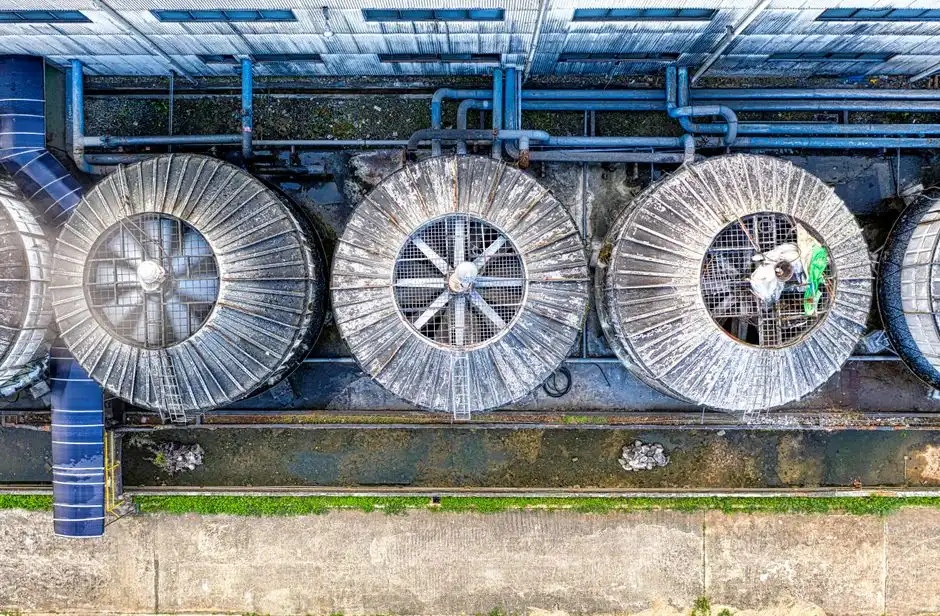
Genesis Water Technologies (2026) recommends side-stream filtration at 1–5% of cooling circulation flow using 10–25 µm self-cleaning filters. This is the first solids-control stage and should be selected from measured circulation flow, expected basin solids, and operating hours. It must also protect heat-exchange and cooling equipment without creating a solids concentration that makes UF backwash or RO pretreatment uneconomic.
A candidate membrane-protection stage is the 0.03 µm PVDF ultrafiltration system. Its specified capability includes feed turbidity up to 300 ppm, automatic backwash, and air scour. Those are equipment specifications rather than a guarantee of Adachi performance, so the bidder must verify feed suitability, cleaning frequency, recovery, and permeate quality against site tests.
UF should remove suspended solids, colloids, and biological material ahead of RO. Do not assign UF the duty of removing hardness, controlling mineral scale, or neutralizing oxidizing biocides. Those functions require separate process steps selected from the projected concentrate chemistry.
If free chlorine is present, the HydropureWater Tokyo guide (2026) requires quenching to below 0.1 mg/L ahead of polyamide RO. Specify the chlorine detection method, quench chemical, dosing response, sensor location, fail-safe arrangement, and membrane-protection limit. An automatic chemical dosing system should be evaluated as part of that control strategy rather than as a generic accessory.
Hardness control should be considered when projected concentrate chemistry indicates calcium carbonate, calcium sulfate, or related scaling. Request an industrial water softener system sized from makeup flow and measured hardness, with regeneration waste included in the site water balance. Antiscalant selection must be linked to the membrane manufacturer’s operating envelope and the authority’s permit conditions; catalog capacity alone does not establish compatibility.
Compare permitted reuse, high recovery and ZLD
The correct reuse route depends on what Adachi can accept in writing, not on which system has the highest nominal recovery. Every option must identify the concentrate destination, residual-solids handling, bypass condition, and operating response to an excursion.
| Route | Applicable condition | Treatment sequence | Residual obligation |
|---|---|---|---|
| Permitted partial reuse | Written concentrate acceptance exists and freshwater reduction is the objective | Side-stream filtration, UF, RO | Authorized concentrate discharge and applicable monitoring |
| High recovery | Discharge volume is restricted and added concentration management is justified | UF, RO, plus controlled precipitation or another validated concentration stage | Smaller liquid stream, but residual solids and remaining concentrate still require an authorized route |
| MVC-assisted ZLD | Liquid discharge is prohibited or effectively unavailable, brine handling is a major constraint, or a board-level water-positive requirement applies | RO followed by MVC concentration and appropriate solids handling | Residual solids handling, thermal-energy demand, and greater operating complexity |
For permitted partial reuse, evaluate an industrial RO system for cooling blowdown reuse after UF. This is the conventional route when a written discharge route exists: permeate returns to the cooling system and the remaining concentrate is discharged under accepted conditions.
For high recovery, add controlled precipitation or another validated concentration-management stage when Adachi restricts discharge volume. Do not simply raise RO recovery until scaling forces shutdown. The supplier must state the recovery definition, feed envelope, scaling calculation, chemical demand, and consequences of seasonal chemistry changes.
MVC-assisted ZLD should remain a conditional option. Genesis Water Technologies (2026) reports MVC distillate below 10 mg/L TDS, 95–98% recovery of RO concentrate, and 95–99% overall recovery for full ZLD. These are benchmarks, not Adachi guarantees. A mechanical upstream stage such as the rotary mechanical bar screen may protect downstream equipment, but it does not authorize concentrate disposal or eliminate chemical residuals.
The HydropureWater Tokyo guide (2026) reports a typical 4–9 month review for a new cooling-tower blowdown discharge permit and recommends planning a 12-month compliance baseline after commissioning. This regional timing is not a guaranteed Adachi schedule. The permit decision should precede procurement of a high-recovery or ZLD train.
Evaluate lifecycle cost instead of water savings alone
Reuse economics must include everything required to deliver a reliable water stream and dispose of the residues. Genesis Water Technologies (2026) gives an installed benchmark of US$250,000–US$500,000 for a 50,000 GPD blowdown RO unit and US$50,000–US$200,000 for side-stream filtration. These are global benchmark figures, not quotations for an Adachi project, and they exclude the site-specific treatment scope that may determine the actual price.
| Cost element | Required quotation scope | Basis |
|---|---|---|
| Installed treatment | RO, UF, softening, filtration, dosing, controls, and site works | Itemized equipment and installed pricing |
| Japan-specific readiness | Seismic design, applicable PSE conformity, Japanese documentation, delivery, and commissioning | Named exclusions and supporting evidence |
| Lifecycle inputs | Energy, chemicals, membrane replacement, labor, sewer or brine disposal, and avoided freshwater | Measured operating forecast |
| Residue handling | Residual solids and brine destination | Permitted route and disposal price |
Open Engineering Inc. (2026) found that its modeled UF+RO scenario used more than five times the freshwater case’s treatment energy, while improved CoC reduced blowdown and chemical consumption. The same study found approximately twice the freshwater case’s GWP, with treatment energy explaining roughly 80% of the difference. These results describe that modeled scope; they do not establish the energy or carbon burden of an Adachi installation.
The study also reported an indirect water penalty of approximately 0.93 L/m³, less than 0.1% of the direct displacement benefit within its modeled reuse scope. Apply that result only within the same scope. For the project decision, compare total cost of water, sewer or brine disposal, energy, chemicals, membrane replacement, labor, and avoided freshwater over the operating period. Request a replacement-element supply plan from the RO and UF membrane supplier, and use the data center blowdown treatment comparison as a lifecycle-review reference rather than as an Adachi cost estimate.
Turn the engineering decision into an RFQ and commissioning plan
The RFQ should convert the selected route into measurable guarantees tied to the actual Adachi water balance and chemistry. Require bidders to state feed assumptions, recovery definition, permeate-quality guarantees, membrane-life assumptions, chemical consumption, acceptance methods, remedies for noncompliance, and the operating conditions outside their guarantee. Do not accept a recovery percentage without defining the feed flow, concentrate flow, temperature, chemistry, and sampling basis.
Separate treatment performance from Japan-specific installation obligations. Require seismic calculations and anchoring details for membrane skids, RO high-pressure-pump bases, dosing skids, control panels, and rotating equipment. Ask each bidder to identify the applicable PSE conformity evidence for electrical equipment rather than offering a blanket compliance statement.
Japanese-language operating procedures, preventive-maintenance schedules, critical-spares lists, operator training, and commissioning handover should be contractual deliverables. The data center wastewater treatment decision guide provides a useful structure for separating process guarantees from site obligations.
Commission against measured makeup, blowdown, evaporation, conductivity, pH, hardness, silica, sulfate, turbidity, and residual biocide. Include automatic isolation or diversion so untreated concentrate cannot reach the authorized discharge route during an excursion. The training material should also define operators’ response to high differential pressure, permeate-quality deterioration, dosing failure, and concentrate-discharge isolation; the UF fouling and recovery troubleshooting guide is a useful technical reference for that handover.
Before finalizing price, confirm the equipment pad, access route, lifting points, weight, utility interfaces, and supply plan for RO and UF replacement elements. A low equipment price can become the highest installed cost if heavy components cannot reach the pad or membrane deliveries are excluded.
Frequently Asked Questions
What budget should be allowed for Adachi cooling-blowdown treatment?
Do not treat Genesis Water Technologies’ 2026 benchmarks of US$250,000–US$500,000 installed for a 50,000 GPD RO unit and US$50,000–US$200,000 for side-stream filtration as an Adachi quotation. Request separate prices for UF, softening, dosing, seismic design, applicable PSE conformity, delivery, commissioning, site works, controls, and membrane replacement. Compare bids over the same installed scope and operating period.
How should an Adachi treatment train be sized?
Size it from peak blowdown flow, planned CoC, measured makeup chemistry, projected scaling limits, required reuse, and guaranteed recovery—not from data-center MW alone. Provide measured makeup, evaporation, and blowdown data plus seasonal chemistry, then require each bidder to state how its guarantees change with feed conditions.
What compliance risk should be closed before choosing a concentrate route?
Obtain current written Adachi sewer or receiving-water acceptance conditions before committing to partial reuse, high recovery, or ZLD. Confirm the authority, discharge point, constituent limits, monitoring duties, and authorized concentrate destination. Regional Tokyo guidance cannot substitute for Adachi acceptance.
Which treatment functions should the selected supplier guarantee?
Require demonstrated cooling-blowdown experience, a defined recovery basis, permeate guarantees, membrane data, Japanese documentation, seismic evidence, electrical conformity, delivery feasibility, and lifecycle support. UF removes colloids, solids, and biological material; softening controls hardness; antiscalant controls scale within the validated envelope. None replaces a valid RO design basis. Relevant spare and valve requirements can be included in the treatment parts, valves, and filter media scope.
Related Equipment
- industrial RO system for cooling blowdown reuse — specifications, capacity range, and technical data