When IFAS Is the Right Fit for a Frozen Food Plant
IFAS can strengthen an activated-sludge treatment train, but it is not a substitute for source control, equalization, or solids and FOG removal. Integrated Fixed-Film Activated Sludge combines suspended-growth activated sludge with plastic or fabric media carrying attached biomass. Hazen and Sawyer describes IFAS as a way to expand activated-sludge capacity within the same tank volume; its municipal demonstration achieved nitrification with less than 50% of the conventional aerobic volume required. For a frozen-food plant, the strongest candidate use case is an existing basin needing more capacity, more consistent nitrification, or retrofit without a full greenfield rebuild. The supplied evidence does not establish that IFAS alone can treat frozen-food washwater, thawing discharge, cleaning wastewater, or product-loss streams. Verify applicable discharge or pretreatment limits before selecting equipment; no frozen-food-specific numerical limits were supplied in the research.
This qualification matters because IFAS changes the biomass inventory and oxygen-transfer requirements inside a biological reactor; it does not remove incoming fats, oils, solids, debris, cleaning chemicals, or incompatible sanitary flows. The IFAS design for seafood processing wastewater and IFAS design for food-processing wastewater provide related process context, but the available full-scale evidence is municipal rather than frozen-food-specific.
Before IFAS enters the project scope, answer four questions:
- Is there an existing activated-sludge basin whose biological capacity or nitrification reliability is the actual problem?
- Can washdown, thawing, product-loss, and cleaning streams be segregated or controlled at the source?
- Will solids, FOG, and colloidal material be removed before biological treatment?
- Can the permit, reuse objective, and expected wastewater temperature be translated into site-specific design criteria?
If the answer to the first question is no, conventional activated sludge, MBR, or another biological process may be a better starting point. If pretreatment is unresolved, improve the treatment train before increasing biological capacity.
Build the Wastewater Profile Before Selecting the Process
Frozen-food wastewater must be characterized by stream and production condition because washwater, thawing discharge, product loss, and cleaning chemicals impose different treatment demands. The facility review should separate floor and equipment washwater, thawing or tempering discharge, product-loss wastewater, cooling or refrigeration blowdown where applicable, and cleaning-chemical discharge. Each stream should be linked to its production schedule and discharge route rather than represented by one plant-wide average.
Use a campaign-based sampling plan covering normal production, thawing or tempering operations, intensive washdown, cleaning operations, and abnormal product-loss events. Dataintelo’s October 2025 food-industry IFAS market report describes food-processing effluent as high-strength and variable-load, but it does not establish a universal frozen-food load range. The engineer therefore needs site measurements, not a generic loading assumption.
| Stream or input | Why it matters | Information to obtain |
|---|---|---|
| Floor and equipment washwater | May contain product residues, suspended material, FOG, and wash chemicals | Flow, COD, BOD, TSS, FOG, pH, temperature, and cleaning-dosing schedule |
| Thawing or tempering discharge | Can vary with product inventory and operating campaigns | Campaign flow and load profile; temperature |
| Product-loss wastewater | Can contain readily biodegradable solids and oils | Loss rate, solids character, COD, BOD, TSS, and FOG |
| Cleaning-chemical discharge | Can cause pH or toxicity shocks and upset biological treatment | Chemical inventory, dose, rinse volume, and segregation controls |
| Sanitary wastewater | Should not be diluted by or mixed automatically with concentrated process streams | Separate flow and load; discharge destination and local requirements |
| Refrigeration or cooling blowdown | Contribution and chemistry vary by plant configuration | Flow, temperature, pH, and chemical content where applicable |
Record flow, COD, BOD, TSS, FOG or oil and grease, pH, temperature, nutrients, salinity where relevant, and the permit basis. Hazen and Sawyer identifies soluble biodegradable COD loading, MLSS, temperature, and DO as factors affecting attached biomass. These variables must be evaluated together; attached growth can respond quickly when loading changes, but that response does not protect the system from toxic shocks or excessive solids loading.
Keep sanitary wastewater separate until an engineering evaluation shows how its flow and chemistry affect process retention time, biomass inventory, and hydraulic loading. A recent academic study provides context for the value of food wastewater rather than proof of an IFAS configuration: the 2026 Frontiers in Microbiology study examined fermentation of citrus wastewater and yogurt whey to produce Penicillium roqueforti biomass proteins. It supports treating food-processing wastewater as a resource and treatment challenge, but it does not establish frozen-food IFAS design criteria.
Recommended Treatment Train for Frozen Food Wastewater
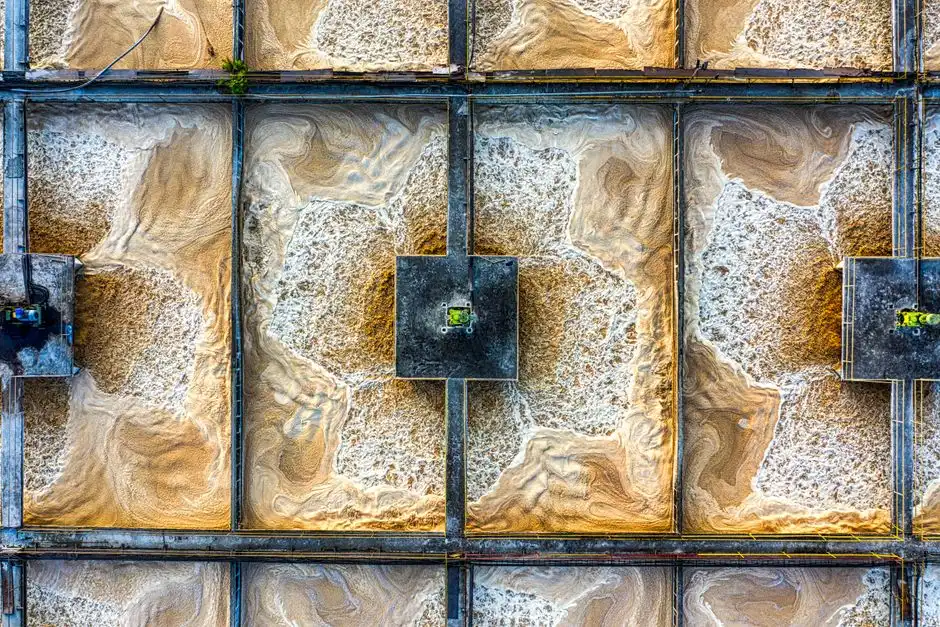
IFAS belongs inside a complete treatment train: source segregation and screening, equalization, suitable solids and FOG pretreatment, biological treatment, clarification, and permit-driven downstream polishing. This sequence protects the biological stage and keeps the project from treating media retention as a substitute for a sound process basis.
- Segregate and screen. Keep concentrated product-loss and cleaning streams controlled at source. Install suitable screening before pumps, aerators, and biological media.
- Equalize variable flows. Buffer production, washdown, and thawing-related peaks before biological treatment.
- Remove solids and FOG. Use DAF or another suitable pretreatment unit when the wastewater profile supports it.
- Apply biological treatment. Place IFAS in the activated-sludge stage where added attached biomass supports capacity or nitrification.
- Clarify biological solids. Add a lamella clarifier or another solids-separation stage where required by the selected configuration.
- Apply permit-driven polishing. Treat disinfection or reuse requirements as separate design obligations.
| Stage | Primary function | Design or procurement focus |
|---|---|---|
| Source segregation and screening | Exclude debris and isolate incompatible streams | Actual stream routing, debris character, screen opening, bypass management, and screenings disposal |
| Equalization | Buffer variable-strength industrial wastewater | Production, washdown, and thawing schedules; wet-weather events; mixing and residence-time calculations |
| DAF pretreatment | Remove suspended solids, FOG, oil and grease, and colloidal material before biology | Analytical basis, recycle performance, sludge handling, and performance tests |
| IFAS biological reactor | Combine suspended and attached biomass for biological treatment | Media, mixing, aeration, DO, foam control, screens, and instrumentation |
| Clarification | Separate biological solids from treated liquid | Solids loading, sludge removal, and downstream reuse or discharge requirements |
| Downstream polishing | Meet permit or reuse requirements | Disinfection and filtration remain separate from IFAS performance claims |
For suspended solids, FOG, oil and grease, or colloidal material that could overload the biological stage, evaluate DAF pretreatment for frozen food wastewater. The product catalog identifies DAF as a high-efficiency pretreatment method for these contaminants in food-processing wastewater, but equipment selection still requires the site’s analytical data.
Hazen and Sawyer observed floatables and debris in an IFAS cell and recommends upstream screens with openings less than 6 mm, with smaller openings preferred; conditions that cause screen bypass should be minimized. Screen selection should also be checked against wastewater headworks bar screen specifications.
After biological treatment, include lamella clarifier for post-biological solids separation where the selected process requires solids capture before discharge or reuse. IFAS does not provide pathogen removal or disinfection, so any disinfection step must remain explicit and permit-driven.
How IFAS Performs on Variable Food Wastewater
IFAS combines two active biological populations: suspended activated sludge and attached biomass on plastic or fabric media. The suspended population contributes bulk mixed-liquor inventory, while attached biomass adds treatment capacity and can respond quickly to changing loading. Media retention, mixing, and aeration determine whether that added inventory remains present, uniformly distributed, and sufficiently oxygenated.
Hazen and Sawyer’s year-long, full-scale Greensboro demonstration used AnoxKaldnes K3 media at a 35% pilot fill fraction. Attached growth responded quickly when loading conditions changed. Generally, media biomass in the 5–15 g TSS/m² range was maintained during the demonstration; design-specific values were determined from actual loading conditions rather than treating the range as universal.
The same municipal demonstration achieved nitrification at approximately 15 °C and a total aerobic SRT of approximately 5.5 days, with fixed-film biomass representing up to 50% of total biomass. Hazen and Sawyer also reported nitrification with less than 50% of the aerobic volume required for the conventional system. These results support IFAS as a capacity and nitrification option, but they are municipal demonstration evidence—not a guarantee for frozen-food effluent.
The temperature observation is relevant because a frozen-food plant may discharge relatively cold wastewater. It cannot be converted directly into a frozen-food design temperature without site data. The engineer must determine the actual annual and campaign temperature profile, then calculate oxygen transfer, biological rates, sludge age, and media inventory for that condition.
Mixing must keep free-floating media uniformly distributed. Aeration must supply enough oxygen and turbulence for sloughing and oxygen transfer through the biofilm. During the Greensboro demonstration, higher air flows were observed than in conventional operation, with no evidence of oxygen-transfer efficiency above the design values used for the test. That finding is a warning to include aeration capability and operating energy in the comparison—not proof of a universal aeration requirement.
For other variable food-processing applications, IFAS design for seafood processing wastewater provides a related frame, while the frozen-food decision still depends on plant-specific stream characterization and pretreatment.
Design the IFAS Basin for Media, Oxygen, Foam, and Debris

An IFAS basin is a controlled solids-retention system, not simply an aerated tank filled with plastic. The procurement scope must define how media stays in the reactor, remains uniformly distributed, receives sufficient oxygen, and is separated from foam and debris. Failure in any of those areas can reduce aeration capacity even when installed blower capacity appears adequate.
| Design issue | Procurement requirement | Acceptance or operating check |
|---|---|---|
| Mixing | Define mixer arrangement and energy needed to keep free-floating media uniformly distributed | Define the approved method for verifying uniform distribution and inspect for accumulation |
| Aeration and DO | Size for process oxygen demand, mixing, sloughing, and the required aerobic condition | Commission the aeration system; confirm DO distribution and airflow response under operating loads |
| Biomass inventory | State media type, active area, fill fraction, expected attached-biomass basis, and excess-biofilm control | Inspect carrier condition, attached biomass, and suspended-growth response |
| Media retention | Provide submerged screens appropriate to the selected media and controls on allowable headloss | Measure headloss, inspect screens, and establish cleaning frequency and access |
| Foam control | Provide defoaming capability and a safe means of wasting trapped foam | Demonstrate that surface foam and entrained media can be removed without losing treatment capacity |
| Debris protection | Use upstream screening with openings less than 6 mm, with smaller openings preferred, and minimize bypass | Inspect screens, screenings handling, and bypass alarms or operating procedures |
| Control strategy | Identify DO, airflow, MLSS, temperature, and media-condition monitoring points | Trend operating data during acceptance and operator training |
For nitrification, Hazen and Sawyer states that suspended-phase DO is typically 3–4 mg/L so that the attached biofilm remains completely aerobic. The final value must come from process calculations, and this range is not a frozen-food effluent guarantee.
Specify the selected biofilm carrier media by type, active area, fill fraction, and handling requirements. Do not simply copy the demonstration’s 35% pilot fill fraction into the final design; the pilot value belonged to a specific municipal geometry, loading condition, and equipment configuration.
Media-retainer design must address installation, removal, cleaning, replacement, and bypass. Hazen and Sawyer reports that excessive headloss above manufacturer recommendations reduced air supply during the pilot, particularly when foam was present. The control plan should therefore link screen condition to airflow availability rather than treating headloss as a routine housekeeping item.
Foam requires an operating response. Hazen and Sawyer identifies defoamant sprays and temporary surface-foam wasting as typical controls. Where chemical dosing is part of the approved response, define storage, metering, compatibility, and operator controls; an automatic chemical dosing system should be scoped only after the process basis establishes that chemical addition is acceptable.
Cold operation also requires active review. The supplied evidence does not define a frozen-food DO correction, temperature setpoint, or biological-rate factor. Use measured winter and campaign temperatures in the final oxygen, SRT, mixing, and performance calculations rather than borrowing the municipal observation at approximately 15 °C as a design default.
IFAS, Activated Sludge, MBR, and A/O: Which Treatment Fits?
IFAS is strongest as an activated-sludge retrofit or expansion strategy, while MBR is strongest when solids separation or reuse dominates the project, and anoxic-oxidation pretreatment is appropriate only when the wastewater and objectives support that process. The choice should follow from the treatment train and permit—not from an equipment category.
| Option | Primary fit | Solid separation | Key operating consideration |
|---|---|---|---|
| IFAS | Added activated-sludge capacity or improved nitrification within an existing biological train | Still requires downstream clarification or other solids separation | Media retention, uniform mixing, aeration, foam, and debris protection |
| Conventional activated sludge | Straightforward biological treatment where basin capacity is adequate | Clarifier required | Simpler media-free configuration but larger biological volume may be needed for the same demonstrated duty |
| MBR | High-quality solids separation or reuse where membrane operation is justified | Integrated membrane separation | Membrane operation, cleaning, integrity monitoring, and replacement |
| Anoxic-oxidation package | Principally domestic wastewater or a clearly matched packaged biological duty | Package includes sedimentation | Package scope is not an automatic substitute for industrial-process pretreatment and design |
Hazen and Sawyer’s demonstration supports the volume comparison for its tested conditions: nitrification was achieved with less than 50% of the conventional aerobic volume required. It does not establish that every frozen-food retrofit can use the same footprint ratio.
The MBR integrated wastewater treatment system combines activated sludge with submerged PVDF membrane filtration and provides near-reuse-quality effluent at less than 1 μm filtration. Consider it where solids separation or reuse is the dominant requirement and accept membrane-operation and maintenance obligations.
The underground integrated sewage treatment package combines anoxic and aerobic biological contact oxidation with sedimentation and disinfection. It is a packaged option where wastewater is principally domestic. Do not use it automatically for concentrated frozen-food process streams.
Use a sequence of decisions:
- If FOG or excessive solids are present, improve source control and evaluate DAF or equivalent pretreatment.
- If an activated-sludge basin needs more capacity or more reliable nitrification, evaluate IFAS.
- If solids separation or reuse is the dominant requirement, compare MBR against the available clarifier and filtration alternatives.
- If the flow is principally domestic, evaluate an anoxic-oxidation package within its demonstrated envelope.
- Do not use Dataintelo’s October 2025 market forecast or generic food-industry claims as project-selection evidence.
Plan Procurement, Commissioning, and Long-Term Operation

A frozen-food IFAS procurement should start with a process basis, not a media-equipment list. The issue package should define flow and load data, wastewater variability, temperature range, permit targets, existing basin geometry, available utilities, and the intended reuse or discharge outcome. For variable-strength industrial wastewater, request actual production, washdown, and thawing schedules rather than an annual daily average.
| Procurement package | Minimum content to request from bidders | Owner review before award |
|---|---|---|
| Process basis | Stream profile, loads, variability, temperature, permit basis, basin geometry, and utilities | Confirm that loads and limits are project-specific rather than catalogue assumptions |
| IFAS equipment | Media type, active area, fill fraction, retainers, mixing, aeration, foam control, access, and maintenance | Check that every component addresses the selected media and basin geometry |
| Controls and instrumentation | DO, airflow, MLSS, temperature, media condition, screen condition, alarms, and interfaces | Define calibration, data logging, and control authority |
| Performance protocol | Owner-approved acceptance conditions tied to project-specific limits | Do not infer a universal frozen-food guarantee from municipal evidence |
| Handover | Training, spare media or parts, inspection, screen cleaning, headloss checks, and biofilm monitoring | Confirm that operating procedures address cold-weather and campaign conditions |
| Residuals | Sludge generation, thickening, storage, and dewatering route | Include downstream solids handling in the complete treatment scope |
Ask bidders to identify media type, fill fraction, media-retainer design, mixing, aeration, foam control, controls, instrumentation, access, maintenance, and performance tests. Require an owner-approved performance protocol with acceptance conditions tied to project-specific limits. No universal frozen-food effluent guarantee can be inferred from the supplied research.
Handover should include operator training, spare media or replacement parts, media inspection, screen cleaning, headloss inspection, and biofilm monitoring. Define what triggers media addition, removal, or replacement and how operators record attached biomass and media condition.
Include sludge dewatering in the complete treatment scope. A sludge dewatering for the frozen food wastewater treatment plant using a plate and frame filter press can provide solids-liquid separation after biological treatment, subject to sludge characterization and the selected solids-handling route.
Frequently Asked Questions
Is IFAS suitable for frozen food wastewater?
Yes, but only after stream segregation, equalization, and suitable solids and FOG pretreatment. IFAS strengthens an activated-sludge stage; the supplied research does not show that it alone treats washwater, thawing discharge, cleaning wastewater, or product-loss streams. Confirm that the wastewater is biologically treatable, that the permit basis is known, and that pretreatment protects the biological stage.
How much does an IFAS retrofit cost for a frozen food plant?
The supplied research provides no frozen-food-specific quotation or reliable project price, so a budget should not be based on a generic percentage or market forecast. Request a priced scope covering media, retainers, mixing, aeration, screens, foam control, instrumentation, installation, civil modifications, commissioning, and residuals handling. Require bidders to identify exclusions and assumptions using the plant’s actual flow, load, temperature, and permit data.
Which supplier qualifications and guarantees should be checked?
Check whether the supplier has designed the proposed media and retainer arrangement for the actual basin, not merely supplied generic IFAS equipment. Require a defined performance protocol, media and screen inspection access, a headloss and aeration-response plan, foam controls, maintenance procedures, training, and handover documents. Do not accept the municipal demonstration’s less-than-50% aerobic-volume result as a frozen-food guarantee; acceptance conditions must be project-specific.
Should DAF pretreatment be installed before IFAS, or should biological capacity be increased first?
Prioritize pretreatment when the wastewater profile shows suspended solids, FOG, oil and grease, or colloidal material that could overload biology or interfere with media retention. Evaluate DAF or equivalent pretreatment first, then size the biological stage against the treated-water profile and production variability. Increasing IFAS capacity without controlling those loads can turn a solids problem into a foam, aeration, or media-loss problem.
What design information is needed for cold-weather and nitrification operation?
Request measured temperature across normal and thawing campaigns, soluble biodegradable COD loading, MLSS, DO, and the applicable aerobic SRT. Hazen and Sawyer identifies 3–4 mg/L suspended-phase DO for nitrification systems, but the final value must be calculated for the site. The same source observed nitrification near 15 °C in a municipal demonstration and generally maintained 5–15 g TSS/m² media biomass; neither observation is a frozen-food design default.