What Morganton Chemical Facilities Need to Decide First
For chemical wastewater in Morganton, MBR is generally the stronger choice when the plant needs low-TSS, low-turbidity effluent for reuse, has limited space, or experiences chemical slugs that make conventional activated-sludge settling unreliable. HydropureWater's 2026 Central US comparison reports MBR effluent typically below 5 mg/L TSS and below 1 NTU, with roughly 60% less treatment-train footprint than CAS. The trade-off is higher capital and operating cost: for a 1,000 m³/day chemical stream, directional MBR estimates are 1.4 to 1.8 times CAS CAPEX and 1.2 to 1.5 times CAS OPEX per cubic meter. CAS remains economical for stable, readily biodegradable flows with adequate land and looser limits. A reuse-driven MBR retrofit may provide the best fit for an operating brownfield site.
Start with the destination, not the equipment. A Morganton facility may discharge to the county treatment system, a surface-water outfall, or reuse treated water for cooling, scrubber dilution, or boiler-feed service after additional treatment. Each destination imposes a different quality envelope, and generic MBR or CAS values must not be treated as universal discharge standards. Obtain the current permit limits, renewal-cycle information, and applicable whole-effluent-toxicity or monitoring conditions before sizing equipment.
Next, characterize the chemical production schedule. Batch discharges of surfactants, solvents, oils, or ammonia can create pH excursions, COD swings, salinity changes, and toxicity events that impair biological activity or membrane compatibility. The available footprint, biosolids-disposal route, haul distance, operator capability, and value of displaced purchased water then determine whether new CAS, retained CAS with membrane separation, or a full MBR is defensible. This comparison addresses the 2026 procurement question: MBR versus conventional activated sludge for chemical wastewater in Morganton, United States.
The MBR wastewater cost per m³ guide provides a starting framework, but the final selection should be based on plant data, reuse chemistry, permit conditions, and a site-specific life-cycle model.
How MBR and Conventional Activated Sludge Work
CAS separates biomass by gravity settling, while MBR separates it through a membrane barrier; that distinction controls both effluent stability and the consequences of a biological upset. CAS grows suspended organisms in an aeration basin and then relies on a downstream secondary clarifier to settle the biological solids. MBR retains the biological stage but replaces the clarifier with membrane modules, commonly submerged flat-sheet or hollow-fiber formats.
HydropureWater's general MBR comparison reports membrane pore sizes of 0.04 to 0.4 μm and identifies physical retention as the mechanism that decouples effluent quality from sludge settleability. Its 2026 chemical-wastewater comparison describes CAS at an SRT of 5 to 15 days and an HRT of 6 to 12 hours. The corresponding MBR ranges are an SRT of 20 to 60 days and MLSS of 8,000 to 15,000 mg/L.
The higher MBR SRT can retain slow-growing organisms, including nitrifiers and organisms responsible for degrading difficult organics. It does not make toxic influent harmless. If a solvent or other incompatible chemical reaches the membrane, fouling or polymer damage can negate the process advantage. CAS remains less vulnerable to direct membrane damage, but its effluent quality can deteriorate quickly when floc settleability changes.
| Design element | Conventional activated sludge | Membrane bioreactor |
|---|---|---|
| Biological solids separation | Secondary clarifier and gravity settling | Submerged membrane barrier |
| 2026 chemical-wastewater design basis | SRT 5–15 days; HRT 6–12 hours | SRT 20–60 days; MLSS 8,000–15,000 mg/L |
| Effect of poor sludge settleability | Clarifier carryover and unstable effluent quality | Biomass remains physically retained |
| Primary chemical-compatibility concern | Inhibition of the biological population | Inhibition plus fouling or membrane damage |
These ranges are comparison bounds, not a design for a Morganton plant. The 2026 MBR and CAS comparison should be reconciled with current influent data, temperature, toxicity, and the selected flux and SRT.
Performance Under Chemical Variability and Winter Conditions
A chemical-plant design based only on average COD will miss the failures most likely to drive an operating decision. HydropureWater's 2026 Central US chemical-wastewater profile identifies COD swings of 800 to 4,000 mg/L in the regional envelope, while emphasizing that final design must use plant-specific influent data. A Morganton buyer should obtain a full production-year dataset, including batch timing, rather than extrapolate from a single composite sample.
Surfactant batches, solvent washdowns, and ammonia shocks can upset CAS through bulking, pinpoint floc, and clarifier instability. MBR protects against loss of biomass when settling deteriorates, but it is not immune to the slug itself. Oil, grease, surfactants, solvents, and incompatible chemicals can foul the membrane or damage the polymer. Equalization and suitable pretreatment therefore remain necessary for both technologies.
Winter operation adds another constraint. HydropureWater's 2026 Central US source identifies January mixed-liquor temperatures of 8 to 12 °C and states that nitrification rates roughly halve for each 10 °C decline. At 10 °C, the same source states that a 30-day MBR SRT can still support full nitrification, while a 10-day CAS SRT typically cannot.
Cold water also increases viscosity and slows gravity settling. MBR permeability declines as viscosity rises, so the biological volume, membrane area, and operating flux must be reviewed together rather than applying warm-weather performance unchanged.
| Event or condition | CAS response | MBR response | Required design response |
|---|---|---|---|
| COD swings within the 2026 Central US profile | Load and settling variations | Greater solids retention, subject to membrane flux | Use plant-specific load and batch data |
| Surfactant, solvent, or ammonia slug | Possible bulking, pinpoint floc, and clarifier upset | Biomass retained; membrane may foul or be damaged | Equalization, toxicity review, and compatible pretreatment |
| January mixed liquor at 8–12 °C | Slowed biology and settling | Lower rates and permeability require additional design checks | Winter SRT, volume, membrane area, and flux review |
| 10 °C and 30-day SRT | Not the cited CAS case | Full nitrification remains supported, per the 2026 source | Verify with site-specific kinetics |
Whole-effluent-toxicity testing is therefore a process-design input, not a closeout item. It should cover normal batches and the shortest credible mixing interval for incompatible discharges.
Effluent Quality, Reuse, and Footprint
MBR's additional capital cost is justified only if its solids and turbidity separation creates measurable compliance, operating, or reuse value. HydropureWater's 2026 Central US article reports typical MBR performance below 5 mg/L TSS and 1 NTU turbidity, compared with 10 to 30 mg/L TSS at best for CAS. CAS quality deteriorates sharply when sludge settleability declines; MBR separation instead depends on membrane integrity and sustainable flux.
Reuse suitability remains application-specific. Cooling water, scrubber dilution, and boiler feed may require additional polishing, disinfection, or chemistry control beyond biological treatment and membrane separation. A supplier's ability to produce a clean membrane permeate does not establish compliance with an off-site reuse specification.
For the 2026 chemicals-wastewater scenario, HydropureWater estimates that MBR can reduce treatment-train footprint by roughly 60% by eliminating the secondary clarifier and most tertiary filtration. Its general MBR comparison gives a broader 30 to 50% footprint reduction for equivalent systems. Those figures have different scopes and should remain separate: the chemicals estimate addresses the treatment train, while the broader figure concerns equivalent systems.
| Evaluation item | CAS | MBR | Procurement implication |
|---|---|---|---|
| TSS reported for chemical wastewater | 10–30 mg/L at best | Below 5 mg/L | Compare against actual permit and reuse limits |
| Turbidity reported for chemical wastewater | Not stated in the supplied 2026 comparison | Below 1 NTU | Obtain a guaranteed site-specific value |
| 2026 chemicals treatment-train footprint | Reference layout | Roughly 60% smaller | Confirm against available Morganton space |
| Broader equivalent-system footprint comparison | Reference layout | 30–50% smaller | Use as a broader market context, not a site guarantee |
The integrated MBR wastewater treatment system publishes filtration below 1 μm and a 60% smaller-footprint specification. Treat those as supplier equipment references, not independent guarantees of whole-plant performance at a Morganton chemical facility.
Capital Cost, Operating Cost, and Biosolids Economics
The economic comparison must include membrane maintenance and biosolids disposal, not only reactor and tank capital. HydropureWater's 2026 framework gives directional MBR CAPEX of roughly 1.4 to 1.8 times CAS and MBR OPEX of 1.2 to 1.5 times CAS per cubic meter for a 1,000 m³/day chemical stream. These are comparison multipliers, not quotations for a Morganton installation.
The same source values displaced purchased process water at $1.50 to $3.00/m³ and states that reuse can move the economic crossover from decades to years. The amount of reusable water, its actual quality, and the number of operating hours over which it displaces purchased water determine whether that crossover is credible. A cooling or scrubber application with seasonal demand may produce less annual value than a continuous process-water service.
MBR also adds membrane scouring and cleaning. HydropureWater's 2026 Central US article identifies 0.3 to 0.6 kWh/m³ of scouring energy above the CAS baseline, weekly maintenance cleaning with NaOCl at 500 to 1,000 mg/L, and semiannual recovery cleaning with citric acid or NaOH. Vendors should price the stated cleaning frequency against the site's actual chemistry and operating schedule.
Biosolids can alter the comparison. Reported observed yields are 0.10 to 0.25 kg VSS/kg COD for MBR and 0.30 to 0.45 kg VSS/kg COD for CAS; the source translates this into 20 to 40% less waste activated sludge. It also gives a 2026 hauling estimate of $35 to $55 per wet ton for Class B dewatering cake and notes that haul distances often exceed 100 km. A Morganton model must use its actual wet-ton generation, moisture content, route, and disposal quote rather than claim a universal saving.
| Economic item | Published comparison | Scope or caution |
|---|---|---|
| Capital cost | MBR at 1.4–1.8× CAS | Directional estimate for a 1,000 m³/day chemical stream |
| Operating cost | MBR at 1.2–1.5× CAS per m³ | Directional 2026 comparison; not a Morganton bid |
| Scouring energy | 0.3–0.6 kWh/m³ above CAS baseline | 2026 Central US article |
| Observed biological yield | MBR 0.10–0.25; CAS 0.30–0.45 kg VSS/kg COD | Reported values; site data required |
| Class B cake hauling | $35–$55 per wet ton in 2026 dollars | Source notes hauls often exceed 100 km |
HydropureWater's general comparison also reports membrane prices falling approximately 60% since 2010 and typical lifespans extending from 5 to 7 years to 7 to 10+ years. Request current replacement pricing and warranty terms. The 2026 cost guide is useful for setting the bid model, but not for substituting for quotations.
Pretreatment and Membrane Compatibility
Neither CAS nor MBR can be specified safely without treating the chemical stream as a variable hazard. Both require equalization and pH control, and chemical wastewater may also require oil-water separation before biology. Pretreatment should intercept the compounds most likely to inhibit organisms, damage membranes, or foul the separation process before they reach the main treatment train.
HydropureWater's general MBR comparison cautions that oils and greases above 50 mg/L can cause irreversible fouling, aggressive solvents can damage membrane polymers, and temperatures above 40 °C are unsuitable for PVDF membranes. Those thresholds require confirmation against the selected membrane and the actual wastewater chemistry.
Require a membrane-compatibility review, influent toxicity characterization, and, where industrial application risk remains unresolved, a pilot trial. The pilot should reproduce relevant batch slugs and winter conditions rather than only testing a stable composite sample.
A DAF pretreatment for oily chemical wastewater may be appropriate where oil, FOG, or floatable solids must be removed. It is a pretreatment step, not a substitute for biological treatment. The DF-series submerged MBR membrane module is a relevant equipment option, but final module selection should follow the chemistry, temperature, flux, and cleaning review.
| Compatibility issue | Documented concern | Buyer's required evidence |
|---|---|---|
| Oil and grease | Above 50 mg/L can cause irreversible fouling, per the general comparison | Influent oil/FOG characterization and removal-performance guarantee |
| Aggressive solvents | May damage membrane polymers | Chemical-by-chemical compatibility statement from the membrane supplier |
| High temperature | Above 40 °C is unsuitable for PVDF membranes | Maximum-temperature design and operating interlocks |
| Biosolids dewatering | Plate-and-frame filter press is an available dewatering option | Site-specific cake moisture, chemical demand, and haulability testing |
For biosolids handling, a plate-and-frame filter press can dewater either treatment train, but no universal cake-solids value should be assigned to every Morganton chemical stream. The source's reported range remains tied to its stated comparison scope and should be verified by testing.
Choosing MBR, CAS, or a Hybrid Retrofit
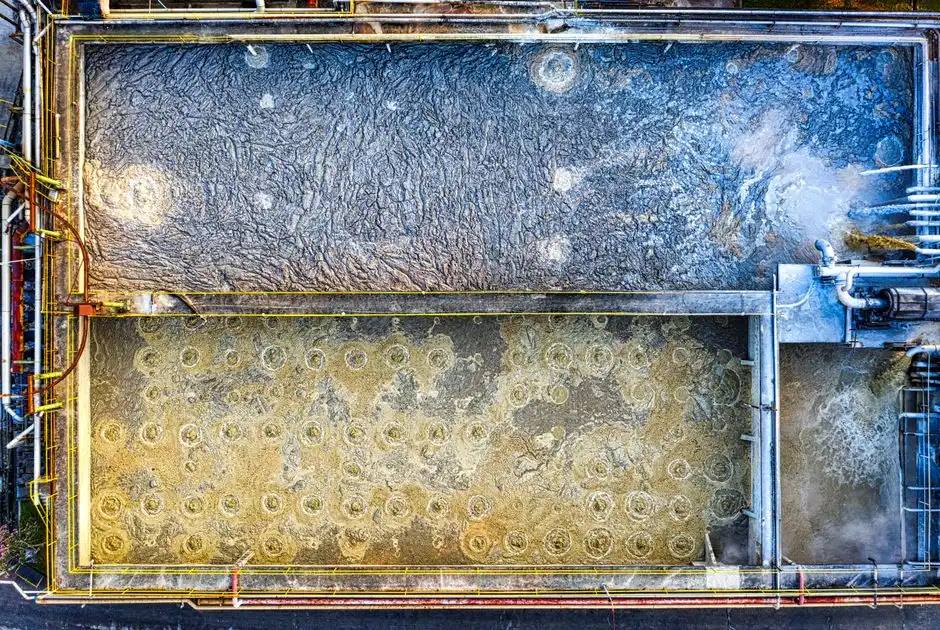
Choose the technology that resolves the site's binding constraints, not the one with the best membrane specification. Full MBR is most defensible when reuse requires very low solids and turbidity, land is constrained, recalcitrant loads are significant, or retaining solids during slug events has high operating value. CAS is appropriate when influent is stable and readily biodegradable, permit headroom is adequate, land is available, the duty is high-volume, and initial capital is the priority.
A hybrid retrofit deserves serious evaluation when the existing aeration basin and clarifier remain serviceable but effluent quality or reuse objectives require better solids separation. HydropureWater's 2026 Central US article identifies a hybrid MBR retrofit as a practical brownfield option for a chemical plant seeking reuse quality while retaining CAS biology.
The same source identifies five MBR-favoring signals: tight discharge limits, reuse, limited land, recalcitrant or variable influent, and long biosolids hauls. It also states that the site score should favor an MBR package when MBR scores at least three of five decision areas. Use that as a screening framework, then resolve ties with site economics and vendor guarantees.
| Plant configuration | When it fits | Principal risk | Required proof |
|---|---|---|---|
| New CAS | Stable, readily biodegradable influent; available land; adequate permit headroom | Clarifier upset and variable effluent solids | 12-month influent record, settleability testing, permit review |
| Retained CAS with added membrane separation | Serviceable existing biology but tighter quality or reuse objectives | Mismatch between existing biology and new membrane demand | Hydraulic, biological, and membrane compatibility review |
| Full MBR | Reuse, constrained land, recalcitrant or variable influent, high value in solids retention | Membrane fouling and higher capital and operating costs | Toxicity testing, pilot work, compatibility evidence, performance guarantees |
A final Morganton recommendation requires current permit limits, a full 12-month influent dataset, toxicity results, reuse-water chemistry, sludge-haul quotations, and enforceable vendor guarantees. The 2026 MBR and CAS procurement comparison supports the framework, but it does not replace those inputs.
What to Request Before Ordering Equipment
A bid comparison is useful only when every vendor sizes the same performance envelope. Request a guaranteed flow basis, the complete influent envelope, hydraulic and contaminant-loading calculations, membrane area, design flux, and turndown limits. A nominal flow without production-batch variation and minimum-flow requirements is not a basis for comparison.
Require the proposal to define equalization, pH control, oil or FOG removal, chemical compatibility evidence, membrane-cleaning chemistry, spare-parts pricing, and membrane-replacement terms. Also ask how the system responds to a chemical slug, power interruption, low-temperature operation, and a failed membrane cassette.
Vendors should guarantee the applicable TSS, turbidity, COD, nutrient, and reuse-quality parameters against the plant's actual permit and end-use requirements. A generic statement that the equipment produces "reuse-grade" water is insufficient.
Request a 20-year life-cycle comparison covering energy, chemicals, membrane replacement, sludge volume, dewatering, disposal, labor, and reuse-water value. Use the published cost multipliers only to check whether the bid is directionally credible.
Finally, request reference installations with comparable chemical slugs, temperatures, flow patterns, and operating staff. Generic municipal MBR references do not establish performance for industrial chemical wastewater.
Frequently Asked Questions
Is MBR more expensive than CAS for chemical wastewater?
Directionally, yes. HydropureWater's 2026 Central US comparison estimates MBR CAPEX at 1.4 to 1.8 times CAS and MBR OPEX at 1.2 to 1.5 times CAS per cubic meter for a 1,000 m³/day chemical stream. These are not site quotations. The economic case depends on membrane energy and cleaning, actual reuse displacement, and avoided biosolids hauling. Request itemized vendor pricing and a local hauling quote rather than applying the multipliers directly.
What inputs are needed to size an MBR or CAS system for a Morganton chemical plant?
Size from the plant's flow and chemistry envelope, not the published comparison ranges alone. The request should include average and peak flow, a 12-month COD record, batch duration, pH, salinity, temperature, toxicity data, required SRT, reuse quality, available footprint, and pretreatment performance. MBR sizing then requires membrane area, design flux, scouring demand, and cleaning frequency; CAS sizing requires basin volume, aeration, SRT, and clarifier loading.
Which supplier qualifications should be checked before selecting an MBR package?
Require written performance guarantees tied to the actual permit and reuse requirements, chemical-by-chemical membrane compatibility evidence, maintenance and operator training, spare-parts availability, and enforceable membrane-replacement terms. Request comparable industrial reference installations and a pilot trial where the wastewater includes unresolved solvent, surfactant, or oil slugs. A generic municipal reference or catalogue performance claim is not enough.
Does MBR eliminate the need for pretreatment in chemical wastewater treatment?
No. HydropureWater's general MBR comparison states that oils and greases above 50 mg/L can cause irreversible fouling, aggressive solvents can damage membrane polymers, and temperatures above 40 °C are unsuitable for PVDF membranes. Equalization and pH control are required for both MBR and CAS, with additional oil, FOG, or floatable-solids removal where characterization shows it is necessary. MBR separates biomass reliably, but it does not make incompatible influent safe.