The Membrane Bioreactor (MBR) has moved from emerging technology to established mainstream in less than two decades. Global MBR capacity exceeded 30 million m³/day by 2024, with annual growth rates of 10–12%. Yet the question remains on every procurement manager's desk: does the 20–40% capital premium over conventional activated sludge (CAS) actually pay for itself?
The answer, as with most engineering questions, is: it depends. This article provides a rigorous, data-driven comparison so you can make that determination for your specific project.
How Each Process Works
Conventional Activated Sludge (CAS)
The CAS process, developed over a century ago and refined continuously since, uses suspended-growth microorganisms in an aeration tank to biologically degrade organic pollutants. The mixed liquor then flows to a secondary clarifier (settling tank), where gravity separates the biological floc from the treated water. The settled sludge is partially returned to the aeration tank to maintain the microbial population, and the excess is wasted.
The process is well-understood, widely applied, and supported by decades of operational data. Its primary limitation is that effluent quality is inherently tied to the settleability of the biological floc — if the sludge doesn't settle well (a condition called bulking), effluent quality deteriorates rapidly.
Membrane Bioreactor (MBR)
An MBR replaces the secondary clarifier with a membrane filtration unit — either submerged directly in the aeration tank (submerged MBR) or in an external loop (sidestream MBR). The membranes, with pore sizes typically between 0.04–0.4 microns, physically separate the treated water from the biomass regardless of sludge settleability.
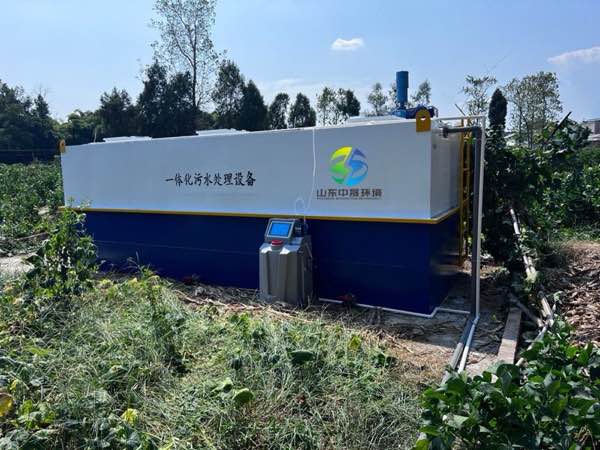
This decoupling of solids separation from gravity settling is the fundamental advantage of MBR. It allows operation at much higher Mixed Liquor Suspended Solids (MLSS) concentrations (8,000–15,000 mg/L vs 2,000–4,000 mg/L for CAS), which means the same biological treatment occurs in a significantly smaller volume. Modern integrated MBR wastewater treatment systems combine the bioreactor and membrane unit into a single compact package.
Effluent Quality Comparison
This is where MBR decisively outperforms CAS:
| Parameter | CAS Typical Effluent | MBR Typical Effluent | Notes |
|---|---|---|---|
| BOD₅ | 10–25 mg/L | < 2–5 mg/L | MBR achieves near-complete BOD removal |
| TSS | 10–30 mg/L | < 1 mg/L | Membrane acts as absolute barrier |
| Turbidity | 5–15 NTU | < 0.2 NTU | Critical for reuse applications |
| TN | 10–20 mg/L | 3–8 mg/L | Higher MLSS enables better nitrification |
| TP | 1–3 mg/L | 0.1–0.5 mg/L | With chemical dosing for both processes |
| E. coli | 10²–10⁴ CFU/100mL | < 10 CFU/100mL | MBR provides 4+ log pathogen removal |
The effluent quality difference is not marginal — it is transformational. MBR effluent, without any additional polishing, meets the requirements for most non-potable reuse applications including landscape irrigation, toilet flushing, industrial cooling water, and vehicle washing. CAS effluent typically requires tertiary filtration and disinfection to approach the same quality.
Footprint and Space Requirements
MBR systems typically require 30–50% less total footprint than equivalent CAS systems. This reduction comes from two sources:
- Elimination of the secondary clarifier: The clarifier alone accounts for 30–40% of the total tank volume in a CAS system. MBR eliminates it entirely.
- Higher MLSS operation: Operating at 10,000–12,000 mg/L MLSS vs 3,000–4,000 mg/L means the aeration tank can be 2–3× smaller for the same organic loading.
For sites where land is expensive or physically constrained — urban infill projects, resort islands, industrial facilities with limited real estate — this footprint advantage often justifies the MBR premium on its own. When the alternative is purchasing additional land or constructing multi-story treatment facilities, MBR's compact footprint translates directly to capital savings.
Energy Consumption
Energy is the area where MBR carries a genuine disadvantage. Typical specific energy consumption:
- CAS: 0.3–0.6 kWh/m³ (aeration dominates at 50–65% of total energy)
- MBR: 0.6–1.2 kWh/m³ (membrane air scouring adds 0.15–0.4 kWh/m³ above CAS aeration costs)
The energy premium for MBR has decreased significantly over the past decade. Early MBR systems consumed 1.5–2.5 kWh/m³. Modern flat-sheet and hollow-fiber membranes, combined with optimized aeration strategies (intermittent scouring, variable-speed blowers), have brought this down considerably. The latest generation of flat-sheet MBR membrane modules featuring low-resistance designs further reduce the energy penalty.
However, if your project involves water reuse, the fair comparison is MBR vs CAS + tertiary filtration + UV disinfection. In that scenario, the total energy consumption is often comparable, and MBR may actually be lower.
Membrane Costs and Lifespan
Membrane replacement is the unique operating cost that MBR carries and CAS does not. Current market data:
- Membrane cost: USD $30–80 per m² of membrane area, depending on type and manufacturer
- Typical membrane life: 7–10 years with proper operation and chemical cleaning protocols
- Annualized membrane replacement cost: Approximately USD $0.02–0.05 per m³ of treated water
This is a real cost, but it is often overstated in older analyses that used membrane prices from 10–15 years ago. As the MBR market has matured, membrane prices have dropped by approximately 60% since 2010, and membrane lifespans have extended from 5–7 years to 7–10+ years.
Operational Complexity
MBR systems require more operational attention than basic CAS in several areas:
- Membrane fouling management: Regular chemical cleaning (maintenance cleans every 1–4 weeks, recovery cleans every 3–6 months) is essential. Fouling rates must be monitored via transmembrane pressure (TMP) trending.
- Pretreatment requirements: MBR membranes are sensitive to hair, fiber, and sharp solids. Fine screening (1–2mm) is mandatory — coarser screening acceptable for CAS will damage membranes.
- Foam and scum management: High MLSS operation can exacerbate foaming. Anti-foam measures may be needed.
On the other hand, MBR eliminates several CAS operational challenges: sludge bulking, rising sludge in clarifiers, and clarifier scum management are all non-issues. The overall operator skill requirement is slightly higher for MBR, but the process is more stable and predictable once properly set up.
When MBR Is Clearly Worth It
Based on hundreds of project evaluations, MBR is the superior choice when:
- Water reuse is required or planned: MBR effluent quality makes reuse straightforward. If you are treating 500 m³/day and reusing even 50% at a value of $0.50/m³, that is $45,000/year in water savings — often enough to cover the entire MBR premium.
- Stringent nutrient limits apply: If your discharge permit requires TN < 10 mg/L and TP < 1 mg/L, MBR provides more reliable compliance with less operator effort than CAS + tertiary treatment.
- Space is constrained: If the land cost saved by MBR's smaller footprint exceeds the capital premium, the decision is straightforward.
- Effluent quality consistency is critical: MBR effluent quality is essentially independent of influent load variations, sludge settleability, and other factors that cause CAS effluent quality to fluctuate. For projects where a single permit exceedance carries severe penalties, this reliability has real economic value.
- The project is in a sensitive environment: Tourism areas, nature reserves, and coastal zones where any visible effluent impact is unacceptable.
When CAS Is the Better Choice
Conventional activated sludge remains the right choice when:
- Standard secondary treatment is sufficient: If your permit only requires BOD < 30 mg/L and TSS < 30 mg/L, CAS achieves this reliably at lower cost.
- Land is abundant and cheap: Rural treatment plants with ample space have no need to pay a premium for footprint reduction.
- Operator skill is very limited: While MBR is increasingly automated, CAS is more forgiving of neglected maintenance in the short term.
- Very large flows: For plants above 50,000 m³/day, the membrane area (and replacement cost) becomes very large. CAS with tertiary polishing may be more economical at this scale.
- Budget is severely constrained: When the project simply cannot accommodate the capital premium, a well-designed CAS plant is far better than an under-specified MBR.
20-Year Total Cost of Ownership Comparison
For a representative 500 m³/day domestic wastewater treatment project meeting EU-level discharge standards (BOD < 10 mg/L, TN < 15 mg/L, TP < 2 mg/L), the approximate 20-year cost comparison is:
| Cost Category | CAS + Tertiary | MBR |
|---|---|---|
| Equipment & installation | $280,000 | $370,000 |
| Civil works | $150,000 | $95,000 |
| 20-year energy | $290,000 | $380,000 |
| 20-year chemicals | $120,000 | $130,000 |
| 20-year membrane replacement | — | $85,000 |
| 20-year sludge disposal | $200,000 | $160,000 |
| 20-year labor | $180,000 | $160,000 |
| Total 20-year NPV | $1,220,000 | $1,380,000 |
The MBR premium at the 20-year mark is approximately 13% — significantly less than the 32% capital cost premium. If any water reuse value is captured, the economics tip in MBR's favor. This example uses conservative assumptions; in many real-world projects, MBR achieves cost parity or better over the system lifetime.
Frequently Asked Questions
Can I retrofit my existing CAS plant with MBR membranes?
Yes, and this is one of the most cost-effective ways to upgrade plant capacity or effluent quality without building new tanks. By replacing the secondary clarifier function with submerged membranes installed in the existing aeration tank (or in a dedicated membrane tank), you can typically double the plant's capacity within the existing footprint. The key requirement is ensuring adequate fine screening upstream and sufficient aeration capacity for both biological treatment and membrane scouring.
How sensitive are MBR membranes to industrial wastewater?
MBR membranes can handle most organic industrial wastewaters with appropriate pretreatment. However, they are sensitive to: oils and greases above 50 mg/L (causes irreversible fouling), solvents and aggressive chemicals (can dissolve or damage membrane polymers), and high temperatures above 40°C for PVDF membranes. For industrial applications, always conduct a membrane compatibility assessment and, ideally, a pilot trial before full-scale design.
What happens if a membrane module fails?
Modern MBR systems are designed with redundancy. A typical configuration includes multiple membrane cassettes or trains that can be individually isolated for cleaning or replacement without shutting down the plant. If a single membrane element develops a defect (detectable by a vacuum decay test or turbidity spike), it can be replaced in-situ within 1–2 hours. Well-operated MBR plants maintain a small inventory of spare membrane elements on-site for exactly this scenario.
Is MBR suitable for cold climate operation?
Yes, but with considerations. At water temperatures below 10°C, biological process rates slow (roughly halving for every 10°C drop), and membrane permeability decreases due to increased water viscosity. Design must account for both factors: larger bioreactor volume for the slower kinetics, and additional membrane area (or lower flux operation) for the reduced permeability. Many successful MBR installations operate year-round in Scandinavia, Canada, and northern China where winter water temperatures reach 5–8°C.