What Streams Does a Bucheon Data Center Need to Treat?
A Bucheon data center generally needs separate treatment paths for cooling-tower blowdown, sanitary wastewater, equipment-room drainage and makeup-water polishing. The correct scope cannot be fixed without the current sewer or receiving-water envelope, measured blowdown flow, cycles of concentration, seasonal water analysis and a comparison of reuse against compliant discharge. Treatment equipment should follow the owner’s confirmed water balance and chemistry rather than assumptions transferred from another Korean city.
Cooling blowdown contains dissolved salts, suspended matter, residual biocides, corrosion inhibitors and scale-control chemicals. UGA Extension TP-121, cited in the Korean cooling-blowdown treatment train, also identifies trace copper, zinc and iron released through condenser and piping corrosion. These constituents affect pretreatment, membrane compatibility, disinfection and the receiving route.
For evaporative cooling, the theoretical blowdown ratio is 1 ÷ (CoC − 1). Genesis Water Technologies (2026) gives approximately 25% at 4 CoC and 20% at 6 CoC. The same source reports that measured blowdown commonly exceeds the theoretical balance by 15–30% because of unmeasured leaks, side-stream losses and emergency dumps. That margin belongs in the treatment design flow.
| Stream | Principal design issue | Recommended treatment boundary |
|---|---|---|
| Cooling-tower blowdown | Concentrated salts, treatment chemicals and corrosion products | Equalization, chemical control, solids or oil removal, filtration and, where reuse targets justify it, UF/RO |
| Sanitary wastewater | Organic load, solids and pathogens | Keep hydraulically separate; assess biological treatment and local discharge requirements independently |
| Equipment-room drainage | Oil, grease, solids and possible chemical contamination | Characterize each drain before deciding whether it can enter the blowdown train |
| Makeup-water or process-water polishing | Hardness, silica, particulates and trace metals | Specify filtration, softening or membrane polishing from the source-water analysis and end-use requirements |
Request 12 months of incoming-water analysis and three months of measured tower influent, blowdown, makeup and drain flows. The supplied research does not establish Bucheon’s water profile, so seasonal values must come from testing rather than a municipal average. The broader data-center wastewater treatment planning guide provides useful workflow context, but its site assumptions cannot replace Bucheon data.
Which Korean Permits and Local Conditions Control the Design?
South Korea’s primary industrial-wastewater statute is the Water Environment Conservation Act, administered by the Ministry of Environment through regional enforcement, as described in the Ulsan discharge-route reference. The applicable limits must come from the route selected for the Bucheon project, not from another municipality’s permit.
First establish whether the final discharge enters a municipal sewer, goes to a wastewater treatment plant, or uses a direct receiving-water outfall. The Ulsan reference states that parameter limits and enforcement differ by route. A direct coastal discharge may also invoke the Marine Environment Management Act under the Ministry of Oceans and Fisheries. A sewer agreement and a coastal-discharge permit are not interchangeable.
Before issuing the RFQ, obtain the current Bucheon sewer discharge agreement or receiving-water approval. It should define permitted flow, temperature conditions, regulated parameters, sampling frequency, analytical methods and discharge fees. Ask the authority to confirm whether any flow or concentration ceiling applies, whether cooling blowdown is accepted, and how emergency or intermittent discharges will be handled.
Planning parameters should include TDS, TSS, pH, residual chlorine or other biocide residues, discharge temperature, and oil and grease where generator or UPS cooling equipment is present. Cu, Zn and Fe should also be included in site sampling because the Daejeon reference identifies them as relevant corrosion-derived constituents. No numerical Bucheon limits are supplied in the research; they must remain authority inputs, not equipment-design assumptions.
Compliance sampling should use a KECO-designated laboratory, as described in the Daejeon guide. Clarify whether pretreatment results can support an internal reuse decision, which parameters require independent compliance testing, and who owns sample collection, chain of custody and laboratory certification.
How Should the Bucheon Treatment Train Be Configured?
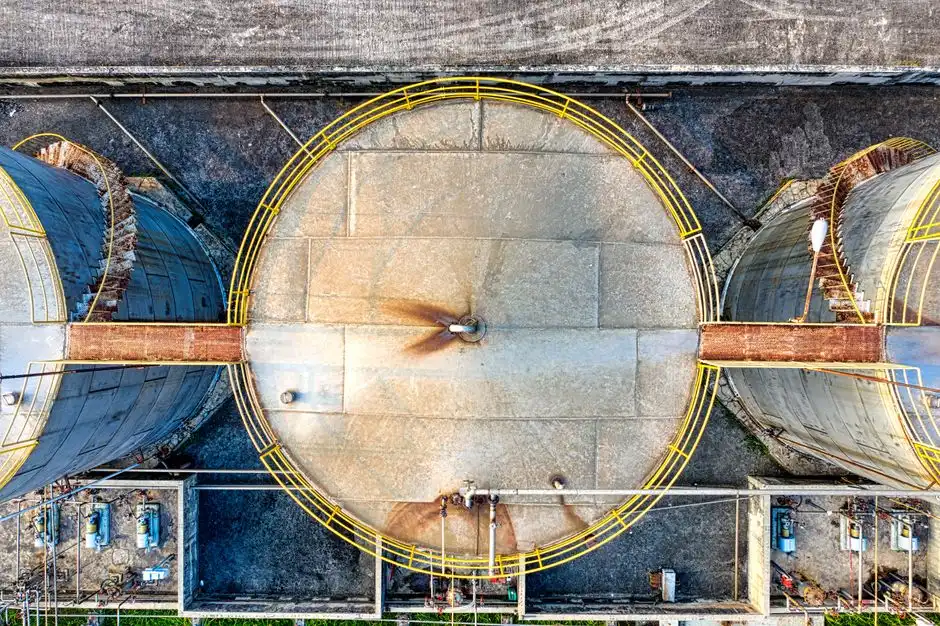
A defensible blowdown train protects the membranes first and keeps concentrate and regeneration waste within the owner’s approved management route. Unit selection depends on measured chemistry, flow variability, cooling chemicals and the final discharge or reuse decision.
- Equalize the blowdown. The Daejeon guide recommends planning equalization for at least 12–24 hours of peak flow to absorb variable purges and emergency dumps. This is a layout reference, not a Bucheon regulatory requirement.
- Control chemistry and remove protected contaminants. Use PLC-controlled pH and antiscalant dosing. Consider DAF where suspended solids, colloids, oil and grease or cooling chemicals justify it; the Daejeon guide prefers DAF where the tower carries biocides and oils.
- Protect the membranes. Apply multi-media filtration for suspended-solids and SDI reduction, followed by 0.03 µm PVDF UF for colloids, bacteria and residual oil. The specified 0.03 µm PVDF ultrafiltration pretreatment should be confirmed against feed-water compatibility, rather than accepted by pore size alone.
- Reduce hardness and evaluate silica. Size industrial softening from seasonal calcium, magnesium, silica and chloride results. Include regeneration brine in the residual-management plan.
- Polish for reuse when justified. The Daejeon reference specifies a 65–75% recovery brackish-water RO skid, with two-pass configurations capable of up to 95% recovery when sewer charges justify the added complexity. The industrial RO blowdown-recovery system should be selected from feed-specific projections for recovery, concentrate quality and cleaning demand.
- Control biology and reuse quality. The Daejeon train includes UV on the reuse loop; the Ulsan reference identifies chlorine dioxide as an alternative for cooling-loop microbial control. Select the control strategy around the source water, residual biocide program, downstream tower chemistry and operator controls.
| Process stage | Primary function | Bid requirement |
|---|---|---|
| Equalization | Absorb purge variability and emergency dumps | Confirm working volume against measured peak flow |
| pH and antiscalant dosing | Condition feed for precipitation control and membrane protection | Provide PLC interlocks, chemical tanks, calibration and duty sequence |
| DAF or lamella clarification | Remove suspended solids, colloids and applicable oil | Provide feed-specific loading, sludge handling and wash-water balance |
| Multi-media filter and UF | Reduce particulates, SDI, colloids and biological load | State membrane material, pore rating, cleaning limits and replacement policy |
| Industrial softener | Reduce hardness before RO | Size from seasonal analysis; include brine storage and disposal |
| RO and optional disinfection | Produce cooling make-up water and concentrate residual streams | Document recovery, permeate quality, concentrate volume and cleaning strategy |
Treat sanitary wastewater separately where objectives differ. The Ulsan reference describes paired MBR trains for the sanitary stream so it does not load seawater membranes. Do not specify seawater-rated UF or RO merely because the project is in Korea; the Ulsan values concern a seawater case, while a conventional Bucheon freshwater or municipal-water loop requires its own feed analysis.
Should Bucheon Discharge, Reuse or Reach Near-Zero Liquid Discharge?
Discharge, cooling-water reuse and near-zero liquid discharge are different engineering outcomes, and their suitability depends on Bucheon’s receiving route, water chemistry, land and operating constraints. The Daejeon guide presents the same three-path framework and reports that capital cost rises as reuse and ZLD equipment is added.
Discharge is the route where treatment is primarily designed around the sewer agreement or receiving-water permit. It still requires characterization, flow control, pretreatment where necessary and compliance monitoring. It should not be selected merely because it has the lowest initial equipment cost.
Reuse converts treated blowdown into cooling make-up water, reducing freshwater demand and the volume sent to the sewer. It is not permission to discharge, and permeate quality alone does not establish reuse acceptability. The owner must also define storage, distribution, microbial control, cooling chemistry limits and any make-up blending strategy.
Near-ZLD requires a defensible route for the final concentrate and, for a true ZLD train, a crystallizer. That route needs further treatment, energy and solid-residue management. The economics should be calculated from owner-supplied Bucheon tariffs and site constraints, not a generic claim that water scarcity justifies the equipment.
The Ulsan reference reports RO performance of 95–99% dissolved-solids rejection, 50–85% recovery and 10–50 mg/L permeate TDS for its seawater case. Those are reference values, not Bucheon guarantees. The same reference cites approximately US$1.50–3.00 per thousand gallons for RO operating cost and 15–25 kWh per 1,000 US gallons of distillate for MVC energy, both from Genesis Water Technologies. Apply these only as international sensitivity checks until local electricity, chemical, water and sewer prices are supplied.
| Decision path | Principal benefit | Principal risk | Inputs required from the owner |
|---|---|---|---|
| Compliant discharge | Simplest treatment boundary | Permit, sewer capacity and fee exposure | Current agreement, flow ceiling, parameter limits and tariff |
| Cooling-water reuse | Reduces freshwater intake and discharge volume | Permeate, microbial control and cooling-chemistry compatibility | Reuse target, feed analysis, tower operating limits and storage arrangement |
| Near-ZLD | Minimizes liquid discharge | Concentrate handling, energy demand and capital cost | Land, utilities, solid-residue route and comparative total-cost model |
Ask every bidder to use the same owner-supplied industrial water tariff, sewer fee, electricity price, chemical prices, freshwater savings and compliance assumptions. The supplied research contains no Bucheon tariffs or local capex, so a Korean payback period would be unsupported.
What Must Be Resolved Before Ordering a Bucheon Treatment Skid?
A purchase order should follow completion of the water balance, permit review, seasonal chemistry review and route selection. Skid dimensions and equipment guarantees cannot be defensible before those inputs are issued to bidders.
- Provide the operating basis. Include average and peak IT load, cooling technology, makeup-water fraction, CoC, theoretical and measured blowdown, sanitary load, equipment-room drains and intended reuse fraction.
- Provide analytical data. Submit 12 months of incoming-water analysis, seasonal peaks, the cooling-chemical inventory and representative effluent chemistry. For direct-liquid or immersion cooling, disclose refrigerant-related constituents and potential PFAS concerns identified in the Daejeon reference.
- Define the permit route. Issue the current Bucheon agreement or approval, parameter schedule, sampling frequency, temperature conditions and analytical methods. Identify who accepts the proposed flow and chemistry.
- Set the commercial basis. Give all bidders the same owner-supplied tariffs and total-cost-of-water assumptions, including freshwater savings, sewer charges, chemicals, energy, maintenance and concentrate disposal.
- Require skid documentation. Request skid-mounted, factory-tested modules, PLC controls, FAT scope, P&ID, electrical and I/O documentation, spare parts, commissioning support, delivery terms and a written schedule. These are procurement requirements, not published Bucheon price or lead-time data.
- Require membrane commitments. Bidders should state membrane material, operating and cleaning limits, feed compatibility, projected replacement cycles, cleaning chemistry and the recommended spare-parts strategy.
Ask bidders to state exclusions for civil work, chemical delivery, residual disposal, laboratory sampling, permit support and site utilities. Tie the purchase schedule to the sewer agreement, baseline monitoring and commissioning milestones. The research provides no published Bucheon lead time, so delivery commitments must be confirmed in writing. The chemical-dosing engineering specification guide can support control and documentation requirements, but it does not establish site costs.
Frequently Asked Questions
How much does a Bucheon data-center blowdown treatment skid
Frequently Asked Questions
How much does a wastewater and cooling blowdown treatment system cost for a data center in Bucheon-si?
Capital expenditure for a turn-key treatment system in Bucheon typically ranges from $250,000 to $850,000 USD, depending on flow rates and local discharge compliance requirements. Costs fluctuate based on the integration of advanced technologies like Reverse Osmosis (RO) or Electrodialysis Reversal (EDR) required to meet the specific water quality standards mandated by the Bucheon-si municipal sewer ordinances.
Should a Bucheon data center use UF and RO to reuse cooling-tower blowdown?
Yes, implementing Ultrafiltration (UF) followed by Reverse Osmosis (RO) is highly recommended for data centers in Bucheon to achieve water recovery rates of 75% to 90%. Given the local focus on environmental sustainability and the cost of municipal water supply in South Korea, this multi-stage treatment effectively removes suspended solids and dissolved salts, allowing the permeate to be recycled back into the cooling tower as makeup water.
How much blowdown should the treatment skid be sized for at 4 or 6 cycles of concentration?
For a data center operating at 4 cycles of concentration, the treatment skid must be sized to handle approximately 33% of the total evaporation rate as blowdown. If the facility increases efficiency to 6 cycles of concentration, the required blowdown treatment capacity drops to approximately 20% of the evaporation rate, significantly reducing the hydraulic load on the treatment system and lowering chemical consumption costs.
What should I require from a Korean wastewater treatment skid supplier before ordering?
You should require a detailed Performance Guarantee document that specifies effluent quality parameters compliant with the Bucheon-si Environmental Protection Act, including limits on Total Dissolved Solids (TDS), Biochemical Oxygen Demand (BOD), and heavy metal concentrations. Additionally, demand a comprehensive P&ID (Piping and Instrumentation Diagram), a list of locally sourced spare parts with lead times, and evidence of K-mark or equivalent domestic safety certifications for all electrical components.
Can I finalize the Bucheon treatment design before receiving the sewer discharge agreement?
It is strongly advised against finalizing the design until the sewer discharge agreement is signed, as Bucheon municipal authorities may impose site-specific discharge limits that differ from national standards. Discharge permits often dictate maximum allowable concentrations for pollutants such as nitrogen, phosphorus, and conductivity, which directly influence the selection of treatment processes and the sizing of the final polishing stages in your skid design.