Start by separating the data center's water streams
A Howrah data center needs a source-specific treatment strategy, not one generic wastewater plant. Segregate domestic sewage, cooling-tower blowdown, process wastewater and construction sewage; then characterize each before sizing equipment. Blowdown typically carries 1,200–6,000 mg/L TDS, 10–50 mg/L suspended solids and concentrated treatment chemicals, so it typically needs filtration, scaling control and membrane treatment before reuse as cooling makeup. UF removes solids and biological material, while RO can produce 10–50 mg/L TDS permeate at 50–85% recovery. Reuse should precede discharge treatment, and ZLD should be reserved for sites where recovery and reject management justify its higher cost.
The first design task is a source-by-source register, because a common outlet or permit should not be assumed to cover every stream. Record the source, flow, destination, treatment objective and responsible authority for each line. Domestic sewage requires a sanitary treatment route; equipment washdown may have detergents, oil or suspended contaminants; process wastewater needs its own contaminant profile; construction sewage requires temporary sediment control; and rainwater must be assessed for first-flush quality and reuse potential. Confirm the receiving route with the relevant authority and sewerage operator rather than assuming that a discharge approval for one stream applies to all flows.
Cooling architecture must be fixed alongside the water strategy. Schneider Electric reported in September 2026 that closed-loop direct-to-chip systems can recirculate more than 95% of coolant, with relatively small losses from maintenance and leaks. That does not remove all facility water demand, but it can reduce evaporative consumption where technically suitable. Future rack density, heat rejection, coolant temperature and available water source therefore belong in the Day One design basis.
| Stream | Possible destination | Design requirement | Decision to confirm |
|---|---|---|---|
| Cooling-tower blowdown | Cooling makeup; further concentration; compliant discharge | Control TDS, hardness, suspended solids and treatment-chemical residuals | Cooling chemistry compatibility and recovery target |
| Domestic sewage | Toilet flushing; compliant discharge | Separate sanitary treatment and reuse-quality assessment | Sewer connection, consent and reuse approval |
| Equipment washdown and process wastewater | Washdown reuse; treatment; discharge | Characterize oil, grease, chemicals and suspended solids | Applicable discharge and reuse conditions |
| Construction sewage and rainwater | Controlled discharge or temporary reuse | Sediment, pH and runoff management | Construction-phase requirements and site drainage controls |
For the preliminary sanitary and process-stream concepts, an underground integrated sewage-treatment system and an DAF machine for oil and solids separation may be relevant, but equipment selection should wait until the stream register and sampling results are complete.
Characterize the wastewater before selecting equipment
Representative sampling must precede flow, membrane or pretreatment sizing because cooling blowdown can contain enough dissolved salts, suspended solids and treatment chemicals to change the treatment route. Collect samples by stream and operating condition, then record flow, temperature, pH, TDS or conductivity, total hardness, alkalinity, calcium, magnesium, silica, suspended solids, oil and grease where relevant, residual chlorine, biocides, scale and corrosion inhibitors, and biological indicators.
Genesis Water Tech reports a preliminary screening range of 1,200–6,000 mg/L TDS, 10–50 mg/L suspended solids and 4–8 times the makeup-water dissolved solids for cooling blowdown. These are warning values for sampling and conceptual design, not Howrah design parameters. Blowdown volume directly correlates with cycles of concentration, so record the makeup-water source, cycles of concentration, evaporation, drift, blowdown-control method, operating hours and expected future load. The same source states that a cooling tower operating at 4 cycles of concentration loses approximately 25–30% of makeup water to blowdown; higher cycles reduce discharge but intensify water-quality challenges.
The sample plan should distinguish normal operation, high-load operation, high-blowdown operation, startup and shutdown. A single composite sample can conceal short-duration peaks in suspended solids, biocide residuals or conductivity. The designer should also state design flow, peak flow, future expansion and minimum continuous-turndown assumptions. The supplied research contains no Howrah flow estimate, so rack count or freshwater demand alone cannot support an equipment size.
| Measurement or operating record | Why it changes the design | Information required before ordering |
|---|---|---|
| Flow and operating pattern | Sets hydraulic capacity, storage and turndown | Measured average, peak, minimum and future flow by stream |
| TDS or conductivity | Indicates osmotic load and blowdown concentration | Makeup and blowdown ranges by operating condition |
| Hardness, alkalinity and silica | Defines scaling risk and RO pretreatment | Seasonal values and chemical-phemistry profile |
| Suspended solids and biological indicators | Determines filtration and UF requirements | Representative solids, biofilm and turbidity data |
| Residual chemicals | Protects membranes and affects discharge acceptance | Biocide, antiscalant, corrosion inhibitor and phosphate concentrations |
Automatic chemical dosing should be specified from measured feed chemistry, not from generic dosage assumptions. The automatic chemical-dosing system must coordinate antiscalant, pH control and biocide requirements, while the treatment parts, valves and media schedule should reflect the selected filtration and membrane materials.
Match the treatment route to the final water use
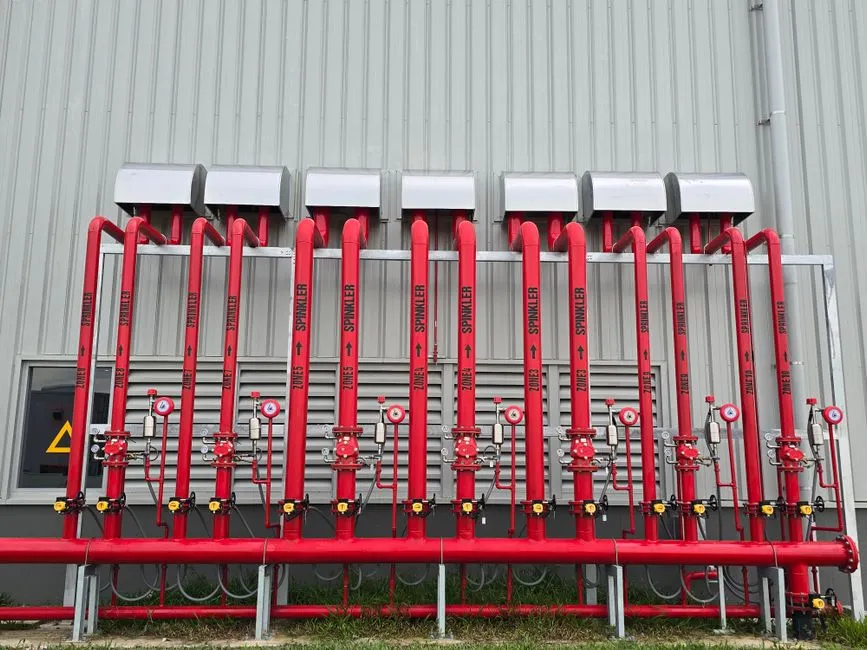
The treatment route follows the required water quality and reject destination, not the available technology. Define the target permeate quality, recovery, reject route, monitoring requirement and total operating cost before selecting equipment. A cooling-tower treatment train and a discharge-compliance train are not interchangeable, and ZLD is a separate capital and operating decision rather than an additional membrane option.
For cooling-tower makeup reuse, Genesis Water Tech reports typical recovery of 60–85%. The treatment must reduce suspended solids, control scaling potential and address biological content while remaining compatible with the cooling-water chemistry program. Where low-TDS permeate is required, evaluate an industrial RO system for low-TDS cooling makeup; where solids and biological control are the main objectives, UF systems for cooling-blowdown pretreatment may be the relevant unit.
For compliant discharge, design against the actual permit conditions. Genesis Water Tech notes that some jurisdictions enforce TDS limits below 1,500 mg/L and that direct-discharge fees can be $5–15 per thousand gallons in water-stressed regions. These are comparative benchmarks, not Howrah limits. The owner must obtain the applicable consent, sewer conditions, sampling method, disposal route and fees before selecting a discharge train.
Full ZLD uses membrane concentration followed by thermal evaporation and crystallization. The cited train reports overall recovery of 95–99%, with solid waste below 1% of the original blowdown volume, but capital cost is $3–8 million and operating cost is $5–15 per thousand gallons treated, according to Genesis Water Tech. Partial recovery is usually the first comparison. A sourced configuration combines RO at 50–75% recovery with MVC treatment of the concentrate at 95% recovery, reaching 85–95% overall recovery.
| Outcome | Water-quality objective | Indicative recovery from the cited source | Reject route and decision |
|---|---|---|---|
| Cooling-tower makeup reuse | Low enough scaling, solids and biological load for the cooling program | 60–85% | Permeate to makeup; define concentrate disposal or further concentration |
| Process or washdown reuse | Fit for the specified non-potable use | Application-dependent | Set acceptance criteria and use-point controls |
| Compliant discharge | Meet the actual consent and sewer conditions | Not established by the supplied research | Confirm receiving authority, sampling basis and disposal route |
| Partial recovery | Increase reuse while reducing liquid reject | 85–95% overall in the cited RO-plus-MVC configuration | Assess concentrate treatment and residual discharge |
| Full ZLD | Eliminate liquid discharge and recover water | 95–99% | Crystallization, solids handling and disposal must be included |
For a comparable decision frame, see data-center cooling blowdown treatment in Teni. It does not establish Howrah flows, permits or costs; those remain site-specific inputs.
Build a pretreatment-to-recovery treatment train
A practical blowdown-recovery train removes contaminants in sequence and protects downstream membranes from solids, colloids and scale-forming species. The starting point depends on the characterized feed, not on a generic plant layout. For solids removal, evaluate a multi-media filter for blowdown pretreatment or side-stream filtration where the loading and operating objective justify it.
Genesis Water Tech reports that side-stream filtration lowers suspended solids and biological loading, with installed capacity commonly equivalent to 1–5% of total circulation flow, depending on conditions and objectives. Side-stream filtration protects the cooling system and can improve blowdown quality before recovery; it is not automatically a substitute for a dedicated blowdown filter. Design the selected filtration stage around solids loading, backwash or cleaning method and disposal route.
Use UF where suspended solids, colloids and biological material are the principal barriers, or as pretreatment ahead of RO. HydropureWater states that its UF systems use 0.03-micron PVDF membranes, handle 2,000–40,000 L/h and include automatic backwash and air scour; the cited application range is 90–95% recovery. These supplier parameters still require confirmation against the selected module arrangement and Howrah feedwater conditions.
RO should be protected by filtration below the source’s 10–15 micron feed target, antiscalant dosing, pH control and an appropriately scaled membrane arrangement. The same source gives typical blowdown-RO operating pressure of 150–400 psi, recovery of 50–85% and permeate TDS of 10–50 mg/L. The antiscalant and pH-control package must be coordinated with the cooling-water chemistry program, not added as an isolated pretreatment component.
NF is a lower-pressure alternative when partial hardness and sulfate removal is sufficient. Genesis Water Tech reports 70–85% recovery and permeate TDS at 30–50% of feed concentration. RO remains the stronger choice where complete demineralization is required, but NF should remain in the comparison when softening—not full TDS removal—is the controlling requirement.
| Process stage | Function | Design basis | Residual stream |
|---|---|---|---|
| Filtration or side-stream filtration | Remove suspended solids and reduce biological loading | Measured solids load, circulation flow and selected objective | Filter backwash or separated solids |
| Chemical conditioning | Control scale, corrosion and feed chemistry | Hardness, alkalinity, silica, pH and inhibitor data | Chemical residual in the reject |
| UF | Remove solids, colloids and biological material | Feed flow, recovery, cleaning method and permeate quality | UF concentrate, potentially returned to blowdown |
| RO or NF | Reduce dissolved solids or selectively remove hardness and sulfate | Feed chemistry, recovery target and scaling calculation | Concentrate requiring concentration, disposal or a defined high-recovery process |
| Polishing, blending or diversion | Meet the final-use specification | Blend target, conductivity alarm and off-spec response | Diverted flow |
Plan the concentrate and solids path before committing. UF concentrate can return to the blowdown stream where the water balance permits; RO reject needs further concentration, permitted disposal or a defined high-recovery process. The RO equipment scope and UF pretreatment scope should therefore include interfaces, valving, controls and reject disposition.
Protect reliability with monitoring, controls and residual management

The control system should detect deteriorating feed quality before it becomes a membrane-cleaning event or cooling-system failure. Continuously trend conductivity or TDS and automatic blowdown control. Schedule sampling for hardness, alkalinity, silica, suspended solids, pH and residual treatment chemicals, with additional checks where the cooling program or permit requires them.
Use permeate flow, normalized permeate conductivity and differential-pressure trends to identify fouling or membrane-performance loss. Genesis Water Tech identifies chemical cleaning every 1–3 months for UF, subject to feed-water quality. That is not a maintenance calendar for a Howrah plant; it is the source’s screening interval for setting operator attention and budget. Normalized data also helps distinguish membrane fouling from feedwater or instrument variation.
Integrate antiscalant, pH adjustment and biocide control with the cooling-water chemistry program. Treatment chemicals accumulate in blowdown and can interfere with membrane operation or affect discharge acceptance. The valves, media and treatment-parts specification should identify chemical compatibility, and the membrane and filter-element schedule should be linked to the actual feed analysis and cleaning strategy.
RO permeate can serve cooling-tower makeup directly or through controlled blending with standard makeup. Before startup, define the final blend target, conductivity alarm and automatic diversion response. The system also needs a reject-flow balance and a bypass that prevents untreated or off-spec water from entering the cooling loop. If ZLD is selected, include a defined crystallization and solids-handling plan rather than treating liquid discharge as an unresolved by-product.
Reliability comes from an agreed water balance, a defined permeate specification, instrumented membrane performance and an automatic response to off-spec flow—not from equipment capacity alone.
Verify the Howrah business case before ordering equipment
The owner must first confirm the priority: reduce freshwater consumption, lower discharge load, increase water resilience or eliminate liquid discharge. Genesis Water Tech describes reuse as the usual balance of water benefit, technical complexity and return, while ZLD carries the highest capital and operating costs. This ordering should be recorded in the design basis because it determines the acceptable recovery, residual route and technology scope.
Compare life-cycle cost rather than equipment price alone. Include energy, chemicals, membrane replacement, cleaning, solids handling, freshwater, disposal and operator attention. A cited 50,000 GPD RO benchmark is $250,000–500,000 installed and $1.50–3.00 per thousand gallons treated, according to Genesis Water Tech. It is only a preliminary comparator, not a Howrah quotation: local power, duty, equipment scope, freight, import conditions, taxes and installation all require current vendor pricing.
| Procurement check | Evidence the bidder must provide | Why it affects the decision |
|---|---|---|
| Flow and recovery | Guaranteed flow, recovery and permeate quality at the actual feed chemistry | Prevents oversized or underperforming equipment |
| Reject management | Complete concentrate, sludge and solids route | Exposes an unfunded operating or disposal obligation |
| Life-cycle cost | Energy, chemicals, cleaning, replacement, disposal and operator inputs | Supports comparison beyond purchase price |
| Local compliance | Applicable consent, sewer conditions and authority interactions | Prevents assuming a non-applicable discharge limit |
| Performance evidence | Freshwater displaced, blowdown avoided, availability and recovered-water quality | Creates a referenceable business case |
Confirm the applicable West Bengal environmental consent, municipal sewer conditions and project-specific reuse requirements with the relevant authorities. The supplied research does not establish a current Howrah permit or numerical discharge limit. It does, however, identify national reuse signals: Schneider Electric reported in September 2026 that the 2025 rules require bulk users consuming more than 5,000 litres per day to increase wastewater treatment and reuse, while the BEE’s 2023 District Cooling Guidelines encourage treated wastewater for cooling-tower makeup where feasible. The project team must confirm how these references apply to the facility rather than treating them as a complete local approval.
Build the business case from measured outcomes: freshwater displaced, blowdown volume avoided, disposal cost avoided, recovered-water quality and operating availability by source and consumptive use. The ZLD versus high-recovery RO for data centers comparison is useful for structuring that decision, while data-center cooling blowdown treatment in Teni provides a separate Indian concept reference. Neither replaces Howrah-specific sampling, permitting and vendor quotations.
Frequently Asked Questions
How should a Howrah data center size its cooling-blowdown recovery system?
Size it from measured average, peak and minimum blowdown flows, not from rack count or total freshwater use alone. The calculation must also include future cooling-load growth, minimum continuous turndown, the selected recovery target and the permitted fate of the concentrate. The supplied research provides no Howrah flow estimate, so the owner should require a metered flow survey and an operating forecast before requesting a final capacity.
Should the project select UF, RO, NF or zero liquid discharge?
Select UF when solids, colloids and biological control dominate, and evaluate RO when low-TDS permeate is required for cooling makeup or blending. NF is relevant where partial hardness and sulfate removal is sufficient. Treat full ZLD as a separate high-cost option with an evaporation, crystallization and solids-disposal basis. For a comparable process sequence, review data-center wastewater treatment design example.
What should a buyer request when evaluating an ETP supplier?
Request membrane data, a recovery guarantee at the actual feed chemistry, antiscalant compatibility, automatic controls, local service capability, an energy calculation and a complete reject-management proposal. Also ask the bidder to demonstrate how off-spec permeate is diverted and how membrane cleaning, replacement and solids handling are included in the life-cycle cost.
What cost inputs are needed before comparing supplier quotations in India?
Ask suppliers to quote installed equipment, membranes, pretreatment, chemical dosing, controls, local utilities, freight or import conditions, installation, commissioning, training, maintenance, membrane replacement, energy and reject disposal. The cited U.S. RO and ZLD figures are screening benchmarks only. A comparable Indian treatment concept is available in data-center cooling blowdown treatment in Teni, but current Howrah pricing requires site-specific quotations.