Start with Design Flow, Not Container Size
Sizing a containerized MBR STP for a Seattle residential or camp project starts with the design flow in m³/day, not the container size. Derive average dry-weather flow from per-capita loading — Pure Aqua's MBR-C reference table uses 50 gpd per capita to translate "Approximate Population" into container capacity — then apply a peaking factor for camp surges, then map the daily flow to a container configuration. MENA-Water package plants range from a few m³/day to several thousand m³/day in a single 40-ft ISO container, and Pure Aqua offers 40' and 20' high-cube insulated, seaworthy containers built around 0.04 µm PVDF hollow-fiber modules. Confirm Seattle climate interaction with the membrane's 68–86°F operating envelope and design temperature of 68°F (20°C) before finalizing any container order.
The sequence matters because every downstream decision — container count, blower sizing, tank volume, permeate pump rating — is anchored to the m³/day figure. Start by separating the service population into residential occupants and camp occupants. Residential occupancy is steady: a 40-unit community on a year-round basis behaves very differently from a 200-bed summer camp that loads in on Friday and loads out on Sunday. Each population type uses a different peaking factor when you translate people into Peak Daily Flow.
Compute Average Dry-Weather Flow (ADWF) first, using the 50 gpd per capita reference value that Pure Aqua publishes in its MBR-C capacity table. For a 200-bed camp, that converts to 10,000 gpd ADWF, or roughly 38 m³/day. Multiply ADWF by a peaking factor — the standard residential peaking factor of 2.0–2.5 (per Ten States Standards and most state design manuals) and the more conservative camp factor of 2.5–4.0 — to obtain Peak Daily Flow, which becomes the design number you hand to the MBR supplier. Before locking container count, verify the design flow sits inside the daily throughput range MENA-Water states for its containerized MBR package plants: "a few m³/day to several thousand m³/day," with more than 1,200 m³/day achievable in a single 40-ft ISO container.
| Step | Input | Calculation | Result for a 200-bed camp |
|---|---|---|---|
| 1. Service population | Occupancy count by type | Residents vs. camp occupants (split) | 200 camp beds |
| 2. Per-capita loading | 50 gpd per capita (Pure Aqua MBR-C reference) | 200 × 50 gpd | 10,000 gpd ADWF ≈ 38 m³/day |
| 3. Peaking factor | 2.5–4.0 for camps; 2.0–2.5 for residential | 10,000 gpd × peaking factor | 25,000–40,000 gpd peak (≈95–151 m³/day) |
| 4. Throughput check | MENA-Water range: a few m³/day to several thousand m³/day per plant | Compare peak to single-container capacity | Fits inside one 40-ft ISO container envelope |
Match the Daily Flow to a Containerized MBR Configuration
Once the peak daily flow is on paper, the next decision is whether the project needs a single 20' high-cube container, a single 40' high-cube container, or multiple containers. Pure Aqua publishes that its MBR-C line ships in both 40' and 20' high-cube containers with insulated walls, zero water leakage, an enhanced container structure, and a seaworthy rating, with the choice driven by capacity. MENA-Water states that more than 1,200 m³/day can be filtered in a single 40-ft ISO container, with internal tanks in stainless steel sheets and factory quality testing that enables plug-and-play site delivery. For a 200-bed camp peaking around 100–150 m³/day, a single 40' HC container is the typical envelope; a smaller residential community may fit in a 20' HC.
Layout matters as much as length. MENA-Water's U-Version places aeration and buffering inside underground water tanks, which minimizes the visible footprint and is the right choice for a permanent residential community where the treatment equipment should not dominate the site. The I-Version is fully integrated inside the container and is described by MENA-Water as the right choice "for mobile applications or if the plants need to be shifted to new locations" — exactly the use case for a seasonal camp that may be decommissioned and re-deployed. If the camp already separates grey water (showers, washbasins) from black water, MENA-Water notes that grey-water systems "permit the recycling of wastewater from showers and wash basins … allowing you to save up to 40 % on fresh water." In that case, size the MBR on the black-water stream only and handle grey water with a separate recycling skid such as this containerized MBR wastewater treatment system sized to the black-water fraction.
| Configuration | Best fit | Visible footprint | Mobility |
|---|---|---|---|
| Pure Aqua 20' HC MBR-C | Small residential community, lower peak flow | One 20' container pad | Relocatable with crane |
| Pure Aqua 40' HC MBR-C | Larger residential or year-round camp | One 40' container pad | Relocatable with crane |
| MENA-Water U-Version (40-ft ISO) | Permanent community, buried buffering and aeration tanks | Container + underground tanks | Fixed installation |
| MENA-Water I-Version (40-ft ISO) | Mobile or seasonal camp, plug-and-play redeployment | Single container, all tanks internal | Designed for relocation |
Confirm the Membrane Specification Will Hit Seattle's Effluent Targets
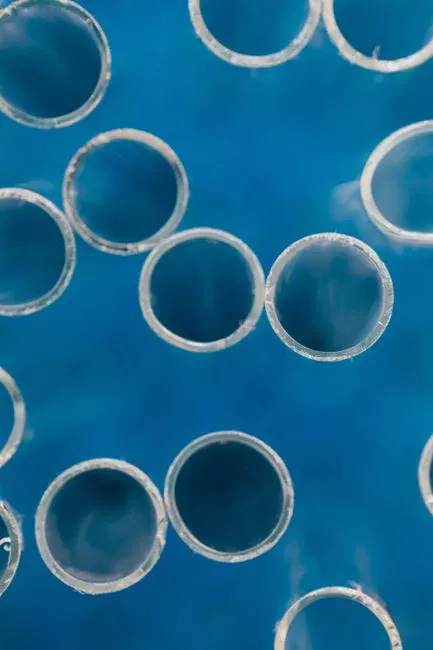
Membrane specification is the part of the submittal that actually determines whether the system meets reuse or discharge limits. Pure Aqua's MBR-C uses hollow-fiber ultrafiltration with a nominal pore size of 0.04 µm, mounted in submerged membrane modules with TIPS PVDF construction, and Pure Aqua states the system achieves "complete retention of bacterial flocs, suspended solids, small colloids, and viruses." MENA-Water's package plants use ultrafiltration membranes arranged on a stainless-steel frame and state a 99.9999% reduction of virus and bacteria. Both vendors describe the ultrafiltration pore size — HUBER and MENA-Water both put it in the 2–100 nm range — and both eliminate the secondary clarifier that a conventional activated-sludge plant would require, which is the main reason the container footprint stays small.
Air-scour and cleaning intervals are the practical numbers an operator will track. Pure Aqua lists "submerged HF membrane modules equipped with coarse bubble diffusers" and a "built-in membrane cleaning and air scoring system" as standard. MENA-Water states that the membranes "don't need regular chemical cleaning except one or two maintenance clearings per year." For any site discharging to surface water or proposing irrigation reuse, specify the optional anoxic zone for denitrification (NO3 removal) that Pure Aqua lists, and pair the MBR with a PVDF flat-sheet MBR membrane module or a downstream UF polishing step if the effluent target is tighter than standard secondary.
Check the Operating Envelope Against Seattle's Climate
This is the failure mode that the top vendor pages skip. Pure Aqua rates the MBR-C for an operating temperature range of 68–86°F (20–30°C) with a design temperature of 20°C (68°F), and an electrical supply of 460V/3Ph/60Hz. Seattle winter ambient temperatures frequently sit below the 20°C design point, so container insulation alone — Pure Aqua lists "insulated container walls" as a standard feature — is not enough to keep mixed-liquor temperature inside the rated window when outdoor air drops into the 30s °F. Specify enclosure heating, heat tracing on the permeate and air lines, or a building skin around the ISO container, and reflect the slower biological kinetics below 20°C in the tank sizing rather than copying a warm-climate MBR design verbatim.
Pre-treatment is part of the climate story as well as the membrane-protection story. Pure Aqua's MBR-C passes feed water through a drum screen with 1.5 mm perforation "to mitigate suspended solids and protect membranes' surface" before the bioreactor. In Seattle's wet season, inflow carries higher inorganic suspended solids from runoff and camp access roads, and cold water increases membrane fouling risk — the drum screen is therefore a cold-weather resilience feature, not just a routine pre-filter. Confirm the blower and process pump selections remain effective at the lower air densities you get at low temperature; an oversized blower at 20°C may be undersized at 5°C if the cabinet heater is not specified.
Plan Footprint, Power, and Ancillary Equipment
The site plan starts from the container outline plus the ancillary pads. Pure Aqua's MBR-C standard inclusions are: pre-treatment drum screen (1.5 mm perforation), aeration tank with fine-bubble diffusers for biomass growth, submerged HF membrane modules with coarse-bubble air-scour diffusers, a built-in membrane cleaning system, and a feed pump. Pure Aqua's listed options include an anoxic zone for denitrification, standby pumps for redundancy, remote monitoring, additional pre- and/or post-treatment processes to meet effluent quality requirements, and a feed water pump. For an unmanned seasonal camp, both standby pumps and remote monitoring should be specified as optional add-ons — they are not standard but they are listed in the option set.
Pre- and post-treatment ancillaries are site-specific. For sites with grit or fibrous material from camp kitchens, add a rotary mechanical bar screen upstream of the drum screen. For effluent disinfection before surface discharge or reuse, a pipeline UV sterilizer is the typical pairing. For nutrient polishing (phosphorus) or pH trim, an automatic chemical dosing system is the standard add-on. Electrical: 460V/3Ph/60Hz per Pure Aqua — confirm utility service availability at the Seattle site, and price the three-phase extension separately if only single-phase service exists at the property line, because the cost of a three-phase drop is site-specific and not in the scraped research.
Align the Sizing Package with Seattle Permitting
The local compliance handoff is what actually gates the project in this market. In Seattle, on-site sewage systems (OSS) under 3,500 gpd are reviewed by Seattle/King County Public Health, while larger systems connect to the Seattle Public Utilities side-sewer and are reviewed under King County Industrial Waste and SPU pretreatment rules. The two review paths are not interchangeable; the design engineer has to identify the correct path at the ADWF / peak flow step, not after the container order is placed.
Package the design flow calculation, peaking factor, influent/effluent characterization, and the MBR component spec (PVDF hollow-fiber UF, 0.04 µm nominal pore size) into the submittal — submitting only the container data sheet is a common rejection cause. Confirm with the reviewing authority whether the project qualifies for any SPU allowance for package plants on temporary or seasonal camp sites, because MENA-Water's I-Version may be treated differently from a permanent buried installation. If the project proposes effluent reuse for landscape irrigation, that triggers separate cross-connection controls and a reuse permit review; this is an additional submittal on top of the OSS or side-sewer package, not a replacement for it.
Sizing Checklist to Hand to the Supplier
Send the supplier a single, ordered set of inputs so the quotation lines up with the engineered design. Inputs to provide: design population (split residential vs. camp), ADWF in m³/day, peak daily flow in m³/day, the peaking factor used, the ambient temperature range at the site, available electrical service (confirm 460V/3Ph/60Hz availability per Pure Aqua's MBR-C rating), the effluent target (BOD, TSS, turbidity, total nitrogen, fecal coliform), and any reuse or discharge permit limits. Confirmations to require back: container size (20' HC vs 40' HC), layout (MENA-Water I-Version vs U-Version, or Pure Aqua HC container), membrane spec (0.04 µm PVDF hollow-fiber per Pure Aqua MBR-C, or the MENA-Water UF frame), and the standard inclusions list (drum screen, fine-bubble diffusers, cleaning system).
Ask the supplier for: a footprint drawing for site layout, a power and control single-line diagram, expected sludge production rates, the chemical cleaning interval, and the remote-monitoring option for unmanned camp operation. Note that pricing, delivery lead time, and installation cost are not stated in the scraped research; request these explicitly as line items in the supplier response. For a buried-tank alternative or a permanent community installation, request a parallel quote on an underground package sewage treatment plant alongside the containerized MBR wastewater treatment system so the owner has a comparable cost basis. If you are scoping a similar project in another UK or Gulf climate, the containerized MBR sizing guide for Birmingham and the containerized MBR sizing guide for Dubai cover the same workflow with different operating-envelope and permitting drivers.
Frequently Asked Questions
How do I convert occupancy into a defensible m³/day figure for a Seattle camp or residential project?
Use Pure Aqua's MBR-C reference of 50 gpd per capita to compute Average Dry-Weather Flow, then multiply by a peaking factor — 2.0–2.5 for a residential community, 2.5–4.0 for a camp with surge loading — to get Peak Daily Flow. Verify the resulting figure sits inside the MENA-Water package-plant throughput range of "a few m³/day to several thousand m³/day" before locking the container count.
Will a standard containerized MBR work in Seattle's cool, wet climate?
Only if the cold-climate interactions are engineered in. Pure Aqua rates the MBR-C for 68–86°F with a 20°C design point, and Seattle winter temperatures sit below that, so specify enclosure heating, heat tracing, and confirm blower performance at low air density. The drum screen (1.5 mm) is standard on Pure Aqua's MBR-C and helps reduce cold-weather fouling by removing suspended solids up front.
Should I specify MENA-Water's I-Version or U-Version for a camp installation?
Use the I-Version for mobile or seasonal camp deployments where the plant will be relocated; MENA-Water describes it as the right choice "for mobile applications or if the plants need to be shifted to new locations." Use the U-Version, with buried buffering and aeration tanks, for permanent residential communities where the visible footprint has to be minimized.
Who reviews the design in Seattle, and how does that affect my supplier selection?
Seattle projects under 3,500 gpd are reviewed by Seattle/King County Public Health for OSS, and larger projects are reviewed under SPU side-sewer and King County Industrial Waste / SPU pretreatment. Identify the review path before requesting a quote, and request pricing, delivery lead time, installation cost, and a remote-monitoring option as explicit line items — the scraped research does not state these, so they must be requested from the supplier.