Why Transportation Equipment Wastewater in Wakarusa Is a Clarification Problem, Not Just a Discharge Problem
Transportation equipment plants in Wakarusa — truck body builders, trailer manufacturers, rail car shops, and heavy-duty component fabricators — produce a wastewater signature that does not look like a refinery or a generic machine shop stream. The mix is dominated by tramp oils from hydraulic press leaks, FOG and surfactant chemistry from aqueous parts washers, emulsified cutting fluid carryover from machining cells, occasional phosphate drag-out from conversion coating lines, and suspended paint solids from spray-booth and dip-tank operations. Most of these contaminants are light, low-specific-gravity, and either float or stay in stable colloidal suspension rather than settling cleanly.
That pollutant mix matters because it dictates which primary clarifier can actually do the separation. A unit that is designed to drop heavy, settleable, inorganic solids to the bottom of a quiescent basin will underperform on the very contaminants that drive the load at a vehicle plant. The relevant 2026 question is therefore not whether to treat but where primary solid–liquid separation happens: in a conventional gravity clarifier, in a DAF unit, or in a hybrid configuration — and that choice locks in chemical use, footprint, and downstream sludge handling for the next 10–20 years.
Wakarusa-area operations also tend to be batch plants, where one paint line idles while another runs and a parts-washer dump may arrive as a slug rather than a steady flow. A primary clarifier has to absorb those swings without bleeding solids to the sewer or burying the operator in chemistry resets. Choosing the wrong technology is rarely a one-time mistake: it tends to show up as chronic POTW excursions, hauled sludge that costs more than the equipment itself, and a retrofit within five years.
How a DAF Clarifier Actually Works
A dissolved air flotation clarifier removes suspended solids, oils, and greases by attaching them to microbubbles and floating them to the surface for skimming. According to Clearwater Industries (2026-04-27), a DAF system "dissolving air in the wastewater under pressure and then releasing the air at atmospheric pressure in a flotation tank" generates bubbles in the 30–50 micron range, and those bubbles "lift solids to the surface, where skimmers remove them." The clarified effluent then discharges from beneath the floating sludge blanket, with heavier settleable solids collected at the bottom of the tank and removed by auger or scraper.
Chemical conditioning is what makes those microbubbles effective. As Clearwater Industries (2026-04-27) explains, "DAF technology should be paired with proper chemical coagulation and flocculation treatments to ensure optimal performance. Efficient chemical conditioning increases the solids' size and ability to be contacted by the microbubbles." The conditioning train is typically implemented as serpentine floc tubes or staged mix tanks with dedicated dosing points for coagulant, pH adjustment, and polymer flocculant, plus a pH sensor and sample valves to verify the reaction has gone to completion before the water reaches the flotation cell.
Construction materials are selected to survive the specific chemistry at a vehicle plant. The same source notes that "standard DAF clarifiers are manufactured with 304SS and are available in 316SS, polypropylene, and other materials upon client request." For coolants, caustics, and phosphate rinse chemistry at a Wakarusa truck or trailer plant, polypropylene or 316SS is commonly specified for wetted parts exposed to the most aggressive streams.
One operational rule that catches first-time buyers out: the DAF must be filled with clean water on startup. Clearwater Industries (2026-04-27) is explicit: "The first step is to fill the DAF system with clean water. If you fill the DAF unit with wastewater, you'll likely discharge dirty and non-clarified water for a long time. Plus, you risk damaging the recirculation pump and air saturation system." Planning clean-water supply, recycle from the DAF outlet, or a temporary fill from a potable line is part of the installation scope, not an afterthought.
Finally, DAF is not strictly a floating-only technology. Most DAF tanks include a bottom sediment zone with an auger or scraper, so a DAF can also strip out heavier settleable solids that come in with the stream. For a Wakarusa transportation equipment plant that mixes parts-washer FOG with metal fines from machining, that dual-zone behavior is part of why DAF is the default starting point.
For a representative unit, see the HydropureWater DAF system.
How a Conventional Gravity Clarifier Actually Works
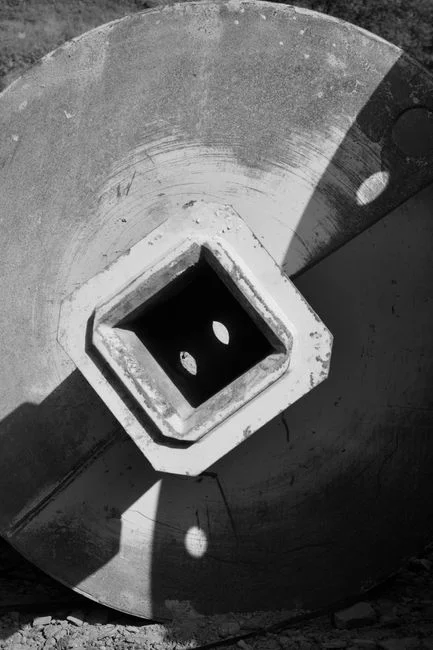
A conventional gravity clarifier separates by residence time and Stokes' law settling. Heavier suspended solids sink to the bottom of a quiescent basin; clarified water overflows from launders at the top; lighter material either stays in suspension or slowly rises as a thin scum layer that a surface skimmer can sweep off. The mechanism is passive, hydraulic, and depends on giving the solids enough time, in a still enough tank, to fall out of the water column.
Because separation is passive, a gravity clarifier is large-footprint equipment relative to throughput. Surface overflow rate, not weir geometry, is the design constraint, and any hydraulic surge from a batch operation in a vehicle plant will tend to resuspend settled solids and push them over the weir. That sensitivity to surge is the main reason gravity clarifiers in batch plants often have to be oversized to handle peak events they rarely see in steady-state operation.
Skimming of surface oil and scraping of bottom sludge are mechanical, not chemically assisted. There is no polymer or coagulant step that flocculates emulsified oil into a separable phase, so removal of emulsified or colloidal oils — the form in which most tramp oil and cutting fluid carryover actually exists at a parts washer — is inherently limited. A gravity clarifier will skim free oil that has already separated on its own, and it will drop heavy grit and metal fines, but it will leave a lot in between.
The technology is well-matched to streams dominated by heavy, settleable, inorganic solids — foundries, aggregate wash, some metal-finishing rinses, and the heavy-solids end of a vibratory finishing line. It is the wrong primary unit when FOG, tramp oil, and emulsified cutting fluid dominate the load, which is the typical case for a Wakarusa transportation equipment plant. A lamella plate design, such as the HydropureWater lamella clarifier, accelerates settling by increasing effective surface area, but the chemistry of separation — passive, unassisted — does not change.
DAF vs Gravity Clarifier: Head-to-Head for Wakarusa Transportation Equipment Wastewater
The matrix below maps the comparison to the parameters that actually drive a 2026 equipment decision at a Wakarusa transportation equipment plant: FOG and light-solids removal, footprint per gallon, flow scalability, response to batch swings, sludge character, and the supporting pre-treatment train. Numeric evidence is drawn from Clearwater Industries (2026-04-27); parameters not supported by that source are flagged as buyer inputs.
| Parameter | DAF Clarifier | Gravity / Lamella Clarifier | Wakarusa Implication |
|---|---|---|---|
| Mechanism | Active flotation with 30–50 µm bubbles (Clearwater Industries, 2026-04-27) | Passive Stokes-law settling | DAF is purpose-built for low-specific-gravity load |
| FOG & light-solids removal | Designed to float and skim oils, greases, light TSS | Only free oil that has already separated; emulsified oil largely remains | DAF preferred when parts-washer FOG dominates |
| Footprint per GPM | High surface loading; compact skid | Requires large quiescent volume | DAF fits a typical Wakarusa plant bay envelope |
| Flow scalability | FPAC (small/medium flow, very high solids); FPBC (low/medium load, lamella); FPHF (high flow, medium/large load); COMPACT DAF ≤66 GPM single skid, >66 GPM two-skid modular (Clearwater Industries, 2026-04-27) | Single basin sized to peak hydraulic load; modular layouts require parallel trains | Single-skid vs two-skid split is defined at 66 GPM per Clearwater Industries (2026-04-27) |
| Response to batch swings | Recovers quickly via chemical conditioning and bubble attachment | Resuspends settled solids on surge; slow to recover | DAF matches batch-style Wakarusa production |
| Sludge character | Thick floated scum, lower water carryover | Dilute, water-laden bottom sludge | DAF lowers downstream hauling and dewatering cost |
| Pre-treatment required | Coarse screening (hydrocyclone or shaker screen) plus pH control (Kemco Systems) | Grit zone and screening; less sensitive to fine screening | Both require screening; DAF also requires pH/chemistry |
| Materials of construction | 304SS standard; 316SS, PP, others on request (Clearwater Industries, 2026-04-27) | Typically carbon steel with coating, or concrete | DAF material selection can match coolant/phosphate chemistry |
For a representative DAF skid in this comparison, see the HydropureWater DAF system; for the gravity / lamella alternative, see the HydropureWater lamella clarifier.
Which Transportation Equipment Streams Push the Decision Toward DAF
Self-classifying the plant's wastewater by sub-stream is the fastest way to land on the right technology. Four sub-streams are common in a Wakarusa transportation equipment facility, and three of them point toward DAF.
Parts-washer overflow carries free and emulsified oils plus FOG, typically well above the level a gravity skimmer can reliably handle. When FOG is the controlling parameter for the local POTW, DAF is the right primary unit because the chemistry train can break the emulsion and the bubbles can lift the resulting floc.
Machining coolant carryover is a DAF application for the same reason. Emulsified cutting fluid is not amenable to plain gravity separation, and a DAF chemistry program — typically a coagulant plus an anionic or cationic polymer — can break the emulsion ahead of flotation. The DAF bottom auger also pulls out the fine metal fines that travel with the coolant, which a gravity clarifier would tend to resuspend under surge.
Phosphate conversion coating rinse water with low-to-moderate FOG and significant TSS is a DAF candidate, especially when paired with a calcium- or aluminum-based coagulation program. The lamella-plate FPBC and the cross-flow FPHF model families are commonly evaluated on this stream because they combine the bubble-driven separation of DAF with a flow geometry that handles higher rinse volumes (Clearwater Industries, 2026-04-27).
Stand-alone vibratory or tumbling finishing is the one stream where a gravity clarifier or a lamella plate settler remains defensible: very low FOG, predominantly settleable metal fines and media, and a flow that is steady rather than batchy. In that case, the lamella clarifier is worth specifying as the primary unit, with a small DAF held in reserve if a parts-washer stream is later added to the same plant.
What a Wakarusa Buyer Should Confirm Before Specifying Equipment in 2026
Equipment selection is downstream of permit limits, influent variability, and discharge routing. A Wakarusa transportation equipment buyer should lock down the following items before talking to a DAF or clarifier supplier, because each one changes the equipment specification and the total installed cost.
| Item to Confirm | Why It Matters | Source / Input |
|---|---|---|
| Local POTW 2026 sewer-use ordinance (FOG, TSS, O&G, metals, pH) | Sets the discharge envelope; without it, the clarifier cannot be sized | Buyer must request from Wakarusa POTW |
| 24-hour composite sampling across at least one production week | Peak-to-average ratio drives tank sizing and single-skid vs two-skid layout | Buyer must collect on-site; ≥ one parts-washer batch, one machining shift, one phosphate dump |
| Discharge route (POTW, on-site pretreatment + haul-off, ZLD) | Drives whether DAF (haul-off economics) or smaller clarifier is favored | Buyer decision; no research data |
| Utilities: compressed air or blower capacity, building height, chemical storage | FPBC is high-profile; saturator needs air; chemistry needs storage | Buyer must verify on-site |
| 2026 supply chain for stainless DAF skids, polymer dosing skids, filter presses | Lead time determines whether a 2026 install is realistic | Buyer must request from suppliers |
| Pre-treatment screening: hydrocyclone or shaker screen | Protects the DAF from lint, scale, sand, and large debris (Kemco Systems) | Standard DAF requirement per Kemco Systems |
Two of the supporting items in that list tie directly to a defined equipment package. The automatic chemical dosing skid handles coagulant, pH adjustment, and polymer flocculant delivery for the DAF chemistry train, and the sludge dewatering filter press handles the floated sludge downstream of either a DAF or a gravity clarifier. The filter press is what converts a wet sludge volume into a disposal payload, and it is where most of the recurring savings on a DAF installation show up because floated sludge enters the press with less water than clarifier bottom sludge.
Frequently Asked Questions
What budget range should a Wakarusa transportation equipment plant expect for a DAF system in 2026?
The supplied research does not include a published price for a DAF skid, so a buyer should request a written quote tied to a defined flow rate (GPM), influent characterization, and discharge limits. Ask the supplier to break out the DAF unit, the chemical dosing skid, the screening stage, the filter press, and installation as separate line items, because that breakdown is what determines the total installed cost and the recurring chemical and hauling line items.
How do I choose the right DAF model — FPAC, FPBC, FPHF, or COMPACT?
Map the choice to flow rate and solids load. Per Clearwater Industries (2026-04-27), FPAC targets small-to-medium flow rates with very high solids loads; FPBC is a high-profile lamella unit for low-to-medium loads including low-buoyancy particles; FPHF treats high flows with medium-to-large loads using combined cross-flow and countercurrent geometry; and COMPACT DAF is the pre-assembled turnkey package, single skid at 66 GPM or less and a two-skid modular layout above 66 GPM. For a Wakarusa vehicle plant with multiple sub-streams, the COMPACT DAF with a two-skid modular layout is often the simplest path.
Can a conventional gravity clarifier handle the FOG from a parts washer?
For free oil that has already separated, a gravity clarifier can skim a portion as scum, but for emulsified oil and FOG above typical POTW limits, plain gravity separation is the wrong mechanism. A DAF chemistry train breaks the emulsion and the bubbles float the resulting floc; a gravity basin will leave most of the load in the overflow and bleed solids during the batch surges common in a vehicle plant.
What should I confirm with the Wakarusa POTW before specifying any clarifier?
Request the 2026 sewer-use ordinance limits for FOG, total suspended solids, oils and grease, total metals, and pH, and ask whether there is a surcharge or haul-off option for non-compliant batches. The supplied research does not include Wakarusa-specific limits, so this is a buyer input rather than a published number; without those limits, neither a DAF nor a gravity clarifier can be sized to compliance. For related guidance, see the DAF or clarifier for fabricated metals wastewater guide and the DAF or clarifier for EV and auto wastewater factory guide. For the underlying DAF design math, the DAF system engineering design guide walks through the calculation sequence.