What "High Water Volume Management" Actually Means on a Manufacturing Site
High water volume management is the engineering and governance practice of reducing intake, segregating streams by quality, treating them in a matched train, and reusing as much as economics and permits allow at a site where daily throughput makes water both a material operating cost and a permit-liability line item. On a manufacturing site, every significant stream is mapped to one of three categories — cooling, washing, or process wastewater (Crini and Lichtfouse 2019, cited in the 2024 review in Molecules/PMC) — and that map becomes the spine of the program.
Manufacturing was the largest wastewater-generating industrial sector in the EU according to WWAP 2017 (cited in the same review), and U.S. manufacturers used approximately 21,000 million gallons per day in 2010, about 31% of U.S. water use once agricultural and thermoelectric withdrawals are excluded (DOE Better Plants, 2015). The goal of high-volume management is throughput and reuse intensity, not discharge compliance alone; the plant treats water as a system it operates, rather than a waste it disposes of.
Step 1: Run a Site Water Audit You Can Actually Defend
The audit creates the baseline for a plant's performance over the next decade, making accuracy essential for a defensible strategy. Before any equipment is specified, the engineering team needs four data sets: intake source and annual volume, discharge points tied to permit limits, stream-by-stream flow and quality, and the reuse demand from production. Each stream is then assigned to one of three buckets — cooling, washing, or process (Crini and Lichtfouse 2019, as reviewed in PMC11374848, 2024) — because the three have very different treatment and reuse profiles. DOE partner experience shows that metering the largest two or three streams first delivers the fastest savings, because the largest streams almost always carry the largest absolute volume and the largest absolute losses. Water and energy cannot be separated in this audit: at a Campbell's Soup tomato processing facility in California, two well-water pumping systems measured 2.4 kWh and 1.7 kWh per 1,000 gallons while a wastewater pumping system measured 0.42 kWh per 1,000 gallons (DOE Better Plants, 2015). The audit closes with a signed baseline report so that future savings can be claimed credibly against a documented starting point rather than reconstructed later.
| Audit data set | What to record | Why it matters |
|---|---|---|
| Intake | Source (surface, ground, third-party), annual volume, unit cost | Defines the price of the next cubic meter of fresh water |
| Discharge | Outfall, permit limits, current concentrations, fees | Sets the compliance ceiling and the avoided cost of non-compliance |
| Stream quality | Flow, temperature, pH, TSS, COD/BOD, FOG, TDS, metals as relevant | Drives treatment selection and reuse eligibility |
| Reuse demand | Quantity and quality needed by cooling, boiler, wash, irrigation | Matches treated output to internal demand |
| Pumping energy | kWh per 1,000 gallons for each pump system | Connects water decisions to energy cost and emissions |
Step 2: Segregate Streams Before You Treat Anything
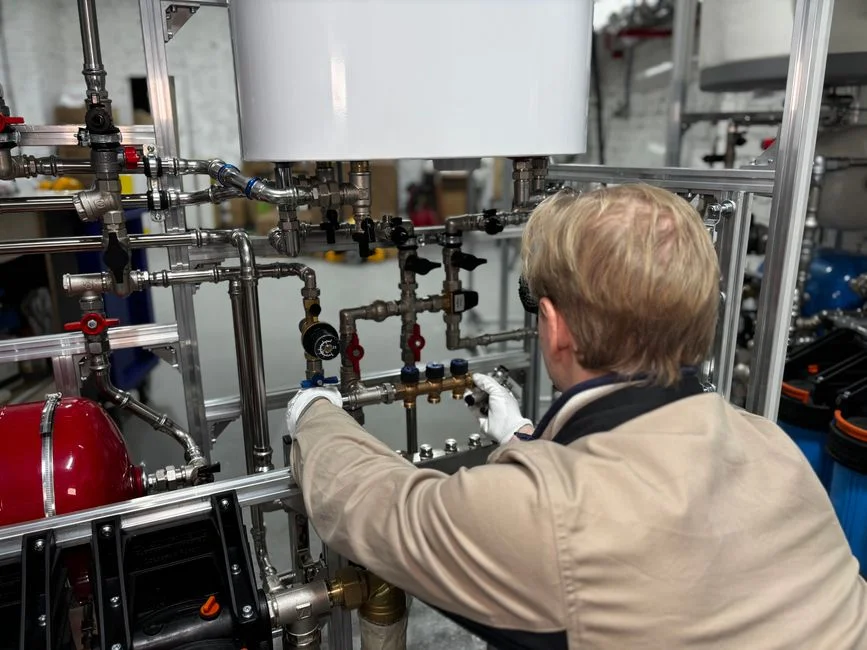
Segregation is the most cost-effective unit operation on a high-volume site, as a stream that does not need biological or membrane treatment should not incur those expenses. Clean cooling-tower blowdown, once stabilized, can often bypass secondary treatment and go directly to disinfection and reuse, which cuts both capex and opex relative to a combined-flow design. The cement industry illustrates this principle: cooling water is typically recycled in-process, while wet-scrubber wastewater — carrying suspended solids, dissolved solids, nutrients, and metals — is treated on a separate train (Sharma et al. 2012, as reviewed in PMC11374848, 2024). The same logic applies across food, metal, and paper plants: high-FOG streams, high-TDS streams, and rinse waters should not be co-mingled, because their treatment chemistries are incompatible and their reuse targets are different. A workable decision rule is to ask, for each stream, whether it can be reused with screening and disinfection alone; if the answer is yes, it should bypass every stage that does not earn its place.
Step 3: Build a Treatment Train That Matches Each Stream
A defensible treatment train sequences four standard stages — preliminary, primary, secondary, and tertiary (Naidoo and Olaniran 2013; Quach-Cu et al. 2018, as reviewed in PMC11374848, 2024) — and assigns a specific removal job to each. Preliminary treatment uses screening, comminution, and grit removal to strip large debris and protect downstream equipment; a rotary mechanical bar screen sits at the head of most trains for this reason. Primary treatment uses sedimentation and dissolved air flotation to drop suspended solids, oils, and FOG, and a dissolved air flotation system is the common workhorse for streams with emulsified oils or high FOG. Secondary treatment uses aerobic or anaerobic biology to reduce organics, nitrogen, and phosphorus through biochemical conversion into biomass (Samer 2015, as reviewed in PMC11374848, 2024), and a packaged MBR membrane bioreactor system combines this stage with a membrane barrier for higher effluent quality. Tertiary treatment applies membrane filtration, adsorption, and chemical or advanced oxidation to meet reuse specifications or strict discharge limits. Two facts sharpen the design: industrial wastewater is often more toxic than municipal wastewater (Häder 2018, as reviewed in PMC11374848, 2024) and frequently cannot be sent to a municipal plant, so on-site treatment is usually required. When the plant's goal is reuse rather than discharge, tertiary becomes the highest-leverage investment because it converts treated effluent into a process input.
| Stage | Typical unit operations | Primary target contaminants | Role in the train |
|---|---|---|---|
| Preliminary | Screening, comminution, grit removal | Large debris, rags, grit | Protects downstream equipment |
| Primary | Sedimentation, dissolved air flotation | Suspended solids, oils, FOG | Bulk separation before biology |
| Secondary | Aerobic or anaerobic biology, MBR | Organics (BOD/COD), nitrogen, phosphorus | Biochemical conversion of dissolved load |
| Tertiary | Membrane filtration, adsorption, AOP, chemical oxidation | Residual organics, color, micro-pollutants, salts | Polishing to reuse or strict discharge quality |
Step 4: Engineer Reuse Loops, Not Just Discharge Compliance
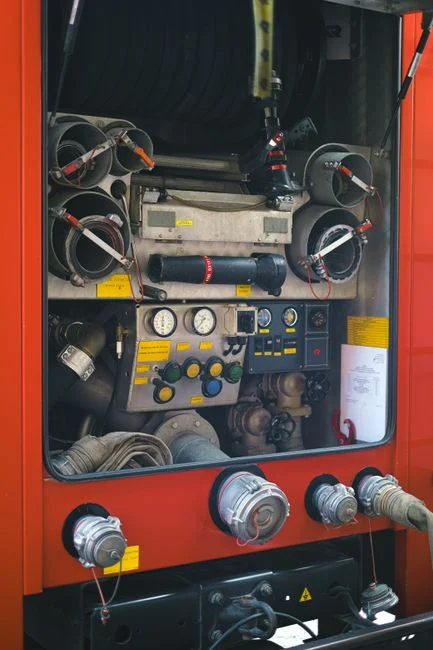
Reuse is the most economical new water source on a manufacturing site, because every cubic meter reused is a cubic meter not drawn, not treated to potable specification, and not discharged. Reuse should be tiered by the water quality each end use can accept: cooling-tower makeup, boiler feed, wash water, and irrigation each tolerate different qualities and unlock different savings (DOE Better Plants, 2015). This ambition is grounded in partner data; most manufacturers in the DOE Better Plants pilot set water-savings targets of 2 to 5% per year, and HARBEC has set a target to become largely water neutral in its manufacturing operations (DOE Better Plants, 2015). The quality match is the discipline that keeps the loop honest: sending RO-quality water to a cooling tower wastes the energy spent on membranes, and sending cooling-tower blowdown to a process rinse creates a quality risk on the product side. A reuse map that pairs each treated stream to a named end use, with a documented quality envelope, is the deliverable for this step. Equipment for the polishing stages — an industrial RO system for low-TDS reuse, or an integrated water purification skid for multi-stage polishing — is specified against that map, not against a generic effluent target.
Step 5: Decide Between Reuse, Partial ZLD, and Full ZLD
The decision between reuse, partial zero liquid discharge (ZLD), and full ZLD is driven by three factors: local water stress, discharge permit stringency, and the marginal cost of the next cubic meter of intake. Reuse for non-critical duties is the default for sites with moderate stress and moderate intake cost; partial ZLD applies to the most stressed streams, typically the highest-TDS blowdowns, where the next reuse step is uneconomic but liquid discharge is no longer acceptable. Full ZLD — crystallizer or equivalent — is reserved for water-scarce or highly regulated sites, and only when the segregated feed to the ZLD system is concentrated enough to make evaporation economic. Local infrastructure is a critical input: roughly 74% of wastewater is treated in high-income regions versus 4% in low-income regions (Jones et al. 2021, as reviewed in PMC11374848, 2024), so the safety net a plant can assume from a municipal receiver varies sharply by region. The decision rule that prevents wasted capital is simple: do not pursue ZLD to solve a metering problem, and do not invest in reuse where the real bottleneck is segregation. Each end state solves a different problem, and the audit identifies the specific requirement for the site.
Step 6: Put the Program in Place — Governance, KPIs, and Metering
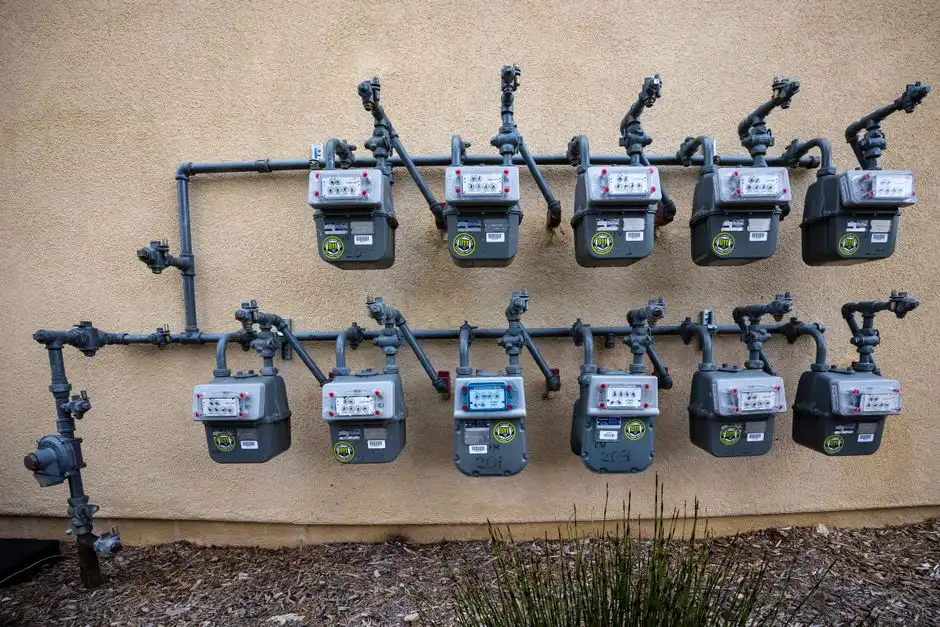
The organizational layer sustains a water program through personnel changes and capital cycles. The Better Plants partners consistently credit senior sponsorship, written goals, and metrics tracked against baseline as the elements that separate a sustained program from a one-time project (DOE Better Plants, 2015). The KPI set that a plant engineer or EHS manager can defend in an executive review is short: water use per unit of production, reuse ratio, discharge quality against permit, and energy per cubic meter treated. A single named owner is a prerequisite; the same DOE work notes that most manufacturers do not have a dedicated water manager, and the work is layered onto energy managers, which is workable only if the ownership is explicit. The program itself is a continuous improvement loop: audit, intervene, measure, report, repeat, with the same baseline document referenced at every cycle. Metering — physical meters on the largest streams, not allocations — is the infrastructure that makes the loop honest, because the KPI is only as good as the data behind it.
Frequently Asked Questions
What budget should a plant expect for a high-volume water management program?
Budget depends on the audited baseline, not on a generic industry range, so the first step is to size the program against intake cost, discharge fees, and the pumping energy the audit has already quantified — the Campbell's Soup data point of 0.42 to 2.4 kWh per 1,000 gallons (DOE Better Plants, 2015) is a reminder that energy is a real cost line in any water decision. The defensible action is to request supplier quotes against the audited stream list and the reuse map from Step 4, rather than against a rule-of-thumb dollar number.
How do we choose between equipment suppliers for a treatment train?
Supplier selection should be tied to the unit operations the audit has justified, and to verifiable references in the same sub-sector. Cross-checking that a vendor has running installations on similar streams — high-FOG food, high-TDS metal finishing, or high-flow pulp and paper — is the most reliable filter. The selection framework in the prefabricated wastewater plant design criteria for 2026 and the DAF vs clarifier selection guide can be used to specify the equipment categories before engaging vendors, which keeps the conversation on fit rather than catalog.
How long does it take to see water savings after the audit?
The DOE partner experience sets a 2 to 5% annual water-savings target as the realistic ambition once a baseline exists (DOE Better Plants, 2015), and the largest-stream-first metering rule from Step 1 means the first visible savings typically come from the streams already metered, not from new capital. Sequencing low-cost segregation and reuse projects ahead of any full ZLD investment is what produces early, defensible results.
When is ZLD actually justified at a manufacturing site?
ZLD is justified when local water stress or discharge permit stringency makes the next cubic meter of liquid effluent uneconomic or imper