Why Konya Changes the Blowdown Math
Konya sits in an inland, semi-arid Central Anatolian basin where the closed Konya Basin aquifer system is among the most overdrafted in Türkiye, and it falls into the same water-stressed category that has hosted roughly two-thirds of data centers built since 2022, according to a Bloomberg News analysis cited by the Lincoln Institute and reported by commercialwaterlab.com (May 2026). That same source notes that water-stressed siting now drives capital planning for hyperscale operators across the U.S. Southwest and Mediterranean climate zones, and Central Anatolia sits squarely in that envelope. Because Konya has no coastal receiving water, the thermal-discharge option available to sites in Northern Europe or the U.S. Pacific coast is unavailable; blowdown must be either reused on-site, sewered under KOSBİ (Organized Industrial Zone) pretreatment limits, or treated to zero liquid discharge.
Konya groundwater is characteristically hard and alkaline, which raises blowdown calcium, magnesium and bicarbonate alkalinity faster than softer source waters and pushes the cycles-of-concentration lever toward aggressive antiscalant chemistry rather than higher cycles alone. No Konya-specific hardness number is given in the supplied research, so the design team should request the latest municipal-supply and well-water analyses from the utility before fixing the cycles-of-concentration target. Globally, industry WUE averages around 1.8 L/kWh with a 1–9 L/kWh range, about 57% of direct water use is potable, and 80–90% is drawn from "blue" sources (lakes, rivers, aquifers), per KETOS. Konya operators that draw from municipal supply are exposed to the same reputational and supply-pressure risk that the KETOS reporting describes for Loudoun County, Virginia, where roughly 1 billion gallons of treated potable water went to data centers in 2023.
What Comes Out of a Konya Data Center: The Wastewater Streams
Cooling tower blowdown is the design driver. Genesis Water Technologies puts the blowdown ratio at 1/(cycles of concentration − 1), so at 4 CoC roughly 25–30% of makeup water leaves as blowdown; for a 10 million-gallon-per-month site that is 2.5–3 million gallons discharged. The same source gives the chemistry band a Konya engineer should design against: TDS 1,200–6,000 mg/L (typically 4–8× makeup), suspended solids 10–50 mg/L, plus scaling ions (Ca, Mg, silica, alkalinity), biocides, corrosion inhibitors, biofilm fragments and corrosion byproducts. Sanitary wastewater from staff areas is small in volume but still has to meet discharge standards; it is normally handled by a packaged biological plant rather than the blowdown train.
Free-cooling once-through streams return warmed water to the receiving body — relevant where Konya operators use evaporative pads or adiabatic coolers, since thermal pollution has to be screened out as a compliance risk even when chemistry is acceptable. Closed-loop and direct-liquid-cooling systems invert the water balance: a closed-loop site consumes only 5–10% of its withdrawal and returns 90–95% as wastewater (KETOS), so the treatment train is smaller in flow but the recovered stream is hotter and more chemical-laden. A medium data center can use up to about 300,000 gal/day for cooling; a hyperscale site up to about 5 million gal/day, equivalent to 1.8 billion gallons annually, per UGA Cooperative Extension TP-121 (Saha, 2026) as cited by commercialwaterlab.com (May 2026). Use that band to bracket the blowdown stream before specifying equipment.
| Stream | Volume vs. makeup | Key contaminants | Treatment route |
|---|---|---|---|
| Cooling tower blowdown (open-loop evaporative, 4 CoC) | ~25–30% of makeup (Genesis Water Technologies) | TDS 1,200–6,000 mg/L; SS 10–50 mg/L; Ca, Mg, silica, alkalinity; biocides; corrosion inhibitors; biofilm fragments | Side-stream → UF → RO/NF → optional MVC; reuse as cooling-tower makeup or compliant discharge |
| Closed-loop / DLC bleed-off | 90–95% returned as wastewater (KETOS) | Higher TDS, hotter, coolant traces (PFAS, glycol) possible | RO + polishing; treat as concentrated blowdown |
| Sanitary wastewater | Small vs. cooling | BOD, TSS, pathogens | Packaged biological plant (MBR / SBR) |
| Free-cooling once-through (where used) | High volume, low TDS change | Thermal load; possible biocides | Thermal compliance screening, optional chemical polishing |
Cooling System Choice and the Cycles-of-Concentration Lever
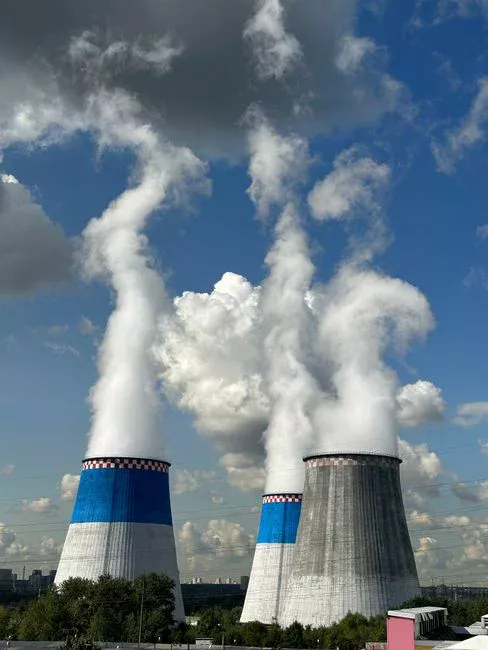
Roughly 75–90% of data centers globally rely on water-based cooling; only 10–25% are water-free (KETOS). Most Konya sites will start from an evaporative baseline, not air cooling, and that baseline dictates the blowdown math. At 4 CoC blowdown is ~25% of makeup; at 5 CoC the ratio falls by only about 5 percentage points to ~20% blowdown because the relationship is hyperbolic, not linear (Genesis Water Technologies). Pushing CoC from 4 to 5 cuts the blowdown stream by one-fifth, not by half — the trade-off the design team has to size against, not the textbook assumption that "more cycles equals dramatically less blowdown."
Higher CoC concentrates the blowdown — TDS 1,200–6,000 mg/L is the typical band — which lowers RO recovery and raises antiscalant demand; that is the core engineering trade-off (Genesis Water Technologies). Closed-loop and direct-liquid-cooling cut evaporation losses by up to ~70% versus open-loop (KETOS) but introduce their own coolant-handling issues; the supplied research flags PFAS and refrigerant handling as an emerging compliance gap that future Konya retrofits will need to address. A 10 MW facility using evaporative cooling at 4 CoC might intake about 15 million gallons monthly, of which about 3.75 million gallons is recoverable blowdown — water already paid for and conditioned, per Genesis Water Technologies.
The Konya Treatment Train: Side-Stream Filtration → UF → RO, with Optional MVC
The treatment chain that turns blowdown into reusable cooling-tower makeup or compliant discharge is built up step by step, and each step has a defined role. Side-stream filtration is sized at 1–5% of circulation flow and removes suspended solids, biofilm precursors and corrosion products before they reach the tower basin; CAPEX $50,000–200,000 (Genesis Water Technologies). This is the step that keeps downstream membranes from fouling prematurely, and it is the point where a self-cleaning multi-media filter for side-stream solids control earns its place in the design. An automatic chemical dosing system for antiscalant and biocide control sits alongside it, since inconsistent chemistry is the leading cause of RO under-performance on blowdown.
Ultrafiltration acts as RO pretreatment: 0.01–0.1 micron PVDF membranes deliver 90–95% recovery at low pressure (10–30 psi), with chemical cleaning every 1–3 months and reliable removal of bacteria and colloids (Genesis Water Technologies). For a Konya site, an ultrafiltration system for blowdown pretreatment is the practical choice because the upstream water carries silica and hardness that foul RO rapidly without this polishing step. Reverse osmosis is the workhorse: 95–99% dissolved-solids rejection, permeate 10–50 mg/L TDS, 50–85% recovery on blowdown feed, antiscalant-injected, OPEX $1.50–3.00 per 1,000 gallons treated, and CAPEX $250,000–500,000 for a 50,000 GPD unit (Genesis Water Technologies). For Konya cooling-tower makeup reuse, an industrial RO system for cooling-tower makeup recovery sized to the audited blowdown flow is the central equipment purchase.
Nanofiltration is the lower-pressure alternative — 75–150 psi, 70–85% recovery, permeate 30–50% of feed TDS — for blowdown where hardness rather than total TDS is the discharge limiter (Genesis Water Technologies). Mechanical vapor compression concentrates RO reject to 20–30% TDS and recovers 95–98% as distillate with <10 mg/L TDS, at 15–25 kWh per 1,000 gallons and CAPEX $1–3M for 10,000–30,000 GPD (Genesis Water Technologies) — the partial-ZLD option for water-stressed Konya sites where sewer discharge is blocked or capped. Full ZLD combines RO + brine concentrator + crystallizer at $3–8M CAPEX, $5–15 per 1,000 gallons OPEX and 95–99% recovery, and is justified only when discharge is genuinely unavailable (Genesis Water Technologies).
| Stage | Function | Key parameters | CAPEX band | OPEX band |
|---|---|---|---|---|
| Side-stream filtration | 1–5% of circulation; 10–25 µm | Self-cleaning, continuous | $50,000–200,000 (Genesis Water Technologies) | Solids disposal, routine maintenance |
| Ultrafiltration (UF) | RO pretreatment; 0.01–0.1 µm PVDF | 90–95% recovery; 10–30 psi; CIP every 1–3 months | Site-specific | Membrane replacement, cleaning chemicals |
| Reverse osmosis (RO) | Dissolved-solids polish; permeate 10–50 mg/L TDS | 95–99% rejection; 50–85% recovery on blowdown; 150–400 psi | $250,000–500,000 for 50,000 GPD (Genesis Water Technologies) | $1.50–3.00 / 1,000 gal (Genesis Water Technologies) |
| Nanofiltration (NF) | Partial softening; selective divalent removal | 70–85% recovery; 75–150 psi; permeate 30–50% of feed TDS | Site-specific | Lower energy than RO at same recovery |
| Mechanical vapor compression (MVC) | Concentrate RO reject; partial ZLD | 95–98% recovery; distillate <10 mg/L TDS; 15–25 kWh / 1,000 gal | $1–3M for 10,000–30,000 GPD (Genesis Water Technologies) | Energy-dominated |
| Full ZLD (RO + brine concentrator + crystallizer) | Eliminate liquid discharge | 95–99% overall recovery; solid cake <1% of feed | $3–8M (Genesis Water Technologies) | $5–15 / 1,000 gal (Genesis Water Technologies) |
Reuse, Discharge or Zero Liquid Discharge: A Konya Decision Framework
Cooling-tower makeup reuse typically achieves 60–85% blowdown recovery and gives the highest economic return; it is the default for Konya sites with on-site cooling demand (Genesis Water Technologies). Process-water reuse — irrigation, washdown, toilet flushing — accepts lower recovery but spreads the benefit and is useful where the campus has landscaped grounds or vehicle wash bays (Genesis Water Technologies). Discharge to the KOSBİ sewer is viable only where the local utility accepts the contaminant profile; blowdown discharge fees of $5–15 per 1,000 gallons and TDS caps below 1,500 mg/L in some jurisdictions (Genesis Water Technologies) mean high-CoC blowdown often cannot be discharged without polishing.
Partial ZLD (RO + MVC, 85–95% overall recovery) and full ZLD (95–99%) are reserved for sites with no discharge option or with hyperscaler-style "water replenishment" commitments; the supplied research does not give a Konya-specific water-replenishment target, so the ESG driver should be confirmed with the operator's sustainability team before sizing. Stock spare RO and UF membrane elements and consumables from the water-treatment parts, valves and media inventory so that a recovery train does not sit idle waiting on a shipping container.
Sizing and Operating the System: Practical Numbers for a Konya Site
A medium data center can use up to about 300,000 gal/day for cooling; a hyperscale site up to about 5 million gal/day (UGA CAES TP-121, Saha 2026, via commercialwaterlab.com, May 2026) — use this band to bracket the blowdown stream before specifying equipment. Audit actual blowdown first: measured blowdown routinely runs 15–30% above the theoretical 1/(CoC − 1) figure because of leaks and emergency dumps, and the gap is where most recovery savings are found (Genesis Water Technologies). Repair leaks, eliminate unnecessary once-through cooling, optimize control sequences to avoid premature blowdown triggers, and add self-cleaning filtration to cut suspended-solids-driven blowdown.
Plan for a PLC-controlled antiscalant, biocide and pH-adjustment dosing system from day one; inconsistent chemistry is the leading cause of RO under-performance on blowdown (Genesis Water Technologies). Specify UV polishing for recycled cooling-tower makeup or an on-site chlorine dioxide generator for cooling-loop biocide control where the permeate returns to the cooling tower or to a hot-water loop with biofilm risk; the supplied research does not give a Konya-specific microbial limit, so request the receiving system's target log-reduction from the operator. For comparison with similar inland and water-stressed data-center sites, see the engineering guides for data-center cooling blowdown treatment in Khulna, data-center cooling blowdown treatment in Can Tho, and data-center cooling blowdown treatment in Hong Kong, which translate the same train to other water-stressed contexts.
Frequently Asked Questions
What discharge limits apply to cooling blowdown in Konya?
The supplied research does not give Konya-specific numeric discharge limits, so the design team must request two documents before final sizing: the KOSBİ (or local organized-industrial-zone) pretreatment letter for the campus, and the Türkiye Su Kirliliği Kontrolü Yönetmeliği (SKKY) parameters that the receiving sewer or environment applies to TDS, heavy metals, nutrients and biocides. Without those two inputs, the RO or NF permeate quality target cannot be fixed.
What capex range should a Konya data center budget for blowdown treatment?
Budget bands from Genesis Water Technologies are: side-stream filtration $50,000–200,000; RO (50,000 GPD) $250,000–500,000; MVC $1–3M; full ZLD $3–8M. The right number for a Konya site shifts with water cost, sewer discharge fee, KOSBİ pretreatment stringency and any ESG water-replenishment commitment, so the procurement package should price the reuse, partial-ZLD and full-ZLD cases side by side rather than locking one in at concept.
Should we choose RO or NF for a Konya site?
Use NF where the discharge limit is driven by hardness (Ca, Mg, sulfate) and total TDS is otherwise acceptable, because NF runs at 75–150 psi with 70–85% recovery and lower energy (Genesis Water Technologies). Use RO where silica, chloride or total TDS is the discharge limiter, because RO delivers 95–99% dissolved-solids rejection and permeate of 10–50 mg/L TDS — necessary when the KOSBİ sewer caps TDS below 1,500 mg/L.
How do we size the blowdown system for a 10 MW site in Konya?
Start from the 1/(CoC − 1) blowdown ratio: at 4 CoC blowdown is ~25% of makeup, at 5 CoC ~20% (Genesis Water Technologies). Then add a 15–30% field-loss uplift for leaks and emergency dumps, and bracket the makeup flow against the UGA CAES TP-121 band of up to 300,000 gal/day for medium sites and up to 5 million gal/day for hyperscale sites (Saha, 2026, via commercialwaterlab.com). The size of the side-stream, UF and RO trains should be set from that audited number, not from a generic per-MW assumption.
Related Equipment
- industrial RO system for cooling-tower makeup recovery — specifications, capacity range, and technical data