
Why food-processing wastewater is a filter-press design problem of its own
Food-processing wastewater is not a single design case. Dairy, brewery, meat, fruit and vegetable, edible oil and starch lines each carry a different mix of suspended solids, FOG and protein, and that mix drives how a filter press performs. The same plate and frame filter press that gives a brewery clean filtrate will blind in minutes on raw slaughterhouse effluent if FOG is not stripped upstream first. A plant engineer who treats "food sludge" as one stream ends up over- or under-specifying the press, the cloth and the chemical program at the same time.
The reason food streams deserve their own sizing logic is that the slurry reaching a dewatering press is almost always biological — activated sludge from a bioreactor, not raw influent. The BRIN (2022) plate-frame study explicitly simulated activated sludge with CaCO3 at 1–4% w/w because real biological sludge is what industrial dewatering equipment actually processes. Generic "filter press" sizing guidance that talks about mineral slurries or generic biosolids does not capture this, and that is the gap this article fills. Per EPA 832-F-00-057 (September 2000), the purpose of dewatering biosolids is to reduce residual volume and cut downstream storage, transport and disposal cost — the same objective applies to food-plant biological sludge once the bioreactor has done its work.
ChemREADY (2024) describes filter presses as one of the oldest and most reliable dewatering devices, with origins in mid-19th-century vegetable oil extraction. That history matters for food plants: the technology has been running on edible-oil, starch and brewery streams for over a century, and the operating envelope is well understood — but only when the upstream stream is characterized and conditioned first. A DAF pre-thickener is the most common way to land a food stream inside the press's design window before plate sizing even starts.
The 50–60% feed-solids window and how to land inside it
ChemREADY (2024) sets a clear design rule: filter presses work best with slurries at 50–60% solids, and streams at 5–10% solids should pass through a clarifier first. That single rule decides whether a plant needs pre-thickening equipment on the same skid as the press, and which type. It is also the difference between a press that delivers its rated cake dryness and one that runs long filter cycles with wet discharge.
The two practical pre-thickening routes for food plants are gravity clarification and dissolved air flotation. Gravity clarifiers, including lamella designs, concentrate solids via sedimentation paired with polymer flocculation; the BRIN (2022) plate-frame work tested feed concentrations of 1–4% w/w CaCO3 and showed that removal efficiency varies with feed concentration, which is exactly why thickening upstream is not optional. A lamella clarifier pre-thickener is a typical choice for streams with low FOG and high settleable solids — brewery, fruit and vegetable wash water, some dairy lines.
DAF is the other route and is specifically suited to food processing because it removes suspended solids, FOG, oil and grease and colloidal matter in a single step. A clarifier or DAF plus filter press train can recover up to 95% of process water for reuse (ChemREADY, 2024) — a critical number for any food plant on a tight water budget or a zero-liquid-discharge trajectory. The table below summarizes the practical decision.
| Feed condition at bioreactor outlet | Pre-thickener choice | Target feed to press | Driver |
|---|---|---|---|
| 5–10% suspended solids, low FOG (brewery, fruit/veg) | Lamella clarifier with polymer dosing | 50–60% solids | Gravity settleables, minimal oil |
| 5–10% solids, high FOG (dairy, meat, edible oil) | DAF unit | 50–60% solids | FOG and colloidal removal required to protect cloth |
| Already above 10% solids (rare in food plants) | None | 50–60% solids | Press can be fed directly after conditioning |
| Below 1% solids, dilute wash water | DAF then clarifier, or two-stage DAF | 50–60% solids | Multi-stage thickening to reach design band |
Outside the 50–60% window, the press still runs but with poor outcomes. Above 60%, the cake is hard to form and pressure rises sharply across the cloth. Below 50% (especially below 10%), cycle times stretch, filtrate carries fines, and the cake slumps on discharge. Both are reasons to size pre-thickening, not the press, as the primary lever.
Anatomy of a plate-and-frame press and what each component does for a food plant
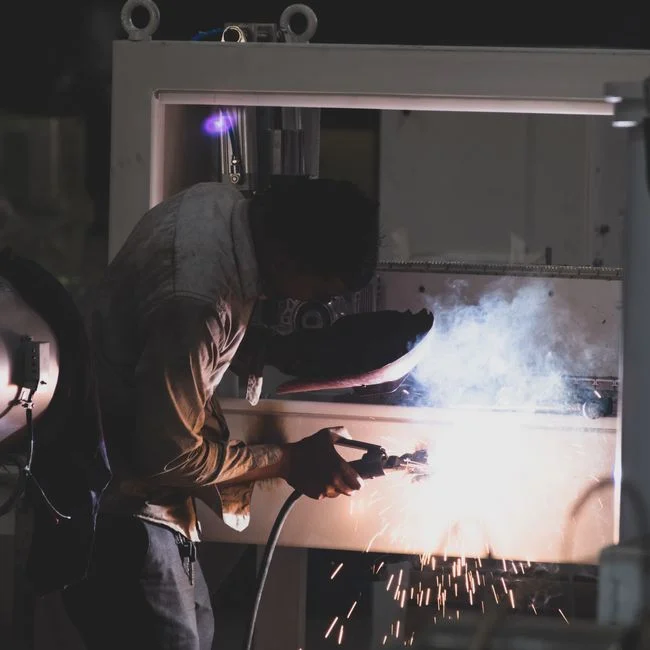
A plate and frame filter press has four functional groups, and a food-plant spec should over-spec some while accepting standard on others. Per ChemREADY (2024), the frame provides structural support, the filter plates hold the cloth and form the dewatering chambers, the manifold handles slurry distribution and filtrate removal, and the filter cloth is the actual separation medium. The cloth is the part that wears and that determines cake dryness, so it deserves the most engineering attention; the frame and manifold are commodity structural items.
Plate and frame units from the verified HydropureWater catalog (2026) cover 1–500 m² filtration area with manual, hydraulic or PLC-controlled operation, and the automation level drives both capex and operator labor. For food applications, stainless plate faces and food-grade cloths are typically specified to survive hot clean-in-place washdowns and the acidic or caustic cleaning agents that rotate through a food plant's sanitation program. A polypropylene or stainless plate that survives a 5% caustic CIP cycle at 70–80°C is the practical minimum; a coated carbon-steel plate will pit in months under the same regime.
High-pressure systems operate at 21–30 bar for difficult slurries (ChemREADY, 2024), and that range is available from manufacturers like Matec. Most food-plant biological sludge runs well below that — typical cake-forming pressure is 7–15 bar — so high-pressure is an option to specify for edge cases (very fine biological floc, high cake dryness targets) rather than a default. The plate and frame filter press line is the right reference product for readers comparing options across that pressure and automation range.
Sizing logic: how many plates, how much area, what cycle time
Plate count and filtration area are the numbers a vendor asks for first, and they are derived from a short list of inputs the design must collect before any plate is selected: daily wet-sludge mass flow, feed solids percent at the press inlet (target 50–60% per ChemREADY, 2024), target cake moisture, available filtration cycle time and the operating shift pattern. Skipping any of these turns sizing into a guess.
The BRIN (2022) plate-frame study observed that filtration performance varies with feed concentration and cloth type, and that finding matters for sizing: the same plate area produces different cycle times at 1% feed versus 4% feed, so the design must be tied to the thickened feed at the press inlet, not the raw bioreactor output. If the upstream DAF or clarifier is not yet specified, the plate count cannot be defended. For context on what those upstream units must deliver, the primary clarifier design parameters reference is useful before plate sizing begins.
Plate and frame units scale from 1 m² (lab and pilot) to 500 m² (large municipal and industrial) per the verified HydropureWater catalog (2026); food plants typically land in the 10–80 m² range per line, with a chamber count set by plate thickness and target cake volume per cycle. Cycle time is governed by fill, filtration, expression and discharge phases; faster cycles favor smaller plates at higher pressure, slower cycles favor larger plates at moderate pressure, and both are valid — the choice is throughput-driven, not technology-driven. The qualitative mapping is:
| Sizing input | What to collect from the plant | How it drives plate count |
|---|---|---|
| Daily wet-sludge mass flow | kg/day from bioreactor + thickener mass balance | Sets total solids to be pressed per shift |
| Feed solids % at press inlet | Target 50–60% (ChemREADY, 2024); measure after DAF/clarifier | Determines slurry volume per cycle |
| Target cake moisture | Disposal or reuse specification (e.g. <75% for landfill) | Sets expression phase pressure and time |
| Available cycle time | Operating hours per day minus CIP and maintenance | Sets number of cycles per shift |
| Filtration area per chamber | Plate size selection (small/medium/large) | Sets chamber count directly |
Without vendor-specific cake-density and filtration-rate data, the final plate count is a quote exercise, not a calculation the engineer can publish. The right move is to lock the five inputs in the table, send them to the shortlisted vendors, and require a written cycle-time and cake-moisture guarantee at those inputs before purchase.
Cloth, chemistry and conditioning choices that change the cake
Cloth is the single most variable component on a food-plant filter press, and the BRIN (2022) plate-frame study gives a direct comparison: cotton cloth outperformed drill cloth across 1–4% w/w CaCO3, with cotton reaching 56.00% solute removal at 4% w/w feed. The takeaway for a plant engineer is that weave structure — not just nominal pore size — drives outcome, and that the default cloth on a vendor quote should be challenged against the actual slurry.
Polymer flocculant selection and dose are the chemical lever on the same problem. Floc strength sets how well the cake holds pressure during the expression phase and how dry the discharged cake is; an automatic polymer dosing skid with PLC-controlled coagulant, flocculant and pH adjustment is the standard way to hold the press feed inside its design band across the raw-material and seasonal swings typical of food plants. A jar test on the actual thickened feed, run with the candidate polymer at the candidate dose, is the cheapest insurance against cloth blinding and wet cake.
For oily food streams, an upstream DAF is normally used to strip FOG before the slurry ever reaches the cloth. FOG that reaches the press blinds the cloth within cycles, raises differential pressure across the cake, and forces premature cloth replacement. The order — DAF, then polymer conditioning, then press — is the standard food-plant train and is the configuration that protects cloth life.
Filter press vs belt press vs centrifuge: when the press wins for food plants
ChemREADY (2024) states that modern filter press designs offer significantly lower energy and maintenance costs than belt presses or centrifuges, with operational costs as low as one-sixth of those alternatives. The US EPA fact sheet on belt filter presses (EPA 832-F-00-057, September 2000) confirms belt presses are also a recognized dewatering option, so the choice between technologies is genuine, not a default. The decision is driven by throughput pattern, cake dryness target and water-reuse priority, not by which technology is newer.
Compared to settling ponds, filter presses are more space-efficient and avoid the dredging and replacement cycle that ponds eventually require (ChemREADY, 2024) — a relevant point for food plants with limited footprints or expansion plans. A practical split, drawn from the research evidence, is: filter press for batch and lower-volume food lines that value dry cake and water reuse, belt press or centrifuge for very high continuous throughputs where capex per m³/h is the dominant constraint. The table below compares the three on the dimensions the research actually supports.
| Dimension | Filter press | Belt press | Centrifuge |
|---|---|---|---|
| Operating cost vs filter press (ChemREADY, 2024) | Baseline | Up to ~6× higher | Up to ~6× higher |
| EPA-recognized dewatering option | Yes (industry-standard) | Yes (EPA 832-F-00-057, September 2000) | Yes (industry-standard) |
| Feed-solids design window (ChemREADY, 2024) | 50–60% solids, with clarifier/DAF upstream for 5–10% streams | Typically lower feed-solids tolerance | Typically lower feed-solids tolerance |
| Process water recovery (clarifier/DAF + press train) | Up to 95% (ChemREADY, 2024) | Lower in typical configuration | Lower in typical configuration |
| Footprint vs settling ponds (ChemREADY, 2024) | Compact, no dredging cycle | Compact | Compact |
| Best-fit food-plant case | Batch lines, dry-cake target, water reuse | High continuous throughput, capex-driven | High continuous throughput, capex-driven |
For plants on a zero-liquid-discharge trajectory or with strict disposal cost, the filter press train is the defensible choice because it pairs with DAF and clarifier for water reuse and produces the driest cake of the three. For very high continuous flow with cheap disposal, belt or centrifuge capex can win despite the higher operating cost. The numbers above are the ones to put in front of procurement; everything else is a quote, not a calculation.
Frequently Asked Questions
What does a filter press for a food plant actually cost to buy and run?
The research does not publish a purchase price for a filter press, so any specific capex number must be requested as a vendor quote against the five sizing inputs listed in the sizing section. What the research does support is an operating-cost comparison: ChemREADY (2024) states modern filter press designs offer significantly lower energy and maintenance costs than belt presses or centrifuges, with operational costs as low as one-sixth of those alternatives. The defensible procurement move is to ask each shortlisted vendor for installed capex, annual energy, annual cloth replacement, and annual polymer consumption at the plant's stated feed-solids and throughput, then compare on a 5-year total cost of ownership basis.
How do I pick a filter-press supplier without getting locked into the wrong cloth or automation tier?
Use the cloth and automation tiers as the qualification gate, not the price. Require written guarantees on cake moisture, cycle time and cloth life at the plant's actual thickened feed solids, and require evidence that the offered cloth has run on biological food sludge — not just mineral slurry. Confirm the automation tier matches the plant's operator skill: a fully PLC-controlled press is overkill for a single-shift dairy line, and a manual press is unsafe on a 24/7 brewery. The HydropureWater catalog (2026) range from 1–500 m² with manual, hydraulic or PLC operation is one example of the tiering to ask for, but the buying decision is the vendor's ability to guarantee performance at the plant's feed conditions.
Which food streams are bad filter-press feeds and what should I do with them?
Raw, high-FOG streams — slaughterhouse effluent, dairy whey, edible-oil separator sludge — are poor direct feeds because FOG blinds the cloth within cycles. The research-supported fix is upstream FOG removal in a DAF unit before the press, paired with polymer conditioning on the DAF subnatant. Streams that are mostly dilute wash water below 1% solids are also poor direct feeds; route them through a clarifier or two-stage DAF first to reach the 50–60% design window. The streams that feed a press well are already-thickened biological sludge from a properly operated bioreactor, with FOG stripped and polymer dosed.
What compliance and pretreatment risk should I plan for in 2026?
Food and beverage plants in the US face local pretreatment limits for BOD, TSS, FOG and pH on the discharge side, and the dewatering step itself is driven by the same disposal-cost logic the EPA fact sheet applies to biosolids (EPA 832-F-00-057, September 2000): reduce volume, cut storage, transport and disposal cost. The compliance move is to size the press and its upstream train so that filtrate quality meets local discharge limits and cake disposal meets the plant's chosen end destination — landfill, incineration, land application or composting. For plants in regulated corridors, the food and beverage pretreatment compliance in 2026 reference and the broader ZLD process and technology guide lay out the discharge and reuse envelope the dewatering step has to hit.