Why Bridgeton Mining and Metals Sites Are Re-evaluating CAS in 2026
A 2011 USGS analysis of EPA's Permit Compliance System (S5, 2011-01-01) documents that tightening NPDES nutrient and metals limits have driven widespread WWTP upgrades across six U.S. regions, and that "localised high concentrations of metals occur in areas … subjected to mining effluent inputs" (S5). For 2026 Bridgeton-area mineral processing, metals finishing, and AMD-affected discharges, the influent envelope combines mineral processing bleed, AMD ingress, and rinsewater — far stronger than food/B&B.
The Bridgeton food/B&B baseline is BOD 800–5,000 mg/L, TSS 300–1,500 mg/L, and pH 3–11 (S3); the mining envelope adds heavy metals (Fe, Mn, Cu, Zn, Pb, As), sulfate typically >1,500 mg/L in AMD-affected streams, and pH swings to 2–4 during AMD events. Bridgeton's regional POTWs typically enforce local limits near BOD 250 mg/L and TSS 250 mg/L on top of the federal categorical pretreatment floor (S3) — the local ceiling any new train must beat. A 2026 retrofit or greenfield decision therefore turns on three questions: is the existing clarifier losing biomass, is reuse required, and does AMD force pH excursions a CAS nitrification basin cannot buffer. S5 confirms regulatory tightening of nutrient and metals limits as a sustained trend; the question is no longer whether limits will tighten, but how much of the train must be rebuilt to clear them.
How a Conventional Activated Sludge Train Behaves on Mining Effluent
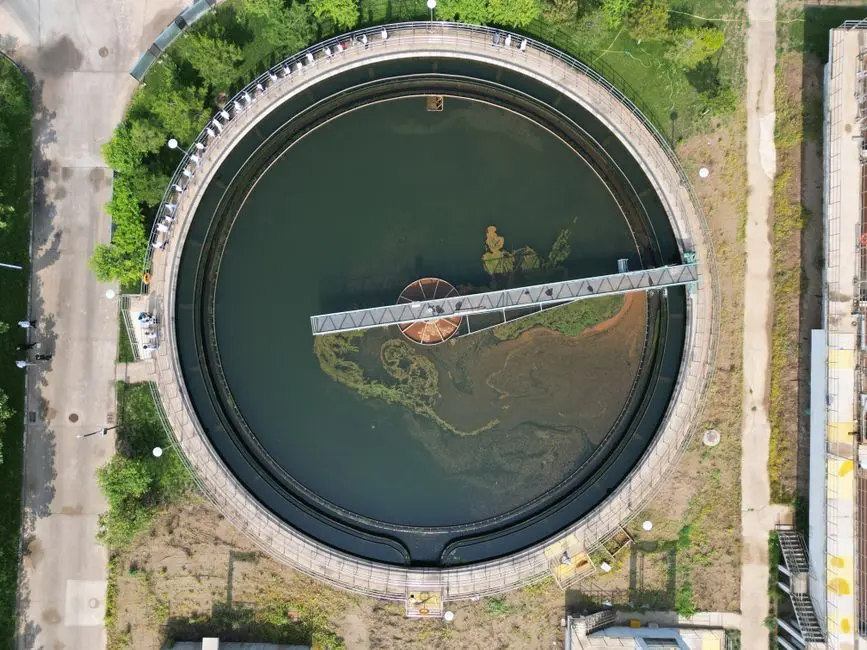
A CAS train pairs primary clarification, an aeration basin, a secondary clarifier, and disinfection, with RAS and WAS loops keeping biomass in the system (S3) — biology and settling are coupled in the same tank chain. On comparable industrial duty, CAS delivers BOD 20–30 mg/L and TSS 20–40 mg/L; ammonia depends on whether the aeration basin was sized for full nitrification and on winter MLSS temperature (S3). In a mining stream, the clarifier is exposed to heavy-metal floc, high TSS, and AMD-driven pH excursions, and S3 documents clarifier washout above roughly 1.5× design flow. Metals-laden floc from lime or sulfide precipitation disrupts settleability in exactly the same way that FOG and bulking disrupt a food-stream clarifier — both are well-documented failure modes. Sulfate >1,500 mg/L and pH <5 inhibit nitrifiers, so the "ammonia depends on design" caveat in S3 is sharper for mining duty than for food/B&B; expect partial nitrification unless the basin was deliberately oversized and upstream pH correction is robust. The implication is that on a mining stream, the secondary clarifier is rarely the place to find spare performance — it is usually the bottleneck.
How a Submerged MBR Changes the Clarifier Equation
A submerged MBR immerses 0.1 μm PVDF flat-sheet or hollow-fiber membranes directly into the mixed liquor, with a coarse-bubble aeration manifold that both oxygenates biomass and scours the membrane surface (S3, HydropureWater verified product catalog, 2026). The 0.1 μm nominal pore sits inside the 0.04–0.2 μm ultrafiltration band documented in the Montpellier membrane thesis (S4, 2012), which physically retains essentially all bacteria and most viruses — clarification is no longer a settling problem. Because the membrane does the clarifier's job, MLSS can be pushed to 8,000–12,000 mg/L, roughly triple a clarifier's comfort zone, which is what produces the 60% smaller footprint versus a CAS-plus-clarifier train of equal capacity (S3 / S6, HydropureWater verified product catalog, 2026). Fouling control rests on controlled aeration intensity, periodic relax cycles, and a PLC-tracked CIP routine; the submerged flat-sheet DF series PVDF flat-sheet membrane module runs at 10–20× lower specific energy than external cross-flow designs (S3, DF series verified specs). The mechanism is not "better biology" — it is that physics replaces settling, so the train no longer depends on floc buoyancy to work.
Bridgeton Mining/Metals Influent Envelope vs Train Effluent
The table below compares what enters the biological stage at a Bridgeton-area mining/metals site against what a CAS and a submerged MBR leave behind. The Bridgeton industrial lower bound is the S3 food/B&B baseline (used here because no mining-specific Bridgeton figure is in the supplied research); mining duty adds heavy metals (Fe, Mn, Cu, Zn, Pb, As), sulfate typically >1,500 mg/L in AMD-affected streams, and TSS that can exceed 5,000 mg/L after crushing/milling — confirm these with site jar tests before sizing.
| Parameter | Bridgeton industrial lower bound (S3, food/B&B baseline) | Mining/metals envelope (site-specific, confirm by sampling) | CAS effluent (S3, 2026) | Submerged MBR effluent (S3, 2026) |
|---|---|---|---|---|
| BOD (mg/L) | 800–5,000 | Site-specific; treat S3 as lower bound | 20–30 | <5 |
| TSS (mg/L) | 300–1,500 | Up to 5,000 after crushing/milling | 20–40 | <1 |
| pH | 3–11 | 2–4 during AMD events | 6.5–8.5 after correction | 6.5–8.5 after correction |
| Sulfate (mg/L) | Not in S3 baseline | Typically >1,500 in AMD-affected streams | Passes through | Passes through (RO required for sulfate reduction) |
| Total metals (Fe, Mn, Cu, Zn, Pb, As) | Not in S3 baseline | Site-specific; elevated in AMD and finishing rinsewater | Removed by upstream precipitation only | Removed by upstream precipitation; membrane retains bound floc |
| Turbidity (NTU) | — | — | Variable; clarifier-dependent | <1 (reuse-ready after UV) |
For a procurement-grade MBR-versus-CAS comparison with capex and reuse framing on a Bridgeton envelope, see the MBR cost per m³ 2026 guide and the primary vs secondary treatment comparison.
CAS vs MBR Comparison Matrix for a 2026 Bridgeton Mine Duty
The matrix below is sized for a 500 m³/day Bridgeton mining duty. Effluent values are steady-state operating points, not guarantees; capex, opex, and kWh/m³ vary with influent load, equalization design, and local power and labor rates, and should be requested from suppliers on the actual site envelope.
| Parameter | CAS with secondary clarifier | Submerged MBR (PVDF, 0.1 μm) |
|---|---|---|
| Capacity envelope | Scales linearly with clarifier area; no fixed upper bound | 10–2,000 m³/day (S6, HydropureWater integrated unit); DF flat-sheet modules 32–135 m³/day each at 80–225 m² (S3) |
| Effluent BOD (mg/L) | 20–30 (S3) | <5 (S3) |
| Effluent TSS (mg/L) | 20–40 (S3) | <1 (S3) |
| Effluent turbidity (NTU) | Clarifier-dependent, swings with bulking | <1 (S3) |
| MLSS operating range (mg/L) | ~3,000–5,000 (clarifier comfort zone, S3) | 8,000–12,000 (S3) |
| Footprint at equal capacity | Baseline | ~60% smaller than CAS-plus-clarifier (S3 / S6) |
| Reuse readiness | Requires tertiary UF/RO to reach reuse quality | Reuse-ready after UV disinfection (S3) |
| Specific energy | Aeration-dominated; comparable to MBR coarse-bubble on a like-for-like MLSS basis — request a quote for site kWh/m³ | 10–20× lower specific energy than external cross-flow (S3, DF series verified specs); coarse-bubble aeration is the main load |
| Metals / pH shock tolerance | Biomass washout above ~1.5× design flow and during bulking; metal floc and AMD pH swings degrade settleability (S3) | Membrane decouples clarification from settleability (S3) |
| O&M familiarity | Standard activated-sludge playbook | Standard plus membrane CIP routine; PLC logs MLSS, TMP, temperature |
| Typical 2026 U.S. capex envelope (USD per m³/day) | 0.40–0.70 (S3) | Higher than CAS; site-specific — request a quote from MBR suppliers for the actual envelope |
For a parallel mining/metals pretreatment comparison (lamella clarifier vs DAF) see the Prattville mining DAF vs clarifier guide; the upstream decision is the same in Bridgeton.
Upstream Train Both Trains Require for Bridgeton Mining Duty
Both CAS and MBR need a GX rotary mechanical bar screen for trash and rags, plus flow equalization to dampen AMD-driven slug loads (S3 decision rules). Mining duty typically adds lime or sulfide precipitation for heavy metals removal and pH correction to 6.5–8.5 before the biological stage, because sulfate >1,500 mg/L and pH <5 inhibit nitrifiers and the S3 baseline clarifier comfort zone does not hold under metal floc. A DAF (4–300 m³/h envelope, S3 catalog) is the standard pre-treatment for FOG and colloidal TSS in food duty; for mining it is replaced or supplemented by a lamella clarifier and chemical precipitation step — confirm with jar tests on site water. Skipping the upstream train is, per S3, the single most common cause of premature membrane fouling or clarifier failure on industrial duty, and on AMD-affected streams it is also the most common cause of nitrification collapse. No Bridgeton mining specification should reach a CAS or MBR datasheet before the upstream metals precipitation, pH correction, and equalization envelope has been confirmed.
Decision Framework: Which Train Fits a 2026 Bridgeton Mining Site
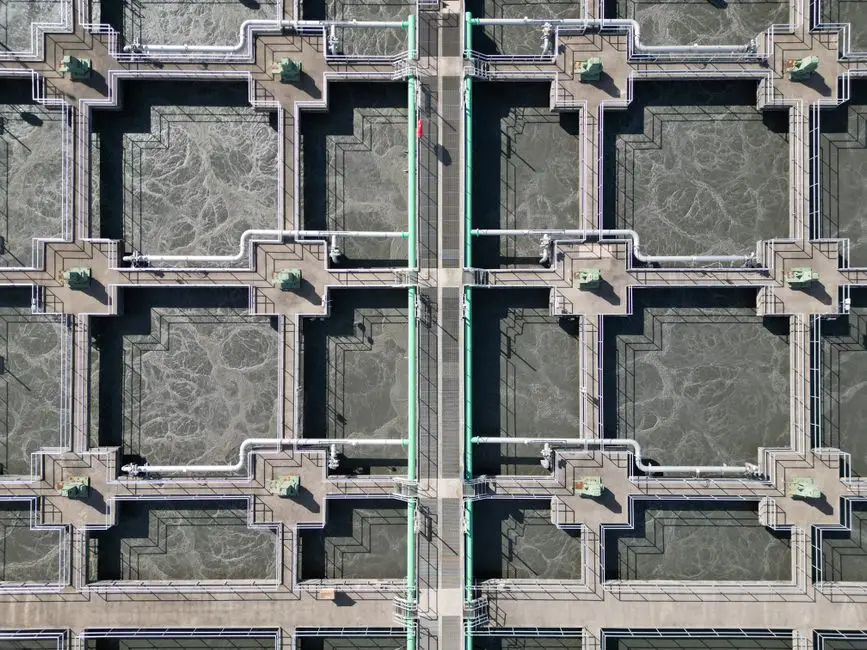
Greenfield, 10–2,000 m³/day, with reuse or a strict ammonia target and AMD swings on the roadmap: an MBR in the HydropureWater integrated envelope gains the <1 NTU effluent and the ~60% footprint saving documented in S3 and S6. Greenfield, >2,000 m³/day, capex-constrained, low reuse ambition, and a stable influent: CAS with a lamella clarifier still offers the lowest capex per m³/day, accepting the documented washout risk above ~1.5× design flow (S3). Existing CAS, tightening metals/ammonia limits or a new reuse target: retrofit the MBR stage as a clarifier replacement, reusing the existing aeration basin — addressed in S3 as the standard retrofit pattern. AMD-dominated catchment with pH 2–4 events and sulfate >1,500 mg/L: MBR is the safer choice because the membrane decouples clarification from settleability and the high MLSS 8,000–12,000 mg/L (S3) is more tolerant of short pH excursions than a clarifier — but only after robust equalization and pH correction upstream. The cheapest capex answer is rarely the lowest lifecycle answer on a Bridgeton mining envelope, and the 2026 question is whether the site can absorb a 1.5× flow event without losing its biomass.
Frequently Asked Questions
What capex envelope should a Bridgeton engineer expect for an MBR versus a CAS train in 2026?
For a CAS train on industrial duty, S3 cites a 2026 U.S. capex envelope of USD 0.40–0.70 per m³/day for the biological stage; MBR capex is higher and varies with influent load, equalization design, and pretreatment envelope. Request a written quote from an MBR supplier on the actual Bridgeton influent envelope rather than relying on a generic range.
How do I evaluate MBR and CAS suppliers for a 2026 Bridgeton mining retrofit?
Shortlist suppliers that document both the 0.1 μm PVDF membrane specification and a referenced CIP chemistry protocol, and that can show a 2025 or 2026 reference list on AMD-affected or metals-bearing industrial duty. Confirm in writing that the proposal includes the upstream bar screen, equalization, and chemical precipitation step rather than offering the MBR or CAS in isolation.
Can a submerged MBR handle AMD-driven pH swings and sulfate above 1,500 mg/L?
MBR decouples clarification from settleability and operates at MLSS 8,000–12,000 mg/L (S3), which is more tolerant of short pH excursions than a clarifier. However, sulfate >1,500 mg/L and pH <5 still inhibit nitrifiers, so the upstream train must include equalization and pH correction to 6.5–8.5 before the biological stage regardless of the membrane choice.
What upstream equipment is mandatory before sizing either an MBR or a CAS clarifier on a Bridgeton mine?
Both trains require a rotary bar screen, flow equalization sized to dampen AMD slug loads, lime or sulfide precipitation for heavy metals, and pH correction to 6.5–8.5 (S3). Skip these and either clarifier failure or premature membrane fouling is the documented outcome, so they belong inside the same equipment scope as the biological stage.