Why UPW Specification Mistakes Are CAPEX, Not Paperwork
A UPW system inside a 300 mm fab is a $200–500M line item, and the recycle add-on adds $50–150M on top, inside single-fab capital programmes of $1B–$4.6B. At that CAPEX, a specification error that survives into execution is not paperwork: it is re-engineering of pretreatment, polishing, or distribution, paid through change orders against a signed PO. A 1% yield loss attributable to UPW quality is a material economic event against that capex envelope, so spec errors that survive into operation cost more than the change order itself.
Most change orders originate in three places. First, the polishing-loop envelope — TOC, dissolved oxygen, particles, and resistivity setpoints — where the spec is usually written to the standard floor rather than to the node. Second, the distribution loop — materials, dead legs, point-of-use filtration, and biofilm control — which is almost always under-scoped in the original RFQ. Third, the fab drain interface — acid, alkaline, CMP, and concentrate streams — which is normally on a parallel procurement track and only re-enters the UPW conversation when a polishing-loop change forces a wastewater re-scope. The drain side is where most change orders are actually priced, and it is the section most often left out of the original UPW RFQ.
The practical consequence is that the RFI is the cheapest place to surface a defect. Any error that passes the RFI lands on the PO, and a spec error paid through a change order is paid at field-labour rates, not engineering rates. A pre-issuance review against the three origins of change orders is the only defensible way to keep a sub-7 nm or sub-3 nm UPW spec inside its envelope.
The Standards Stack: F63, D5127, and ISO 3696 Are Not Interchangeable
SEMI F63 sets the floor: resistivity ≥18.2 MΩ·cm at 25 °C, total organic carbon (TOC) below 1 ppb, dissolved silica 0.2–1.0 ppb, particles above 0.05 µm counted at less than 0.3/mL, and bacteria held below 1 CFU/100 mL. The 18.2 MΩ·cm figure is the theoretical maximum for absolutely pure water at 25 °C, equivalent to 0.05501 µS/cm conductivity, and every fab specification is written against it. In practice, sustained loop operation lands in the 18.15–18.18 MΩ·cm window, and any drop below 18.15 MΩ·cm on the return loop is treated as an actionable excursion rather than normal operation. A 0.1 ppb NaCl contamination shifts resistivity from 18.18 to 18.11 MΩ·cm, so the spec must state the inline meter location and the alarm setpoint, not just the headline number.
The standards stack is a hierarchy, not a list of equals. ASTM D5127 is the broader electronics UPW standard at ≥18.0 MΩ·cm and TOC below 10 ppb. ISO 3696 Grade 1 covers laboratory reagent water at ≥10 MΩ·cm and carries no TOC or particle limit. A common change-order trigger is omitting which standard binds each water class. The spec must say F63 for the polishing loop and tool supply, D5127 for general electronics, and ISO 3696 Grade 1 for incoming QC reagent water. A multi-media filter for RO pretreatment and SDI control is the front-end guard that prevents the F63 envelope from being compromised by upstream excursions.
| Standard | Resistivity (MΩ·cm, 25 °C) | TOC limit | Particle limit | Where it binds |
|---|---|---|---|---|
| SEMI F63 | ≥18.2 | <1 ppb | <0.3/mL above 0.05 µm | 300 mm polishing loop and tool supply |
| ASTM D5127 | ≥18.0 | <10 ppb | Per water type | General electronics UPW |
| ISO 3696 Grade 1 | ≥10 | None stated | None stated | Laboratory reagent water, incoming QC |
The spec line should name the standard per water class and reject any RFQ response that conflates the three. Conflation is a common source of disputes during acceptance testing, because the supplier is allowed to deliver to whichever standard they wrote against if the buyer has not specified.
The Eight Spec Mistakes That Drive 2026 Change Orders
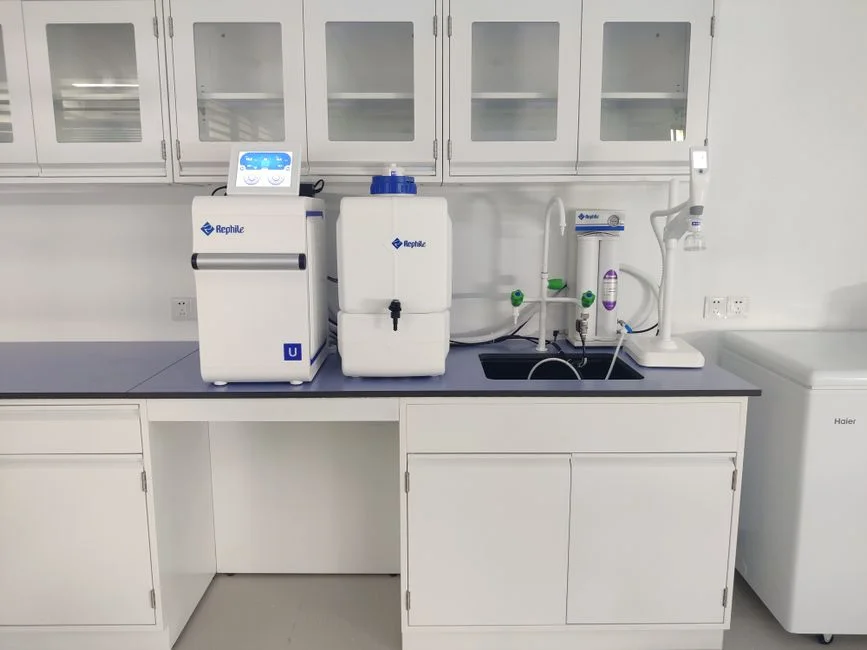
Each of the eight errors below has a known failure mode, a parameter it distorts, and a defensible spec line that closes it. Going through the list before the RFQ goes out is faster than defending a change-order review later.
1. Single TOC limit written to the floor. Sub-3 nm production now targets TOC below 0.5 ppb at point of use, with online alarms typically set at 0.7 ppb and a hard action at 1 ppb. The failure mode is pattern defects in photoresist. The spec must state the online analyser location, the setpoint, and the action, not just a single TOC number.
2. Missing DO limit at point of use. Dissolved oxygen must be held below 10 µg/L at point of use to prevent oxidation of metal films and low-k dielectrics. The spec must require an optical-fluorescence sensor at POU and an alarm at 10 µg/L, because this sensor type drifts less than membrane-electrochemical cells over multi-month campaigns.
3. Particle limit not scaled to node. The half-feature-size rule means a 40 nm feature requires removal of all particles above 20 nm (0.02 µm) and a 3 nm feature requires filtering to roughly 1.5 nm, with distribution-loop final filters typically ≤200 nm at point of use. The spec must require a laser particle counter at POU and a ≤200 nm final filter installed at POU, not just at the skid outlet.
4. Resistivity spec missing meter location and alarm. State 18.15–18.18 MΩ·cm sustained, below 18.15 MΩ·cm as an excursion, and require an inline meter on the return loop with the alarm setpoint stated.
5. Feedwater profile and variability envelope left out. Reclaimed feed introduces small organics such as urea that slip past RO, EDI, and standard UV, so UV-AOP (UV plus H2O2, or sulfate-radical AOP) is moving from pilot to supplementary polishing for sub-7 nm fabs and must be specified when feed is reclaimed. The spec must state source, variability envelope, and peak demand and size to peak. An industrial RO system for UPW pretreatment is the typical front end for sub-ppb polishing.
6. Loop materials underspecified. State PVDF, PP, or SS-316L with orbital-welded joints and require the material schedule and weld procedure in the RFQ.
7. Missing CIP and consumable schedule. UV lamp life 9,000–12,000 h, RO membrane 3–5 years, EDI module 5+ years on a planned schedule, so the spec must require a planned replacement schedule in the RFQ rather than a TBD line item.
8. Drain interface left out of the UPW RFQ. State drain segregation, concentrate destination, and ZLD scope if water-stressed. Fabs segregate acid (HF, H2SO4, HCl, HNO3), alkaline (NH4OH, H2O2, TMAH developer), CMP slurry, and solvent streams, and the drain matrix must be in the RFQ so a polishing-loop tightening does not become a wastewater change order.
| # | Mistake | Parameter distorted | Failure mode | Spec line that closes it |
|---|---|---|---|---|
| 1 | Single TOC limit | Organics at POU | Pattern defects in photoresist | <0.5 ppb target; 0.7 ppb alarm; 1 ppb hard action; analyser location stated |
| 2 | Missing DO limit at POU | Dissolved O2 | Oxidation of metal films, low-k dielectric | <10 µg/L; optical-fluorescence sensor; alarm at 10 µg/L |
| 3 | Particle limit not scaled to node | Particle count at POU | Killer defects at advanced nodes | Half-feature-size rule; ≤200 nm final filter at POU |
| 4 | Resistivity spec without meter and alarm | Return-loop resistivity | Excursion undetected on return | 18.15–18.18 MΩ·cm sustained; alarm setpoint stated |
| 5 | Feedwater profile and variability envelope left out | Organic load and peak demand | RO/EDI breakthrough under peak | State source, variability envelope, peak demand; size to peak |
| 6 | Loop materials underspecified | Wetted surface and joints | Biofilm, leaching, dead legs | PVDF, PP, or SS-316L; orbital-welded joints |
| 7 | Missing CIP and consumable schedule | Lamp, membrane, module life | Unplanned outage; performance drift | UV 9,000–12,000 h; RO 3–5 years; EDI 5+ years on planned schedule |
| 8 | Drain interface left out of UPW RFQ | Wastewater envelope | Polishing change becomes wastewater change order | Drain segregation, concentrate destination, ZLD if water-stressed |
Polishing-Loop Tightening in 2026: TOC, DO, and the Half-Feature-Size Rule
Sub-3 nm production now targets TOC below 0.5 ppb at point of use, with online alarms typically set at 0.7 ppb and a hard action at 1 ppb. The action setpoint is a hard rejection criterion, not a soft alarm: a single 1 ppb excursion is enough to trigger a tool hold and a yield review, and the spec must say so explicitly.
Dissolved oxygen must be held below 10 µg/L at point of use to prevent oxidation of metal films and low-k dielectrics. The failure mode is set by the metallisation stack, not by what is convenient to measure. Optical-fluorescence DO sensors are the practical choice for the return loop because they drift less than membrane-electrochemical cells over multi-month campaigns. A dual-wavelength 185/254 nm UV sterilizer for TOC reduction, sized to the TOC target with lamp life 9,000–12,000 hours, handles the organic reduction duty.
The particle cut is where a 2022 template is most likely to fail. The half-feature-size rule means a 40 nm feature requires removal of all particles above 20 nm (0.02 µm), and a 3 nm feature requires filtering to roughly 1.5 nm; distribution loop final filters are typically ≤200 nm at point of use. A spec written from a 2022 or earlier template will miss all three tightenings, and these are the change-order line items most often seen in 2026 retrofits.
Reclaimed feedwater introduces small organics such as urea that slip past RO, EDI, and standard UV; UV-AOP (UV plus H2O2, or sulfate-radical AOP) is moving from pilot to supplementary polishing stage for sub-7 nm fabs and must be specified when feed is reclaimed. The spec must state the oxidant dose and the polishing target, not just name the technology.
Likelihood × Blast Radius: Prioritising the Eight Mistakes Before the PO
The eight mistakes translate into a procurement conversation through three axes: how often the error shows up in 2024–2026 retrofits (likelihood), how much of the system is affected when it does (blast radius), and which line item on the change order ends up absorbing the cost. The table below scores each mistake on those axes so the reader can prioritise which spec lines to harden before the PO goes out. The scores reflect the prevalence of each error in 2024–2026 retrofit reports; they are not site-specific measurements.
| Mistake | Likelihood | Blast radius | Cost line that absorbs it |
|---|---|---|---|
| 1. Single TOC limit | High | High (loop + drain via resin regeneration) | Return-loop instrumentation upgrade; UV stage and mixed-bed resin replacement |
| 2. Missing DO at POU | High | High (metrology + yield) | Loop degasser and POU DO sensor add-on |
| 3. Particle limit not scaled to node | Medium | High (POU only, but per-tool) | POU filter retrofit and particle counter add-on |
| 4. Resistivity spec without meter and alarm | Medium | Medium (excursion detection only) | Return-loop instrumentation upgrade |
| 5. Feedwater profile and variability envelope left out | Low | High (forces pretreatment re-scope) | RO area and pretreatment re-scope; UV-AOP add-on |
| 6. Loop materials underspecified | High | High (loop re-piping) | Loop re-piping and weld procedure re-issue |
| 7. Missing CIP and consumable schedule | Low | Medium (planned outage vs. emergency) | UV lamp, RO membrane, EDI module replacement; CIP program |
| 8. Drain interface left out of UPW RFQ | High | High (drain contract re-scope) | Wastewater plant re-scope; ZLD retrofit |
High-likelihood, high-blast-radius mistakes are single TOC limit, missing DO limit at point of use, and underspecified distribution-loop materials — these account for the majority of mid-project change orders on 2024–2026 fab retrofits. High-blast-radius but lower-likelihood mistakes are missing feedwater profile and missing CIP regime; these surface late and are expensive because they force re-scoping of pretreatment or membrane area. Ask the supplier for a written allocation of which line items are fixed in the base price and which are provisional, and require any provisional item to be tied to a measurable spec trigger before the contract is signed.
Drain-Side Spec: Why It Belongs in the UPW RFI
Fabs segregate drain streams at the point of generation: acid waste (HF, H2SO4, HCl, HNO3), alkaline waste (NH4OH, H2O2, TMAH developer), CMP slurry waste, and solvent waste. Mixing incompatible streams is both a safety hazard and a treatment-cost event. HF-bearing streams drive calcium fluoride precipitation and fluoride limits; TMAH requires biological treatment because it is biodegradable; CMP slurry contains abrasive particles plus metal-laden slurry and is normally sent to hazardous-waste disposal. An MBR system for TMAH-bearing alkaline drain is the standard biological stage for the alkaline stream.
Cooling tower blowdown and RO concentrate are the highest-volume reclaim candidates; zero-liquid-discharge (ZLD) systems enable near-zero net discharge at water-stressed sites but add CAPEX and must be in the original scope, not a change order. A polishing-loop spec that adds UV-AOP or tightens DO to below 10 µg/L at point of use will shift the wastewater side too — more concentrate, different organics profile, possible ZLD re-scope. The two specs must be reviewed together, or the wastewater plant becomes the change order. For US sites, the drain-side spec also has to clear the pretreatment rules at the sewer discharge boundary; see 2026 pretreatment compliance for sewer discharge for the 40 CFR 414 interface.
RFI Checklist: What to Lock In Before the RFQ Goes Out

Run this list against the draft RFQ before it is issued. Each item maps to a defensible spec line and a measurable acceptance criterion; the qualitative inputs a buyer must obtain from the supplier are flagged where the research does not give a number.
| Item | Spec line / commitment | Acceptance criterion |
|---|---|---|
| Standard per water class | F63 (polishing), D5127 (general UPW), ISO 3696 Grade 1 (QC reagent) | Standard cited per water class in RFQ |
| TOC at POU | <0.5 ppb target for sub-3 nm; 0.7 ppb alarm; 1 ppb hard action | Online UV-persulfate analyser at POU |
| DO at POU | Optical-fluorescence sensor; alarm at 10 µg/L | Sensor model and location in RFQ |
| Particle cut | Half-feature-size rule; ≤200 nm final filter at POU | Laser particle counter at POU; ≤200 nm filter installed |
| Resistivity | 18.15–18.18 MΩ·cm sustained; <18.15 MΩ·cm = excursion | Inline meter on return loop; alarm setpoint stated |
| Feedwater profile | State source, variability envelope, peak demand | Design feed profile table in RFQ |
| Loop materials | PVDF, PP, or SS-316L; orbital-welded joints | Material schedule and weld procedure in RFQ |
| Measurement | Post-UV TOC, return-loop resistivity, POU particle, optical-fluorescence DO, online Na ISE | Locations and setpoints in RFQ |
| Consumables | UV 9,000–12,000 h; RO 3–5 years; EDI 5+ years | Planned replacement schedule in RFQ |
| Drain side | Drain segregation; concentrate destination; ZLD if water-stressed | Drain matrix in RFQ; ZLD scope stated if applicable |
| Recycling and energy | 85–92% closed-loop recycling; 3–7 kWh per 1,000 gallons UPW | Supplier guarantees both numbers |
Ask the supplier for the minimum 2026 tightening commitments: TOC below 0.5 ppb target with a 0.7 ppb online alarm, DO below 10 µg/L at point of use, half-feature-size particle cut at POU, 85–92% closed-loop recycling, and 3–7 kWh per 1,000 gallons. The chemical-free EDI polishing module sized for the actual cation and anion load is the consumable-bound stage most often mis-sized in the original RFQ. For a fuller cost-line review, see microelectronics wastewater treatment cost breakdown; for legacy ETP due diligence on a brownfield site, see semiconductor factory ETP due diligence.
Frequently Asked Questions
What is the minimum 2026 supplier commitment set a buyer should require before signing a UPW PO?
The minimum is a documented CIP regime covering UV lamp life (9,000–12,000 h), RO membrane life (3–5 years), and EDI module life (5+ years), plus the ability to meet the 2026 tightening: TOC below 0.5 ppb target with a 0.7 ppb online alarm, DO below 10 µg/L at point of use, and a half-feature-size particle cut at POU. The supplier should also commit to 85–92% closed-loop recycling and 3–7 kWh per 1,000 gallons of UPW produced, since both are buyer-evaluation criteria at water-stressed sites.
How should a buyer structure an RFI to keep the polishing-loop and drain-side specs from drifting apart?
Keep the drain matrix inside the UPW RFQ, not on a parallel procurement track. State drain segregation, concentrate destination, and ZLD scope if the site is water-stressed, and require the supplier to flag any polishing-loop change that shifts the wastewater side. If the wastewater plant is on a separate contract, polishing-loop changes surface as a change order against that contract rather than the UPW contract.
Which 2022-era spec lines are most likely to fail a 2026 sub-3 nm acceptance test?
Three: TOC target tightened below 0.5 ppb for sub-3 nm, DO below 10 µg/L at point of use, and a particle cut scaled to the half-feature-size rule rather than a fixed 0.05 µm line. A spec written from a 2022 or earlier template will miss all three, and each shows up in retrofits as a separate change order.
What is the defensible way to ask a supplier for a budget range on a sub-7 nm UPW polishing loop?
Ask the supplier for a written allocation of which cost lines are fixed in the base price and which are provisional, and require any provisional item to be tied to a measurable spec trigger (resistivity setpoint, TOC action level, DO alarm, particle cut, recycling rate) before the contract is signed. The UPW polishing envelope itself runs $200–500M per leading-edge fab and the recycle add-on adds $50–150M on top, so the per-line provisional list is the only way to compare bidders on an apples-to-apples basis without an indicative quotation in the RFI.