
Why Airport Wastewater Treatment Starts with DAF
Airport wastewater combines apron runoff, aircraft wash water, terminal greywater, and seasonally heavy discharges of ethylene glycol and propylene glycol from deicing operations. During winter, the BOD and COD load swings dramatically because deicing fluids (Types I, II, and IV) carry glycol, surfactants, corrosion inhibitors, and sometimes formate-based additives that depress pH and add toxicity. S2 (Russian civil-aviation journal, 2026) reports that civil-aviation deicing fluids create a significant environmental burden due to glycol toxicity and high biological oxygen demand, requiring physicochemical pretreatment upstream of any further treatment train to remove that load before it reaches biological units.
DAF is preferred over plain sedimentation on this stream because the contaminants that matter most — emulsified oil, glycol-bound floc, and fine suspended solids — do not settle well. The HydropureWater DAF system saturates a pressurized recycle stream with air in an air drum and releases it through a pressure-reduction valve, so microscopic bubbles nucleate on floc particles and lift them to the surface for skimming. A DAF unit with 4–300 m³/h capacity (S6, HydropureWater verified product catalog) can absorb the seasonal swing from base sanitary flow to peak deicing flow without being rebuilt for winter duty. Removing oil, FOG, and floatable glycol before activated sludge or MBR is the standard way to prevent biomass washout and foaming events downstream, and the broader DAF selection logic is laid out in the best DAF unit for industrial wastewater 2026 guide.
How DAF Works in an Airport Treatment Train
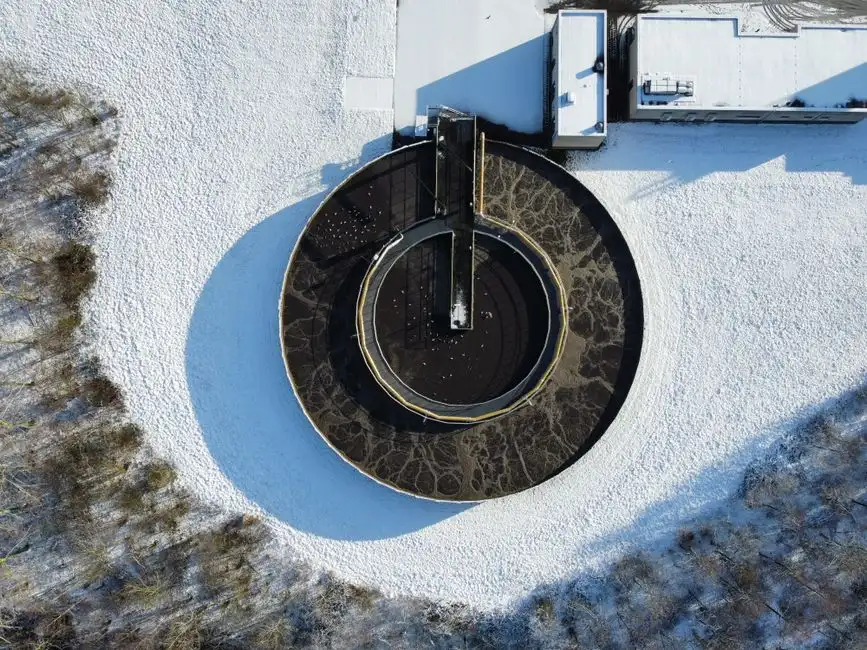
The recycle-stream path functions by clarifying effluent in the float cell, pressurizing it, and saturating it with air inside an air drum. The saturated stream is then re-injected at the front of the float tank through a pressure-reduction valve; the pressure drop causes the dissolved air to come out of solution as microscopic bubbles that nucleate on floc and oil surfaces (S4, Wikipedia). Once enough bubbles attach, the combined mass becomes buoyant and rises to the surface, where a skimmer removes the float layer and clarified underflow exits the bottom of the tank. The recycle ratio is the operating knob that controls bubble density, and a stable ratio provides consistent solids removal when influent load varies.
A typical airport train runs oil/water separator (apron-side API or coalescing unit) → equalization basin → coagulation/flocculation → DAF → biological treatment (activated sludge, MBR, or SBR) → tertiary filtration/polishing → discharge or reuse. DAF sits after chemical conditioning because the bubbles need pre-formed floc to attach to; without coagulant and polymer dosing upstream, the bubbles have nothing to lift. S3 (ProChem) emphasizes that a properly engineered DAF coordinates the flotation tank, recycle pump, air injection, control panel, and skimmer as one system, with the recycle ratio and consistent microbubble formation driving stable performance. The DAF vs API separator comparison is useful here because the API separator handles the bulk oil on the apron side while the DAF polishes the residual emulsified oil, FOG, and glycol-bound floc downstream.
Core DAF Design Parameters for Airport Duty
The parameter sheet below details the values a design engineer should include in a design basis or RFP before approaching suppliers. The exact values for recycle ratio, air-to-solids ratio, and surface loading rate at design and peak flow are not generic constants — they must be calculated by the DAF vendor against your specific influent and justified with their air-to-solids calculation. Treat any quoted value that is not tied to a specific flow, solids load, and temperature as unverified.
| Parameter | Design target for airport duty | Source / note |
|---|---|---|
| Recycle ratio | Set by supplier's air-to-solids calculation; treat as a project-specific value | Request the supporting calculation; insufficient recycle is a common under-performance cause in oily streams (S3) |
| Residence time — circular DAF | About 3 minutes | S4 (Wikipedia): circular units complete separation in ~3 min and use a spiral scoop |
| Residence time — rectangular DAF | 20 to 30 minutes | S4 (Wikipedia): rectangular units require 20–30 min residence time |
| Air-to-solids ratio (A/S) | Calculated value at design and peak flow | Supplier must provide; request the A/S at both operating points |
| Coagulant | Aluminum sulfate or ferric chloride, dosed upstream of flocculation | S4 (Wikipedia); S3 (ProChem) |
| Flocculant | Polymer, tuned to glycol-influenced stream chemistry | S3 (ProChem); pilot-verify on actual apron runoff |
| Float sludge consistency | Typically 3–5% dry solids (qualitative; confirm with vendor) | Feeds a downstream plate-and-frame filter press for dewatering |
| Materials of construction | Stainless wetted parts; corrosion-resistant skimmer drive | Airport deicing chemicals (glycol- and formate-based) are aggressive |
| Controls | PLC with influent flow pacing, recycle pressure transmitter, surface sludge torque monitoring, remote telemetry | Airport plants are often unstaffed overnight |
| Geometry choice | Circular for tight apron footprints and shorter residence; rectangular where footprint allows longer residence | S4 (Wikipedia) — see residence-time values above |
Geometry choice drives footprint, not removal efficiency per se. S4 (Wikipedia) is explicit that circular DAF units are more efficient in surface-area terms and complete separation in about 3 minutes, while rectangular units require 20 to 30 minutes. The longer residence of a rectangular unit is a disadvantage on a constrained apron site but can be useful as a buffer when influent quality is highly variable. For chemical conditioning, both S3 and S4 call out aluminum sulfate and ferric chloride as the standard coagulants, with polymer flocculant added after coagulation to build the floc size that bubbles can lift. The DAF system maintenance guide covers the inspection cadence for air injection, recycle streams, and skimmer operation that this parameter sheet implies.
Sizing a DAF to Match Airport Peak Flows
Sizing a DAF for an airport is dominated by the difference between base flow (terminal sanitary, aircraft wash, fuel-farm runoff) and peak deicing flow, where a single winter storm can multiply design flow by a large factor over a few hours. The exact peak-to-base multiplier is site-specific — it depends on the number of deicing pads, the type of deicing fluid used (Type I glycol versus Type II/IV thickened fluids), and the climate — so it must be developed from the airport's own deicing-event records. Once the peak is quantified, the sizing workflow is to use an upstream equalization basin to dampen the peak so the DAF can be sized closer to the average winter flow, then select the DAF model and the number of parallel units against the published flow range.
Against a published DAF flow range of 4–300 m³/h (S6, HydropureWater verified product catalog), the design choice is usually not which single model fits but how many parallel units to run. Two smaller DAFs in parallel are typically preferred over a single oversized unit at airports, because it lets one unit stay online while the other is in maintenance during a critical deicing day. The sizing table below shows the relationship between target flow band, recommended unit count, and the operational reason for that count; the actual model selection inside the band must come from the supplier's air-to-solids calculation.
| Target flow band | Recommended unit configuration | Operational reason |
|---|---|---|
| Up to ~50 m³/h (small regional airport or base flow) | Single DAF within the 4–300 m³/h published range | Matches base sanitary flow; peak handled with upstream EQ |
| ~50–150 m³/h (medium hub, moderate deicing season) | Two parallel DAFs, each sized for average winter flow | One unit can stay online during maintenance on a deicing day |
| ~150–300 m³/h (large hub, heavy deicing season) | Two or more parallel DAFs sized for the post-EQ flow | Redundancy and skimmer-service continuity during peak events |
| Above 300 m³/h (exceptional peaks) | Multiple parallel trains with central coagulation/flocculation | Equalization must be sized aggressively; confirm with pilot |
The sizing exercise should also confirm that the upstream automatic chemical dosing system can pace coagulant and polymer to the flow-paced signal that the DAF PLC expects. More detail on the unit itself is on the HydropureWater DAF system product page.
Compliance and Discharge Targets the DAF Must Help Hit
DAF removal performance is a contractual deliverable against the airport's actual permit. In the US, airport discharges are typically governed by an airport-specific NPDES permit; in Europe, local Urban Waste Water Directive thresholds or national aviation-environment rules apply; elsewhere, ICAO and ACI sustainability guidance is increasingly referenced. Because the governing effluent limits vary by permit, the design engineer must request the exact effluent limits from the client or the regulator before specifying DAF removal.
The defensible framing is to set DAF as the unit operation responsible for TSS, oil and grease, and a defined fraction of BOD/COD reduction, with biological polishing sized for the residual load leaving the DAF. For airports targeting water reuse (apron wash, irrigation, toilet flushing), require the DAF effluent turbidity target to be low enough that downstream filtration and disinfection are not overloaded — a DAF that discharges high-turbidity water into a reuse polishing train simply moves the problem downstream. The compliance milestone to anchor on is the residual load after DAF, expressed in the same units the permit uses.
Buyer's Checklist: Questions to Put to a DAF Supplier
Before issuing a PO, the design engineer should be able to answer "what did the supplier commit to, in writing?" for each line below. The questions are ordered from physics to paperwork, which is the order a defensible technical evaluation should follow.
- Ask for the calculated air-to-solids ratio at design and peak flow, the recycle ratio, and the surface loading rate at each candidate model — all three must be in the bid, not a generic catalog value.
- Request a reference list of similar airport, refinery, or oily-wastewater DAF installations commissioned within the last five years, with contact names and available performance data.
- Confirm materials of construction, coating systems, control panel standard (PLC/HMI versus relay logic), and warranty terms explicitly for airport-corrosive service.
- Require a written commissioning protocol, a performance test procedure with pass/fail criteria tied to the airport's permit limits, and a defined spare-parts package before signing.
This checklist is the same framework used in the DAF for hotel wastewater design guide, adapted for the more aggressive chemistry and the seasonal peak loading that an airport duty cycle imposes.
Frequently Asked Questions
What size DAF does a mid-size airport typically need for deicing runoff?
There is no single published "typical" airport DAF size; the design flow is dominated by the number of deicing pads and the climate, and the site-specific peak-to-base flow multiplier must be developed from the airport's own deicing-event records. The HydropureWater DAF product range covers 4–300 m³/h across 13 standard models (S6, HydropureWater verified product catalog), so the practical exercise is to calculate the post-equalization design flow, then choose between one or more parallel units inside that band so one unit can stay online during maintenance.
How much does an airport-duty DAF system cost?
No published price for an airport-duty DAF system was identified in the supplied research, and pricing is heavily driven by materials of construction (stainless versus coated carbon steel), flow capacity, control scope, and the level of redundancy. The actionable buyer step is to request a budgetary quotation tied to the calculated air-to-solids ratio, the recycle ratio, and the surface loading rate at design and peak flow, and to ask for an itemized spares and commissioning
Frequently Asked Questions
How is a DAF system sized for airport deicing wastewater?
DAF sizing for airport deicing operations is primarily driven by the peak hydraulic loading rate during winter storm events and the high chemical oxygen demand (COD) of glycol-laden runoff. Engineers typically design based on a surface overflow rate (SOR) ranging from 2.0 to 4.0 meters per hour (m/h) depending on the coagulant-flocculant chemistry employed. The system must also account for the maximum anticipated glycol concentration, which can spike from 500 mg/L to over 10,000 mg/L during active deicing, requiring robust recycle flow ratios (typically 8% to 12% of influent flow) to ensure adequate bubble-to-solids ratios.
What removal efficiency can a DAF achieve for ethylene glycol in airport runoff?
While DAF is exceptionally efficient at removing suspended solids and emulsified oils (often achieving 90-95% removal), it is not a direct removal process for dissolved ethylene glycol. Because glycol is highly soluble, the DAF unit acts as a critical pretreatment step to remove particulate matter and hydrocarbons that would otherwise inhibit downstream biological treatment processes. When integrated with advanced oxidation or biological aerobic systems, the DAF pretreatment ensures that the overall treatment train can achieve greater than 95% total COD removal, protecting the performance of downstream membrane bioreactors or moving bed biofilm reactors.
Should an airport DAF be circular or rectangular, and what residence time is typical?
Rectangular DAF systems are generally preferred for airport applications due to their superior footprint efficiency and better performance in handling the high-solids loading characteristic of deicing fluids. Rectangular units allow for integrated mechanical sludge scraping and provide more consistent flow patterns during high-volume storm events. Typical hydraulic residence times (HRT) for these systems range from 20 to 45 minutes, a period sufficient to allow for the attachment of micro-bubbles to particulates and the subsequent flotation of the sludge blanket.
What is the capital cost range of a DAF unit for a mid-size airport wastewater plant in 2026?
For a mid-size airport processing approximately 0.5 to 2.0 million gallons per day (MGD) of deicing runoff, the capital expenditure for a complete DAF system—including saturation pumps, air compressors, and control instrumentation—typically ranges from $850,000 to $2.2 million USD. This estimate accounts for 2026 inflation and the requirement for stainless steel construction (304 or 316L) necessitated by the corrosive nature of glycol and runway chemical additives. Total project costs may vary significantly based on site-specific civil works, chemical storage requirements, and the level of automation integration.
Which DAF suppliers have delivered airport or aviation wastewater projects in the last five years?
Several specialized industrial water treatment firms have successfully executed airport-grade DAF installations recently, including Evoqua Water Technologies (now part of Xylem), Veolia Water Technologies, and WesTech Engineering. These suppliers are frequently selected for their ability to provide skid-mounted systems that meet stringent local discharge permits and their capability to integrate automated chemical dosing skids specifically calibrated for the fluctuating influent characteristics of glycol-contaminated stormwater.