Why Jeddah Needs Tertiary, Not Secondary-Only Treatment
Al Khumrah WWTP, the largest facility on the Jeddah coast with a combined design capacity of approximately 250,000 m³/d across AK1, AK2, and AK3 and a 621 km collection network, was originally sized for 320 mg/L BOD; the AK3 module alone was built in 2004 for 140,000 m³/d and currently receives roughly 125,000 m³/d (Saleh et al., 2021). For any engineer sizing an onsite plant, this means a Jeddah domestic stream cannot be designed against textbook municipal curves — strength and residence time are governed by what the trunk sewer actually carries, not by EU or U.S. EPA defaults.
Between September 2019 and February 2020, Al Khumrah's recorded influent averaged 8.0 mg/L NH3-N (σ = 1.2; range 6.2–9.4) and 2.1 mg/L PO4, while the treated effluent averaged 3.5 mg/L NH3-N (range 2.8–4.2) and 1.7 mg/L PO4 — both above the 1.0 mg/L Saudi General Environmental limit (Saleh et al., 2021). The plant therefore discharges an estimated 21,261 kg of nitrogen and 3,360 kg of phosphorus per day to coastal waters (Saleh et al., 2021). A secondary-only package sized on the same assumptions will replicate that exceedance on a private outfall. The engineering takeaway is direct: any Jeddah domestic plant must specify a tertiary polish — MBR minimum, RO plus ClO2 where reuse is the deliverable — and treat the Al Khumrah effluent profile as the operating envelope, not the design target.
| Parameter | Al Khumrah influent (Sep 2019–Feb 2020) | Al Khumrah effluent | Saudi PME limit |
|---|---|---|---|
| NH3-N (mg/L) | 8.0 mean (range 6.2–9.4) | 3.5 mean (range 2.8–4.2) | 1.0 |
| PO4 (mg/L) | 2.1 mean | 1.7 mean | 1.0 |
| Daily discharge (kg/d) | — | 21,261 N; 3,360 P | — |
| Design BOD (mg/L) | 320 (original basis) | — | 25 |
| Collection network | 621 km | — | — |
For a private compound or hotel campus tied to a similar feeder network, the same NH3-N and PO4 exceedance pattern is what PME/MAW reviewers will look for. Cross-reference the full KSA 2026 envelope in the KSA 2026 domestic sewage engineering guide.
The 2026 Regulatory Envelope: PME, MAW, and Reuse
PME Decree M/12 and its executive regulations set the 2026 national discharge floor that NCEC enforces across the Kingdom: BOD ≤25 mg/L, COD ≤150 mg/L, TSS ≤30 mg/L, O&G ≤10 mg/L, and total nitrogen 30–50 mg/L (hydropurewater.com 2026). Any design failing these numbers will be rejected at the discharge manifold, regardless of influent strength. The MAW 1989 reuse thresholds remain binding for any treated sewage effluent (TSE) destined for unrestricted irrigation or industrial reuse: turbidity ≤1 NTU and nitrate-N ≤10 mg/L (hydropurewater.com 2026). Vision 2030 has tightened enforcement of both layers, and the 2000 Royal Order already mandates tertiary treatment for all wastewater generated in the Kingdom.
Jeddah is not a Royal Commission city, so the RC overlay (chromium ≤0.05 mg/L, dual online analyzers, 8-hour UPS, 30-day cure-or-suspension clock) does not apply unless a site is annexed. Standard KSA EPC practice is to design to the RC envelope pre-emptively because the RC frequently expands boundaries and a PME-only plant may need 12–18 months of modifications if absorbed into a zone (hydropurewater.com 2026). NEOM, Red Sea Global, and AMAALA mandate 100% reuse for new tourism developments — any KSA tourism campus on the Red Sea coast south of Jeddah must therefore be specified to reuse-grade, not discharge-grade. The Saudi domestic stream also runs at 2,000–10,000 mg/L TDS, which exceeds the parameters used to calibrate standard EU and U.S. design curves, so any RO train must be sized against that band rather than textbook brackish numbers (hydropurewater.com 2026).
| Regulation | Scope | Key 2026 limits | Applies to Jeddah? |
|---|---|---|---|
| PME Decree M/12 / NCEC | National discharge floor | BOD ≤25; COD ≤150; TSS ≤30; O&G ≤10; TN 30–50 mg/L | Yes |
| MAW 1989 reuse | Unrestricted irrigation / industrial reuse | Turbidity ≤1 NTU; nitrate-N ≤10 mg/L | Yes (binding for any TSE offtake) |
| Royal Commission overlay | Jubail, Yanbu, Ras Al-Khair, Jazan | Same BOD/TSS; tighter metals (Cr ≤0.05 mg/L); dual online analyzers; 30-day cure clock | No (unless annexed); design pre-emptively |
| NEOM / RSG / AMAALA | New tourism developments | 100% reuse mandate | Yes for Red Sea coast projects |
These four rows are what a design review at PME/MAW will be scored against, and they are the columns a P&ID must close on. The full clause-by-clause mapping is in the KSA 2026 domestic sewage engineering guide.
Jeddah-Specific Design Drivers You Cannot Ignore
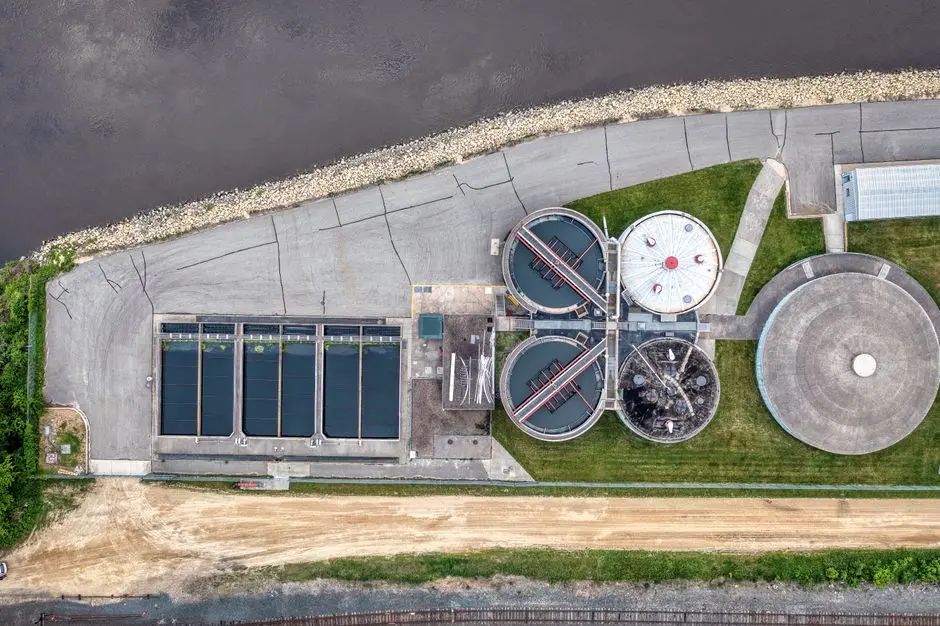
NWC sewerage coverage in Jeddah stood at 50% as of 2010, against 60% in Riyadh and 78% in Dammam (hydropurewater.com 2026). Compounds, workers' villages, hospitals, and hotels outside the main network therefore cannot rely on a municipal tie-in and must run a package STP with a TSE offtake. Confirming NWC status is the first pass/fail gate on the plot before any flow number is set.
Summer ambient temperatures of 40–50 °C accelerate biological kinetics by approximately 30% compared to the 15 °C basis used in Western textbook examples, meaning aeration basins can be downsized on paper — but oxygen transfer efficiency drops at high temperature, so the blower and diffuser curves must be re-verified rather than read off a nameplate (hydropurewater.com 2026). Peak flow on a Saudi compound is governed by prayer-time and climate, not weekday commuting, so equalization basins must exceed a flat 24-hour average. Jeddah's coastal salinity pushes the upper end of the 2,000–10,000 mg/L TDS band, raising RO concentrate volumes and turning ZLD or brine handling into a scoping question for any flow above roughly 50 m³/d. Collection networks at high ambient temperature generate H2S, so HDPE or epoxy-coated concrete should be specified for any buried tank or wet well. A buried WSZ package sewage treatment plant fits this envelope directly — it sits below grade, can be landscaped over on tight Jeddah compounds, and combines A/O contact oxidation with sedimentation and disinfection in a single automated unit sized 1–80 m³/h.
Process Train Selection: From Buried Package to Full Reuse Plant
Train selection in Jeddah is driven by three questions: what is the flow band, what is the reuse target, and is the plot inside or outside NWC coverage? The answer is not one train for all sites. For compounds and small communities where discharge to a TSE irrigation network is the primary goal, a packaged WSZ unit replaces a DAF + MBR train and handles 1–80 m³/h (hydropurewater.com 2026; WSZ product datasheet).
Any site with kitchen, laundry, or vehicle-wash loading above roughly 30 mg/L O&G needs a dissolved air flotation system upstream — Al Khumrah's 320 mg/L BOD design basis and 621 km of collection imply comparable O&G spikes on a private feeder network (Saleh et al., 2021). DAF achieves O&G below 15 mg/L and 60–80% TSS removal before the biological stage. Any domestic plant above ~10 m³/day, or any plant with a reuse offtake, should use an integrated MBR membrane bioreactor system: 2–5 mg/L TSS, <5 mg/L BOD, sub-1 µm filtration, which meets PME and RC BOD/TSS standards (hydropurewater.com 2026). MBR alone, however, rarely hits MAW 1 NTU turbidity or 10 mg/L nitrate-N, so a polishing industrial RO system is required where reuse-grade TSE is the deliverable — RO permeate typically holds <50 mg/L TDS, <0.5 NTU turbidity, and 75–95% salt rejection, making it necessary for any flow above ~2,000 mg/L TDS or any flow with a reuse offtake.
Disinfection must be specified as a chlorine dioxide generator rather than free chlorine because KSA feedwater is high-bromide; ClO2 at 0.2–0.5 mg/L residual gives E. coli <1 CFU/100 mL without bromate formation (hydropurewater.com 2026). Rotary mechanical bar screens at the headworks protect downstream pumps and membranes on a Jeddah collection stream carrying grit, rags, and plastics. Operating ranges, removal rates, and sizing triggers for each unit are summarized below.
| Unit | Function | Performance | Specify when |
|---|---|---|---|
| DAF | O&G and floatable removal | O&G <15 mg/L; TSS removal 60–80% | Kitchen, laundry, or vehicle-wash O&G > ~30 mg/L |
| MBR | BOD and TSS polish to PME/RC | 2–5 mg/L TSS; <5 mg/L BOD; sub-1 µm | Any plant > ~10 m³/d or any reuse offtake |
| RO | TDS cut and MAW 1 NTU reuse polish | <50 mg/L TDS; <0.5 NTU permeate; 75–95% rejection | Feed > ~2,000 mg/L TDS or TSE offtake |
| ClO2 | Disinfection without bromate | 0.2–0.5 mg/L residual; E. coli <1 CFU/100 mL | Any high-bromide KSA feed |
| WSZ package | Combined secondary/tertiary buried | 1–80 m³/h; A/O + sedimentation + disinfection | Compounds, hotels, hospital campuses, workers' villages with TSE irrigation offtake |
| Rotary bar screen | Headworks protection | — | Any Jeddah collection stream |
For nutrient-limited sites, the MBR-vs-extended-aeration cost breakdown and the advanced nutrient removal construction guide linked from the MBR effluent quality specifications guide provide the next level of design detail.
CAPEX, OPEX, and Payback for a Jeddah Onsite Plant
Tertiary RO/ClO2 polish typically pays back in 4–6 years by displacing SWCC potable water priced at SAR 4–7/m³, and improves eligibility for NWC privatization contracts (hydropurewater.com 2026). That payback window is the number the procurement side will sign against, and it holds whether the offtake is landscape irrigation, district cooling makeup, or toilet flush water on a compound.
Sludge handling should be scoped from day one: KSA sludge is saline and may carry heavy metals from brine-bearing domestic streams, so plate-and-frame dewatering plus controlled disposal is standard. A plate-and-frame filter press sized to the design solids load closes the mass balance on the P&ID and avoids a permit surprise at commissioning. A buried WSZ package sewage treatment plant avoids the civil and structural cost of an above-grade tank farm and can be landscaped over, which matters on tight Jeddah compounds where footprint is constrained.
Any 2026 quote must be parameterized by flow (m³/d), peak diurnal factor, TDS, BOD/COD/TSS, O&G, reuse offtake, and PME versus RC jurisdiction — a quote without those line items is not comparable to the next bidder (hydropurewater.com 2026). Population growth in the Kingdom has slowed from 4.24% in 2007 to 2.5% in 2023, but treated wastewater use is forecast to grow 43.6% by 2035, so plant sizing should be stress-tested against that demand curve rather than a flat 20-year horizon (hydropurewater.com 2026).
Pre-Design Checklist for a Jeddah Domestic Sewage Plant
Before P&ID freeze, walk through these pass/fail items: (1) confirm whether the plot sits inside current or planned NWC coverage (Jeddah 2010 figure: 50%) or whether a package STP with TSE reuse is mandatory; (2) confirm whether MAW 1 NTU turbidity and 10 mg/L nitrate-N apply to the offtake — this decides whether RO is in or out of scope; (3) verify that BOD/COD/TSS design points cover O&G peak loading from kitchens, laundries, or vehicle wash; (4) confirm whether the site produces RO concentrate that needs ZLD or brine handling, especially for TDS in the upper 2,000–10,000 mg/L band; (5) specify ClO2 over free chlorine to avoid bromate exceedance in high-bromide Jeddah feedwater. Each of those five answers either opens or closes a unit on the train and a line item on the budget. The industrial RO system sizing is the most common scope change once the TDS and offtake decisions are locked.
Frequently Asked Questions
What is the realistic 2026 cost of a domestic sewage treatment plant in Jeddah for a 50 m³/d compound?
There is no single published price for a Jeddah domestic plant in the research data, and any quote not parameterized by flow, peak diurnal factor, TDS, BOD/COD/TSS, O&G, reuse offtake, and PME versus RC jurisdiction is not comparable. Buyers should request a line-item quotation that explicitly closes each of those parameters and a separate SWCC potable-water displacement figure at SAR 4–7/m³ so the 4–6 year payback can be verified (hydropurewater.com 2026).
How do I choose a sewage treatment equipment supplier in Jeddah without inheriting a compliance risk?
Shortlist suppliers who can document PME M/12 performance data, MAW 1 NTU and 10 mg/L nitrate-N offtake results, and ClO2 dosing over free chlorine for high-bromide feedwater. Ask for at least one reference plant of comparable flow and TDS band operating in the Kingdom, and require the proposal to call out the 2,000–10,000 mg/L TDS design band and the ZLD or brine-handling scope for any flow above ~50 m³/d (hydropurewater.com 2026).
Can a buried package STP replace a full DAF → MBR → RO train on a Jeddah compound?
Yes, but only if the offtake is TSE irrigation rather than reuse-grade polishing. A buried WSZ unit combines A/O contact oxidation, sedimentation, and disinfection in one automated package sized 1–80 m³/h, and it can be landscaped over on tight plots (hydropurewater.com 2026; WSZ product datasheet). Once kitchen or laundry O&G exceeds ~30 mg/L, or the offtake requires MAW 1 NTU turbidity, the train must escalate to DAF, MBR, and RO.
What is the lead time on an MBR or RO skid for a Saudi domestic project in 2026?
Specific 2026 lead-time figures for MBR or RO skids into Jeddah are not present in the research data. Buyers should request a written schedule from the supplier tied to P&ID freeze, equipment FAT, shipment, and site commissioning, and confirm that the MBR flux and RO salt-rejection guarantees are matched to the 2,000–10,000 mg/L TDS band rather than standard EU or U.S. curves (hydropurewater.com 2026).
Related Equipment
- integrated MBR membrane bioreactor system — specifications, capacity range, and technical data
- chlorine dioxide generator — specifications, capacity range, and technical data