
Why the DAF vs Clarifier Question Hits Differently in a La Porte Chemicals Plant
La Porte sits inside the Houston Ship Channel industrial corridor, where organic, petrochemical, and synthetic-fibers plants discharge under TCEQ-issued TPDES permits and through POTWs running EPA categorical pretreatment programs. That permit layer is the first reason a generic DAF-versus-clarifier comparison falls short: equipment is judged against the Organic Chemicals, Plastics, and Synthetic Fibers (OCPSF) baseline at 40 CFR Part 414 long before it is judged on hydraulic throughput.
Chemicals wastewater at these sites is rarely a single-fraction stream. Reactor carryover, cleaning-cycle surfactant loads, and emulsified oils mix with dense catalyst fines, metal-hydroxide floc from neutralization steps, and dissolved salts from cooling-tower blending, so any unit selected as a primary settler has to handle a moving mixture rather than a textbook influent. Gulf Coast weather adds a second pressure: hurricane-season dilution spikes and hypersaline cooling-tower drift shift TSS and COD week to week, which means a single bench sample will not defend a 2026 unit selection. Operators scoping pretreatment in this corridor should treat the chemicals-plant EPA pretreatment compliance guide as a companion reference for the 40 CFR Part 414 and TCEQ TPDES line items.
What a DAF System Actually Does in a Chemicals Stream
A dissolved air flotation unit separates suspended matter by attaching micro-bubbles 30–50 microns in diameter to flocculated particles and floating the resulting aggregate to the surface, where a skimmer pulls the sludge blanket into a collection trough (Clearwater Industries, 2026-04-27). In a chemicals stream those particles are typically emulsified oil droplets, surfactant-stabilized colloids, light biological floc from a downstream bioreactor, and the loose floc produced when polymer is added ahead of the cell. The recirculation loop pressurizes clarified effluent with air and returns the saturated stream to the tank; on depressurization the micro-bubbles nucleate and attach to the incoming floc, which is the step that distinguishes a DAF from a gravity settler. Standard DAF builds use 304 stainless steel, with 316SS, polypropylene, and other materials available on request for corrosive or solvent-bearing streams (Clearwater Industries, 2026-04-27). Chemical conditioning is mandatory: coagulant, pH adjustment, and polymer flocculant are dosed either into flocculation tubes that give a 15–45 second flash mix or into impeller mix tanks with longer contact time, and the dose is set by jar testing rather than supplier default. The Logan, Utah wastewater study recorded an optimum of 30 mg/L aluminum sulfate on a lagoon effluent and explicitly framed DAF optimization as an empirical jar-test exercise (Elder, Utah State University, 2011). The HydropureWater DAF product line documents industrial capacity of 4–300 m³/h across 13 standard models, with applications including petrochemical and metalworking streams, and is the candidate primary or polishing unit for the chemicals fractions listed above (HydropureWater DAF system).
What a Clarifier — Conventional or Lamella — Does for a Chemicals Stream
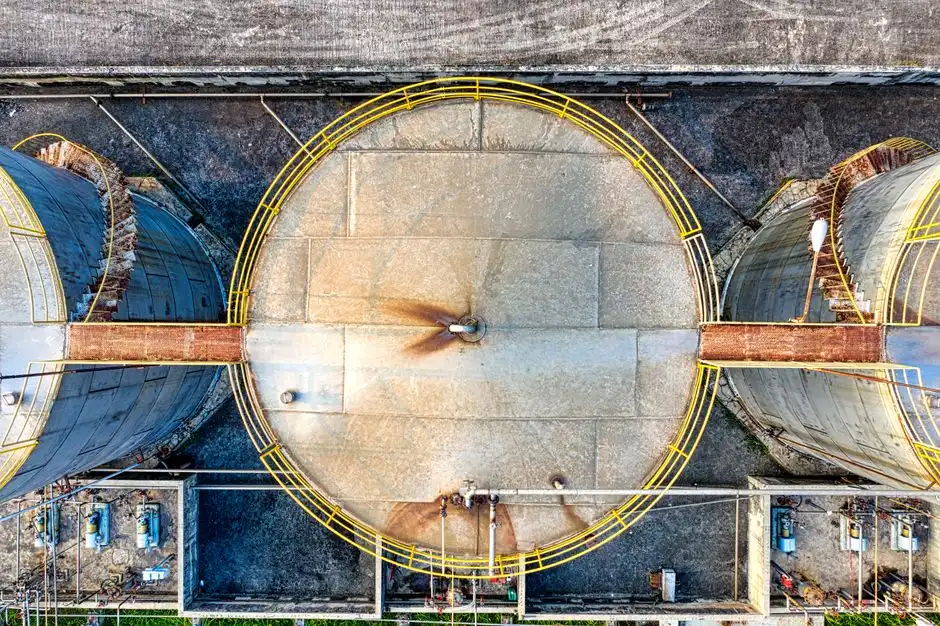
A clarifier separates by gravity: particles with specific gravity greater than water settle under the surface overflow rate set by tank geometry, the sludge is withdrawn from the bottom, and clarified water overflows a peripheral launder. In a chemicals plant the settleable fraction is typically dense catalyst fines, metal-hydroxide sludge from a pH-adjustment step, and any inorganic carryover that arrives with raw feeds. A conventional clarifier is the workhorse for that load, and performance is set by particle settleability, surface overflow rate, and sludge-withdrawal design rather than by chemical conditioning intensity. Lamella designs compress the same mechanism: inclined plates multiply the effective settling area inside a smaller tank volume, which raises the allowable surface loading rate for a fixed civil footprint, a relevant tradeoff on a built-out La Porte pad. The HydropureWater high-efficiency sedimentation tank publishes a surface loading range of 20–40 m/h and claims up to 30% chemical consumption reduction relative to conventional settlers, both per the product catalog. The trade-off is that lamella plates do not change the mechanism: colloidal fines, oils, surfactants, and dissolved organics pass through, so a lamella is rarely the final step in a chemicals train — it is the primary settler, with polishing downstream (HydropureWater high-efficiency lamella clarifier).
DAF vs Clarifier in a Chemicals Stream: Head-to-Head Matrix
The dominant mechanism decides which unit wins which fraction. Micro-bubble flotation at 30–50 µm captures what gravity cannot, and gravity settling captures what flotation is not well suited to lift (Clearwater Industries, 2026-04-27; Fluence, in the HydropureWater 2026 mining/metals article). For most chemicals plants the streams are combined; the following matrix clarifies the sequence of using a clarifier ahead of a DAF polisher.
| Decision Parameter | DAF (Micro-Bubble Flotation) | Clarifier (Conventional or Lamella) |
|---|---|---|
| Dominant mechanism | 30–50 µm micro-bubbles attach to floc and float it to a surface skimmer | Gravity settling; lamella plates increase effective settling area for the same footprint |
| Best target fraction | Oils, FOG, surfactants, emulsions, light biological or chemical floc, low-specific-gravity precipitate | Dense catalyst fines, metal-hydroxide sludge, any particle with specific gravity meaningfully greater than water |
| Worst-case feed | High silt or inorganic-fines load, which DAF is not well suited to lift (Fluence, in the HydropureWater 2026 mining/metals article) | Emulsified oils, colloids, and dissolved organics, which pass through to downstream polishing |
| Chemical conditioning | Coagulant, pH, and flocculant set by jar testing; 30 mg/L aluminum sulfate recorded as an optimum in a jar-test study (USU, 2011) | Coagulant aid is optional; performance is governed by surface overflow rate and sludge-withdrawal design |
| Sludge output | Thick floated sludge that may need little further dewatering (Clearwater Industries, 2026-04-27) | Thickener-style underflow; typically handled by a thickener or filter press |
| Footprint | Compact tank; high-rate designs available for medium-to-large flows | Large civil footprint for conventional units; lamella designs compress the footprint |
| Role in a chemicals train | Primary for oil/FOG/colloid loads; polisher after a clarifier for combined streams | Primary for bulk settleable solids; pre-step ahead of DAF in a combined train |
| Reuse and recycle support | Documented for recycling process water and materials in industrial waste treatment (Fluence, in the HydropureWater 2026 mining/metals article) | Recycles clarified supernatant; does not address colloidal or buoyant load |
The practical reading is that a clarifier sized only for the settleable fraction will discharge the colloidal, buoyant, and dissolved loads, and a DAF forced to handle raw catalyst fines will be overwhelmed by the silt and clay fraction it cannot lift (Fluence, in the HydropureWater 2026 mining/metals article). Combined streams therefore route to a clarifier first and a DAF second.
Per-Stream Decision Rule for a 2026 La Porte Selection
The matrix collapses to four if-then lines a procurement lead can apply during an RFQ review. The engineer must confirm each line against the influent characterization, because the rule is stream-driven, not vendor-driven.
| Dominant Stream Fraction | 2026 Selection | Notes for the RFQ |
|---|---|---|
| Free oil, FOG, or surfactant-stabilized emulsion | Specify a DAF as the primary unit, with chemical conditioning tuned by jar testing | Request air-to-solids ratio and bubble-size distribution; insist on 316SS or higher alloy if the stream carries solvents (Clearwater Industries, 2026-04-27) |
| Dense suspended solids (catalyst fines, metal-hydroxide floc from neutralization) | Specify a clarifier or high-rate lamella as the primary settler | Use the 20–40 m/h surface loading band from the product catalog to set the civil footprint |
| Combined load (typical organic and specialty chemicals plant) | Sequence clarifier (often lamella) primary, then DAF as the oil/colloid polisher, then biological or membrane treatment | Matches the working rule for combined reactor washwater and process water (Clearwater Industries, 2026-04-27) |
| Existing clarifier on site, with oil or colloid breakthrough | Retrofit a DAF as a downstream polisher rather than build new primary capacity | Retrofit logic is supported by the same source; a HydropureWater PLC-controlled coagulant and flocculant dosing skid holds the jar-test-derived dose steady |
Every line in the table assumes the engineer has the influent characterization in hand: total suspended solids, particle size distribution, pH, temperature, dissolved organic load, oil and grease, and seasonal flow variation. Vendors will demand those inputs to size the unit, and an undersized specification is the most common cause of a clarifier or DAF failing in the first year.
Cost, Footprint, and the La Porte-Specific Siting Check
Industrial DAF capital cost is widely cited in the $150,000 to over $1,500,000 band, with the range driven by flow rate (m³/h) and material of construction; a 20–30% premium applies for harsher materials such as 316L stainless steel or specialty coatings used in corrosive or solvent-bearing chemicals streams (HydropureWater 2026 mining/metals article). The HydropureWater lamella line publishes a 20–40 m/h surface loading range, which is the relevant civil-footprint lever in a built-out La Porte site where pad space is constrained. Research does not support a 2026 unit price for a specific DAF or clarifier on a specific La Porte flow, so the engineer must request a budgetary quotation tied to the actual flow, TSS, and contaminant-fraction profile. A buyer should ask the vendor to quote the DAF, the chemical conditioning skid, and the sludge-dewatering step as a single line: a well-conditioned DAF produces a thick sludge that may need little further dewatering, which reduces the downstream sludge-handling line item (Clearwater Industries, 2026-04-27), and that saving must be visible in the quote. The La Porte-specific permit check is the last gate before signing the PO: confirm 40 CFR Part 414 OCPSF categorical applicability and the local TCEQ TPDES or POTW pretreatment limits, because either can change the polishing step required downstream of the DAF or clarifier. The chemicals-plant EPA pretreatment compliance guide covers the regulatory framing in more detail.
Frequently Asked Questions
What is the working rule for picking a DAF versus a clarifier in a chemicals plant?
Pick the unit by the dominant stream fraction. A DAF targets oils, FOG, surfactants, emulsions, and flocculated colloids via 30–50 µm micro-bubbles (Clearwater Industries, 2026-04-27). A clarifier or lamella targets dense settleable solids by gravity. For most organic and specialty chemicals plants the streams are combined, so the working rule is a clarifier (often a high-rate lamella) as the primary settler and a DAF as the oil, emulsion, and colloid polisher ahead of biological or membrane treatment.
What is the 2026 capital envelope for an industrial DAF on a chemicals stream?
The HydropureWater 2026 mining/metals article cites an industrial DAF CAPEX band of $150,000 to over $1,500,000, driven by flow rate (m³/h) and material of construction, with a 20–30% premium for 316L stainless steel or specialty coatings used in corrosive or solvent-bearing streams. Research does not
Frequently Asked Questions
Is a DAF or a clarifier the right primary treatment for an organic chemicals wastewater stream in La Porte, TX?
For organic chemicals wastewater in La Porte, a Dissolved Air Flotation (DAF) unit is generally superior if the contaminants include hydrophobic organics, emulsified oils, or low-density solids with specific gravities near or below 1.0. DAF systems typically achieve 80-95% removal of suspended solids and oil and grease in these streams by utilizing micro-bubbles to float particles to the surface.
Conversely, a conventional clarifier is more effective if your wastewater contains high concentrations of heavy, inorganic precipitates or solids with a specific gravity significantly greater than 1.2. If your influent requires high-density sludge settling to meet TCEQ or local POTW discharge standards, a clarifier is the more reliable mechanical choice.
When should a chemicals plant run a clarifier and a DAF in series rather than choosing just one?
A series configuration is recommended when the wastewater contains a high-solids load (typically >500 mg/L) that would overwhelm a DAF’s saturation capacity, paired with a secondary fraction of light, non-settleable organics. In this setup, the primary clarifier acts as a roughing stage to remove dense, high-volume solids, while the DAF acts as a polishing stage to remove residual emulsified oils and light floc that fail to settle.
This hybrid approach is critical for facilities facing stringent BOD or oil/grease limits that cannot be met by gravity settling alone. By removing the bulk of the solids in the clarifier first, you prevent the DAF from becoming overloaded, which reduces chemical coagulant consumption and sludge handling costs in the downstream process.
What influent data and jar-test results do I need before I can spec a DAF for a chemicals plant in 2026?
To properly size a DAF, you must provide 24-hour flow-weighted composite data including Total Suspended Solids (TSS), Oil & Grease (FOG), Chemical Oxygen Demand (COD), pH, and temperature. Temperature is particularly vital in La Porte, as higher ambient temperatures decrease gas solubility and affect the air-to-solids ratio required for effective flotation.
Jar testing must determine the optimal coagulant and flocculant dosages, as well as the required air-to-solids (A/S) ratio. You must document the rise velocity of the floc in a clear cylinder; a DAF can only be sized if the surface overflow rate (SOR) of your specific chemical floc is lower than the rising velocity of the micro-bubble-attached particles, typically targeted at 0.5 to 2.0 gallons per minute per square foot.
Is retrofitting a DAF onto an existing clarifier cheaper than building a new DAF for a chemicals plant?
Retrofitting is often 30-50% cheaper than greenfield construction, as it utilizes existing concrete basins, piping, and foundation work. However, this is only viable if the existing clarifier tank geometry provides sufficient surface area to accommodate the required hydraulic loading rate for DAF operation. You must also account for the cost of installing a skimmer mechanism, sludge scrapers, and the air-saturation pressure vessel.
If the existing clarifier basin lacks the necessary depth or structural integrity to handle the pressurized recycle flow or the specific mechanical components of a DAF, the retrofit may lead to hydraulic short-circuiting. In such cases, the reduced efficiency and increased maintenance costs often negate the initial capital savings, making a standalone, purpose-built DAF unit more cost-effective over a 10-year lifecycle.
What is the 2026 capital cost band for an industrial DAF serving a chemicals plant, and what drives the premium?
For a standard industrial-grade DAF system in 2026, capital costs typically range from $250,000 to $850,000, depending on the flow capacity (typically 100 to 1,000 GPM) and metallurgy requirements. Systems requiring 316L stainless steel construction or explosion-proof (XP) rated electrical components for volatile organic compound (VOC) environments command the higher end of this range.
The primary cost driver is the level of automation and material specification required for hazardous environments common in La Porte’s chemical corridor. Additional premiums are driven by the complexity of the influent equalization requirements, the inclusion of automated sludge dewatering integration, and the necessity for advanced PLC-based control systems to manage real-time air-to-solids ratios based on fluctuating influent chemical loads.