
What "Sizing a Containerized MBR STP" Actually Means in Marseille
A containerized MBR sewage treatment plant is a factory-built package that combines a bioreactor, submerged hollow-fiber ultrafiltration (UF) membranes, blowers, a drum screen and a PLC inside a 20' or 40' ISO high-cube (HC) container. Pure Aqua's MBR-C product page documents the standard configuration: feed passes through a drum screen with 1.5 mm perforation, then flows to an aeration tank with fine-bubble diffusers and finally to a submerged UF membrane cassette with 0.04 µm nominal pore size, with an anoxic zone for denitrification included as standard. The physical envelope the calculation must respect is therefore the internal volume of one or more ISO containers, not an open civils footprint.
MENA-Water's product page states that its compact package plants are being developed so that more than 1,200 m³/day can be filtered in a single 40-foot ISO container, with stainless-steel internal tanks and plug-and-play factory testing. That single figure frames the entire sizing question for a residential or camp project in Marseille: most sites fall inside one 40' HC unit, and only the largest combined developments push into a multi-unit train. "Sizing" reduces to three coupled numbers that must close simultaneously — hydraulic capacity in m³/day, organic load in kg BOD/day, and membrane area in m² — and any one of them being wrong will cap the design.
The Marseille layer sits on top of the envelope. The Pure Aqua MBR-C operating temperature range is 20–30°C with a 20°C design point, and Marseille's hot-summer Mediterranean climate sits inside that band for most of the year. The winter minima and the July–August peaks must still be checked against the rated window, because biological kinetics, oxygen demand and membrane fouling rate all move with mixed-liquor temperature. The sizing workbook below uses these envelope limits — 1,200 m³/day per 40' ISO container and 20–30°C operating window — as hard constraints.
For the underlying reference package, the HydropureWater MBR integrated wastewater treatment system follows the same factory-built envelope logic, with the membrane cassettes, blowers, drum screen and PLC pre-assembled so that the only on-site work is the inlet/outlet piping and power.
Step 1 — Build the Hydraulic Profile for Residents vs Camp Occupancy
Hydraulic sizing starts from occupancy, not from a generic m³/day number. Pure Aqua's MBR-C datasheet publishes an "Approximate Population" reference based on 50 gpd per capita (≈190 L/c·d), and that figure is the per-person flow used to size the average dry-weather flow (ADWF). The peaking factor that converts ADWF into peak wet-weather flow (PWWF) is a local decision: 2.0–2.5 is normal for a residential development with morning and evening peaks, while a worker camp with shared ablution blocks can reach 3.0 because a single shift change sends the whole population through the showers inside a 30-minute window.
Marseille adds a seasonal layer that inland French projects do not face. Coastal camps and holiday residences approach 100% occupancy in July–August and drop to near-zero in winter, so the engineer must state explicitly whether the plant is sized for annual average, peak month, or absolute peak day. Sizing for peak day means the bioreactor carries ten months of under-loaded volume; sizing for average means the equalization tank and transfer pumps must absorb the summer surge. The defensible position for a camp is usually to size the biological stage on peak-month average and the hydraulic stage (drum screen, transfer pumps, equalization) on peak day, then check both against the 1,200 m³/day per 40' ISO container ceiling.
Add a separate inflow/infiltration (I/I) allowance — typically 10–20% for new gravity sewers in the Marseille agglomeration — and a trade-waste allowance if the camp includes catering or laundry operations producing fats, oils and grease (FOG), which Skyview lists as a standard MBR application. Carry both ADWF and PWWF forward as separate design points: the bioreactor volume is set by ADWF, while the drum screen, transfer pumps and equalization must be rated for PWWF. The table below summarizes the inputs the engineer must lock down before the next step.
| Hydraulic input | Residential development | Worker camp / holiday residence | Source |
|---|---|---|---|
| Per-capita base flow | ≈190 L/c·d (50 gpd) | ≈190 L/c·d (50 gpd) | Pure Aqua MBR-C product page |
| Peaking factor (ADWF → PWWF) | 2.0–2.5 | 2.5–3.0 | Engineering practice; confirm with Agence de l'Eau |
| I/I allowance | 10–20% | 10–20% | Engineering practice |
| Trade-waste / FOG allowance | 0–5% | 5–15% (catering, laundry) | Skyview containerized MBR product page |
| Design occupancy basis | Peak day or annual average | Peak month (Jul–Aug) and peak day | Local project decision |
Step 2 — Translate Population Into BOD, COD and Nitrogen Loading
Hydraulic capacity and biological capacity must close at the same number, which is why the second sizing input is per-capita pollutant load. The research sources do not publish explicit per-capita BOD, COD, TSS, total nitrogen or total phosphorus values, so these must be requested from the local Agence de l'Eau or the project's maître d'œuvre as design inputs, not assumed. What the sources do confirm is the envelope: Pure Aqua's MBR-C is designed around submerged UF with PVDF TIPS membranes in an anoxic + aerobic configuration, and Skyview publishes both AO (carbon removal only) and A2O (carbon + nitrogen + biological phosphorus) as standard biological process options. The choice between AO and A2O is driven entirely by the effluent quality target, not by the container size.
The compliance layer that drives the load reduction is the EU Urban Waste Water Directive (91/271/EEC), which sets effluent standards for agglomerations above 2,000 population equivalent and tighter standards for discharges to sensitive areas. Any project that discharges — directly or indirectly through a smaller watercourse — into a sensitive catchment around Marseille (the Huveaune, the Arc, coastal bathing waters) inherits the stricter targets, which is what forces the A2O configuration and a low total nitrogen in the effluent. The design must therefore confirm the receiving environment before the biological stage is frozen, not after.
Once the per-capita loadings are confirmed and the process choice is set (AO vs A2O), cross-check that the chosen population multiplied by the per-capita BOD still fits inside the kg BOD/day envelope that one 40' ISO container can biodegrade at the manufacturer reference flux, with the 1,200 m³/day hydraulic ceiling as a second check. If either envelope is exceeded, the design moves to a two- or three-container train, with the biological stage split across containers in parallel. The loadings to confirm with the local authority are summarized in the table below.
| Pollutant | Typical scope for a French municipal design | Source of the value |
|---|---|---|
| BOD₅ per capita per day | Confirm with Agence de l'Eau / maître d'œuvre | Not published in the scraped research |
| COD per capita per day | Confirm with Agence de l'Eau / maître d'œuvre | Not published in the scraped research |
| TSS per capita per day | Confirm with Agence de l'Eau / maître d'œuvre | Not published in the scraped research |
| Total nitrogen per capita per day | Drives A2O vs AO choice | Skyview AO / A2O process options |
| Total phosphorus per capita per day | Drives chemical P removal add-on | Skyview enhanced P-removal options |
| Effluent targets (receiving environment) | UWWTD 91/271/EEC, sensitive-area rules if applicable | EU regulatory anchor |
Step 3 — Match the Plant to Marseille's Mediterranean Operating Window
Marseille's climate is favourable for biological treatment in summer but creates two specific constraints that the bare datasheet does not show. The Pure Aqua MBR-C operating temperature range is 20–30°C with a 20°C design point, and Marseille's annual average sits comfortably inside that band. The cooler months (January–February) drop the mixed-liquor temperature enough that nitrification rates slow, so the engineer must request the supplier's derating curve for the lower end of the window before signing the PO. If the design temperature is set at 20°C, the supplier's quoted biological capacity is the conservative figure and the plant will over-perform in summer.
Summer is the other constraint. Highs near 30–35°C push oxygen demand up and accelerate membrane fouling, so the aeration blower capacity and the membrane scour-air ratio must both be confirmed at the upper end of the temperature window, not just at the design point. The Mistral wind and high UV push operators toward covered or buried equalization: MENA-Water's U-Version places the aeration and buffering inside underground water tanks for exactly this reason, while the I-Version is fully integrated above ground for mobile or temporary sites. For a permanent residential or camp installation in Provence, the U-Version is usually the better fit, and the WSZ underground integrated sewage treatment plant follows the same buried-tank logic for sites where above-ground equipment is undesirable.
Water stress is the third Marseille-specific factor. Provence-Alpes-Côte d'Azur is a water-stressed region, and discharging a polished MBR effluent to a coastal watercourse is increasingly the wrong design choice. MENA-Water's product page states explicitly that the MBR system produces water usable for irrigation after ultrafiltration, and the UWWTD 91/271/EEC framework supports reuse over discharge. The sizing exercise should therefore size the MBR to a reuse envelope (irrigation quality, toilet flush, landscape watering) and use the receiving environment as a fallback rather than the design target.
Step 4 — Pick the Container: 20' HC, 40' HC, or Multi-Unit Train
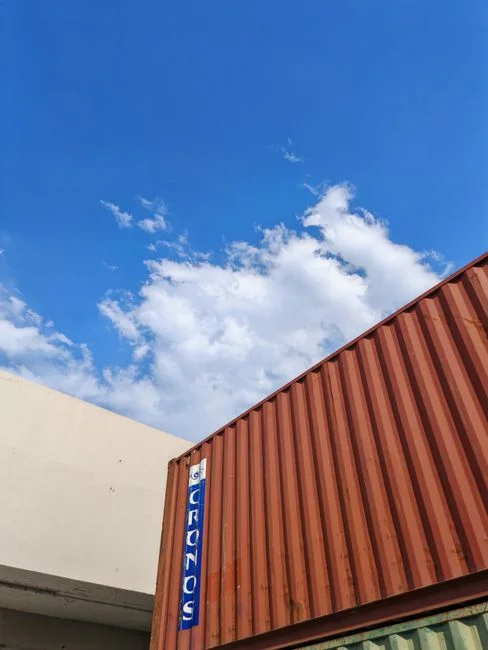
The deliverable of the sizing exercise is a specific container count and configuration. The reference scale is MENA-Water's 1,200 m³/day per 40-foot ISO container, which means a single 40' HC unit covers most Marseille residential and camp projects once the peaking and load factors are applied. Pure Aqua's MBR-C datasheet confirms that the same container envelope accommodates the drum screen (1.5 mm perforation), the aeration tank with fine-bubble diffusers, the submerged HF membrane modules with coarse-bubble diffusers, the built-in membrane cleaning and air-scour system, the anoxic zone and the PLC control panel. Optional equipment that affects the same envelope includes chemical phosphorus removal, air-flotation for FOG, standby pumps for redundancy, and remote monitoring — all of which Skyview lists as standard or optional modules for its containerized MBR.
The choice between I-Version and U-Version is a site decision rather than a capacity decision. The I-Version is fully integrated above ground and factory tested, which makes it the right answer for mobile or temporary camps, for sites with no excavation budget, and for fast-track projects where the plant must be operational within weeks. The U-Version puts the aeration and buffering tanks underground, leaving only the container and the membrane cassettes visible, and is the right answer for permanent residential developments where visual impact, Mistral wind exposure and UV ageing of equipment are constraints. The container-count rule is the same in both cases; the site integration is what changes.
The final step is the membrane module selection. The DF series PVDF flat-sheet MBR modules, referenced via the DF series PVDF flat sheet MBR modules product page, slot into the same ISO container envelope and offer a flat-sheet alternative to the hollow-fiber cassettes in the standard MBR-C, which is useful when the influent has a higher FOG or hair content that fouls fibers faster. The container-count decision is summarized in the table below.
| Project size after peaking and I/I | Container configuration | Version | Notes |
|---|---|---|---|
| Up to ≈1,200 m³/day | 1 × 40' HC ISO container | I-Version (mobile) or U-Version (buried buffer) | MENA-Water reference scale |
| ≈1,200–2,400 m³/day | 2 × 40' HC in parallel | I- or U-Version | Biological stage split across containers |
| Up to ≈500 m³/day, footprint-tight site | 1 × 20' HC ISO container | I-Version | Pure Aqua MBR-C 20' HC option |
| Any size, reuse envelope | Add UV disinfection downstream | I- or U-Version | See UV sterilizer for water treatment |
Step 5 — Lock Down Compliance and Commissioning Before You Order
A correctly sized plant can still be rejected at commissioning if the compliance paperwork is not closed before the container ships. Confirm the regulatory stack up front: the project falls under the EU Urban Waste Water Directive 91/271/EEC, the French Arrêté du 21 juillet 2015 applies to small wastewater treatment plants under 20 EH, and the relevant Agence de l'Eau requirements apply to projects at or above 20 EH. Specify the effluent sampling protocol — 24-hour composite versus grab — and the receiving environment classification, because a sensitive-area discharge under 91/271/EEC tightens the total nitrogen and phosphorus targets and changes the biological process choice made in Step 2.
If the design is sized for reuse — which is the preferred envelope for water-stressed Provence — disinfection is mandatory. UV is the default for containerized MBR reuse applications, and a downstream UV sterilizer for water treatment unit is the standard add-on, either inside the same ISO envelope or as a small wall-mounted panel next to the irrigation storage tank. Request from the supplier, in writing, the factory test certificate, the membrane warranty terms, the chemical-cleaning frequency (MENA-Water cites one to two maintenance clearings per year for its UF modules), and a remote-monitoring option (PLC + SCADA or 4G telemetry) so that the operating data is visible to both the project engineer and the Agence de l'Eau inspector.
Build the commissioning plan around Marseille's dry/wet weather seasonality. Spring (April–May) is the right window for biological seeding and plant stabilisation, because the mixed-liquor temperature is already inside the 20–30°C operating range and the campsite or housing development can be brought up to design load gradually as the tourist season starts. Commissioning in late autumn forces the plant to seed through the winter low-temperature window and risks a failed nitrification test in the first months — a common and avoidable commissioning failure.
Frequently Asked Questions
What budget should a project engineer in Marseille plan for a containerized MBR STP?
The scraped research does not publish a price list for containerized MBR plants, so a defensible budget cannot be assembled from these sources alone. The actionable check before signing a PO is to request a written quote that itemises the container envelope, the membrane area in m², the blower and pump list, the PLC scope, the UV add-on if reuse is in scope, and the membrane warranty terms. Without those line items, two quotes at the same m³/day can differ by the cost of the membrane area alone.
How do I choose between suppliers for a Marseille residential or camp project?
Use three written confirmations as the supplier-selection filter. First, ask for a project reference in the same hydraulic and load envelope, ideally in a Mediterranean climate, and request the operating data after one year. Second, ask for the membrane module's nominal pore size, the membrane material (PVDF is the standard), and the chemical-cleaning frequency — MENA-Water cites one to two maintenance clearings per year for its UF modules, and any supplier quoting a much higher frequency is signalling a fouling problem. Third, ask for the factory test certificate and the plug-and-play commissioning scope, because on-site civils work is what destroys the budget on a containerized project.
How do I size for a Marseille campsite with 100% July–August occupancy?
Size the biological stage on the peak-month average load, not on the absolute peak day, because the plant will be at peak load for six to eight weeks rather than a single shift change. Size the hydraulic stage — drum screen, transfer pumps, equalization — on the absolute peak day with the 2.5–3.0 peaking factor for shared ablutions. Then check that both points sit inside the 1,200 m³/day per 40' ISO container envelope from MENA-Water; if they do not, the design moves to a two-container train in parallel. The reuse envelope (irrigation during the operating season, storage in winter) is the right target for a Provence campsite because the Huveaune and Arc catchments are sensitive under 91/271/EEC.
What French effluent limits apply to a containerized MBR in Provence?
The compliance stack is the EU Urban Waste Water Directive 91/271/EEC, the French Arrêté du 21 juillet 2015 for installations under 20 EH, and the relevant Agence de l'Eau requirements for installations at or above 20 EH. The exact limits depend on the receiving environment: a discharge to a sensitive area under 91/271/EEC tightens total nitrogen and total phosphorus and forces the A2O configuration, while a non-sensitive discharge can usually be met with AO. The project engineer must request the receiving environment classification from the Agence de l'Eau before the biological process is frozen, because changing from AO to A2O after the container is built is a costly redesign.