Why textile effluent defeats gravity clarifiers
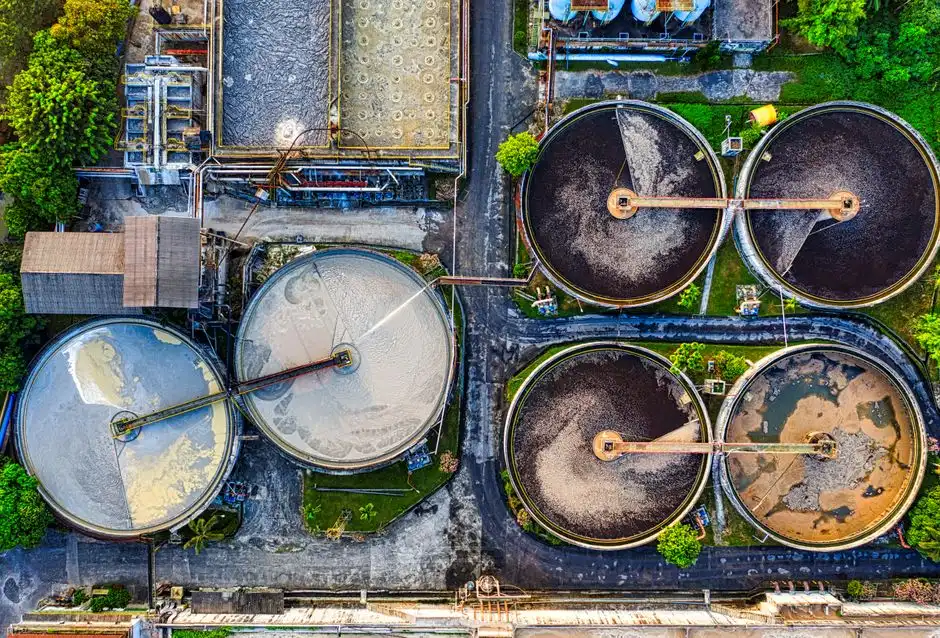
Textile dye-house effluent carries reactive and disperse dyes, sizing agents, machine oils and short fibers that together produce a high-color, high-TSS stream a conventional clarifier cannot resolve on footprint alone. Residual reactive dyes and most textile auxiliaries sit in the colloidal or near-colloidal size range, where Stokes-law settling velocities are too low for any realistic clarifier surface area to deliver the residence time those particles need. The same stream also contains low-density fibers and oil droplets that float or stay suspended rather than sink, so gravity-based units end up underloaded on the settled-solids side and overloaded on the floatable side.
SIGMADAF describes its DAF equipment as a separation system designed specifically for non-floating solids, oils and flocs that "do not have sufficient buoyancy" on their own, and notes that the technology reduces COD and BOD ahead of downstream polishing (SIGMADAF, 2026). That positioning matches the textile problem directly: a DAF supplies the buoyancy the particles lack, rather than waiting for them to settle. The next two sections make that buoyancy mechanism explicit, then pin it to the chemistry that textile mills must lock in before any sizing exercise.
Micro-bubble physics: what makes a DAF unit actually float dye and fiber
Inside a DAF, a recirculation pump takes clarified effluent, pressurizes it to roughly 6 bar, and dissolves air into it; when that stream is depressurized inside the flotation tank, the dissolved air comes out of solution as 30–50 µm micro-bubbles that attach to floc and lift it to the surface (SIGMADAF, 2026). Dagyee describes the same aeration step at typically 3–5 bar (Dagyee, 2026). The two figures are consistent when 6 bar is read as saturation pressure at the pump discharge and 3–5 bar as the operating range across the recirculation loop and saturator; a buyer should treat 6 bar as the spec to demand on the data sheet.
The 30–50 µm window is the operative one. Bubbles in that band are small enough to nucleate on floc surfaces and large enough to generate enough buoyant force per particle to rise inside a realistic hydraulic retention time. SIGMADAF quotes more than 90% removal for typical contaminants on this envelope (SIGMADAF, 2026). For textile color bodies that figure is a baseline, not a guarantee: reactive dye molecules do not float on their own, so the micro-bubbles are lifting a coagulated floc, not the dye. That is why the chemistry in the next section, not the bubble spec, sets the ceiling on textile color removal. The engineering consequence for any DAF unit for textile wastewater is that supplier claims of >95% color cut without a paired chemistry scope should be treated as unverified.
| Parameter | Operating value | Source |
|---|---|---|
| Recirculation / saturation pressure | ~6 bar at pump discharge | SIGMADAF, 2026 |
| Aeration stage pressure range | 3–5 bar (typical) | Dagyee, 2026 |
| Micro-bubble diameter | 30–50 µm | SIGMADAF, 2026 |
| Stated removal efficiency (general contaminants) | > 90% | SIGMADAF, 2026 |
| Recirculated stream source | Clarified DAF outlet (closed loop) | SIGMADAF, 2026 |
Textile-specific chemistry: coagulant, pH and floc strength

The strongest published textile-DAF removal number comes from Cruz et al., who coupled electrocoagulation (EC) with DAF on synthetic Remazol Red effluent and reported more than 98% dye removal under initial conditions and more than 95% under the optimized model, with HPLC showing no detectable dye in the treated samples (Cruz et al., ACS Omega, 12 Dec 2025). The same study characterized the sludge as aluminum oxyhydroxide, convertible to aluminum oxide above 293 °C, and reported an energy consumption of 4.70 kWh·m⁻³ averaged across the electrocoagulation stage (Cruz et al., 12 Dec 2025). For a mill engineer, the implication is direct: even with the bubble stage held constant, textile DAF removal tracks coagulant dose and pH, so the chemistry package has to be specified together with the DAF, not after it.
The Cruz et al. work used aluminum electrodes and a single reactive dye; it does not establish the same removal band for disperse, vat or acid dyes, and the 4.70 kWh·m⁻³ figure is on the EC stage, not the flotation stage. For conventional chemical coagulation, an automatic chemical dosing system sized to the DAF inlet is the practical way to keep coagulant and polyelectrolyte feed inside the narrow band the floc needs. A buyer who cannot quote a jar-tested dose and pH window specific to their dye mix should expect the actual plant number to sit below the Cruz et al. headline until on-site trials close the gap.
Placing the DAF in a textile wastewater train
The standard textile-mill train runs equalize → DAF → biological → polish, with DAF carrying the bulk of the color, fiber and oil cut before the bio-step so the aeration basin is not loaded with non-biodegradable color. SIGMADAF positions DAF as reducing both COD and BOD ahead of downstream treatment, which is consistent with placing the unit upstream of a biological reactor (SIGMADAF, 2026). A second, less common arrangement uses DAF as a polish step after a bio-stage when the mill already has biological capacity and needs a final color/TSS cut before reuse or discharge.
The Cruz et al. EC+DAF pairing is direct evidence that the bubble stage is robust enough to follow an electrocoagulation reactor, so a mill that elects EC upstream of DAF for hard-to-floc reactive dyes is operating within the published envelope (Cruz et al., 12 Dec 2025). DAF cannot sit at the head of the train, however: Dagyee lists coarse screening, homogenization, sand removal and coagulation–flocculation as required pre-treatment ahead of the unit (Dagyee, 2026). A rotary mechanical bar screen is the standard first unit, followed by equalization and chemistry dosing, then the DAF, then a downstream MBR membrane bioreactor or equivalent biological step if polish is required.
DAF model sizing: 3 m³/h to 120 m³/h textile duty
Dagyee publishes a 13-model DAF range that maps directly onto textile-mill flows. The smallest unit, DAF-003, handles 3 m³/h at 1,500 kg dry weight and 5,000 kg operating weight; the largest, DAF-120, handles 120 m³/h at 10,000 kg dry weight and 130,000 kg operating weight (Dagyee, 2026). Intermediate sizes step at 5, 10, 15, 20, 30, 40, 50, 60, 70, 80 and 100 m³/h, with inlet/outlet piping growing from DN50 on the smallest unit to DN300 on DAF-100 and DAF-120.
For a textile buyer, the practical translation is: a small dye-house or print line typically sits in the DAF-003 to DAF-010 band, a mid-sized finishing plant in DAF-020 to DAF-050, and a full integrated mill in DAF-060 to DAF-120. SIGMADAF markets its FPHF high-flow model for textile industry duty, which anchors the upper end of that range with a commercially available textile-specific envelope (SIGMADAF, 2026). Operating weight, not just flow, drives the foundation and floor-loading design — a DAF-080 at 100,000 kg operating weight is a structural decision that should be confirmed with the mill's civil engineer before the procurement order is released. The standalone DAF unit for textile wastewater spec page covers a wider 4–300 m³/h envelope with 13 standard models, which is the right place to start when the mill's flow profile does not sit cleanly on the Dagyee grid.
| Model | Flow (m³/h) | Inlet / outlet | Dry weight (kg) | Operating weight (kg) |
|---|---|---|---|---|
| DAF-003 | 3 | DN50 / DN50 | 1,500 | 5,000 |
| DAF-005 | 5 | DN80 / DN80 | 1,600 | 7,000 |
| DAF-010 | 10 | DN100 / DN100 | 2,000 | 12,000 |
| DAF-020 | 20 | DN150 / DN150 | 3,000 | 22,000 |
| DAF-030 | 30 | DN150 / DN150 | 3,800 | 32,000 |
| DAF-050 | 50 | DN200 / DN150 | 5,500 | 55,000 |
| DAF-080 | 80 | DN250 / DN250 | 7,500 | 100,000 |
| DAF-100 | 100 | DN300 / DN250 | 9,000 | 110,000 |
| DAF-120 | 120 | DN300 / DN250 | 10,000 | 130,000 |
DAF vs clarifier vs EC+DAF: choosing the right train for a textile mill
The three trains answer different questions. A DAF is the default for streams that are color-, oil- and fiber-dominated, because the micro-bubble stage lifts what gravity cannot; SIGMADAF and Dagyee both list textile, laundry, food and paper as primary DAF applications (SIGMADAF, 2026; Dagyee, 2026). A high-efficiency sedimentation tank (lamella clarifier) suits streams where the solids are heavier and largely inorganic, where the higher surface loading rate pays back on footprint. EC+DAF is the high-removal option for hard-to-floc reactive dyes, anchored to the Cruz et al. more than 95% Remazol Red figure, with the caveat that the 4.70 kWh·m⁻³ energy cost is on the EC stage, not the DAF (Cruz et al., 12 Dec 2025).
For most dye-house effluents the right answer is DAF-as-primary rather than lamella, because the lamella's strength on dense inorganic solids is irrelevant to a stream dominated by reactive dye, sizing chemical and short fiber. EC+DAF is the right call when a single reactive dye is resisting conventional coagulation and the plant has the electrical capacity to feed the EC stage; the published energy figure should be demanded from the EC supplier as a separate line item, not bundled into the DAF quotation. The DAF unit still anchors the train, which is why the DAF unit for textile wastewater spec should be the lead item on any comparison. Any mill switching between these trains should plan a jar test followed by an on-site DAF pilot, because dye chemistry varies by fiber blend and recipe in ways no model table captures.
| Train | Best-fit textile stream | Strongest supported figure | Source |
|---|---|---|---|
| DAF alone (coagulation + flotation) | Color, oil, short fiber, sizing | > 90% removal (general contaminants) | SIGMADAF, 2026 |
| Lamella clarifier | Dense inorganic TSS, grit, metal-bearing streams | Not textile-specific in supplied research | — |
| EC + DAF | Hard-to-floc reactive dyes (e.g. Remazol Red) | > 95% Remazol Red (optimized); 4.70 kWh·m⁻³ (EC stage) | Cruz et al., ACS Omega, 12 Dec 2025 |
Frequently Asked Questions
What removal efficiency can a DAF realistically deliver on textile dye-house effluent?
The strongest published textile figure is more than 95% Remazol Red removal on an EC+DAF train, with more than 98% under the initial conditions of the same study (Cruz et al., ACS Omega, 12 Dec 2025). For DAF on its own, SIGMADAF quotes more than 90% removal for typical contaminants, which a textile engineer should treat as a baseline rather than a guaranteed color number (SIGMADAF, 2026). The Cruz et al. result is for one reactive dye on one reactor pair, so the mill should run a jar test on its own dye mix before committing to a removal guarantee in the procurement contract.
What saturation pressure and bubble size should the data sheet show?
Any DAF data sheet for a textile duty should show recirculation/saturation pressure of approximately 6 bar at the pump discharge and a micro-bubble diameter of 30–50 µm; the Dagyee aeration-stage range of typically 3–5 bar is the same envelope measured at a different point in the loop (SIGMADAF, 2026; Dagyee, 2026). A supplier that quotes only "high-pressure saturation" or a single pressure figure without the bubble band has not given the engineer enough to audit the unit. Demand both numbers in writing, and ask for the test method used to size the bubble distribution.
Which DAF model size matches a typical textile-mill flow?
The Dagyee DAF-003 to DAF-120 range covers 3–120 m³/h and aligns with textile flows as follows: small dye-houses and print lines typically sit on DAF-003 to DAF-010, mid-sized finishing plants on DAF-020 to DAF-050, and full integrated mills on DAF-060 to DAF-120 (Dagyee, 2026). For high-flow textile duty above that band, SIGMADAF markets the FPHF model specifically for the textile industry (SIGMADAF, 2026). Confirm operating weight with the mill's civil engineer before ordering — a DAF-080 at 100,000 kg operating weight is a foundation decision, not a line item.
How should a textile mill select a DAF supplier without overpaying?
Anchor the comparison on three written deliverables: a guaranteed bubble-size band of 30–50 µm, a saturation pressure of approximately 6 bar, and a reference list of operating textile plants at the mill's flow band (SIGMADAF, 2026; Dagyee, 2026). For budget, request a unit price broken out against the model table and a separate line for the chemistry dosing skid, then request a pilot-trial cost and a jar-test protocol; without those, any quoted number is a placeholder. For compliance risk, ask the supplier to confirm whether the unit is built to a recognized pressure-vessel standard and to provide a foundation drawing keyed to the operating weight on the model table, because a 130,000 kg operating weight on DAF-120 is the kind of figure that can stop a project if it surfaces during civil review.