What a DAF System Does in a Domestic Sewage Train
Dissolved air flotation (DAF) clarifies domestic sewage by injecting a pressurized recycle of clarified effluent into the float tank through a pressure-reduction valve, releasing micro-bubbles that nucleate on flocculated suspended matter and lift it to the surface for skimming (S3). In a domestic-sewage train, the unit sits after coarse screening and grit removal and ahead of biological treatment, removing suspended solids, particulate organics, and a portion of colloidal COD; phosphorus can be co-removed if a coagulant is dosed upstream (S1). Because the bubbles attach to low-density floc rather than waiting for gravity to settle it, DAF can deliver a drier, more consistent float sludge than primary sedimentation on colloidal, grease-bearing domestic flow (S1).
DAF requires air compression to saturate the recycle stream, and the source notes that DAF "uses more energy than for the sedimentation process because energy is needed to compress the air" (S1). For a municipal or package-plant designer, this means the OPEX line for the DAF stage will be dominated by compressor duty and coagulant consumption, not by the tank itself. The benefit is a clarified stream with lower shock-load potential to the downstream biological stage and to any membrane cassettes in an MBR, which is the main reason DAF is specified ahead of A/O, MBR, or SBR rather than used as a stand-alone clarifier.
Domestic vs Industrial DAF: Why the Design Differs
Domestic sewage is dilute, low in FOG, and rich in colloidal organics that vary with diurnal flow, while industrial food-and-oil streams carry high FOG and a more consistent pollutant profile. A DAF sized for an industrial FOG duty would typically be oversized for chemical dose and recycle ratio on raw domestic sewage, and the design contrast must be drawn at the specification stage rather than copied from an industrial datasheet. The mechanism is identical — a pressurized recycle, nucleation on floc, and skimming — but the loadings, the chemistry, and sometimes the gas choice change.
Adapting these parameters is essential for successful system integration. In the oil and gas industry, a modified version of the DAF is used, called the dissolved gas flotation system (DGF), in which nitrogen gas replaces air "to reduce the risk of explosion" and reach "less than 25 ppmv" oil-in-water (S1). Domestic sewage does not need a DGF; compressed air is acceptable because there is no flammable-gas headspace risk. Drinking-water DAF, by contrast, treats "low turbidity and high colour" raw water and uses a surface floc blanket as the separation product, with clarified water withdrawn from the bottom (S3). The chemistry pattern — coagulant upstream, floc blanket on top, clarified stream out the bottom — is the same one used in domestic sewage, but the dose targets and the downstream hand-off differ: drinking-water DAF feeds a clearwell, while domestic-sewage DAF feeds a biological stage.
Circular vs Rectangular DAF and the Role of Lamella Packing
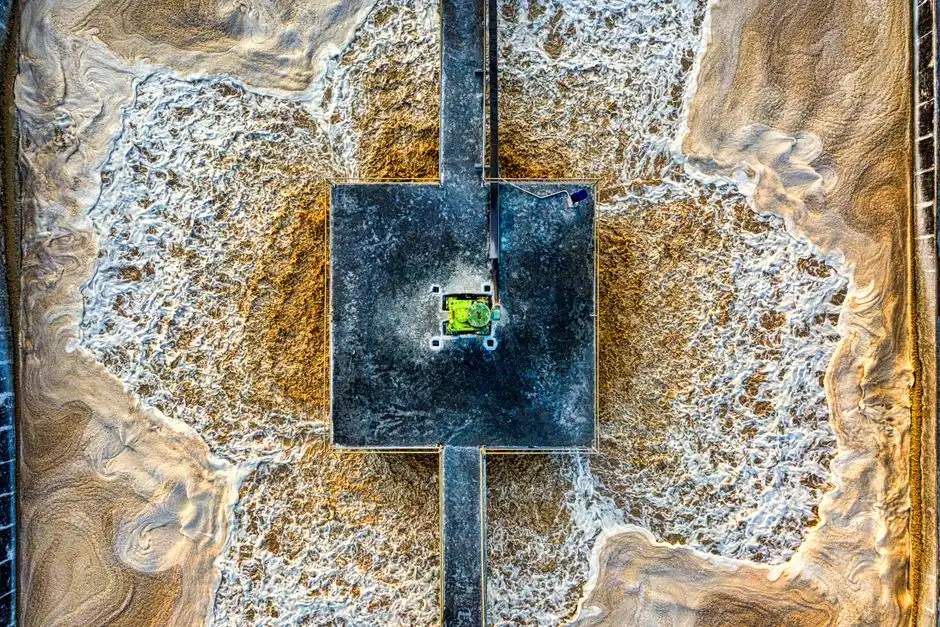
DAF systems are categorized as circular (more efficient) and rectangular (more residence time); the circular type requires just 3 minutes of residence time, while the rectangular type requires 20 to 30 minutes (S3). The circular geometry is hydraulically efficient and uses a spiral scoop for float removal, which is why it dominates compact and package-plant footprints. The rectangular geometry offers more residence time and a longer, quieter flow path, which is why it is the default at municipal scale where footprint is less constrained and the operator wants more margin against diurnal flow swings.
Engineers often evaluate structural enhancements to optimize these footprint requirements. Some DAF unit designs use parallel plate packing (lamellas) "to provide more separation surface and therefore to enhance the separation efficiency of the unit" (S3). For domestic sewage, lamella retrofits are most often evaluated when a rectangular tank is hydraulically overloaded but the civil footprint cannot be expanded, or when the engineer wants to push hydraulic loading without lengthening the tank. A circular unit generally does not need lamellas because the residence time is already short and the geometry is already efficient; a rectangular unit is the more common host for plate packing.
| Geometry | Residence time | Typical duty | Lamella option |
|---|---|---|---|
| Circular | ~3 min (S3) | Compact / package plant, building-scale, mobile | Rarely used; geometry is already efficient |
| Rectangular | 20–30 min (S3) | Municipal scale, sites with flow variability | Useful when footprint is fixed or loadings are at the upper limit (S3) |
The geometry choice also has to be cross-checked against the downstream biological stage. A 3-minute circular DAF ahead of an MBR demands a tighter coagulant dose and a more reliable skimmer than a 30-minute rectangular DAF ahead of a conventional A/O, because there is less hydraulic buffer between the float tank and the membrane cassettes. The unit selection framework in the best DAF unit for industrial wastewater guide covers the same geometry decision in an industrial context; for domestic sewage, the same logic applies but the loadings and the downstream coupling shift.
Core Design Parameters for a Domestic Sewage DAF
Residence time is the primary sizing parameter for a domestic-sewage DAF: ~3 minutes for circular units and 20 to 30 minutes for rectangular units (S3). The other core parameters — hydraulic loading rate, air-to-solids (A/S) ratio, saturation pressure, and micro-bubble size — are not specified numerically in the supplied research, so the buyer must request these from the specific unit vendor and cross-check them against the DAF system engineering specifications guide. Skimmer speed, float-sludge withdrawal rate, and bottom-sludge removal cadence are likewise vendor-specific and should be confirmed against the unit's nameplate and the influent solids profile.
Coagulant selection should follow the pollutant being targeted. The supplied research notes that "monomeric aluminum was more efficient in removing suspended solids and soluble chemical oxygen demand (COD) than polymeric or colloidal aluminum," while "polymeric or colloidal aluminum were more effective in removing soluble silica" (S1). For typical domestic sewage — where the driver is suspended-solids and soluble-COD reduction ahead of biology, not silica removal — this finding maps to a default preference for monomeric aluminum coagulants (alum or poly aluminum chloride in monomeric form), with a polymer upgrade only when the floc proves too fragile for skimming. The research explicitly notes that "polyelectrolyte or polymers could be included in situations of reduced performance of the DAF system if the floc is fragile and cannot be removed entirely by skimming" (S1), which is a common wet-weather condition on domestic plants.
Skimmer and float-sludge handling are part of the design, not an afterthought. DAF treatment can lead to sludge formation when "chemicals, depending on their properties, that do not float due to the DAF treatment, can sink to the bottom and form a sludge that would then need to be removed" (S1). For a domestic-sewage unit, the float goes to a sludge thickener (commonly a lamella thickener or a plate-and-frame press) and the bottom bleed goes to the same sludge line; both streams have to be sized into the plant's solids budget. An automatic chemical dosing system is typically specified alongside the DAF skid so the coagulant dose tracks the influent flow rather than being held at a fixed setpoint.
| Parameter | Value from supplied research | Status / action |
|---|---|---|
| Residence time, circular DAF | ~3 min (S3) | Use as design starting point |
| Residence time, rectangular DAF | 20–30 min (S3) | Use as design starting point |
| Hydraulic loading rate | Not specified in supplied research | Request from unit vendor; confirm against site diurnal flow |
| Air-to-solids (A/S) ratio | Not specified in supplied research | Request from unit vendor; verify against float-sludge dryness target |
| Saturation pressure | Not specified in supplied research | Request from unit vendor; typical saturation is several bar |
| Micro-bubble size band | Not specified in supplied research | Request from unit vendor; cross-check against floc size |
| Coagulant — default for SS / soluble COD | Monomeric aluminum more efficient than polymeric/colloidal (S1) | Default to alum or PACl in monomeric form |
| Coagulant — soluble silica target | Polymeric/colloidal aluminum more effective (S1) | Only relevant for silica-rich industrial streams, not typical domestic sewage |
| Polymer / flocculant | Used when floc is fragile and skimming is incomplete (S1) | Specify as wet-weather / peak-flow option |
Integrating DAF with Downstream Biological Treatment

DAF belongs upstream of the biological stage and downstream of preliminary treatment, so the typical domestic-sewage train is screening → grit removal → DAF (with coagulant dosing) → A/O or A²/O for nitrogen removal, or → MBR for combined biological and membrane separation, and finally → disinfection. The supplied research frames DAF as a pretreatment stage that "clarifies wastewater" and "assists in meeting water regulatory standards" (S1); in a domestic-sewage context, that role is to knock down suspended solids and colloidal COD so the biological stage sees a more uniform feed and the membranes in an MBR see less fouling load. The hand-off matters because the DAF effluent is not the discharge stream — it is the feed to the biology, and any design choice that improves DAF effluent quality directly reduces the load on the aeration tank and the membrane cassette.
Proper integration ensures long-term operational stability. For a building-scale or small-community plant, an integrated package such as the HydropureWater underground package sewage treatment plant or an MBR-integrated system can be specified with a DAF pretreatment stage ahead of the biological reactor, and the float sludge is then thickened on a plate-and-frame filter press or a lamella thickener with the filtrate returned to the head of the plant. The how to eliminate COD and SS in wastewater guide walks through the same hand-off logic for the biological side, and the phases of building a water treatment plant roadmap places the DAF skid in the civil and mechanical phase rather than the commissioning phase.
Frequently Asked Questions
How much does a DAF system for domestic sewage cost?
The supplied research does not include a numeric price or installed-cost range for a DAF unit, so a buyer must request a quotation sized to the design flow, the chosen geometry (3-min circular or 20–30 min rectangular), and the coagulant dosing scope. The actionable check is to ask each vendor for a priced bill of materials that separates the float tank, the recycle pump and air saturator, the skimmer, and the chemical dosing skid, so the cost of the DAF stage can be compared line-by-line against the cost of the downstream biological stage it feeds.
How do I choose the right DAF supplier for a domestic-sewage package plant?
Ask each shortlisted supplier for at least two domestic-sewage reference plants of similar flow to the one being designed, with the geometry (circular or rectangular) and the downstream biology (A/O, MBR, or SBR) named explicitly. The supplied research confirms that DAF is used in municipal wastewater treatment and that the geometry choice is a function of residence time and footprint (S3), so a supplier with no domestic reference list is a compliance and commissioning risk. Confirm that the vendor will size the recycle ratio, the air saturator, and the skimmer to the actual influent — not to a generic industrial-DAF datasheet — and that they will hand off the float-sludge characteristics to the sludge-thickening vendor before the contract is signed.
What residence time should I use for a municipal-scale domestic-sewage DAF?
Use 20 to 30 minutes for a