Why Houston Refineries Are Re-Engineering Their Water Loop in 2026
Houston refineries recycled roughly 4 billion gallons per year in the most recent reporting cycle, yet a single 250,000-bpd complex can still pull 16,000–24,000 m³/day from a combination of surface water, the Brazos/Trinity systems, and Gulf Coast groundwater — with cooling-tower makeup typically representing 50–70% of that total intake. The two constraints deciding whether a new treatment train gets funded are the Harris-Galveston and Fort Bend Subsidence District groundwater withdrawal caps, which are still tightening after the 2024–2025 rule update, and TCEQ TPDES permit renewals that increasingly require demonstrated reuse rather than dilution-based compliance. EPA's industrial-reuse guidance treats onsite reclaimed water as a lower-exposure stream, which is the regulatory hook that lets refineries reclassify a portion of their treated effluent as a non-discharge resource rather than a permitted waste (per EPA Water Reuse for Industrial Applications Resources, 2025). The practical consequence is that the design question for 2026 is not "do we treat wastewater" but "which end-use are we treating it for" — because the unit process stack, the energy cost, and the membrane CAPEX all change once the reuse spec is fixed. Cooling-tower makeup, medium-pressure boiler feed, and desalter wash each demand a different conductivity, silica, oil & grease, and BTEX envelope, and only the first of those three is usually the limiting economic target for a Houston refiner with a constrained fresh-water budget.
The Wastewater Streams a Houston Refinery Has to Treat Separately
"Refinery wastewater" is a misnomer on a P&ID: a 250,000-bpd unit has four to six streams that behave differently and should not be combined upstream of primary separation. Desalter effluent carries 200–500 mg/L oil & grease, 100–400 mg/L TSS, and chloride levels from 1,000 to 5,000 mg/L after the crude wash; it is the largest single source of oily water by volume and the natural feed for an API separator or refinery-grade DAF system polishing step. Sour water stripper overhead is a different design problem: it is rich in H2S (1,000–10,000 mg/L), NH3 (1,000–5,000 mg/L), and dissolved BTEX, and the ammonia load in particular will impair an activated-sludge basin if it is fed in above roughly 50–80 mg/L NH3-N without a side-stream stripper. OWS (oil-water separator) effluent, slop-oil decanter water, and tank-farm draw-off water all fit the classic API + DAF duty, with the conventional design point being a free-oil outlet below 50 mg/L going into the biological stage. Cooling-tower blowdown is the inverse problem: low organics (COD often under 100 mg/L) but conductivity 2,000–4,000 µS/cm, silica 40–150 mg/L, and residual scale inhibitors — it is almost always routed to a side-stream RO unit rather than a biological basin, because the salts and silica will pass through activated sludge untouched and then foul downstream membranes. Process wastewater and contaminated stormwater are intermittent, surge-prone, and need a 6–24 hour equalization basin ahead of the same DAF → bio → membrane train, and the equalization volume typically drives the hydraulic profile of the entire plant for upset conditions.
Industrial Water Treatment Methods, Stage by Stage
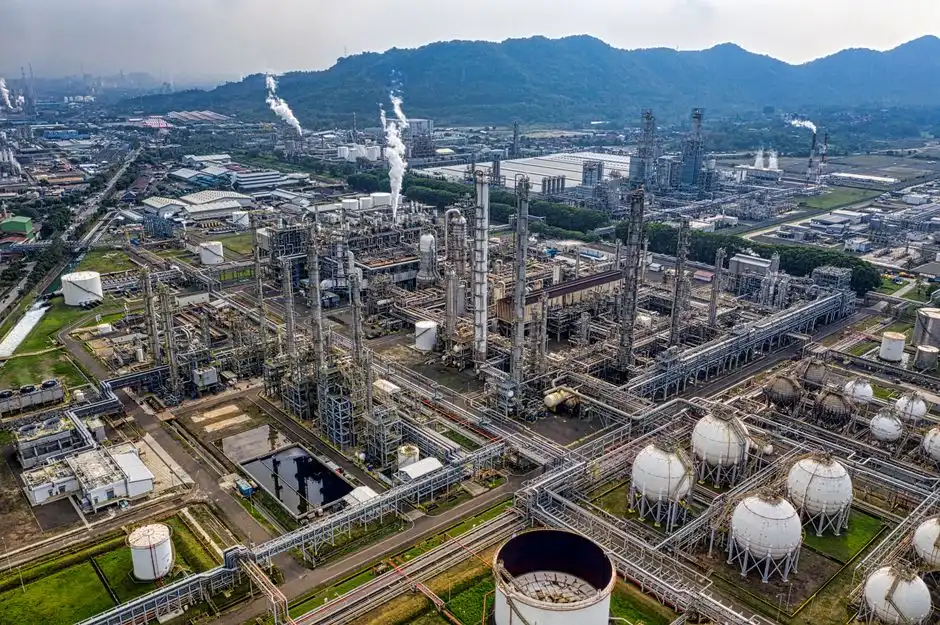
A 2026-vintage Houston refinery treatment train has four stages plus a sludge side, and each stage has a defensible performance range that procurement can put into a bid document. Stage 1 — oil-water separation. An API separator (gravity, residence time 30–60 min) takes out free oil to roughly 100–200 mg/L, and a downstream refinery-grade DAF system brings total oil & grease below 30–50 mg/L and TSS down by 60–80% on a typical refinery feed (HydropureWater DAF field data, 2025). Stage 2 — biological treatment. Activated sludge, MBBR, or MBR all strip dissolved organics and BTEX below the WHO drinking-water thresholds of 10 µg/L benzene, 700 µg/L toluene, 300 µg/L ethylbenzene, and 500 µg/L xylene (Processes 2020 review, doi:10.3390/pr8040447); an MBR delivers TSS below 5 mg/L and tighter BOD, which materially extends RO membrane life downstream. The same review warns that conventional and even advanced coagulation generate large volumes of unrecoverable hazardous sludge, which is one of the reasons the industry is moving toward physical separation followed by membrane and adsorption polishing rather than chemical precipitation. Stage 3 — membrane polishing. A 0.03 µm PVDF UF RO pretreatment skid protects the RO from biomass carryover and oil sheens, and an industrial RO unit with modern thin-film composite elements can run at 75–85% recovery on refinery feed, with 95% achievable on well-pretreated sidestreams (HydropureWater industrial RO design spec, 2026); the RO system design parameters for industrial plants guide walks through flux, recovery, and CIP sizing for that envelope. Stage 4 — conditioning. Mixed-bed ion exchange or an EDI electrodeionization system brings conductivity below 0.1 µS/cm for medium-pressure boiler feed, while an automatic chemical dosing skid handles antiscalant, biocide, and pH trim ahead of the membranes. Sludge side. DAF float and waste activated sludge are dewatered on a sludge dewatering filter press to 25–35% dry solids before offsite disposal. The biological step is the most energy-intensive unit in the train; the aeration energy cost optimization guide is a useful reference for the 30–50% of plant electrical load that the aeration basin typically consumes. For projects that need to verify nanofiltration as a side-stream option for sulfate or hardness rejection ahead of RO, the nanofiltration system design guide lays out the relevant spec.
Matching the Treatment Train to the End-Use
Each refinery must align its unit-process stack with the end-use water-quality specification rather than assuming a universal treatment path. The table below maps typical influent to a unit-process sequence and the corresponding end-use envelope, with the WHO BTEX thresholds acting as the biological floor and an RO + mixed-bed train as the boiler-feed ceiling.
| Influent stream | Unit-process sequence | Key effluent parameters | Realistic end-use |
|---|---|---|---|
| OWS / desalter effluent | API → DAF → equalization | Oil & grease <50 mg/L; TSS ~100–150 mg/L | Pre-bio feed only |
| DAF effluent | Activated sludge / MBBR / MBR | BTEX below WHO limits; NH3-N <5 mg/L (MBR tighter) | Bio floor for all reuse |
| MBR permeate / bio effluent | UF → RO sidestream | Conductivity <500 µS/cm; silica <50 mg/L; no free oil | Cooling-tower makeup |
| RO permeate | Mixed-bed IX or EDI | Conductivity <0.1 µS/cm; silica <0.02 mg/L | Medium-pressure boiler feed |
| Bio effluent (no membrane) | DAF + MBBR only, with cartridge filtration | TSS <30 mg/L; oil & grease <10 mg/L; BTEX within limits | Desalter wash reuse (lower-purity) |
| RO concentrate / cooling-tower blowdown | Evaporation pond or brine crystallizer | Zero liquid discharge (ZLD) recovery >95% | ZLD scheme only when discharge is restricted |
The desalter wash row is the one procurement typically under-specifies: the chloride and hardness budget for desalter washwater is much looser than for boiler feed, which means the project can stop at DAF + biological + cartridge filtration and avoid the membrane CAPEX entirely. ZLD is the other end of the spectrum: a brine crystallizer is capital-intensive and is only justified when the discharge option is genuinely off the table, which is rarely the case for a Houston refiner with a TCEQ-permitted outfall.
Houston-Specific Compliance, Cost and Vendor Reality Check

Three quantifiable levers drive the 2026 commercial case for water recycling in Houston, and the right unit processes to buy are those that move at least one of these levers on a 3–5 year payback basis.
| Lever | Driver | Order-of-magnitude CAPEX (USD) | What to require in a bid |
|---|---|---|---|
| Subsidence-district groundwater cap | Cooling-tower & boiler-feed makeup is the largest freshwater demand (50–70% of plant intake) | DAF unit low six figures; MBR package mid six figures; industrial RO train high six to low seven figures | Performance guarantee on conductivity, silica, oil & grease, and BTEX for the reuse stream |
| TCEQ TPDES renewal pressure | Permit cycles now require demonstrated reuse or significant pollutant reduction | Same envelope as above, plus dosing skid (low six figures) | Compliance mapping: influent spec → unit process → effluent spec → permit limit for each stream |
| Hurricane / flood / seismic design | Gulf Coast projects are exposed to all three; outdoor skids take the brunt | +10–20% structural premium on outdoor skids in Houston ship channel | Explicit pricing line for IBC seismic category, wind uplift to ASCE 7-22, and flood-load elevation |
When bid documents only ask for "reuse water" and skip the conductivity, silica, and BTEX numbers, the project usually ends up with a working system that does not pass the TCEQ reuse demonstration, which is the single most common retrofit trigger in 2025–2026. The other trap is the membrane-only retrofit: skipping the MBR and trying to send DAF effluent directly to RO is a 6–12 month path to fouled membranes, and the cleaning cost overwhelms the membrane CAPEX saving. A defensible 2026 bid for a Houston refiner should therefore include (1) a numeric performance guarantee tied to the reuse end-use spec, (2) a clear allocation of which unit processes handle desalter effluent, sour water, and cooling-tower blowdown separately, and (3) explicit pricing for seismic, hurricane, and flood-load specifications on any outdoor skid in the Houston ship channel or La Porte–Pasadena corridor.
Frequently Asked Questions
What end-use spec should a Houston refinery target first for water recycling?
Cooling-tower makeup is the highest-value first target because it accounts for 50–70% of plant freshwater intake and only requires conductivity below 500 µS/cm, silica below 50 mg/
Frequently Asked Questions
What is the best wastewater treatment method for oil refineries in Houston?
The most effective approach for Houston refineries is a multi-stage process combining Membrane Bioreactor (MBR) technology followed by Reverse Osmosis (RO). This configuration is preferred due to the high salinity and variable organic load characteristic of the Houston Ship Channel industrial corridor, consistently achieving over 95% removal efficiency for Total Suspended Solids (TSS) and Chemical Oxygen Demand (COD).
In 2026, many facilities are integrating Advanced Oxidation Processes (AOPs), specifically UV/H2O2, as a tertiary polishing step to meet stringent Texas Commission on Environmental Quality (TCEQ) discharge standards and optimize water recovery rates for internal reuse.
Can refinery wastewater be reused for boiler feed water?
Yes, refinery wastewater can be reclaimed for boiler feed water, provided it undergoes high-recovery demineralization. The treated effluent must meet ultra-low conductivity requirements, typically below 0.1 µS/cm, and silica levels must be reduced to less than 0.02 mg/L to prevent scale formation in high-pressure boilers.
This process usually requires a closed-circuit RO system coupled with Electrodeionization (EDI) or Ion Exchange (IX) polishers. When properly treated, reclaimed water often exhibits better consistency than raw municipal or surface water supplies, extending the service life of boiler tube metallurgy.
How do you remove BTEX from refinery wastewater?
BTEX (Benzene, Toluene, Ethylbenzene, and Xylene) removal is primarily achieved through a combination of air stripping and Granular Activated Carbon (GAC) adsorption. Air stripping towers are utilized as the primary stage to remove up to 90-95% of dissolved VOCs, depending on the Henry’s Law constants of the specific compounds.
For residual concentrations, liquid-phase GAC filters act as a final polishing barrier. In 2026, some refineries are adopting biological aerated filters (BAF) with specialized microbial cultures capable of degrading aromatic hydrocarbons, which reduces the frequency of carbon media regeneration and lowers operational costs.
What water quality is needed for cooling tower makeup in a refinery?
Cooling tower makeup water requires careful management of alkalinity, hardness, and corrosion inhibitors to prevent scaling and biofouling. Generally, the water should maintain a pH between 7.0 and 8.5, with calcium hardness levels kept below 500 mg/L as CaCO3 and chlorides below 250 mg/L to protect stainless steel and carbon steel heat exchangers.
Refineries utilizing recycled water must also monitor total phosphorus and nitrogen levels to prevent excessive algae growth within the cooling basin. The use of scale and corrosion inhibitors is mandatory when recycled water cycles exceed a Concentration Ratio (CR) of 4.0.
How much does it cost to install a refinery water recycling system in 2026?
The capital expenditure for a refinery water recycling plant in 2026 ranges from $15 million to $50 million, depending on the required throughput and the complexity of the influent stream. A typical facility processing 1 to 3 million gallons per day (MGD) often sees a return on investment within 4 to 7 years, driven by the reduction in raw water procurement costs and wastewater discharge fees.
Operational expenditure (OPEX) is estimated between $1.50 and $3.50 per 1,000 gallons of treated water, influenced heavily by electricity prices, membrane replacement cycles, and chemical consumption for pretreatment and anti-scalants.