Sludge Thickener Energy Benchmarks by Technology (2026 Data)
Sludge thickener energy consumption ranges from 0.5-2.5 kWh/ton DS for gravity thickening, 15-35 kWh/ton DS for DAF (including aeration), 25-50 kWh/ton DS for centrifuges, and 8-18 kWh/ton DS for rotary drums. Advanced Process Control (APC) optimizing polymer dosing and solids loading can reduce thickener-specific energy 15-25% while raising TS 9.5% — cascading to 10% higher methane yield and 43-51% plant energy self-sufficiency (full-scale 6-year data, Water Research 2024).
The kWh/ton DS metric quantifies the total electrical energy consumed per dry ton of solids thickened, encompassing drives, aeration, polymer preparation, and control systems. This benchmark excludes heating, focusing solely on the mechanical and electrical power required for solids concentration.
- Gravity thickeners operate with the lowest energy footprint, typically consuming 0.5-2.5 kWh/ton DS, primarily for rake drives (per S5 data). These units are best suited for primary sludge or digested sludge, achieving total solids (TS) concentrations of 6-10% and requiring large footprints, often 6-20m in diameter (per S5 data). They have zero aeration energy demand. Gravity thickening is a foundational method, often implemented with lamella clarifiers for gravity thickening to enhance efficiency in smaller footprints.
- Dissolved Air Flotation (DAF) systems show energy consumption in the range of 15-35 kWh/ton DS. This figure includes a significant contribution from the saturation pump (approximately 60% of DAF energy), skimmer drives (20%), polymer preparation (15%), and control systems (5%). DAF is highly effective for Waste Activated Sludge (WAS), concentrating it to 4-6% TS (per S5 data) through microbubble generation. Operators can achieve these efficiencies with modern DAF systems for WAS thickening.
- Centrifuges are among the most energy-intensive thickeners, with consumption between 25-50 kWh/ton DS. The bowl drive accounts for about 70% of this energy, with the scroll drive contributing 15%, polymer preparation 10%, and controls 5%. Centrifuges effectively thicken WAS to 4-6% TS (per S5 data) by applying high G-forces, typically 2000-3000g.
- Rotary drum thickeners offer a moderate energy profile, consuming 8-18 kWh/ton DS. The drum drive accounts for roughly 50% of the energy, backwash systems 25%, polymer preparation 20%, and controls 5%. These systems can achieve 3-6% TS (per S5 data) for various sludge types, including WAS, and are known for their gentle mechanical action.
- For specialized applications, such as thermophilic MBR/UF integration, membrane scouring in ceramic ultrafiltration (UF) adds 0.3-0.5 kWh/m³ permeate, but enables over 85% VS removal at a very low biomass yield of 0.01 kg VS/kg COD removed (per Water Environment Research 2026, S2 data). This represents a different process category focused on sludge reduction rather than just thickening.
| Thickener Type | Typical Energy (kWh/ton DS) | Typical Feed Sludge | Typical Output TS% | Key Energy Consumers |
|---|---|---|---|---|
| Gravity | 0.5 - 2.5 | Primary, Digested | 6 - 10% (S5) | Rake Drive (<5% sludge line energy) |
| DAF | 15 - 35 | WAS | 4 - 6% (S5) | Saturation Pump (60%), Skimmer (20%) |
| Centrifuge | 25 - 50 | WAS | 4 - 6% (S5) | Bowl Drive (70%), Scroll Drive (15%) |
| Rotary Drum | 8 - 18 | WAS, Mixed | 3 - 6% (S5) | Drum Drive (50%), Backwash (25%) |
Energy Breakdown: Where Thickener Power Actually Goes
In DAF systems, the saturation pump typically consumes 60% of the total energy, making it the primary target for energy reduction strategies (per S5 data). Optimizing the recycle ratio, which typically ranges from 20-40%, and maintaining saturation pressure at the lower end of its typical operating range (4-6 bar) can yield substantial savings; each 0.5 bar drop in saturation pressure can save approximately 8% of pump energy. This precision in operation is often enhanced by modern control systems.
For centrifuges, the bowl drive accounts for roughly 70% of the overall energy consumption. Implementing Variable Frequency Drives (VFDs) on the scroll differential speed allows the unit to match varying solids loading rates, which can reduce energy consumption by 12-18% during partial load operation. This dynamic control is crucial for managing the inherent variability of sludge characteristics.
- Polymer preparation and dosing systems typically represent 10-20% of a thickener's total energy demand. Employing inline viscosity control in PLC-controlled polymer dosing for thickener optimization can reduce overdosing by 20-30%. Full-scale data from a 6-year study demonstrated a 75% reduction in FeCl3 consumption via Advanced Process Control (APC) (Water Research 2024, S3).
- Gravity thickener rake drives consume less than 5% of the overall sludge line energy. However, monitoring torque spikes can indicate sludge bridging, prompting torque-based speed control adjustments that can save approximately 15% of drive energy by preventing unnecessary high-speed operation.
- Rotary drum thickener backwash systems consume about 25% of the drum's total energy. Transitioning from timer-based backwash cycles to pressure-triggered systems can cut water and energy consumption by up to 30%, capitalizing on the continuous operation advantage noted in S5 data.
| Thickener Component | Proportion of Thickener Energy | Optimization Strategy | Potential Energy Savings |
|---|---|---|---|
| DAF Saturation Pump | 60% (DAF total) | Optimize recycle ratio (20-40%), reduce saturation pressure (4-6 bar) | ~8% per 0.5 bar pressure drop |
| Centrifuge Bowl Drive | 70% (Centrifuge total) | VFD on scroll differential speed | 12-18% at partial load |
| Polymer Prep & Dosing | 10-20% (Thickener total) | Inline viscosity control, APC | 20-30% reduction in overdosing (S3) |
| Gravity Rake Drive | <5% (Sludge line total) | Torque-based speed control | 15% drive energy |
| Rotary Drum Backwash | 25% (Rotary Drum total) | Pressure-triggered vs. timer-based | 30% water/energy |
APC and Automation: Quantified Energy Reduction from Real Plants
Advanced Process Control (APC) strategies implemented at a full-scale wastewater treatment plant over six years (2015-2021) delivered a 9.5% increase in total solids (TS) content, a 10% improvement in methane yield, and boosted the plant's energy self-sufficiency from 43% to 51% (Water Research 2024, S3). These results were achieved through three primary APC strategies: (i) optimization of primary sludge (PS) and waste activated sludge (WAS) thickening, (ii) improved anaerobic digestion (AD) performance, and (iii) reduction of chemical consumption across the sludge line.
- Thickener-specific APC loops involve real-time solids loading rate control (e.g., DAF systems typically operate between DAF solids loading rates 24-48 lbs/ft²/day), underflow concentration PID control, and feedforward polymer dosing based on incoming TS and Sludge Volume Index (SVI). These automation layers ensure optimal performance under variable influent conditions.
- Polymer reduction is a significant benefit of APC. The S3 study specifically documented a 53% reduction in antifoam and a 75% reduction in ferric chloride (FeCl3) consumption. Typical polymer doses range from 2-8 kg/dry ton for DAF systems and 3-10 kg/dry ton for centrifuges (per S5 data). APC aims to achieve a 15-25% polymer reduction while maintaining solids capture.
- The energy self-sufficiency gains from APC are directly linked to improved thickener performance. A 9.5% increase in thickener TS translates to a higher organic loading rate (OLR) for anaerobic digesters, which can lead to smaller digester volumes or increased throughput for existing facilities. The S3 study reported annual energy gains of 1.3 GWh for a 50,000 population equivalent (p.eq.) plant due to these optimizations.
- The capital expenditure for SCADA integration and thickener APC implementation typically ranges from $50,000 to $200,000 in 2026 (per 2026 SCADA pricing guides). With electricity costs around $0.10/kWh, the payback period for these investments can be as short as 8-14 months, making them highly attractive for operational efficiency upgrades.
Downstream Cascade: How Thickener TS% Drives Digester Energy
Digester heating accounts for approximately 40% of the total energy consumption in the sludge line, making it a critical area for energy reduction through improved thickening (per S3 data). Feeding a digester at 6% TS compared to 4% TS effectively reduces the hydraulic volume by 50% for the same dry solids load, significantly decreasing the energy required to heat the sludge to mesophilic (35-37°C) or thermophilic (50-55°C) temperatures (per S2 data). This direct relationship underscores the importance of maximizing thickener output TS%.
- Digester mixing typically consumes 15-20% of sludge line energy. While higher TS concentrations result in increased sludge viscosity, which demands more mixing energy per cubic meter, the overall reduction in hydraulic volume means that the net mixing energy required per kilogram of volatile solids (VS) destroyed drops by 8-12% when feeding at 6% TS compared to 4% TS.
- Methane yield is directly enhanced by higher feed TS concentrations. Both S3 and S5 data indicate a 10%+ improvement in methane yield when digesters are fed with sludge containing over 4% TS. Assuming a typical yield of 0.35 m³ CH4/kg VS destroyed and a 35% combined heat and power (CHP) electrical efficiency, a 10% yield gain translates to an additional 0.035 m³ CH4/kg VS, equating to roughly 0.35 kWh/kg VS in electrical energy. These gains directly contribute to digester energy reduction strategies.
- Thermophilic digestion (50-55°C), as described in S2, increases the heating load by approximately 35% compared to mesophilic processes. However, it achieves greater than 85% VS removal and a low biomass yield of 0.01 kg VS/kg COD removed. For thermophilic systems to be net energy positive, a high TS feed (greater than 6%) is essential to offset the increased heating demand.
- Downstream dewatering operations also benefit substantially from higher thickener TS. The S3 study reported an 11% reduction in dewatered sludge production. Each 1% increase in TS to the dewaterer can reduce polymer consumption by 5-8% and proportionally decrease centrifuge run-hours, leading to significant operational savings. Understanding the anaerobic digester working principle and its upstream dependencies is key to overall plant efficiency.
| Impact Area | Effect of Higher Thickener TS% (e.g., 6% vs 4%) | Quantified Benefit/Change |
|---|---|---|
| Digester Heating Load | Reduced hydraulic volume to heat | ~50% less volume to heat; ~2.5% heating cut per 1% TS increase >4% |
| Digester Mixing Energy | Reduced net energy per kg VS destroyed | 8-12% drop in net mixing energy (at 6% vs 4% TS) |
| Methane Yield | Increased biogas production | 10%+ improvement (S3, S5); 0.35 kWh/kg VS electrical gain (at 35% CHP eff.) |
| Dewatering Sludge Volume | Reduced volume to dewater | 11% reduction in dewatered sludge (S3) |
| Dewatering Polymer/Run-Hours | Reduced chemical use and operational time | 5-8% polymer cut per 1% TS increase to dewaterer |
Technology Selection Decision Framework
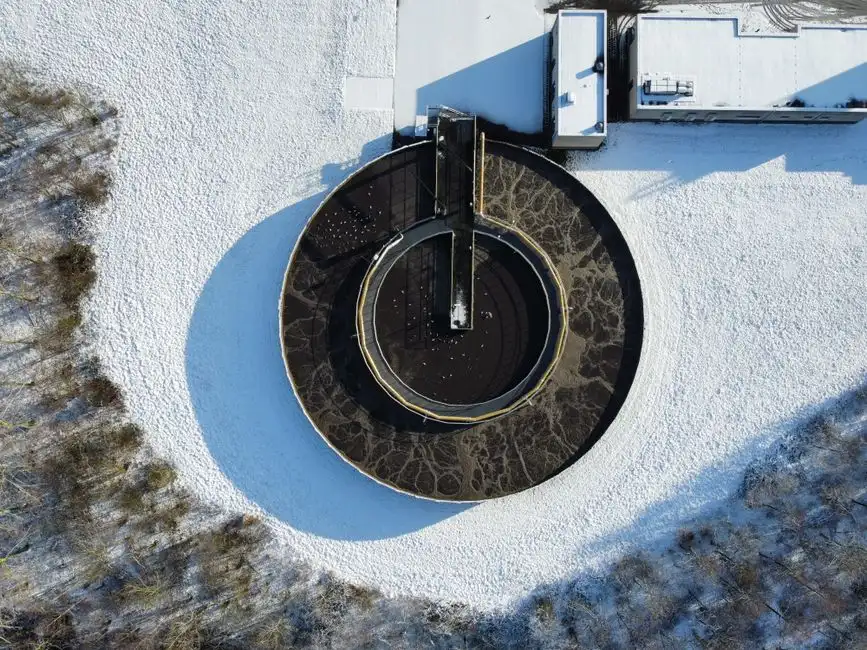
Selecting the optimal sludge thickening technology requires a comprehensive evaluation of several critical factors, including available footprint, the specific type of sludge (primary vs. Waste Activated Sludge), the desired target TS% for downstream processes like digestion, energy budget constraints, polymer chemical costs, and the operational skill level of plant personnel. Each technology presents a unique balance of these parameters.
- Gravity thickeners offer the lowest energy consumption (0.5-2.5 kWh/ton DS) but demand the largest footprint, often requiring circular tanks 6-20m in diameter (per S5 data). They are exclusively suitable for primary or digested sludge, achieving 6-10% TS (per S5 data), and are generally ineffective for WAS. For plants with ample space and primary sludge, lamella clarifiers for gravity thickening can be a cost-effective choice.
- DAF systems present moderate energy consumption (15-35 kWh/ton DS) and a moderate footprint. They are particularly well-suited for WAS, consistently achieving 4-6% TS (per S5 data). Polymer costs for DAF typically range from $1-5/dry ton (per S5 data), which can be reduced by 20-30% through APC. Modern DAF systems for WAS thickening provide robust performance.
- Centrifuges have the highest energy consumption (25-50 kWh/ton DS) but require the smallest footprint, making them ideal for space-constrained facilities. They offer consistent performance for WAS, typically achieving 4-6% TS (per S5 data), but incur higher polymer costs (3-10 kg/dry ton). The integration of VFDs and APC is essential to mitigate their operational expenses.
- Rotary drum thickeners demonstrate low-to-moderate energy consumption (8-18 kWh/ton DS) and a small footprint. They can achieve 3-6% TS (per S5 data) and are known for their gentle treatment of fragile flocs, making them an emerging and effective option for WAS thickening with polymer addition.
- Hybrid systems are increasingly common, combining technologies to address diverse sludge streams or variable loads. For instance, a plant might use gravity thickening for primary sludge and a DAF or centrifuge for WAS. Alternatively, DAF systems can be paired with rotary drums to handle variable loads efficiently, optimizing for specific DAF solids loading rates 24-48 lbs/ft²/day.
| Criterion | Gravity Thickener | DAF System | Centrifuge | Rotary Drum |
|---|---|---|---|---|
| Energy (kWh/ton DS) | 0.5 - 2.5 (Lowest) | 15 - 35 (Moderate) | 25 - 50 (Highest) | 8 - 18 (Low-Moderate) |
| Footprint | Largest (6-20m dia.) | Moderate | Smallest | Small |
| Sludge Type | Primary, Digested | WAS (Best) | WAS | WAS, Mixed |
| Target TS% | 6 - 10% (S5) | 4 - 6% (S5) | 4 - 6% (S5) | 3 - 6% (S5) |
| Polymer Cost ($/dry ton) | None/Minimal | $1 - $5 (S5) | Higher (3-10 kg/dry ton) | Moderate |
| Floc Shear | Very Low | Low | High | Low |
Retrofit ROI Calculator Template
Justifying capital expenditure for thickener retrofits or new installations requires a clear understanding of the return on investment (ROI). This template provides a framework to quantify savings, validated by real-world APC data from the S3 study. Key inputs include your plant's current thickener type, daily flow (m³/d), current feed TS%, target TS%, polymer dose (kg/dry ton), electricity cost ($/kWh), digester type (mesophilic/thermophilic), and current energy self-sufficiency percentage.
- Calculate Current Thickener Energy: Determine your baseline energy consumption using the formula: Current Energy (kWh/year) = Flow (m³/d) × Feed TS% (%) × 365 days/year × Benchmark kWh/ton DS (from the table in "Sludge Thickener Energy Benchmarks by Technology (2026 Data)").
- Estimate APC Savings: Project savings from Advanced Process Control (APC) implementation. Based on the 6-year S3 study, expect 15-25% reduction in thickener-specific energy, 15-25% reduction in polymer consumption, and a 9.5% increase in output TS%.
- Cascade to Digester Savings: Quantify downstream impacts.
- Heating energy reduction: (1 - Current TS / Target TS) × Current Digester Heating Load.
- Methane gain: 10% (S3) × VS Destroyed (kg/year) × 0.35 kWh/kg VS (electrical equivalent) (assuming 35% CHP efficiency). This directly contributes to digester energy reduction strategies.
- Dewatering Savings: The S3 study showed an 11% reduction in dewatered sludge production. Calculate savings as: 11% × Current Dewatered Sludge Volume (tons/year) × Dewatering Cost/Ton. This also impacts dewatering OPEX after thickening.
- Total Annual Savings vs. CAPEX: Sum all energy, chemical, and disposal savings. Compare this total to the estimated capital expenditure (e.g., APC $50,000-$200,000; DAF retrofit $200,000-$500,000; centrifuge $400,000-$800,000). Payback periods typically range from 1.5 to 3 years. For comprehensive planning, consult a sludge dewatering system specifications guide.
Sensitivity Analysis: Evaluate your ROI with varying parameters such as electricity costs ($0.08-$0.15/kWh), polymer prices ($2-$6/kg), and sludge disposal fees ($50-$150/ton) to understand the robustness of your project's financial viability.
Frequently Asked Questions
What is the typical kWh per dry ton for a DAF thickener?
A Dissolved Air Flotation (DAF) thickener typically consumes 15-35 kWh per dry ton of solids (kWh/ton DS). This figure includes the energy for the saturation pump, which alone accounts for about 60% of the DAF's total power, along with skimmer drives, polymer preparation, and control systems.
How much energy does APC save on a sludge thickener?
Advanced Process Control (APC) implemented on a sludge thickener can reduce thickener-specific energy consumption by 15-25% and polymer usage by 15-25%. Full-scale 6-year data (Water Research 2024, S3) demonstrated that APC led to a 9.5% increase in thickener output total solids (TS) and a 10% gain in methane yield from anaerobic digestion, significantly improving overall plant energy self-sufficiency (43-51%).
Which thickener uses the least energy?
Gravity thickening uses the least energy, typically 0.5-2.5 kWh/ton DS, but it is primarily suitable for primary or digested sludge, achieving 6-10% TS. For Waste Activated Sludge (WAS), rotary drum thickeners are the most energy-efficient option at 8-18 kWh/ton DS, followed by DAF systems (15-35 kWh/ton DS), and then centrifuges (25-50 kWh/ton DS).
Does higher thickener TS% really reduce digester energy?
Yes, a higher thickener total solids (TS) percentage significantly reduces digester energy consumption. Every 1% increase in TS above 4% can cut digester heating load by approximately 2.5% due to the reduced hydraulic volume. Data from the S3 study showed that a 9.5% increase in thickener TS directly led to a 10% gain in methane yield and contributed to a 43-51% plant energy self-sufficiency.
What polymer dose minimizes energy per ton DS?
Minimizing polymer dose while maintaining capture efficiency is key to reducing both chemical and associated energy costs. For DAF systems, an optimized polymer dose is typically 2-4 kg/dry ton (compared to a broader range of 2-8 kg/dry ton). For centrifuges, 4-6 kg/dry ton is often achievable (versus a typical 3-10 kg/dry ton). Advanced Process Control (APC) with inline viscosity monitoring, as demonstrated in the S3 study with 53-75% chemical reductions, is crucial for achieving these lower, optimized doses without compromising performance.