Why Calgary's Water Reality Reshapes Fab and Data Hall Wastewater Design in 2026
Calgary semiconductor fabs and data halls must design process wastewater treatment around a single binding constraint: Alberta's standing moratorium on new Bow River Basin water licences. The defensible path is municipal supply, segregated fab-stream and cooling-blowdown treatment, 85-90% high-recovery reverse osmosis reuse, and zero-liquid-discharge (ZLD) polishing, with PFAS, fluoride, and metals tracked to Alberta Environment and Protected Areas (AEPA) approval limits. Any plant that treats water as a textbook problem rather than a permit problem will not break ground in southern Alberta in 2026.
Richard Jones of Brownlee, quoted in National Magazine, confirms the constraint directly: "Currently, there is a moratorium on any new licences for water from the Bow River Basin. To operate a data centre in southern Alberta, [a company] will have to either buy an existing water licence from another user, which may be a barrier to entry, or seek a water supply from a municipal utility" (National Magazine, 2025). That single sentence defines the water-supply envelope for every hyperscale build-out Alberta is actively courting. The province launched its AI Data Centres Strategy expecting billions in capital deployment, and eStruxture Data Centers has publicly stated it plans to site its largest facility near Calgary — the build is real, even if provincial disclosure rules have not yet caught up (National Magazine, 2025).
The scale of the water demand explains why this is now a permitting problem, not a procurement problem. A single semiconductor fab can use around 14 billion litres of ultrapure water (UPW) per year, and for every unit of UPW produced, 1.4-1.6 units of municipal water are drawn (TNFD, Feb 2026). Hyperscale data centres can exceed 2 billion litres of water annually, with a typical facility ranging from 25 million to 770 million litres depending on size (TNFD, Feb 2026). Globally, 40% of new fabs announced since 2021 are projected to sit in basins with high or extremely high water-stress risk by 2030; Calgary is comparatively water-rich but allocation-locked, which is functionally similar for any new entrant (TNFD, Feb 2026). The Vancouver-style "municipal-plus-recycle" model therefore matters more here than the Phoenix-style "freshwater-plus-ZLD" model. Engineers approaching this with an Arizona or Taiwan template will over-specify the front end and under-specify the recovery train. For a parallel case in another water-scarce metro, see this analogous 2026 water-scarcity fab guide on Baku.
Calgary Wastewater Streams: What a Fab and a Data Hall Actually Discharge
Before any equipment is selected, the chemistry of each waste stream has to be mapped. Mixing incompatible streams upstream of pH neutralization creates hydrogen fluoride release risk, ammonia stripping, and solids precipitation that downstream membranes cannot tolerate. Calgary facilities should expect AEPA to require a stream-by-stream mass balance before an approval is issued.
Fab-side streams include: HF and HCl from wet etching and RCA cleaning sequences; alkaline developer drain at pH 10-12; chemical mechanical polishing (CMP) slurry containing silica, ceria, and alumina abrasives; photoresist solvents and strippers; ammonia and amine compounds; and the UPW reject stream, which runs at 1.4-1.6x the UPW volume itself in raw municipal intake (IDE Technologies, 2024-2026; TNFD, Feb 2026). CMP alone is consistently 30-40% of total fab wastewater volume, which makes the CMP drain the single largest design driver in any new fab (IDE Technologies, 2024-2026).
Data-hall streams are simpler in chemistry but larger in volume in Calgary's climate. Evaporative cooling-tower blowdown carries total dissolved solids (TDS), scale inhibitors (phosphonates, polymers), and oxidizing or non-oxidizing biocides. Humidification bleed-off contributes additional dissolved solids, and any on-site RO used to polish makeup water produces its own reject stream. Because Calgary's climate swings from -30°C winter to +30°C summer, blowdown is more seasonal than in warm jurisdictions — winter blowdown concentrates more aggressively because evaporative losses drop with ambient temperature, which changes both the volume and the chemistry of the discharge.
PFAS is the most rapidly tightening parameter across the industry. The U.S. EPA's PFAS Roadmap now includes legally binding maximum contaminant levels in drinking water, and CERCLA has designated PFAS as hazardous substances, which enables EPA to hold parties responsible for PFAS contamination liable for cleanup costs (IDE Technologies, 2024-2026). Industry pressure is moving toward "complete elimination" of PFAS discharge in semiconductor wastewater even where Canadian federal or provincial numbers are not yet binding (IDE Technologies, 2024-2026).
| Stream | Source | Key Contaminants | Typical pH | Volume Share |
|---|---|---|---|---|
| Acid / etch drain | HF, HCl, H₂SO₄ wet etch + RCA | F⁻, Cl⁻, metals (Cu, Ni, W) | 2-4 | 20-30% |
| Alkaline developer drain | Photoresist development | TMAH, organics, NH₃ | 10-12 | 10-15% |
| CMP slurry drain | Chemical mechanical polishing | SiO₂, CeO₂, Al₂O₃, surfactants | 6-9 | 30-40% |
| UPW reject | UPW system blowdown | Dissolved ions, TOC, silica | 6-8 | 15-20% |
| Cooling-tower blowdown | Evaporative cooling + humidification | TDS, scale inhibitors, biocides | 7-9 | Seasonal — peaks in summer |
| RO reject (data hall) | On-site makeup-water polishing | Concentrated hardness, silica | 6-8 | 10-25% of makeup |
The 2026 Alberta and Federal Compliance Stack for Process Wastewater
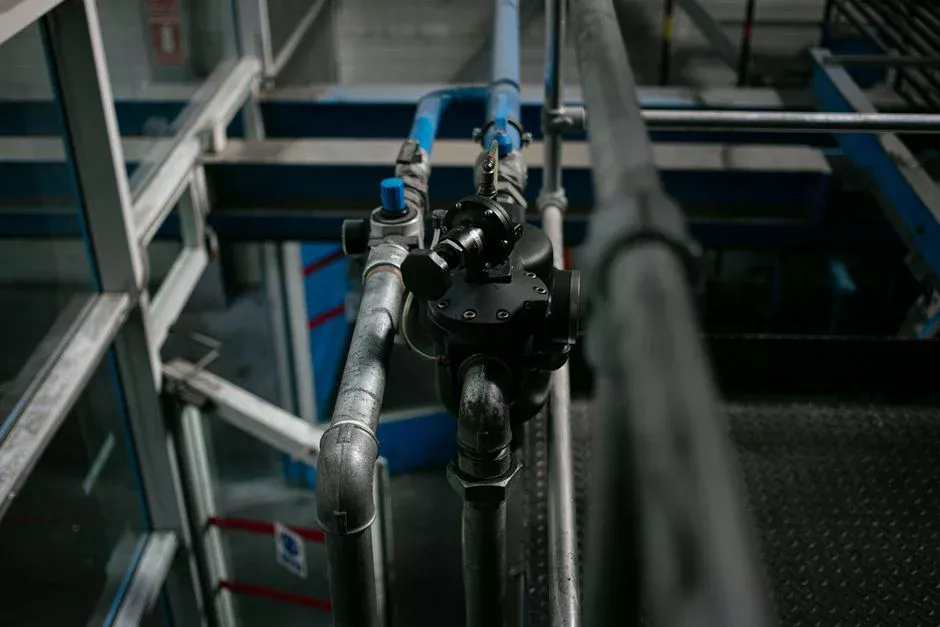
Calgary operators need a permit chain ordered from provincial down to federal before a single pipe is welded. The most common delay we see in 2026 is engineers treating the federal Fisheries Act and Alberta EPEA as parallel reviews; in practice AEPA approval under EPEA is the gating item, and the federal review is layered on top for any discharge to fish-bearing water.
Alberta EPEA approval under the Environmental Protection and Enhancement Act is required for any industrial wastewater discharge above EPEA thresholds. Approvals are site-specific and negotiated numerically — there is no flat Alberta fluoride number, no flat Alberta PFAS number, and no generic Alberta metals cap. The facility proposes limits, AEPA counters, and the final number is what the approval binds. Expect pH 6.0-9.5 at the discharge point, TSS typically in the 30-100 mg/L range, fluoride usually negotiated between 5-15 mg/L depending on the receiving stream and downstream water users, and metals on a case-by-case schedule tied to upstream treatment performance. For pretreatment-driven sectors adjacent to fab design, the food and beverage pretreatment-limits playbook is a useful comparator on permit negotiation tactics.
Water Act licence transfer or municipal supply. The Bow River moratorium forces any new entrant to either buy an existing water licence from another user (typically an irrigation holder) or commit to a long-term municipal utility supply agreement through the City of Calgary. The licence-transfer route is the rate-limiting capital constraint for 2026; it also sets the upper bound on intake, which is why high-recovery design matters far more here than in water-rich jurisdictions.
Federal Fisheries Act. Subsection 36(3) prohibits depositing deleterious substances into fish-bearing waters, and the Calgary area's receiving streams — the Bow, the Elbow, and their tributaries — are fish-bearing. Fluoride, unionized ammonia, copper, nickel, and zinc all sit on the substances-of-concern list, which gives federal reviewers a direct stake in any numeric limit AEPA sets.
CCME PFAS guidance and the federal framework. Even without a binding Alberta PFAS number, AEPA benchmarks facilities against the Canadian Council of Ministers of the Environment (CCME) PFAS guidance and Environment and Climate Change Canada's (ECCC) emerging-science strategy. Self-imposed monitoring at or below EPA's 4 ng/L PFOA and 10 ng/L PFOS drinking-water MCLs is now the 2026 standard for any new Alberta fab permit application.
Cold-climate discharge considerations. Calgary's lower receiving-water temperatures raise dissolved-oxygen capacity but slow biological reaction kinetics by roughly 30-50% relative to warm-climate defaults. That changes the discharge negotiating leverage: cold-stream ammonia limits are easier to defend, but nitrate and BOD limits are harder to meet in winter without an MBR or moving-bed biofilm reactor (MBBR) polish.
| Authority | Instrument | Calgary Driver | Typical Parameter |
|---|---|---|---|
| Alberta EPEA | Industrial approval | Discharge numeric limits | pH 6.0-9.5; F⁻ 5-15 mg/L negotiated; site-specific metals |
| Alberta Water Act | Licence transfer or municipal supply | Allocation security | Volume cap = intake cap |
| Fisheries Act (federal) | Subsection 36(3) prohibition | Deleterious-substance test | F⁻, NH₃ un-ionized, Cu, Ni, Zn |
| CCME / ECCC | PFAS guidance | Emerging contaminant benchmark | Self-imposed to EPA 4 ng/L PFOA, 10 ng/L PFOS |
| City of Calgary | Sanitary discharge bylaw | Sewer discharge limits | Sanitary (not process) discharge only |
A Calgary-Specific Treatment Train: Segregated Streams, High Recovery, ZLD Polish
The treatment train below assumes segregated collection from the wet bench to the central treatment plant. Combining acid and alkaline streams upstream of equalization is the single most common permit-blocking design error in fab pretreatment — it neutralizes reagent cost recovery, spikes TDS load on the RO, and risks HF release during pH transitions. Each stage carries a Calgary-climate adjustment.
Stage 1 — Segregated collection. Four segregated drains: HF/RCA acid drain (pH 2-4), alkaline developer drain (pH 10-12), CMP slurry drain, and cooling-tower blowdown. Each drain gets its own flowmeter, pH probe, and conductivity probe tied to a historian for AEPA reporting. Continuous monitoring is the 2026 Calgary norm, not grab sampling.
Stage 2 — pH adjustment, lamella clarification, and DAF. Acid and alkaline streams are neutralized in separate equalization tanks, then combined for metals precipitation. A lamella clarifier for primary metals precipitation is sized at 20-40 m/h surface loading for the bulk of the hydroxide sludge, and a DAF for CMP solids and FOG removal — operating at 4-300 m³/h — polishes the CMP drain for fine abrasive particles and any residual oils. Calgary's colder water viscosity raises DAF air-to-solid ratios roughly 10-15% relative to warm-climate defaults; spec accordingly.
Stage 3 — UF polishing. A 0.03 µm PVDF hollow-fiber UF pretreatment — 2,000-40,000 L/h per skid — protects the downstream RO from any residual CMP particles and colloidal silica. This stage is non-negotiable in Calgary because the colder feedwater carries higher silica scaling potential, and silica fouling on an RO membrane is irreversible without a clean-in-place that operators will not want to run in a Calgary winter.
Stage 4 — High-recovery RO with NF pretreatment for the CMP recycle loop. Industrial RO systems (up to 95% recovery) are the heart of the recovery train. Operating at 85-90% recovery — IDE's published design range for state-of-the-art fabs (IDE Technologies, 2024-2026) — reduces raw intake demand and shrinks the brine volume going to the thermal stage. A nanofiltration (NF) pretreatment on the CMP recycle loop selectively passes water and rejects multivalent ions, which protects the RO from silica and hardness scale.
Stage 5 — Thermal brine concentrator and crystallization for ZLD-ready sites. Sized for Calgary's cold ambient air, which lowers evaporation rate by 30-40% relative to warm-climate defaults; the crystallizer handles the residual brine. For a pharmaceutical comparator on sand filtration as a parallel polish step, see this pharmaceutical sand-filter guide. The cooling-tower blowdown stream runs in parallel through softening and reuse, and a filter press for fab hydroxide sludge dewaters the clarifier underflow to 25-35% dry solids for off-site disposal.
| Stage | Unit Operation | Design Parameter | Calgary Adjustment |
|---|---|---|---|
| 1 | Segregated collection | 4 drains, dedicated flow + pH + conductivity | Continuous monitoring per AEPA 2026 norm |
| 2 | pH adjust + lamella + DAF | Lamella 20-40 m/h; DAF 4-300 m³/h | +10-15% air-to-solid ratio for cold water |
| 3 | UF polish | 0.03 µm PVDF, 2,000-40,000 L/h | Mandatory silica-fouling guard |
| 4 | NF + high-recovery RO | 85-90% recovery (up to 95%) | Lowers intake demand; shrinks brine volume |
| 5 | Brine concentrator + crystallizer | ZLD polish | Heat-recovery from blowdown offsets energy premium |
| Sludge | Filter press | 25-35% dry solids cake | Off-site hydroxide disposal |
Recovery Economics: Why 90% Beats 75% Even at Calgary OPEX Premiums
Recovery economics are what get a Calgary project approved by both AEPA and the CFO. At 75% RO recovery, roughly 33% of intake water leaves the plant as liquid waste; at 90% recovery, only 10% does (HydropureWater microelectronics ZLD analysis, 2026). For a 10 million gallon/day fab, that is millions of litres per day of avoided municipal demand and avoided discharge fees — and, more importantly, it is millions of litres per day less of licence-transfer volume the operator has to purchase or allocate under the Bow River moratorium.
The licence-transfer cost is the real rate-limiting capital constraint. A 90% recovery design lets a Calgary facility right-size its licence-transfer purchase, which is typically the single largest non-equipment line item on the project. IDE's published benchmark for state-of-the-art fabs targets 85-90% recovery using high-recovery RO, advanced filtration, and thermal polishing; facilities pursuing ZLD can reach higher (IDE Technologies, 2024-2026). The 99.5% reuse-ROI case — published in our hybrid ZLD and reuse-ROI benchmark — is the long-term target, but the 85-90% design point is the optimal 2026 capex/opex trade for Calgary specifically.
Cold-climate OPEX reality works in the design's favour. Thermal brine concentration is energy-intensive, but Calgary's low winter temperatures enable heat-recovery from blowdown and condenser-side heat that warmer sites cannot capture. A well-designed cold-climate brine system recovers 15-25% of its thermal energy from the blowdown stream itself, partly offsetting the energy premium. Net of heat recovery, the lifetime OPEX gap between 75% and 90% recovery designs in Calgary is smaller than in warm-climate benchmarks — and the avoided licence-transfer cost makes the 90% case strictly dominant.
Frequently Asked Questions
Can a new Calgary data centre or fab get a Bow River water licence in 2026?
No new Bow River Basin allocations are being issued. Any new entrant must either buy a licence from an existing holder (typically an agricultural user) or commit to a long-term City of Calgary municipal supply agreement. The licence-transfer route is the rate-limiting capital item for most 2026 projects (National Magazine, 2025).
What fluoride limit applies to fab wastewater in Alberta?
There is no flat Alberta fluoride number. AEPA sets site-specific limits under EPEA, and the negotiated range for fab discharges is typically 5-15 mg/L at the discharge point, benchmarked against the federal Fisheries Act prohibition on deleterious substances in fish-bearing waters.
Is zero liquid discharge mandatory in Calgary?
ZLD is not formally mandatory, but it is increasingly the cheapest path to AEPA approval because it eliminates the discharge-quality negotiation. A high-recovery RO + brine concentrator + crystallizer train collapses the liquid waste stream to a manageable solids volume.
What PFAS limits are enforceable in Alberta in 2026?
No binding Alberta PFAS number exists yet, but AEPA benchmarks facilities against the CCME PFAS guidance, the ECCC emerging-science strategy, and the EPA's MCLs of 4 ng/L PFOA and 10 ng/L PFOS. New fabs in 2026 are designing to those EPA numbers as a self-imposed floor.
How does Calgary's cold climate change the treatment train design?
Cold climate lowers biological reaction kinetics by 30-50% relative to warm-climate defaults, raises DAF air-to-solid requirements by 10-15%, and lowers thermal evaporation rates by 30-40%. It also enables heat-recovery from blowdown that warmer sites cannot capture, which partly offsets Calgary's thermal OPEX premium. For a parallel cold-climate comparator, see our Sydney semiconductor wastewater 2026 guide — note that Sydney's climate constraint is the inverse of Calgary's.