Why Pharmaceutical Plants Use Sand Filter Water Treatment
Pharmaceutical wastewater influent varies so widely that a single static treatment step cannot handle it. Veolia's research across 50 reference plants documents daily flows of 30–600 m³/d, COD of 400–62,000 mg/L, and COD/BOD5 ratios of 1–15, with one extreme plant at 300,000 mg/L (Veolia, 2020). Sand filter water treatment for pharmaceutical service is a tertiary polishing step placed after biological treatment (MBBR or activated sludge) and activated carbon, where it removes residual suspended solids, turbidity, and biomass carryover — typically targeting effluent turbidity below 1–2 NTU and SDI below 3 — to protect downstream RO membranes used in water reuse.
Sand filtration alone cannot treat pharma influent. Refractory COD from chemical synthesis and API residuals is not removed by a sand bed; it is the job of upstream biology, carbon, or advanced oxidation. What sand does capture is the suspended carryover that biology and carbon leave behind — floc fragments, biomass sloughing, and fine precipitates. In Veolia's Example F line, the sequence ends with EQUALIZATION > MBBR > DAF > MBBR > ACTIVATED CARBON > SAND FILTRATION, confirming sand as the final barrier before any membrane or reuse step.
The protection logic is straightforward. Pharma plants reusing water send RO permeate to EDI or to WFI pretreatment, and sand filtration keeps SDI low enough for those membranes to survive. When sand fails — whether from upstream breakthrough, missed backwash, or media fouling — the consequence appears in premature RO membrane replacement.
Where Sand Filtration Fits in a Pharmaceutical Treatment Train
The unit operation has a fixed slot in a pharma treatment train to ensure consistent effluent quality for downstream processes. Equalization smooths batch spikes; neutralization sets pH; biological treatment (MBR, MBBR, or activated sludge) digests biodegradable organics; a DAF or lamella clarifier strips the bulk of TSS; activated carbon adsorbs API traces, solvents, and color; then sand filtration polishes for RO. Veolia's two example lines that terminate with sand are: EQUALIZATION > EVAPOCONCENTRATION > MBBR > HYDROSTATIC FILTRATION > GAC FILTRATION (Example B) and EQUALIZATION > MBBR > DAF > MBBR > ACTIVATED CARBON > SAND FILTRATION (Example F) (Veolia, 2020).
Placing DAF or a lamella clarifier ahead of sand is not optional. A sand filter receiving more than ~30–50 mg/L TSS will blind within hours, and in pharma duty that means COD excursions trace back to biology shedding floc. A properly sized DAF pre-clarifier drops TSS to the 10–30 mg/L range so the sand bed can run 24–72 h between backwashes.
Activated carbon is needed before sand when API traces, solvents, or color remain in the stream. Carbon does the dissolved-phase work; sand does the particulate-phase work. Skipping carbon pushes dissolved organics onto the sand media, accelerating fouling and raising SDI. The downstream interface is unambiguous: sand filter effluent must hit SDI <3 (commonly <2) for RO. A multi-media filter configured as anthracite over sand over garnet is the configuration most often used to meet that target in pharma polishing duty.
Sand Filter Design Parameters for Pharmaceutical Service
The design envelope for a 2026 RFQ is well-defined to ensure optimal filtration performance. Single-media silica sand runs at 8–12 m/h filtration rate; multimedia polishing (anthracite/sand/garnet) runs 10–20 m/h. Higher rates compress bed depth and shorten run length, so the spec for tertiary polishing duty is typically 12–15 m/h.
Media gradation for a multimedia pharma filter: anthracite cap 0.8–1.2 mm effective size with uniformity coefficient ≤1.7; silica sand 0.45–0.55 mm with UC ≤1.6; garnet 0.2–0.3 mm with UC ≤1.6. Bed depths: 0.6–1.0 m sand plus 0.3–0.5 m anthracite cap, with ≥50% freeboard for backwash expansion (typically 30–40% bed expansion at 36–45 m/h water and 20–25 m/h air scour). Vessel material is rubber-lined carbon steel for general ETP duty; 304L stainless for hygienic zones near finished-product manufacturing, where CIP residue and condensate can pit carbon steel.
Backwash is the operational lever that determines whether SDI stays below 3. Trigger on differential pressure of 0.5–0.7 bar across the bed, plus a timed backwash every 24–72 h as a safety floor. Backwash water consumption is 3–6% of throughput, which is non-trivial in pharma where water is a cost driver. Sourcing quartz sand and anthracite media that meets AWWA B100 and is low in fines reduces initial rinse-ups and SDI excursions on fresh beds.
| Parameter | Single-media sand | Multimedia (anthracite/sand/garnet) |
|---|---|---|
| Filtration rate | 8–12 m/h | 10–20 m/h |
| Sand effective size | 0.45–0.55 mm | 0.45–0.55 mm |
| Anthracite cap | — | 0.8–1.2 mm, 0.3–0.5 m depth |
| Garnet layer | — | 0.2–0.3 mm |
| Sand bed depth | 0.6–1.0 m | 0.6–1.0 m |
| Uniformity coefficient | ≤1.6 | ≤1.6 (each layer) |
| Backwash trigger (ΔP) | 0.5–0.7 bar | 0.5–0.7 bar |
| Backwash water | 3–6% of throughput | 3–6% of throughput |
| Typical effluent turbidity | 1–2 NTU | <1 NTU |
Multimedia vs Single-Media vs Sand-Ballasted: Which Configurations Pharma Plants Choose
Three configurations compete for the polishing slot, and the right answer depends on upstream variability. Single-media sand has the lowest CAPEX and the simplest controls, but shorter run lengths and higher SDI variability — it is only suitable after very stable upstream biology with low TSS excursions. Most API plants do not have that stability, and the media choice usually follows the influent envelope.
Multimedia (anthracite/sand/garnet) is the best balance for pharma polishing. The coarse anthracite captures floc and biomass carryover; the sand layer strips fines; the garnet polishes to sub-1 NTU. Runs are longer (often 48–72 h between backwashes), SDI is consistently <3, and the configuration is forgiving of moderate TSS shocks from batch dumps. It is the default choice for steady API production with biological and carbon stages upstream.
Sand-ballasted clarification (Densadeg, Hydro-Clear, and similar) operates at much higher rates (20–40 m/h equivalent) with a small footprint and handles shock TSS loads from batch spills. The trade-off is higher OPEX from coagulant, polymer, and microsand consumption, plus more complex controls. For finished-product lines with high variability or for plants consolidating clarification and filtration into a single step, sand-ballasted is the right call. For API plants with already-stable upstream biology, multimedia is usually the lower-TCO option. Veolia's Example D uses sand-ballasted lamellae settling; Examples B and F end with conventional sand or GAC sand beds (Veolia, 2020).
| Configuration | Best fit | Filtration rate | Effluent turbidity | CAPEX | OPEX driver |
|---|---|---|---|---|---|
| Single-media sand | Stable upstream biology, low TSS | 8–12 m/h | 1–2 NTU | Lowest | Backwash water, media change |
| Multimedia (anthracite/sand/garnet) | Steady API polishing duty | 10–20 m/h | <1 NTU | Moderate | Backwash water |
| Sand-ballasted (Densadeg, Hydro-Clear) | Batch variability, shock TSS, high flow | 20–40 m/h | <1 NTU | Highest | Coagulant, polymer, microsand |
How Sand Filtration Protects Downstream RO and Reuse Systems
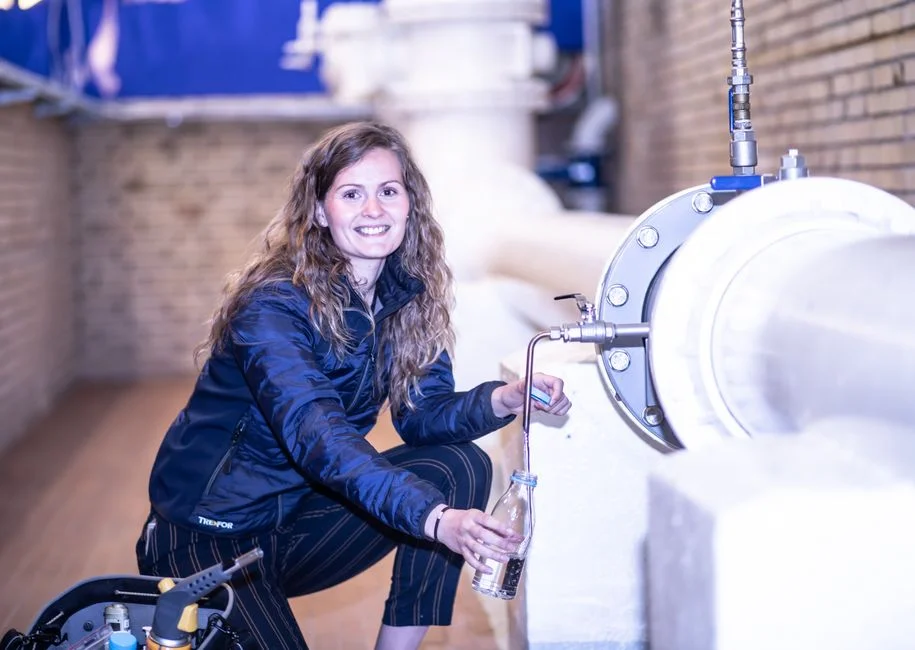
RO membranes in pharma water reuse are specified at SDI <3, with most plants targeting <2. A poorly operated sand filter is the single most common cause of premature membrane fouling in pharma reuse trains — when the sand bed releases fines or breakthrough occurs, SDI climbs and RO flux drops within days. Veolia's example lines place sand filtration as the last step before RO in pharma reuse schemes (Veolia, 2020), confirming its role as a guard filter rather than a primary treatment.
Media life and replacement intervals should be planned into pharma plant shutdown windows since the line is continuous. Quartz sand typically lasts 3–5 years; anthracite 2–4 years depending on backwash water quality and feed organics. Specifying media that meets AWWA B100 and ordering spare bed volumes ahead of the next planned turnaround avoids emergency changeouts during a campaign. The pharma RO system downstream of the sand filter, and any EDI electrodeionization system further downstream, both depend on this polishing reliability.
Frame the ROI in membrane terms, not filter terms. Sand filter CAPEX is typically 3–8% of total ETP cost; replacing a fouled RO train runs into six figures per skid, and RO membrane replacement is the line item that justifies polishing reliability. Engineers writing RFQs in 2026 should reference the RO design criteria that link SDI targets to flux and recovery, and the broader RO for pharmaceutical water treatment envelope when sizing the upstream sand filter. A separate primer on primary vs secondary treatment also helps frame why the polishing slot is fixed.
Frequently Asked Questions
What does sand filtration remove in pharmaceutical wastewater?
Sand filtration in pharma service is a tertiary polishing step that removes residual suspended solids, turbidity, and biomass carryover after biological and carbon stages. It targets effluent turbidity below 1–2 NTU (multimedia: <1 NTU) and SDI below 3, typically below 2. It does not remove dissolved COD, API traces, or salts; those are handled upstream by biology, carbon, or advanced oxidation.
Where does sand filtration sit in a pharmaceutical treatment train?
Sand filtration is placed after equalization, biological treatment (MBR/MBBR/activated sludge), DAF or lamella clarification, and activated carbon — and before RO/UF and any EDI or WFI pretreatment. Veolia's Examples B and F both terminate with sand filtration (Veolia, 2020), confirming its position as the final guard filter before membrane or reuse steps.
What filtration rate and media gradation should a 2026 pharma RFQ specify?
For multimedia polishing, specify 10–20 m/h filtration rate (12–15 m/h typical), anthracite 0.8–1.2 mm with 0.3–0.5 m cap depth, silica sand 0.45–0.55 mm with 0.6–1.0 m depth and UC ≤1.6, and optional garnet 0.2–0.3 mm. Backwash on ΔP of 0.5–0.7 bar with a 24–72 h timed safety trigger; expect 3–6% of throughput as backwash water.