Why a Melbourne fab or data hall needs a five-stream wastewater model in 2026
A 2026-compliant Melbourne semiconductor or data-hall site routes at least five separate streams — domestic, cooling-tower blowdown, UPW reject, fab process drain, and construction fill-and-flush — through distinct trains before discharge to a Melbourne Water trade-waste sewer under EPA Victoria and the Environment Protection Act 2017. On a 20 MW IT load at 4–6 cycles of concentration with 1% drift, blowdown alone runs 240–300 m³/day, equal to roughly 20–25% of makeup. Any RFQ that collapses these streams into a single package will fail the EPA Victoria free-chlorine, heavy-metal and nutrient caps on first sampling.
The global scale explains why the regulator cares. The TNFD 2026 tech-sector case study reports that the semiconductor industry consumes ~210 trillion litres of water per year and a single fab draws ~14 billion litres of UPW per year, with 1.4–1.6 units of municipal water consumed per unit of UPW (TNFD, 2026-02). Translated to a 20 MW Melbourne data-hall scope, that benchmark is consistent with 25–40 million litres of direct on-site consumption per year before fab UPW is even added. Melbourne's design wet-bulb is milder than northeast Asia but the absolute mass balance still demands metering, not estimation.
Lepawsky (2024) and the TNFD 2026 case study both project that 40% of existing fabs and over 40% of new fabs announced since 2021 will sit in high or extremely high water-stress basins by 2030. That is the headline reason Victorian reuse targets exist and why EPA Victoria is tightening scrutiny on every trade-waste application — a 20 MW Melbourne campus cannot credibly claim it is below the radar. ASCE 2024 also cites the Uptime Institute finding that only 51% of data-centre operators globally track water use, which is why Modbus/TCP metering, daily flow logs, and a digital-twin supervisory layer above the PLC are now baseline expectations in Melbourne RFQs (ASCE 2024 climate-driven design).
The five streams are: domestic (BOD₅, TSS, NH₃-N, fecal coliform), cooling-tower blowdown (TDS, hardness, silica, residual biocide), UPW reject (high TDS, 50–200 µS/cm, 5–20 mg/L silica, trace Cu from mixed-bed regenerant), fab process drain (CMP slurry, HF/NH₃ rinse, TMAH developer), and construction fill-and-flush (corrosion inhibitors, biocides, microbes). The Loudoun Water / Cheyenne, Wyoming precedent — where the Board of Public Utilities traced cupriavidus gilardii in the municipal sewer to fill-and-flush discharge from a Meta-backed data-centre construction project, fined the developer, and revoked the permit (per E&E News, 2025) — is the control mechanism Melbourne Water is converging on for 2026. For a comparable cooling-blowdown template, see the 2026 engineering guide to data center cooling blowdown treatment.
The 2026 Victorian compliance stack: EPA, Melbourne Water, and the Environment Protection Act 2017
Three binding instruments frame every Melbourne fab and data-hall discharge in 2026. The Environment Protection Act 2017 (Vic) sets the General Environmental Duty, which makes pollution minimisation a strict obligation on the operator regardless of permit wording. The EPA Victoria Trade Waste Customer Guide is the operational instrument that defines the trade-waste application, sewer discharge limits, and the prescribed-waste pathway for anything the on-site train cannot accept. The third layer is the receiving Melbourne Water retail sewer, licensed through one of three retailers — Yarra Valley Water, Greater Western Water, or South East Water — whose corridor allocation must be confirmed in writing before the P&ID is frozen. Any RFQ compliance appendix that names fewer than all three will be flagged by the auditor on first inspection.
Baseline sewer discharge targets for a Melbourne industrial site translate the Buenos Aires ADA 389/98 numbers to Victorian practice: TSS ≤30 mg/L, BOD₅ ≤30 mg/L, free Cl₂ <0.5 mg/L, pH 6.5–10, oil & grease ≤10 mg/L. Heavy-metal and nutrient monitoring (Cu, Cr, Ni, Zn, Pb, total N, total P) is layered on top for any site whose receiving catchment is designated sensitive or nutrient-trading. The free-chlorine ceiling of <0.5 mg/L is the single most-missed parameter on early-stage designs — sodium-hypochlorite-dosed cooling-tower blowdown routinely exceeds it at the sewer tap, which is why on-site ClO₂ generation is the standard Victorian workaround. For the off-site pathway, the Veolia Brooklyn VIC prescribed-waste facility is licensed by EPA Victoria to receive filter cake, treatment sludges, and any process waste the on-site train cannot accept (Veolia ANZ).
| Instrument / Authority | Scope | Binding limits / duty |
|---|---|---|
| Environment Protection Act 2017 (Vic) | Primary legal frame | General Environmental Duty; pollution minimisation |
| EPA Victoria Trade Waste Customer Guide | Operational instrument | Trade-waste application, sewer discharge limits, prescribed waste |
| Yarra Valley Water / Greater Western Water / South East Water | Retail sewer corridor | Confirm receiving corridor before P&ID freeze |
| EPA Victoria baseline sewer limits | Discharge to trade-waste sewer | TSS ≤30 mg/L, BOD₅ ≤30 mg/L, free Cl₂ <0.5 mg/L, pH 6.5–10, O&G ≤10 mg/L |
| Sensitive / nutrient-trading catchments | Heavy-metal & nutrient overlay | Cu, Cr, Ni, Zn, Pb, total N, total P monitoring and caps |
| Veolia Brooklyn VIC | Off-site prescribed-waste pathway | Filter cake, treatment sludges, manifest disposal |
Climate-driven blowdown math for a 20 MW Melbourne site
ASCE 2024 climate-driven design gives the working relationship blowdown = makeup / (CoC − 1). For a hybrid evaporative cooling loop at a 20 MW IT load, the cycles-of-concentration envelope sits at 4–6 to hold conductivity and silica inside the cooling-tower manufacturer's water-specification sheet. At 4–6 CoC with 1% drift, blowdown runs 240–300 m³/day, equal to ~20–25% of makeup on a 20 MW scope (ASCE 2024).
Melbourne's design wet-bulb is materially lower than Buenos Aires (24–26°C) and slightly below Phoenix (22–25°C), which trims CoC demand a little, but the same 240–300 m³/day envelope still holds because the dominant driver on a hyperscale site is IT-load heat-rejection, not ambient wet-bulb alone. The standard blowdown train is therefore a high-efficiency sedimentation tank (lamella clarifier) followed by a softener, with a ClO₂ polishing cell at the discharge header to hold free Cl₂ below the 0.5 mg/L ceiling. Side-stream filtration upstream of the lamella protects the softener from suspended-solids fouling and keeps CIP frequency inside the planned maintenance window.
Stream-by-stream unit operations for the five effluents
The P&ID and the RFQ line items have to match the chemistry of each stream. The table below summarises the unit-operation train an EPC consultant can pin to vendor datasheets at the scoring stage.
| Stream | Key chemistry / flow | Unit-operation train |
|---|---|---|
| 1. Domestic | BOD₅, TSS, NH₃-N, fecal coliform; 5–10 m³/day for a 50-person 24/7 team | Packaged WSZ (1–80 m³/h) for <30% reuse, or integrated MBR membrane bioreactor system (10–2,000 m³/day, sub-1 NTU, BOD₅ <5 mg/L) for toilet-flush or cooling-tower makeup reuse. Sizing 50–80 L/head/day × 2.5–3.0× peak factor. |
| 2. Cooling-tower blowdown | TDS, hardness, silica, residual biocide; 240–300 m³/day at 20 MW | Side-stream filter → lamella clarifier → softener → on-site ClO₂ generator polishing (50–20,000 g/h range) to drop free Cl₂ <0.5 mg/L. |
| 3. UPW reject | 50–200 µS/cm, silica 5–20 mg/L, trace Cu, 50–90% of fab inlet flow | Chemical precipitation → dual-media filter → industrial RO system at 75–95% recovery. Do not blend into the blowdown softener. RO permeate returns to cooling tower after a pH trim. |
| 4. Fab process drain | CMP slurry, HF/NH₃ rinse, TMAH developer; metals load | pH adjust → metal precipitation with automatic chemical dosing system (sulfide or ferric chloride, Cr dose 1.5–2.5 mg/L, As dose 0.8–1.2 mg/L Na₂S per Buenos Aires industrial dosing practice as a transferrable reference) → ammonia stripping before any blending with domestic or blowdown streams. |
| 5. Construction fill-and-flush | Corrosion inhibitors, biocides, microbes | Independent third-party pre-discharge testing on every batch, modelled on the Loudoun Water 2025 protocol, before any sewer release. |
Blending UPW reject into the cooling-tower blowdown train is the single most expensive design mistake on a hybrid fab + data-hall site. UPW reject typically runs 50–200 µS/cm conductivity, carries trace copper from mixed-bed regenerant, and holds silica at 5–20 mg/L — none of which a blowdown softener is sized to remove. The reject stream is also 50–90% of the fab inlet flow, so a single misroute exposes the operator to a year of out-of-spec discharge and the corresponding EPA Victoria fine schedule. For the domestic stream, an MBR membrane bioreactor module with 0.1 µm PVDF membranes at 10–20 L/m²·h flux is the standard answer for sub-1 NTU polishing at the 10 m³/day entry point.
Reuse versus discharge: where the boundary pays back in 2026
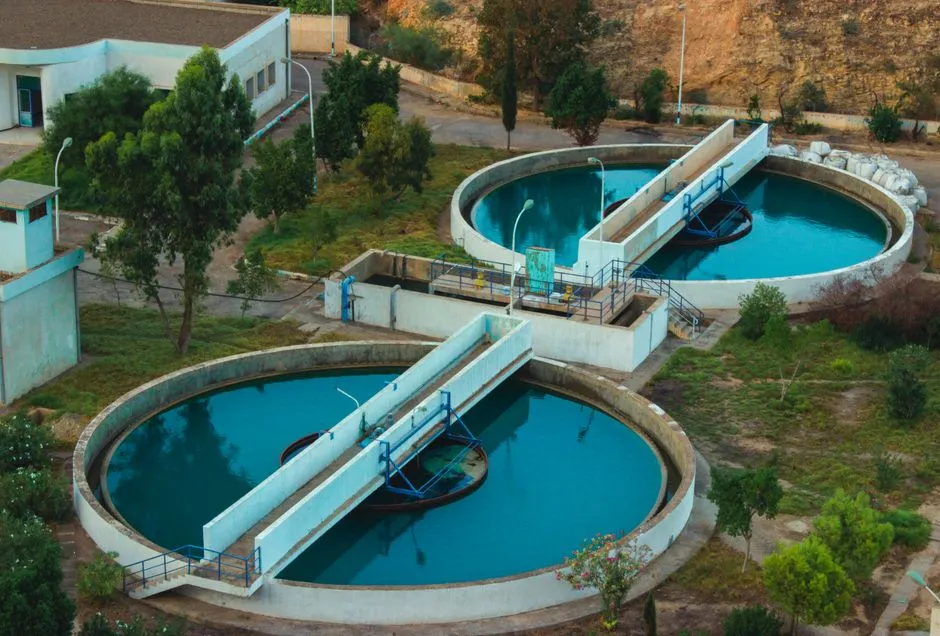
Reuse becomes straightforward once the streams are kept separate. Clarified and softened blowdown blends with MBR effluent in a blend tank, then polishes through an industrial RO system at 75–95% recovery and returns to the cooling tower as makeup. RO pretreatment on Melbourne feedwater — typically Yarra or Thomson raw water — is mandatory: a multi-media filter for ultra-pure water plus activated carbon keeps CIP intervals manageable, and the resulting sludge is best handled by a plate and frame filter press to drop sludge volume before manifest to Veolia Brooklyn VIC. The same closed-loop template is in service at the Google Douglas County, GA hyperscale facility — 1.3 million sq ft of data-hall space taking utility-treated wastewater and re-treating it for cooling reuse (ASCE 2024). The unit operations transfer directly; only the inlet water quality and the EPA Victoria discharge ceiling change.
The decision trigger is straightforward: RO polish is mandatory once reuse ≥ 50% or blowdown hardness > 200 mg/L as CaCO₃, because cycles of concentration and CIP frequency otherwise drift out of spec. Below those triggers, a discharge-to-sewer path with MBR + lamella + softener + ClO₂ polish is defensible and avoids over-specifying a high-reuse train on a low-reuse project. For deeper reuse-and-recovery specs, see the semiconductor wastewater resource recovery 2026 engineering specs reference.
CapEx, OPEX, and the 2026 Victorian cost band
The 2026 industrial CapEx bands — DAF AUD $1.2M–$8M, MBR AUD $1.8M–$12M, chemical precipitation AUD $0.9M–$6M — transfer from the Buenos Aires benchmark with a Victorian install premium layered on top. A 20 MW hybrid fab + data-hall reference case typically lands in the mid-MBR band plus a DAF pre-treatment unit, with the RO polish train on the UPW reject stream sized separately against fab inlet flow. DAF units for fab pre-treatment are typically priced via the standard DAF machine datasheet class.
OPEX sits in the AUD $0.80–$2.50/m³ band, split 40% energy, 30% chemical reagents, 20% sludge disposal, with the balance labour and consumables. Victorian sludge disposal has trended upward and structurally favours MBR over DAF for high-BOD applications because MBR produces less waste activated sludge per kilogram of BOD removed. The compliance appendix of the RFQ should reference the Environment Protection Act 2017, the EPA Victoria Trade Waste Customer Guide, and the receiving retailer's corridor allocation by name in a single block, with routine deliverables during commissioning and operations listed explicitly: lab analysis of BOD/TSS/metals, free-Cl₂ verification, and a Veolia Brooklyn VIC sludge disposal manifest.
| Unit operation | 2026 Victorian CapEx band (AUD) | OPEX driver |
|---|---|---|
| DAF pre-treatment | $1.2M – $8M | Polymer dose, sludge haulage |
| MBR (domestic + reuse) | $1.8M – $12M | Energy (aeration), membrane CIP, sludge |
| Chemical precipitation (UPW reject, fab drain) | $0.9M – $6M | Reagents (Na₂S, ferric chloride, NaOH), sludge |
| RO polish (UPW reject reuse) | Sized to fab inlet flow | Energy, CIP chemicals, membrane replacement |
| On-site ClO₂ generation | Per discharge-header sizing | Precursor chemicals, service interval |
Frequently Asked Questions
What are the binding 2026 instruments for a Melbourne fab or data hall?
The three binding instruments are the Environment Protection Act 2017 (Vic) and its General Environmental Duty, the EPA Victoria Trade Waste Customer Guide, and the receiving Melbourne Water retail sewer corridor — Yarra Valley Water, Greater Western Water, or South East Water. Baseline sewer limits include TSS ≤30 mg/L, BOD₅ ≤30 mg/L, and a free-Cl₂ ceiling of <0.5 mg/L that the on-site ClO₂ polish is sized to hold.
How much blowdown does a 20 MW Melbourne data hall produce?
240–300 m³/day at 4–6 cycles of concentration with 1% drift, equal to ~20–25% of makeup, per the blowdown = makeup / (CoC − 1) relationship in ASCE 2024 climate-driven design. The same envelope holds for a Melbourne wet-bulb because IT-load heat-rejection, not ambient wet-bulb, is the dominant driver on a 20 MW scope.
Can UPW reject be blended into the cooling-tower blowdown stream?
No. UPW reject typically runs 50–200 µS/cm conductivity, carries trace Cu from mixed-bed regenerant, and holds silica at 5–20 mg/L — none of which a blowdown softener is sized to remove. The reject stream is 50–90% of the fab inlet flow, so any misroute exposes the operator to a year of out-of-spec discharge. Route it through chemical precipitation → dual-media filter → industrial RO at 75–95% recovery and return RO permeate to the cooling tower after a pH trim.
What is the cheapest way to hit the free-Cl₂ ceiling?
On-site ClO₂ generation in the 50–20,000 g/h range, sized to the recirculating water volume, not the blowdown volume alone. ClO₂ oxidises isothiazolone and glutaraldehyde residuals and drops free chlorine to below 0.5 mg/L without producing the trihalomethane load that sodium hypochlorite carries at high TDS.
When is third-party fill-and-flush testing required?
On every batch, before any sewer release, modelled on the Loudoun Water 2025 protocol and the Cheyenne, Wyoming cupriavidus gilardii enforcement case (per E&E News, 2025). Melbourne Water commissioning is converging on the same control point for any 2026 hyperscale or hybrid fab + data-hall project.