Why Yerevan Process Wastewater Cannot Follow a Standard 2026 Playbook
A 2026 Yerevan semiconductor or data-hall facility must hit 80–95% internal reuse from day one, because the Ararat basin is allocation-capped, the Yerevan Jur plant only provides mechanical treatment to 8% of Armenia's wastewater, and the Hrazdan baseline fixes a de facto effluent ceiling near 1,000 mg/L TDS. The Ararat basin surface and groundwater withdrawal is already at or above the 1990s-era cap tied to Lake Sevan policy, and the State Committee of Water Systems has no new allocation headroom in 2026 under the RA Water Code (2002, as amended). Any hyperscale withdrawal beyond what the site can re-use internally is not a commercial question — it is a permit pre-condition that is already closed.
The Yerevan Jur plant compounds the constraint. Sized for 500,000–600,000 m³/day of domestic sewage with no industrial CTBD load class, the interceptor reaches into the Hrazdan carry summer TDS of 400–700 mg/L and winter TDS up to 900 mg/L in low-flow years. Discharge to municipal sewer is not a design option at hyperscale flow. The EU4GRE 2025 baseline confirms that Aeratsia (in the Yerevan catchment) treats 92% of Armenia's treated wastewater through mechanical-only screening — 10% BOD/TSS removal and 1–2% nutrient removal. The 2026 MoE limit band anchored to the Hrazdan receiving-water baseline: TDS <1,000 mg/L, ΔT <5 °C, heavy metals to trace mg/L. The 80% reuse threshold emerging in 2026 MoE practice for high-water-stress ICT projects is policy alignment, not generosity, anchored to Government Decree N 59-N on effluent limits.
CTBD Chemistry That Sets the Yerevan Design Envelope
The blowdown formula B = E/(COC−1) converts evaporation rate E to blowdown volume for any heat-load assumption: at 4 COC, blowdown equals 25% of make-up; at 6 COC, 20%. That ratio drives the evaporator, the RO train, and ultimately the brine management. Per the Ecologix 2026 reference profile, the stream leaving a 4–6 COC tower carries TDS up to 2,000 ppm, effluent temperature 30–40 °C, Cu/Zn/Fe corrosion products, isothiazolinone biocide residuals, phosphonate antiscalants, and biofilm suspended solids. Three sparingly soluble salts drive scaling risk: silica, calcium carbonate, and calcium sulfate. Conventional BWRO plateaus at 75–80% recovery before scaling becomes unmanageable (IDE-Tech, 2026).
Cooling-tower make-up quality targets the engineer should enforce: TDS <200 mg/L, hardness <50 mg/L as CaCO₃, silica <10 mg/L as SiO₂, chloride <100 mg/L. Langelier Saturation Index held between −0.5 and +0.5; Ryznar Stability Index above 6 for non-aggressive operation. Yerevan-specific make-up: Ararat aquifer 300–500 mg/L TDS, moderately hard, with seasonal silica variation; direct Hrazdan summer intake pushes higher. These values drive the antiscalant selection and the second-pass recovery ceiling downstream.
| CTBD Stream Parameter | Operating Range (4–6 COC) | Design Driver |
|---|---|---|
| TDS (Hrazdan summer baseline) | 400–700 mg/L | Sets ambient for ΔT calculation |
| Blowdown TDS (concentrated) | 600–1,200 mg/L at 4 COC; up to 2,000 mg/L at 6 COC | Drives second-pass recovery ceiling |
| Hardness (Ararat make-up) | Moderately hard, seasonal | Softener sizing, antiscalant dose |
| Silica (SiO₂) | Seasonal variation in Ararat; Hrazdan summer pushes higher | RO recovery limit; CIP frequency above 95% |
| Corrosion products | Cu, Fe, Zn from tower metallurgy | Foul RO membranes quickly — route through ClO₂ side-loop first |
| Discharge ΔT limit | <5 °C above ambient | Anchors Hrazdan thermal envelope |
The 2026 Six-Stage On-Site Train for a Yerevan Hall
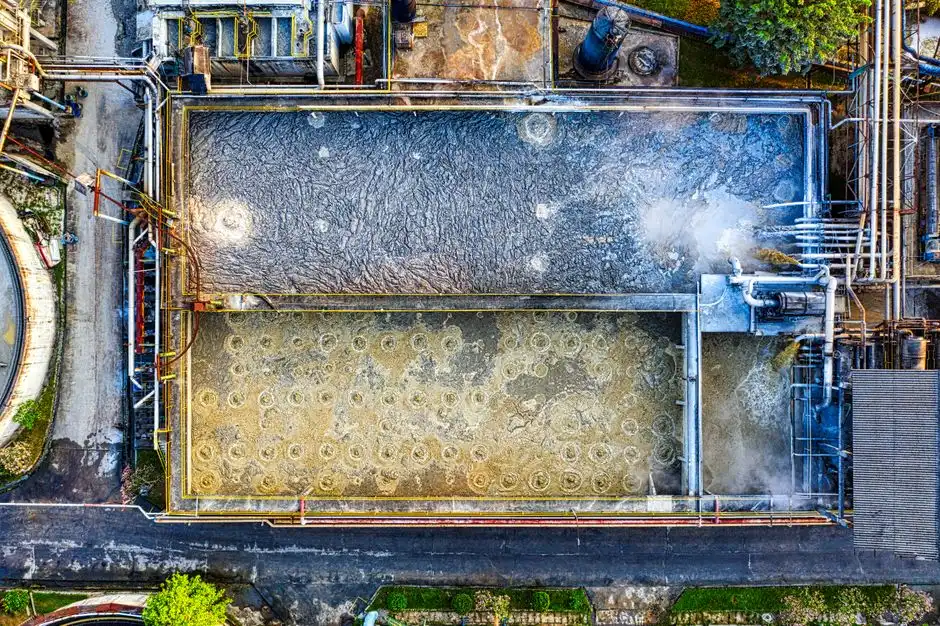
Stage 1 — Segregation and equalization. A dedicated EQ tank with 4–8 hour hydraulic retention time and online pH/conductivity dampens the 1–5 pH excursions that follow chiller trips, which are routine on a hyperscale site. Humidification and AHU condensate (typically <50 mg/L TDS) is segregated into its own line because glycol from coil leaks requires stripping, not blending into the main RO loop.
Stage 2 — DAF and multi-media filtration. A dissolved air flotation system in the 4–300 m³/h class floats oils, biofilm, and metal-hydroxide floc, followed by a multi-media filter that drops SDI below 3 and protects the RO from Cu, Fe, and Zn fouling. This combination is the workhorse for the corrosion-product load in CTBD.
Stage 3 — Softening and antiscalant dosing. A KJ-WT twin-tank water softener (1–45 T/h class) targets hardness <50 mg/L as CaCO₃ and silica <10 mg/L, with a PLC-controlled antiscalant dosing skid tied to RO feed flow handling residual scaling potential that softening cannot reach.
Stage 4 — MBR polishing (optional for stand-alone halls). A submerged PVDF MBR polishing stage with 0.1 µm membranes delivers <1 NTU and <10 mg/L COD, allowing direct RO feed without media filtration. Only required if sanitary load is co-mingled.
Stage 5 — Two-pass RO at 80–95% recovery. An industrial two-pass RO unit delivers permeate at <50 mg/L TDS. First pass runs at 150–250 psi (10–17 bar) for bulk salts; second pass polishes to cooling-tower make-up spec — TDS <200 mg/L, Cl⁻ <100 mg/L. Above 95% recovery, silica scaling on second-pass membranes drives CIP frequency up sharply. Recovery tuning is per stream, not a single number, and 80–95% is the practical operating window per the RO design criteria 2026 reference.
Stage 6 — ZLD on RO brine only. Mechanical vapor recompression at 25–40 kWh/m³ of brine concentrated. Full-stream ZLD is over-specified for a stand-alone hall; reserve it for the RO brine when the Hrazdan discharge path is restricted. Side-stream filtration at 1–5% of total circulation flow using 10–25 µm self-cleaning spiral units drops suspended solids to levels the RO can handle without pre-coat — the cheapest way to push COC higher and shrink the RO train.
| Stage | Equipment / Configuration | Design Parameter |
|---|---|---|
| 1 — Segregation/EQ | EQ tank, online pH/Cond | 4–8 h HRT; condensate segregated (<50 mg/L TDS) |
| 2 — DAF + MMF | DAF + multi-media filter | 4–300 m³/h; SDI <3 downstream |
| 3 — Softening | KJ-WT twin-tank softener + antiscalant | Hardness <50 mg/L CaCO₃; SiO₂ <10 mg/L |
| 4 — MBR (optional) | PVDF submerged, 0.1 µm | <1 NTU; <10 mg/L COD |
| 5 — Two-pass RO | Industrial RO, 150–250 psi | 80–95% recovery; permeate <200 mg/L TDS, Cl⁻ <100 mg/L |
| 6 — ZLD (brine only) | MVC at 25–40 kWh/m³ | Only on RO brine, not full stream |
Co-Located Fab vs Stand-Alone Data Hall: Two Different Trains
The chemistry and discharge limits diverge sharply once a semiconductor fab enters the envelope. Co-located fab adds HF-etch fluoride (50–500 mg/L), CMP nanoparticles, and TMAH to the wastewater load — contaminants a stand-alone data hall never sees. Stand-alone hall chemistry is dominated by cooling-tower blowdown (TDS up to 2,000 ppm, 4–6 COC) and AHU condensate (<50 mg/L TDS); baseline is MBR + two-pass RO at 80–95% recovery, with ZLD on RO brine only via MVC at 25–40 kWh/m³.
For co-located fabs, full-stream ZLD is the 2026 default because the combined fluoride + nanoparticle + TMAH load is not negotiable down to a 1,000 mg/L TDS Hrazdan envelope; expect hyperscale-class CAPEX ($800–1,200/m³/day installed). Decision rule: stand-alone hall starts at MBR + two-pass RO 80–95%; fab or fab-hall hybrid must move to MBR + two-pass RO + MVC brine concentration as a non-negotiable baseline. Reference the semiconductor fab ZLD specs 2026 for the worked fab train, or the broader electronics wastewater ZLD design for cost-breakdown context.
| Parameter | Stand-Alone Data Hall | Co-Located Semiconductor Fab |
|---|---|---|
| Dominant load | CTBD blowdown + AHU condensate | CTBD + HF fluoride + CMP nanoparticles + TMAH |
| Baseline train | MBR + two-pass RO (80–95%) | MBR + two-pass RO + MVC brine concentration |
| ZLD scope | RO brine only, when Hrazdan restricted | Full-stream ZLD, 2026 default |
| CAPEX band | Mid-size $400–700/m³/day | Hyperscale $800–1,200/m³/day |
| Below ~300 m³/day threshold | Brine haul-off cheaper than MVC | Same rule applies unless zero-discharge zone |
Permit Pathway Under the RA Water Code and 2014 EIA Law
The statutory stack: RA Water Code (2002, amended), Law on Environmental Impact Assessment (2014, amended 2021), Government Decree N 59-N on effluent limits, and 2026 MoE guidance specific to data centers. Hyperscale flows push a project into full EIA rather than screening because the freshwater withdrawal threshold and the discharge envelope both trip higher-tier review. The negotiating counterparty is the MoE Environmental Impact Assessment Expert Center; 2026 full-EIA review typically runs 90–180 days from submission, conditional on the project demonstrating >80% internal reuse.
The IDE-Tech case data point — silica permeate ~1 mg/L at 95% recovery — is the number that lets a designer argue for a 95% recovery permit limit rather than the 75–80% default, and that argument lands in 2026 MoE practice because it directly addresses the Ararat basin allocation closure. Closed-loop / >80% reuse expectation is policy alignment: projects that cannot demonstrate internal reuse above 80% find permit issuance slow and conditional. The MoE limit band for 2026 industrial discharge to the Hrazdan (TDS <1,000 mg/L, ΔT <5 °C, trace heavy metals) is anchored to the receiving-water baseline, not the municipal sewer capacity.
2026 CAPEX, OPEX and Payback for a 5–20 MW Yerevan Hall
2026 CAPEX bands (engineering estimates, not firm quotes): a small data hall <200 m³/day with package plant plus haul-off runs $150–300/m³/day installed; mid-size 200–1,000 m³/day MBR + RO runs $400–700; hyperscale with ZLD on brine runs $800–1,200. A 5–20 MW Yerevan hall typically sits in the mid-size band; flow is roughly 200–1,000 m³/day of blowdown at 4–6 COC.
Avoided-discharge math at $5–15/kgal: 100 m³/day of untreated blowdown at the upper end is ~USD 400/day, so an 80% recovery RO typically pays back inside 24 months at hyperscale flow (HydropureWater field data, 2026). OPEX lines that push cost up: membrane CIP frequency above 95% recovery due to silica scaling on second-pass; biocide residuals shortening RO life (the case for a chlorine dioxide generator upstream of the RO rather than isothiazolinone in the tower); MVC electricity at 25–40 kWh/m³ of brine. Use RO/UF membrane elements rated for high-silica feed to control replacement frequency.
Worked Yerevan example: IDE-Tech's 2,000,000 L/day reference for a 100 MW facility implies a 5–20 MW hall at 100,000–400,000 L/day, well into the mid-size CAPEX band, with >80% reuse satisfying MoE 2026 in 90–180 days. The 95% recovery ceiling extends payback further only when the Hrazdan discharge path is restricted; otherwise the OPEX penalty from silica CIP frequency erodes the gain.
| CAPEX Tier (USD/m³/day installed) | Flow Range | Configuration | ZLD Required? |
|---|---|---|---|
| $150–300 | <200 m³/day | Small data hall, package plant + haul-off | No — brine removed by tanker |
| $400–700 | 200–1,000 m³/day | Mid-size hall, MBR + RO | Only if Hrazdan discharge restricted |
| $800–1,200 | >1,000 m³/day or fab-hall hybrid | Hyperscale + ZLD on brine | Yes — full-stream for co-located fab |
Avoided-discharge payback at $5–15/kgal: ~24 months at 100 m³/day, 80% recovery. 80% is the floor that closes the economics; 95% is the practical ceiling before silica scaling erodes the gain.
Frequently Asked Questions
What is the minimum internal reuse percentage the Armenia MoE will accept for a hyperscale data-hall permit in 2026?
The MoE Environmental Impact Assessment Expert Center expects >80% internal reuse for high-water-stress ICT projects in 2026, anchored to Government Decree N 59-N and the RA Water Code. Below 80%, permit issuance becomes slow and conditional because the project cannot credibly address the Ararat basin allocation closure.
Which two-pass RO recovery window — 80% or 95% — is the right design target for a Yerevan 5–20 MW hall?
Design for 80–95% recovery. 80% is the floor that closes the avoided-discharge payback inside 24 months at hyperscale flow (HydropureWater field data, 2026); 95% is the ceiling above which silica scaling on second-pass membranes drives CIP frequency up and erodes the OPEX gain unless the Hrazdan discharge path is restricted.
Why does a co-located semiconductor fab require full-stream ZLD where a stand-alone data hall does not?
Co-located fabs introduce HF-etch fluoride (50–500 mg/L), CMP nanoparticles, and TMAH — a combined load that cannot be negotiated down to the 1,000 mg/L TDS Hrazdan envelope. Stand-alone data halls see only CTBD blowdown (up to 2,000 ppm TDS, 4–6 COC) and AHU condensate (<50 mg/L TDS), which two-pass RO at 80–95% recovery handles without full-stream ZLD.
What is the typical 2026 full-EIA review timeline at the MoE for a hyperscale Yerevan project?
Full EIA rather than screening is triggered at hyperscale flow because both the freshwater withdrawal threshold and the discharge envelope trip higher-tier review. 2026 full-EIA review at the MoE Environmental Impact Assessment Expert Center typically runs 90–180 days from submission, conditional on demonstrating >80% internal reuse.
Related Equipment
- PVDF MBR polishing stage — specifications, capacity range, and technical data