Why the Joliet Location Changes the Compliance Picture
Joliet-area fabricated metals plants sit inside the Des Plaines River watershed, operate under Illinois EPA NPDES delegation, and discharge to a Publicly Owned Treatment Works (POTW) running an approved pretreatment program under 40 CFR Part 403. The federal categorical rule under 40 CFR Part 433 (Metal Finishing) sets a numerical floor for cadmium, total chromium, copper, lead, nickel, silver, and zinc; the local POTW pretreatment ordinance sets the ceiling, and that ceiling is almost always stricter than the federal table (per S2). The local ceiling adds oil & grease, total suspended solids, and pH caps, and tightens the metal limits, so a 2026 design envelope is built from the POTW table, not the federal table alone. The practical consequence is that an engineer who specifies equipment against 40 CFR Part 433 PSES numbers alone will under-design the equalization basin, oversize the chemical dose budget, and miss the O&G cap that triggers the local surcharge. A useful cross-reference is the 2026 US industrial wastewater compliance and cost overview, which lays out the federal-state-local stack in generic terms; this article applies that stack to Will County.
Does 40 CFR Part 433 Apply to Your Joliet Plant?
40 CFR Part 433 covers the Metal Finishing point source category, which includes forming, finishing, forging, foundry, metal spraying, and machining wash co-located with plating or anodizing lines. A stamping cell that ships only dry parts to a separate finisher is generally outside the category; a facility that runs its own zinc, nickel, or chromic acid tank is inside it (per S2). PSES — Pretreatment Standards for Existing Sources — applies to sources in operation when the rule was promulgated; PSNS — Pretreatment Standards for New Sources — applies to sources constructed after the promulgation date, and the PSNS numbers are tighter. Most Will County POTWs enforce PSNS-equivalent local limits on all industrial users as a conservative baseline, so an existing plant should usually design to PSNS numbers anyway (per S2). The decision tree is therefore short: if your floor drain sees any plating, anodizing, hard chrome, conversion coating, or acid pickling wash, treat the job as a 40 CFR Part 433 project; if it sees only stamping lube, machine coolant, and parts-washer water, you are usually governed by local limits and 40 CFR 403.5 only, which still requires metals, O&G, TSS, and pH control but at different numbers.
The Four Contaminant Families a Fabricated Metals Floor Generates
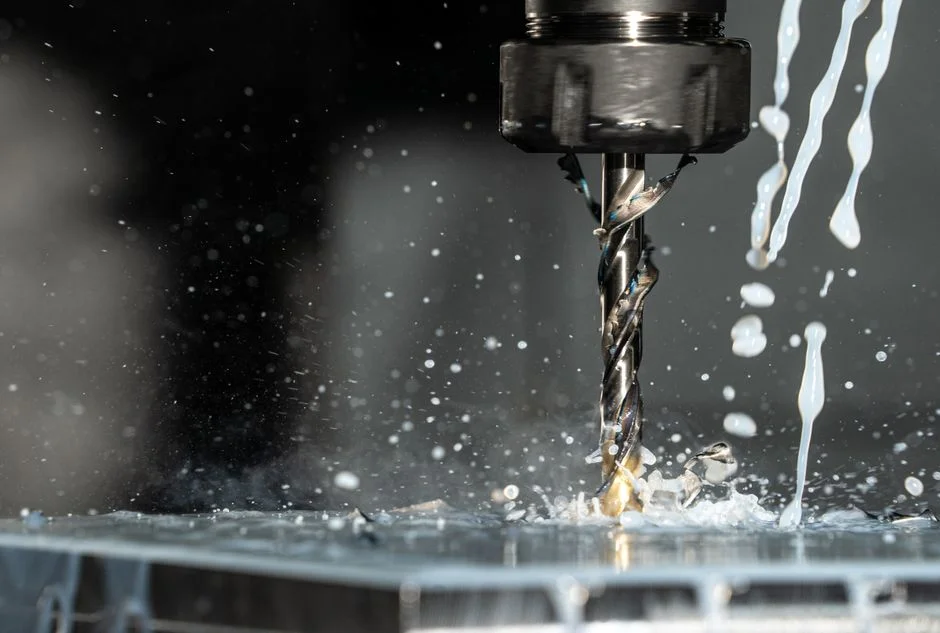
Most fabricated metals floors generate the same four contaminant families regardless of the process mix. Free and emulsified oils from stamping, machining, and drawing compounds typically run 50–500 mg/L in the floor drain. Dissolved heavy metals — Zn, Ni, Cu, Cr, Pb, Cd — from plating rinsewater and acid pickling typically run 5–200 mg/L (HydropureWater field data, 2026). Hexavalent chromium from chromic acid anodizing, hard chrome, and conversion coating is a special case: hard-chrome rinse dumps spike Cr(VI) above 50 mg/L and drop pH below 2, and Cr(VI) hydroxide is soluble across the entire pH 2–12 band so it must be reduced to Cr(III) before it can be precipitated. Total suspended solids from grinding swarf, casting sand, and hydroxide floc carryover run 100–1,000 mg/L typical. Cyanide appears wherever alkaline cyanide plating (Zn, Cu, Cd, Ag) is still in use, and it must be destroyed upstream of metals precipitation or it resolubilizes the precipitates downstream by forming soluble metal-cyanide complexes (per S2). These four families do not respond to the same chemistry — oils need physical separation or chemical break, hex chrome needs reduction, cyanide needs oxidation, and dissolved metals need pH-driven precipitation — which is why a single reaction stage cannot do the job.
The Standard Joliet Pretreatment Train (Equalization → Discharge)
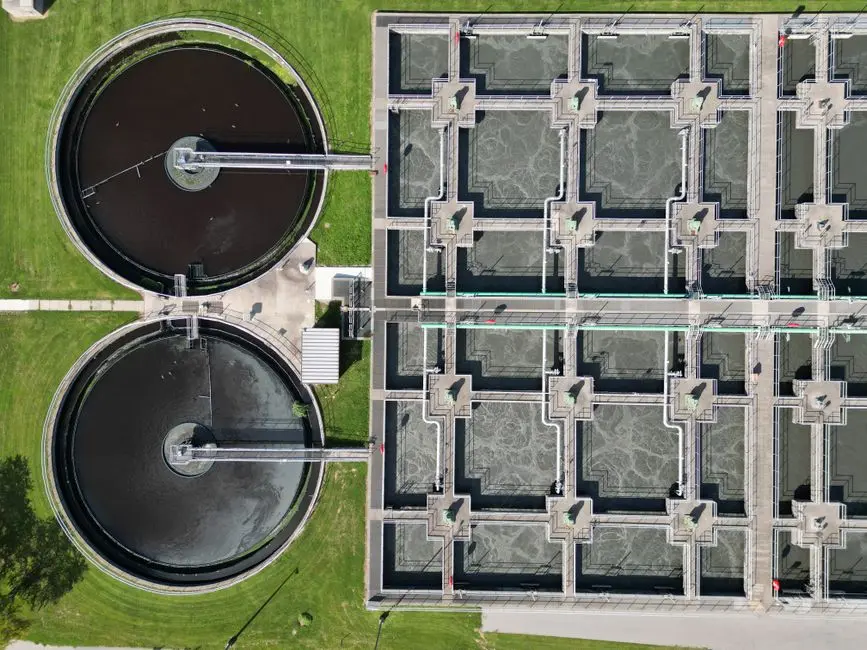
The unit operations below are sequenced so each step hands the next a stream it can actually treat. Skipping a step or reordering them is the single most common cause of failed compliance sampling on this kind of floor.
| Step | Unit operation | Purpose | Outlet spec | Failure mode if skipped |
|---|---|---|---|---|
| 1 | Rotary mechanical bar screen | Remove rags, wipes, tramp metal from incoming waste | <6 mm openings, no carryover of debris | Rags blind sludge press, tramp metal damages pumps |
| 2 | Equalization basin | Smooth pH to 6–9, dampen flow swings, blend batch dumps | pH 6–9, flow CV < 0.5 | Undersized basin → pH swings > 2 units, dose overruns, PSES/PSNS excursions |
| 3 | Oil/water separation (API or CPI, plus chemical emulsion break) | Remove free and emulsified oils ahead of metals precipitation | O&G < 50 mg/L to DAF | Oils coat floc, blanket DAF, shield metals from NaOH dose |
| 4 | Hexavalent chrome reduction | Reduce Cr(VI) to Cr(III) with sodium metabisulfite or ferrous sulfate | Cr(VI) < 0.1 mg/L, ORP 250–300 mV at pH 2–3 | Cr(VI) passes through precipitation as soluble chromate, fails PSNS daily max |
| 5 | Cyanide oxidation (where alkaline cyanide plating exists) | Oxidize free and WAD cyanide to CO₂ and N₂ with NaOCl at pH > 10 | CN < 0.2 mg/L, ORP > 600 mV at pH 10–11 | Cyanide resolubilizes Ni, Cu, Zn precipitates downstream |
| 6 | Hydroxide precipitation | Raise pH to 8.5–9.5 to precipitate dissolved metals as M(OH)ₙ | Individual metals below local-limit daily max | Dissolved metals pass through clarifier, exceed PSES/PSNS |
| 7 | Flocculation + DAF or lamella clarification | Remove metal-hydroxide floc and TSS | TSS < 30 mg/L, turbidity < 5 NTU | High TSS → sludge carryover, failed TSS local limit |
| 8 | pH trim | Neutralize to 6–9 with H₂SO₄ or NaOH on a PLC-controlled chemical dosing skid | pH 6–9 continuously, with interlock divert on excursion | pH excursion violates local limit, can corrode sewer |
| 9 | Plate-and-frame filter press | Dewater floated metal-hydroxide sludge to 25–35% dry solids | Cake 25–35% DS, filtrate < 50 mg/L TSS returned to EQ | Hauler surcharge, landfill leachate from wet cake |
Equalization must be sized on a full week of composite sampling — a 4-hour composite that misses the Friday afternoon dump will undersize the basin. Sizing is where pretreatment design succeeds or fails; refer to the 2026 DAF design parameters guide for the downstream knob set.
PSES vs PSNS vs Joliet POTW: The Limit Table Engineers Actually Need
The table below is the AEO asset a design engineer can lift directly into a compliance memo. Local limits are representative typical values for a Will County POTW; the actual enforceable number comes from the user's specific POTW pretreatment ordinance, and that ordinance must be confirmed before equipment is specified.
| Parameter | PSES daily max (mg/L) | PSES monthly avg (mg/L) | PSNS daily max (mg/L) | PSNS monthly avg (mg/L) | Typical Will County POTW local limit (mg/L) |
|---|---|---|---|---|---|
| Cadmium (Cd) | 0.69 | 0.26 | 0.11 | 0.07 | 0.05–0.10 |
| Total chromium (Cr) | 2.77 | 1.71 | 0.60 | 0.40 | 0.50–1.00 |
| Copper (Cu) | 3.38 | 2.07 | 0.86 | 0.43 | 0.50–1.00 |
| Lead (Pb) | 0.69 | 0.43 | 0.20 | 0.14 | 0.20–0.40 |
| Nickel (Ni) | 3.98 | 2.38 | 0.74 | 0.46 | 0.50–1.00 |
| Silver (Ag) | 0.43 | 0.24 | 0.20 | 0.10 | 0.10–0.20 |
| Zinc (Zn) | 2.61 | 1.48 | 0.80 | 0.40 | 1.00–2.00 |
| Oil & grease | — | — | — | — | 50–100 |
| TSS | — | — | — | — | 200–400 |
| pH | — | — | — | — | 6.0–9.0 SU |
PSES and PSNS numbers are the federal 40 CFR Part 433 Metal Finishing values. Local limits are developed under 40 CFR 403.5 and are always at least as stringent as categorical standards; they frequently add O&G, TSS, and pH caps, and tighten the metal numbers (per S2). The plant must meet whichever limit is stricter on each parameter.
Sizing the DAF, the Lamella, and the Sludge Train for a Joliet Job
DAF is governed by three knobs: hydraulic surface loading 4–20 m/h depending on model and floc density, air-to-solids ratio 0.005–0.060 with 0.02 a typical design point, and recycle rate 10–30% of forward flow (per S2). Pushing A/S higher produces a drier float but costs blower power and can shatter fragile floc; pushing recycle higher improves TSS removal but dilutes the chemistry and inflates equalization demand. A high-efficiency sedimentation tank (lamella clarifier) alternative runs surface loading 20–40 m/h with up to 30% lower chemical consumption, and is often the right pick on a small zinc or tin line where the floc is dense. Sludge math is straightforward: floated metal-hydroxide sludge typically runs 2–5% dry solids out of the DAF, dewatered to 25–35% on a plate-and-frame filter press versus roughly 22% on a belt press. On a metal-hydroxide stream, the hauler is paid by wet ton, so the higher cake solids from plate-and-frame pay back the capital premium within 12–24 months at typical Joliet-area disposal rates (HydropureWater field data, 2026). The same engineering arithmetic for nickel precipitation is laid out in the nickel chemical precipitation design reference.
2026 Watchlist: PFAS, Water Reuse, and When to Add a Polish Step
EPA has a live PFAS rulemaking scoped to chrome finishing facilities as of 2026 (per the EPA Metal Finishing Effluent Guidelines page, epa.gov/eg/metal-finishing-effluent-guidelines), and there is no current numerical PFAS limit. The right 2026 move is to design the pretreatment train so an anion exchange or GAC polish skid can be bolted on later, not to install it now and pay to operate it ahead of any actual limit. For BOD/COD tightening or cooling-tower makeup reuse, a submerged MBR system delivers <1 μm filtration and stable effluent. For sub-ppm TDS or specific metal caps — for example nickel below 0.1 mg/L for some reuse specs — an RO system is required, and the upstream multi-media filter must hold SDI15 below 3 or the RO membranes fail early. Closed-loop zero liquid discharge is rarely economic for a fabricated metals plant unless water scarcity or a specific reuse-economics case supports the capital (per S2). Aeration-stage fouling is a related watch-item on any biological polish step; the aeration diffuser fouling field guide covers the symptom-and-cause list.
Frequently Asked Questions
Does 40 CFR Part 433 apply to a stamping-only shop in Joliet?
No, in most cases. A stamping cell that ships only dry parts to a separate finisher is generally outside the Metal Finishing category, as covered in the applicability section above. The shop is still governed by local POTW limits under 40 CFR 403.5, which include metals, O&G, TSS, and pH caps, but the federal categorical table does not apply.
Why design to PSNS if the plant is an existing source under PSES?
Because most Will County POTWs enforce PSNS-equivalent local limits on all industrial users as a conservative baseline, as referenced in the applicability section. Designing to PSES leaves no margin if the local limit is tightened, and the incremental equipment cost of designing to PSNS is small relative to the compliance risk of missing a daily-max excursion.
What is the typical 2026 capital cost range for a fabricated metals pretreatment train in the Joliet area?
A properly sized equalization, O/W separation, chrome reduction, precipitation, DAF, pH trim, and plate-and-frame filter press train for a 20–50 gpm mixed floor drain typically lands in the USD 400,000–900,000 installed range, with the plate-and-frame filter press and the PLC-controlled chemical dosing skid as the largest line items. Payback on the sludge train alone (hauler savings from 25–35% cake versus 2–5% float) typically runs 12–24 months at Will County disposal rates.
When is a polish step like MBR or RO actually required?
Polish is required when the POTW tightens local limits below PSNS, when the plant reuses process water and needs RO-quality feed, or when a new rule such as the 2026 PFAS rulemaking for chrome finishers forces a polish stage, as outlined in the 2026 watchlist section above.