What the Lonza Synaffix deal tells deal teams about a German target
Lonza's 2023 acquisition of Synaffix for $107 million (C&EN, Vol. 101, Issue 18) is the most legible precedent for what a 2026 German plant deal looks like on the wastewater side, because the ADC platform is the stress test for any inherited AbwV Annex 49 envelope. Synaffix's payload and site-specific linker chemistry introduces cytotoxic API residues, organic solvents (notably NMP and DMAc), and elevated halide loads that map directly onto the COD, AOX, and metal-specific BAT-AEL ceilings a buyer will inherit at closing.
Any German acquisition by Lonza will inherit a seller's existing §8 WHH Erlaubnis or §13 WHG Anzeige in the target's legal name, and on Day 1 the four parallel permit rails described in the next section activate in the buyer's name while the underlying permit survives. The question the rest of this article answers is what specifically activates on Day 1, what the 2026 euro-denominated retrofit envelope looks like, and where the Land-specific Satzung divergence in BY, BW, and NW will compress or stretch the 4–9 month Genehmigungsverfahren clock. A parallel cross-border case walkthrough appears in the WuXi AppTec Germany compliance guide.
Four parallel permit rails that activate on closing day
Four parallel regulatory filings activate the day a Lonza acquirer takes possession of a German pharma plant, and each carries a different agency, deadline, and Bußgeldrahmen. Missing one filing does not excuse the others, because the penalty schedule attaches separately to each parameter under §103 WHG. A U.S. deal team trained on EPCRA Form R and 40 CFR 433 routinely drops two of these rails inside the 90-day sprint, so they are listed in the order a corporate development associate should brief the integration committee.
- Rail 1 — §16 WHG Anzeige to the competent Wasserbehörde, due within one month of closing. The existing §8 Erlaubnis or §13 Anzeige in the seller's name does not lapse on closing, but a missed notification triggers a Bußgeldrahmen of up to €50,000 per missed Eigenüberwachung parameter under §103 WHG.
- Rail 2 — BImSchG operator-change Anzeige. If a capacity increase is contemplated, a combined BImSchG plus WHG Genehmigungsverfahren runs 4–9 months, including the Beteiligung der Öffentlichkeit public participation phase under §10 BImSchG.
- Rail 3 — AbwV Eigenüberwachung calendar plus §58 LWG Indirekteinleiter confirmation plus kommunale Satzung confirmation at Day 0. The Satzung is the German analogue of U.S. POTW pretreatment limits and routinely runs tighter than the federal AbwV floor, so the buyer's compliance dashboard must reflect the Land-level values, not the federal ceiling.
- Rail 4 — European PRTR (EC 166/2006) successor filing by March 31 for the prior calendar year. The threshold trigger is on Ni, Co, NMP, and standard pharma API markers, filed through the Umweltbundesamt PRTR portal. Liability for missed filings survives closing under German Umweltrecht successor-liability principles, distinct from the EPCRA framework that U.S. counsel usually pattern-match against.
Land-specific divergence in BY, BW, and NW changes the §58 LWG and Satzung interpretation. BY (Landeswassergesetz Bayern) treats the kommunalen Abwasserverband as the binding Indirekteinleiter gate; BW (Wassergesetz Baden-Württemberg) folds Satzung confirmation into the untere Wasserbehörde's Anzeige, while NW (Landeswassergesetz NRW) routes the operator-change through the Bezirksregierung as a single combined Anzeige. A single "Germany" answer is rarely defensible to an integration committee. A comparable U.S. crosswalk appears in the Bayer Arizona acquisition guide.
| Rail | Filing | Trigger / deadline | Agency | Penalty exposure |
|---|---|---|---|---|
| 1 — WHG | §16 WHG Anzeige; §8 Erlaubnis survives in seller's name | Within 1 month of closing | Wasserbehörde | Up to €50,000 per missed parameter (§103 WHG) |
| 2 — BImSchG | Operator-change Anzeige; §4 Genehmigung if capacity rises | Pre-construction; 4–9 months including Beteiligung der Öffentlichkeit | Land authority / Immissionsschutzbehörde | Operating prohibition + Bußgeldrahmen |
| 3 — Indirekteinleiter | Eigenüberwachung calendar + §58 LWG + kommunale Satzung | Transfers with asset; Satzung at Day 0 | Land authority + local Abwasserverband | Compounds with Rail 1; €50,000 per parameter |
| 4 — PRTR | EC 166/2006 + Nachweisverordnung for AVV 11 01 09* | March 31 successor filing for prior calendar year | Umweltbundesamt + Land authority | §103 WHG and §69 KrWG Bußgeldrahmen |
AbwV Annex 49 vs IED 2024/2995 BAT-AEL: the parameter envelope
AbwV Anhang 49 governs the manufacture of pharmaceutical products and active pharmaceutical ingredients, not the automotive-focused Anhang 40 cited in mid-2020s compliance guides, and the parameter set is materially different. The pharmaceutical envelope covers COD, AOX, total nitrogen, sulfate, mercury, and API surrogate parameters on a 24-h Mischprobe basis, with values tighter than the metal-finishing ceilings. Any acquired site that has been characterising itself against Anhang 40 needs a gap analysis on Day 30, because the same influent will fail an AbwV Anh. 49 limit under different load assumptions.
On the European side, IED Annex I 4.1(b) covers installations for the manufacture of basic pharmaceutical products, and the 2024 BAT-AEL conclusions under Implementing Decision 2024/2995/EU layer on top of the AbwV floor. The discharge-point envelope is COD ≤30–100 mg/L, total N ≤10–15 mg/L, total P ≤0.3–2 mg/L, plus metal-specific limits (Hg, Cd, Ni, Co) measured at the discharge point, not the ETP inlet. The 17 April 2024 AbwV overhaul (BGBl. 2024 I Nr. 132) introduced a 50 ng/L PFOS/PFOA cap that sits below the limit of detection of legacy online analysers, so every site that wants to keep operating with continuous monitoring will need a CAPEX line for LC-MS sampling or a new online PFAS sensor, and that is the single most common deal-breaking new parameter on a 2026 German pharma retrofit. The full asset register is captured in the Lonza ETP due-diligence checklist.
| Parameter | AbwV Anh. 49 limit | IED 2024/2995 BAT-AEL | Note |
|---|---|---|---|
| COD | Site-specific per Genehmigungsbescheid | ≤30–100 mg/L at discharge point | Pharma-specific; tighter than Anh. 40 |
| Total N | Site-specific | ≤10–15 mg/L | Drives biological stage sizing |
| Total P | Site-specific | ≤0.3–2 mg/L | Chemical precipitation required |
| AOX | 1 mg/L typical Anh. 49 ceiling | Per BAT-AEL | Solvent chemistry dependent |
| Hg | 0.05 mg/L | Per BAT-AEL metals table | API catalyst residues |
| PFOS / PFOA | 50 ng/L (BGBl. 2024 I Nr. 132) | Watch-list under 2024/2995 | Below LOD of legacy online analysers |
Reference train sized for a 1,000–1,500 m³/day biotech envelope
The Penzberg 480 m³ Biobed EGSB plus membrane train is the only documented Roche-scale reference in the public record, and it is the benchmark a buyer's engineering team should gap any acquired site drawings against. The five-stage reference train below is reverse-engineered from the Penzberg arrangement, German Genehmigungsbescheid structures, and current best practice at comparable German pharma sites, sized for a 1,000–1,500 m³/day biotech flow envelope. For a German-pharma MBR retrofit, the HydropureWater MBR system with submerged PVDF hollow-fibre modules is the standard Stage 4 selection.
- Stage 1 — Equalization surge basin. 6–12 hour HRT with PLC-controlled coagulant and pH dosing to 6.5–7.5, mandatory because fermentation batch cycles drive significant hydraulic and load swings. The HydropureWater automatic chemical dosing system is the standard package for nutrient and trace-metal trim.
- Stage 2 — Dissolved air flotation. Sized in the 4–300 m³/h skid range with 80–95% FOG removal and downstream TSS below 100 mg/L. The HydropureWater DAF system fits this duty and is the highest-impact equipment choice for FOG removal on a German retrofit.
- Stage 3 — Anaerobic EGSB. The Penzberg 480 m³ Biobed is the benchmark, producing energy-rich biogas that offsets more than 90% of plant electricity, eliminating the previous upstream aerobic high-load stage and cutting roughly 950 t/yr of CO₂. CHP pays back 3–5 years at German industrial tariffs.
- Stage 4 — MBR polish. Submerged PVDF hollow-fibre modules delivering effluent turbidity below 1 NTU at MLSS 8,000–12,000 mg/L, reactor volume sized to peak flows near 5,000 m³/day at full scale.
- Stage 5 — Two-pass RO plus disinfection. 70–85% recovery with permeate conductivity below 50 µS/cm for cooling-tower makeup, plus ClO₂ (50 g/h to 20,000 g/h) or UV disinfection aligned to EU Drinking Water Directive 98/83/EC. The HydropureWater industrial RO system covers this duty.
CAPEX and OPEX envelope a deal team can put in the integration memo
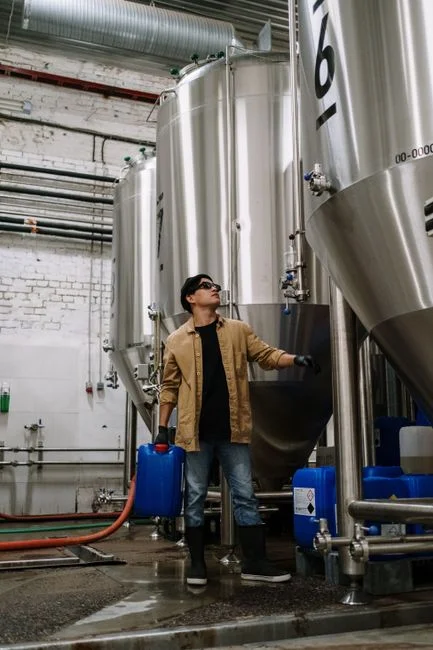
The defensible number for an integration memo is a 2026 euro envelope, not a U.S. dollar figure, because German Anlagenbauer rates, the German construction-cost index, and Indirekteinleiter Abwassergebühren are jurisdiction-specific. The table below is the single data asset on a biotech-scale train. All numbers are euro, German-installed, 2026, and reflect current scope at a 1,000 m³/day design point. Two OPEX lines routinely break the model at signing: brine reject off-site disposal and AVV 11 01 09* hazardous waste routing from the HydropureWater plate and frame filter press package, which must be priced as a discrete line and not bundled into "treatment upgrades".
| Line item | 2026 euro envelope | Source / note |
|---|---|---|
| Full train (DAF + MBR + RO, no evaporator) | €0.9M–€3.5M CAPEX (~€1,000–€3,500 per m³/day) | HydropureWater field data, 2026 |
| Add EGSB (Penzberg 480 m³ Biobed analogue) | +€0.6M–€1.2M; CHP pays back 3–5 years at industrial tariffs | Biogas offsets >90% of plant electricity |
| ZLD-ready (evaporator / crystallizer) | 1.5x–2.5x multiplier on the full train | Strongest argument against brine reject OPEX |
| Sludge dewatering (filter press + sedimentation tank) | Discrete CAPEX line | AVV 11 01 09* hazardous waste routing |
| Hidden OPEX — brine reject off-site disposal | 15–30% reject on 1,000 m³/day = 150–300 m³/day at €30–€60/m³ Abfallgebühren | Single largest hidden OPEX line |
| Hidden OPEX — PFOS/PFOA LC-MS or online sensor | €120,000–€350,000 CAPEX; €40,000–€90,000/yr OPEX | Mandated by BGBl. 2024 I Nr. 132 at 50 ng/L |
30/60/90-day post-close cadence for a Lonza integration
The cadence below mirrors the Lonza ETP due-diligence workflow so a serial-acquirer reader recognises the rhythm, but every step is German-anchored to §16 WHG, BImSchG, and AbwV items. Treat the Land-specific Genehmigungsverfahren rules in BY, BW, and NW as a separate workstream; they diverge in ways that compress or stretch the 4–9 month clock.
- Day 0: Indirekteinleiter Satzung confirmation; lock the Eigenüberwachung calendar onto the buyer's dashboard.
- Day 30: File the §16 WHG Anzeige and the BImSchG operator-change Anzeige; baseline 24-h influent/effluent panel against the 250/30/6.5–8.5 mg/L envelope at the ETP inlet, secondary clarifier outlet, and downstream of any polishing stage.
- Day 60–90: Vendor selection for the PFOS/PFOA online sensor or LC-MS sampling line mandated by BGBl. 2024 I Nr. 132; EGSB feasibility study if not already installed; SPA escrow and specific indemnity windows tracked alongside permitting. Reference the full asset register in the Lonza ETP due-diligence checklist.
Frequently Asked Questions
What is the §16 WHG Anzeige deadline after closing a German pharma acquisition?
One month from the closing date, filed with the competent Wasserbehörde. The seller's existing §8 Erlaubnis or §13 Anzeige survives the closing, but a missed §16 notification triggers a Bußgeldrahmen of up to €50,000 per missed Eigenüberwachung parameter under §103 WHG.
How does AbwV Annex 49 relate to the IED 2024/2995 BAT-AEL on a 2026 German pharma site?
AbwV Anh. 49 is the federal pharmaceutical parameter set (COD, AOX, total N, sulfate, Hg, API surrogates, 50 ng/L PFOS/PFOA per BGBl. 2024 I Nr. 132). IED 2024/2995/EU BAT-AEL layers on top with COD ≤30–100 mg/L, total N ≤10–15 mg/L, total P ≤0.3–2 mg/L measured at the discharge point, not the ETP inlet. Both must be satisfied; the tighter value binds.
What is the single largest deal-breaking retrofit cost driver in 2026?
The 50 ng/L PFOS/PFOA cap under BGBl. 2024 I Nr. 132, which sits below the limit of detection of legacy online analysers. A compliant retrofit typically requires a €120,000–€350,000 CAPEX line for an LC-MS sampling rig or a new online PFAS sensor, plus €40,000–€90,000 per year in OPEX, and it is the parameter most likely to force a vendor selection workstream inside the 60–90 day window.
Why does the Indirekteinleiter Satzung change the compliance answer across German Länder?
The kommunale Satzung is the German analogue of U.S. POTW pretreatment limits and can run tighter than the federal AbwV floor. BY routes confirmation through the local Abwasserverband, BW folds it into the untere Wasserbehörde's Anzeige, and NW sends a single combined operator-change Anzeige through the Bezirksregierung, so the same plant will face three different procedural clocks depending on the Land.
Does the European PRTR successor filing survive closing?
Yes. Under EC 166/2006 and the German Nachweisverordnung, the successor files by March 31 for the prior calendar year, threshold-based on Ni, Co, NMP, and standard pharma API markers, through the Umweltbundesamt portal. Liability for missed filings survives closing under German Umweltrecht successor-liability principles, distinct from the U.S. EPCRA framework.