
Does 40 CFR Part 433 Apply to a Fabricated Metals Plant Near Monticello?
A fabricated metals plant is inside 40 CFR Part 433 — the federal Metal Finishing categorical pretreatment standard — if it performs any forming, finishing, forging, foundry, metal spraying, or machining wash operation co-located with a plating or anodizing line, or if it runs its own zinc, nickel, or chromic acid tank (per 40 CFR Part 433, scope section). A stamping shop that ships only dry parts to a separate finisher is generally outside the category; the regulatory trigger is wet chemistry on site, not metal forming. Plants that sit on the boundary — for example, a fabricator with a shared plating line operated by a sister company — should assume in-scope until the receiving POTW confirms otherwise, because the dry-shipment carve-out is narrow and POTWs apply it conservatively.
Once the plant is in-scope, the rule splits limits into two buckets: PSES (Pretreatment Standards for Existing Sources) for plants constructed before the rule's promulgation date, and PSNS (Pretreatment Standards for New Sources) for plants built after. PSNS limits are tighter because they reflect the best available technology at the time of new source construction. In practice, most POTW pretreatment programs enforce PSNS-equivalent local limits on all industrial users as a conservative baseline, so an existing plant in Monticello, IL should usually design to PSNS numbers on the categorical parameters (cadmium, total chromium, copper, lead, nickel, silver, zinc, and total toxic organics). The plant's permit will state which set applies, and that permit controls.
What the Local POTW Adds to the Federal Floor
Local limits are the legally enforceable numeric or narrative discharge standards a POTW imposes at the industrial user's point of connection to the collection system, developed under 40 CFR 403.5(c) to protect the POTW from pass-through and interference, including sludge management (per EPA, "Pretreatment Standards and Requirements-Local Limits"). EPA reviews and approves those limits, but the substantive numbers belong to the POTW. The federal categorical table is the floor, not the ceiling.
What local limits almost always add beyond the Part 433 table is the parameters the categorical rule underweights: caps on copper, nickel, zinc, lead, and silver; oil & grease (typically 100 mg/L daily maximum at small Midwest POTWs); total suspended solids (typically 250–300 mg/L daily maximum); and a pH range of 6.0–9.0 at the point of discharge. The compliance rule is simple but unforgiving: the plant must meet whichever limit is stricter on each parameter, federal or local. That is why the design envelope is built from the POTW table — and from the strictest single number across the suite — not from the federal table alone. A plant that designs only to PSNS on metals and ignores the local TSS or oil & grease cap will pass the categorical sampling but fail the permit.
The Four Contaminant Families a Monticello Floor Drain Generates
Most fabricated metals floors generate the same four contaminant families regardless of the specific process mix, and recognizing the family your plant produces is the first step in designing the right chemistry sequence.
Family 1 — free and emulsified oils. Stamping, machining, drawing compounds, and parts-washer carryover all contribute free oils, soluble oils, and stable emulsions. Typical influent runs 50–500 mg/L total oil & grease (HydropureWater field data, 2026), and the emulsion is what defeats a simple gravity skimmer.
Family 2 — dissolved heavy metals. Plating rinsewater and acid pickling generate dissolved Zn, Ni, Cu, Cr, Pb, and Cd, typically 5–200 mg/L total dissolved metals across batch dumps (HydropureWater field data, 2026). These respond only to pH-driven hydroxide precipitation; physical separation will not touch them.
Family 3 — hexavalent chromium and cyanide. Chromic acid anodizing, hard chrome plating, and conversion coating produce Cr(VI), which is soluble across the entire hydroxide precipitation pH band and must be chemically reduced to Cr(III) first. A hard chrome line will spike Cr(VI) to 50+ mg/L and drop pH below 2 on a rinse dump (HydropureWater field data, 2026). Cyanide appears wherever alkaline cyanide plating (Zn, Cu, Cd, Ag) is still in use; it must be oxidized before metals precipitation or it will resolubilize the precipitates downstream.
Family 4 — total suspended solids. Grinding swarf, casting sand, and hydroxide floc carryover push influent TSS to 100–1,000 mg/L across batch dumps (HydropureWater field data, 2026). pH across the same floor can swing from 2 to 12 between an acid-pickle dump and an alkaline cleaner dump. A four-hour composite that misses the Friday afternoon dump will undersize every unit operation downstream.
Equalization First: Why Batch Dumps Break Pretreatment
Plating shops run batch dumps, not steady flow, so equalization is the unit operation that makes the chemistry downstream work at all. A properly sized equalization basin smooths pH to 6–9, drops the flow coefficient of variation below 0.5, and gives the operator (or PLC) enough residence time to sequence reaction stages that require different pH setpoints — hex chrome reduction at pH 2–3, then metals precipitation at pH 8.5–9.5. Without equalization, the four contaminant families do not all respond to the same chemistry, and trying to drop them into one reaction stage produces an effluent that fails on at least one parameter and usually on three.
The sizing rule is straightforward but routinely violated: you must sample a full week of composite flow before specifying equalization volume, because a 4-hour composite that misses the Friday afternoon dump will undersize the basin by 40–60% on a small fabricated metals floor. Daily composite sampling for seven consecutive operating days — covering every shift and every known batch event — is the prerequisite for equipment specification. Anything less is guesswork, and undersized equalization is the single most common root cause of a downstream chemistry upset turning into a discharge violation.
The 2026 Treatment Train: Step, Purpose, Outlet Spec, Failure Mode
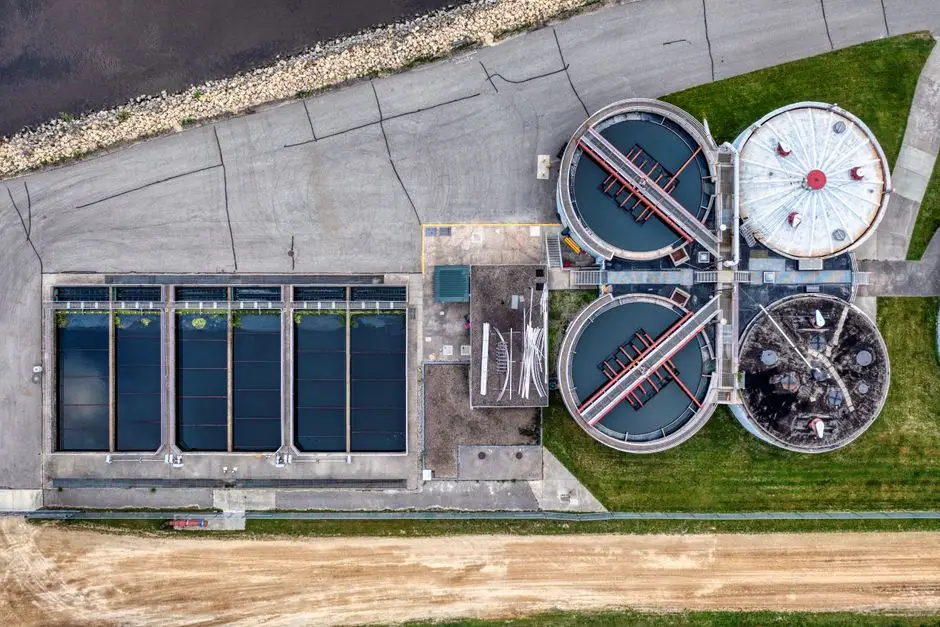
The treatment train below is the standard sequence a fabricated metals plant uses to hit PSNS-equivalent POTW limits. Each step has a defined purpose, a defined outlet spec, and a defined failure mode if it is skipped. For a 2026 pretreatment layout near Monticello, IL, the train is sized to the local-limit envelope, not the federal floor.
| Step | Unit Operation | Purpose | Outlet Spec | Failure Mode if Skipped |
|---|---|---|---|---|
| 1 | Rotary mechanical bar screen | Remove rags, wipes, tramp metal | <6 mm openings | Premature press-cloth failure on the sludge train |
| 2 | Oil/water separation or chemical break | Drop free and emulsified oils | Oils <50 mg/L | DAF float overload, polymer overdose, TSS carryover |
| 3 | Hex chrome reduction (sodium metabisulfite) | Reduce Cr(VI) to Cr(III) | pH 2–3, ORP 250–300 mV, residence 15–30 min | Cr(VI) passes through precipitation as soluble chromate |
| 4 | Cyanide oxidation (NaOCl), if applicable | Destroy free cyanide | CN <0.1 mg/L, ORP >600 mV at pH >10 | Cyanide resolubilizes metal hydroxide precipitates downstream |
| 5 | pH adjustment to 8.5–9.5 with NaOH | Precipitate dissolved metals as hydroxides | pH 8.5–9.5, residence 20–30 min | Dissolved metals (Zn, Ni, Cu) pass through DAF |
| 6 | DAF or lamella clarification | Remove floc and TSS | TSS <30 mg/L target | TSS excursion at the POTW connection |
| 7 | pH trim back to 6–9 | Meet POTW pH cap | pH 6.0–9.0 | pH excursion, POTW violation |
| 8 | Optional polish (MBR, RO, anion exchange, GAC) | Tighten BOD/COD, TDS, or PFAS | Site-specific | Only required if local limits tighten, reuse is targeted, or PFAS rule lands |
A GX series rotary bar screen upstream of equalization keeps debris out of the sludge train — the single most common cause of premature press-cloth failure. A HydropureWater DAF handles the floc and TSS step. Dosing is governed by a skid-mounted PLC chemical dosing skid with flow-paced and pH/ORP feedback loops. For a head-to-head on DAF versus a settling clarifier on this stream, see the DAF vs clarifier for fabricated metals field guide.
DAF Sizing Envelope for a Monticello-Scale Fabricated Metals Floor
DAF sizing succeeds or fails on three knobs, and a vendor quote that does not state all three is not a real quote. The knobs interact: pushing any one of them too hard dilutes the others, and the right 2026 design picks one knob to optimize and holds the other two at their typical design point.
| Knob | Range | Typical Design Point | Trade-off |
|---|---|---|---|
| Hydraulic surface loading | 4–20 m/h | 10–15 m/h | Higher loading shrinks tank but raises TSS carryover risk |
| Air-to-solids ratio (A/S) | 0.005–0.060 | 0.02 | Higher A/S dries the float but costs blower power and can shatter fragile floc |
| Recycle rate | 10–30% of forward flow | 20% | Higher recycle improves TSS removal but inflates equalization demand and dilutes chemistry |
Pushing A/S and recycle simultaneously dilutes the chemistry, inflates basin size, and rarely pays back on a small fabricated metals floor. Pick one knob to push. For less oily streams — for example, a rinsewater-dominant floor with a separate oil break upstream — a lamella clarifier alternative runs at 20–40 m/h surface loading with up to 30% lower polymer consumption. For oilier streams that include compressor condensate, see the DAF sizing for oily condensate walkthrough.
Chemical Dosing Skid, Sludge Dewatering, and Discharge Interlocks

Chemical dosing is governed by feedforward (flow-paced) and feedback (pH/ORP) control on a PLC-controlled skid-mounted PLC chemical dosing skid. The four chemicals are NaOH or H₂SO₄ for pH trim, sodium metabisulfite for chrome reduction, NaOCl for cyanide destruction, and anionic/cationic polymer for floc. Every pump needs a calibration column and a stroke-count totalizer; without those, the operator is dosing blind and the effluent proves it.
On the solids side, floated metal-hydroxide sludge typically runs 2–5% dry solids out of the DAF and dewateres to 25–35% dry solids with a plate and frame filter press. A belt press is cheaper and continuous but caps out around 22% dry solids on metal hydroxide — if the hauler is paying by wet ton, plate and frame pays back. Polymer selection and dose matter as much as equipment choice; see the polymer optimization on the filter press guide for the numbers.
Finally, interlocks: pH excursion, ORP out of range, and high TSS should automatically divert flow back to the equalization basin header so a chemistry upset does not become a discharge violation. A auto-divert valve on the DAF outlet, wired to the same PLC that runs the dosing skid, is the cheapest insurance on the whole train. A 4-20 mA TSS probe on the DAF overflow, with a setpoint around 50 mg/L, is the single sensor that prevents the most permit excursions.
Local-Limit Envelope and 2026 PFAS Readiness for Monticello Discharge
The design envelope for a fabricated metals plant near Monticello, IL is the strictest single number across the federal PSNS table and the local POTW table on each parameter. The local POTW almost always adds caps the federal table underweights.
| Parameter | Federal 40 CFR Part 433 PSNS Daily Maximum (mg/L) | Typical Local POTW Daily Maximum (mg/L) | Design Number (mg/L) |
|---|---|---|---|
| Cadmium | 0.11 | 0.05–0.10 | Local (strictest) |
| Total chromium | 2.77 | 1.0–2.0 | Local (strictest) |
| Copper | 3.38 | 1.0–2.0 | Local (strictest) |
| Lead | 0.69 | 0.20–0.50 | Local (strictest) |
| Nickel | 3.98 | 1.0–2.0 | Local (strictest) |
| Silver | 0.43 | 0.10–0.20 | Local (strictest) |
| Zinc | 2.61 | 1.5–2.5 | Local (strictest) |
| Oil & grease | — | 100 | Local only |
| TSS | — | 250–300 | Local only |
| pH | — | 6.0–9.0 | Local only |
Permit-side, a new or modified industrial user near Monticello files a baseline monitoring report and a slug load control plan with the receiving POTW before startup, per 40 CFR 403.5 and 40 CFR 403.12(b). The slug load plan must identify the maximum possible discharge of any pollutant at any time, the location of that discharge, and the plant's preventive procedures — for a small fabricator, that is typically a floor drain map, a plating-line dump schedule, and the equalization basin's role as a buffer.
On PFAS, EPA has a live rulemaking scoped to chrome finishing facilities as of 2026 (per EPA Metal Finishing Effluent Guidelines page), with no numerical limit yet. The right 2026 design move is to lay out the pretreatment train so an anion exchange or GAC polish skid can be bolted on later — pipe stubs, a spare wall penetration, a 480V breaker space, and a foundation pad — rather than installing polish equipment now and paying to operate it ahead of any actual limit. Closed-loop zero liquid discharge is rarely economic for a fabricated metals plant unless water scarcity or a specific reuse case supports the capital. For a 2026 capex plan, spend the budget on the train that meets today's envelope, and protect the option to add polish later.
Frequently Asked Questions
Does every fabricated metals plant near Monticello trigger 40 CFR Part 433?
No. The category covers forming, finishing, forging, foundry, metal spraying, and machining wash operations co-located with plating or anodizing lines. A stamping shop that ships only dry parts to a separate finisher is generally outside the category. A facility that runs its own zinc, nickel, or chromic acid tank is inside it. Plants on the boundary should assume in-scope until the receiving POTW confirms otherwise.
What is the difference between PSES and PSNS limits?
PSES (Pretreatment Standards for Existing Sources) applies to plants constructed before the rule's promulgation date, and PSNS (Pretreatment Standards for New Sources) applies to plants built after, with tighter numbers that reflect the best available technology at promulgation. Most POTW pretreatment programs enforce PSNS-equivalent local limits on all industrial users as a conservative baseline, so an existing plant should usually design to PSNS numbers on the categorical parameters.
How is hexavalent chrome removed before discharge?
Hexavalent chrome is reduced to trivalent chrome using sodium metabisulfite (or ferrous sulfate) at pH 2–3, with ORP controlled at roughly 250–300 mV. The trivalent form then precipitates as Cr(OH)₃ in the pH 8.5–9.5 precipitation stage, where Cr(VI) hydroxide would otherwise remain soluble. ORP and pH must both stay in range for the full residence time, typically 15–30 minutes.
When is a polishing step required?
Polishing is needed when the POTW sets limits tighter than PSNS, when the plant reuses process water and needs RO-quality feed, or when a new rule forces it. MBR handles BOD/COD tightening and water reuse, RO handles sub-ppm TDS or specific metal caps like nickel <0.1 mg/L, and anion exchange or GAC handles the PFAS rulemaking EPA has in motion for chrome finishing facilities in 2026.
What sludge dewatering target should a fabricated metals plant design to?
Floated metal-hydroxide sludge typically runs 2–5% dry solids out of the DAF and dewateres to 25–35% dry solids with a plate and frame filter press. A belt press is cheaper and continuous but caps around 22% dry solids on the same sludge. If the hauler is paying by wet ton, the plate and frame press pays back through reduced disposal volume.