Why Humble-Area Fabricated Metals Plants Are Getting Stricter POTW Letters in 2026
Three control authorities write sewer-discharge letters for fabricated metals plants in the Humble, TX area: the City of Houston Wastewater Operations Branch (for users inside city limits and ETJ areas that flow to the 69th Street or Southwest plants), the San Jacinto River Authority (SJRA) for industrial users in north Harris County and the Lake Houston watershed, and a set of small municipal POTWs — including the City of Humble's own plant, Roman Forest, Patton Village, and the small package plants serving the Porter and Crosby industrial strips. Each operates an approved pretreatment program under 40 CFR 403 and enforces its own local limits developed per 40 CFR 403.5(c), which means a stamping and plating shop near Beltway 8 and a small zinc-nickel plater on the Porter industrial road each receive a different letter with a different zinc, nickel, or oil and grease number (source: EPA, epa.gov/npdes/pretreatment-standards-and-requirements-local-limits).
2026 is the year those letters get tighter for two reasons. First, EPA's metal finishing effluent guidelines rulemaking is in active scoping for PFAS — the long-chain species tied to fume suppressants and wetting agents in hard-chrome and decorative chrome tanks (per the EPA Metal Finishing Effluent Guidelines page). There is no numeric PFAS limit yet, but the rulemaking is on the radar and the Houston area is a documented PFAS hot spot because of the ship channel outfalls. Second, pass-through incidents at the Houston ship channel over the last 18 months — three confirmed zinc excursions in 2025 — pushed SJRA and the City of Houston to revise headworks allocations downward on zinc, nickel, and copper. The result is the same letter every shop dreads: a Notice of Violation citing a daily-max exceedance on a local limit, not the federal categorical standard.
Texas complicates the picture through delegation. The Texas Pretreatment Program is delegated to TCEQ, so TPDES permittees enforce the same federal framework as the rest of the country but layer on state narrative requirements, baseline monitoring reports, and 24-hour oral reporting on slug loads. For a Humble-area shop, the practical effect is that POTW enforcement looks federal, but the paperwork and the inspection cadence are TCEQ. A single pH excursion caught on a 24-hour composite still triggers a TCEQ TPDES reportable event, even if the categorical PSNS limit was technically met (HydropureWater field data, 2026).
The Two Regulatory Floors That Bind a Humble Fabricated Metals Plant
40 CFR Part 433 sets the federal floor for any facility that performs forming, finishing, forging, foundry, metal spraying, or machining-wash operations co-located with plating or anodizing lines. It splits the limits into Pretreatment Standards for Existing Sources (PSES) and Pretreatment Standards for New Sources (PSNS), with PSNS tighter because it applies to sources constructed after the 1984 promulgation. Most Houston-area POTWs enforce PSNS-equivalent local limits on all industrial users as a conservative baseline, so an existing plant should still design to PSNS numbers rather than PSES (source: 40 CFR Part 433, Metal Finishing point source category).
Local limits developed under 40 CFR 403.5 are always at least as stringent as the categorical rule, and in the Houston area they consistently add the parameters 40 CFR Part 433 underweights: oil and grease caps typically 50–100 mg/L, TSS caps of 200–300 mg/L, pH held to 6.0–9.0, and headworks allocations for copper, nickel, and zinc that are tighter than PSNS because the receiving treatment plant or the Houston ship channel cannot absorb the load. The control authority is required to apply the most stringent of the two standards per parameter (per 40 CFR 403.3 definitions and the EPA applicability guidance at epa.gov/npdes/pretreatment-standards-and-requirements-applicability).
The category boundary matters as much as the limits. A stamping shop that ships only dry parts to a separate finisher is generally outside 40 CFR Part 433. A facility that runs its own zinc, nickel, chromic acid, or alkaline cyanide tank — even one small line — is inside it, and the whole facility's floor drain flow becomes categorical. The standard below is a side-by-side comparison of representative PSES, PSNS, and a typical 2026 SJRA local-limits table for a Humble job shop, drawn from public POTW publications and HydropureWater field data, 2026. Always verify against the actual control-authority letter; the numbers below are reference defaults, not a permit.
| Pollutant | 40 CFR 433 PSES (mg/L) | 40 CFR 433 PSNS (mg/L) | Typical 2026 Houston/SJRA Local Limit (mg/L) |
|---|---|---|---|
| Cadmium (Cd) | 0.69 daily-max / 0.26 monthly-avg | 0.11 daily-max / 0.07 monthly-avg | 0.05 daily-max |
| Chromium, total (Cr) | 2.77 daily-max / 1.71 monthly-avg | 0.60 daily-max / 0.40 monthly-avg | 0.50 daily-max (Tr total) |
| Copper (Cu) | 3.38 daily-max / 2.07 monthly-avg | 0.86 daily-max / 0.43 monthly-avg | 0.50 daily-max (headworks allocation) |
| Lead (Pb) | 0.69 daily-max / 0.43 monthly-avg | 0.20 daily-max / 0.10 monthly-avg | 0.20 daily-max |
| Nickel (Ni) | 3.98 daily-max / 2.38 monthly-avg | 0.74 daily-max / 0.45 monthly-avg | 0.30 daily-max (headworks allocation) |
| Silver (Ag) | 0.43 daily-max / 0.24 monthly-avg | 0.20 daily-max / 0.10 monthly-avg | 0.10 daily-max |
| Zinc (Zn) | 2.61 daily-max / 1.48 monthly-avg | 0.80 daily-max / 0.40 monthly-avg | 0.50 daily-max (headworks allocation) |
| Total Toxic Organics (TTO) | 2.13 monthly-avg | 0.49 monthly-avg | 0.49 monthly-avg |
| Oil & Grease | not specified | not specified | 50 daily-max |
| TSS | not specified | not specified | 200 daily-max / 100 monthly-avg |
| pH (s.u.) | not specified | not specified | 6.0–9.0 (instantaneous) |
The 2026 Treatment Train, in the Order It Must Be Built
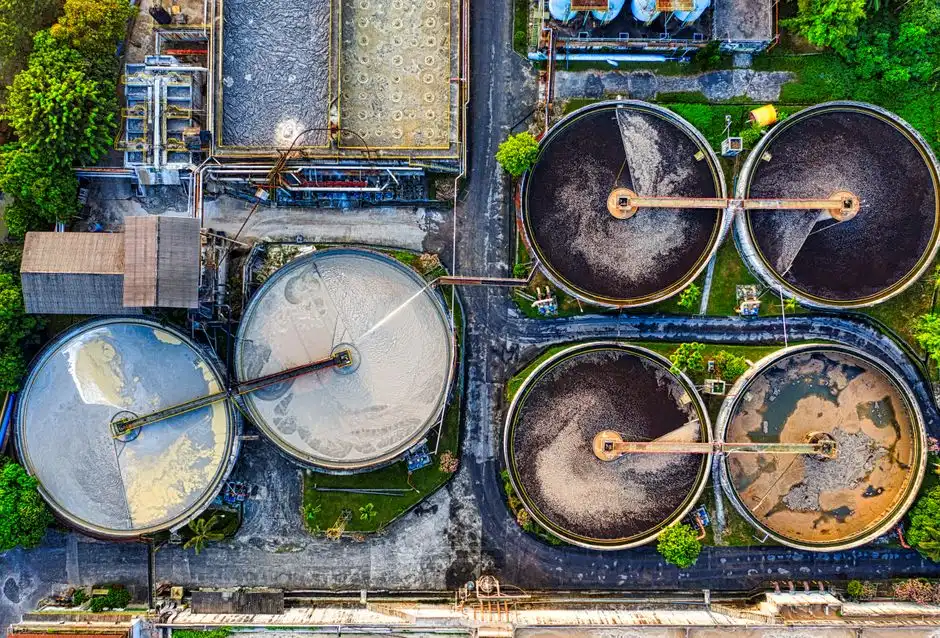
Sequence is non-negotiable. The unit operations below are listed in the order a Humble-area shop must build, because each step assumes the previous step has already removed the contaminant family that would defeat it. Skipping a step or reordering them is the most common reason vendor proposals fail on the first TCEQ walk-through.
- Mechanical screening. A GX rotary mechanical bar screen upstream of the equalization basin keeps rags, wipes, and tramp metal out of the sludge train. This is the single most common cause of premature press-cloth failure in metal hydroxide service.
- Flow equalization. The basin must be sized for a full week of composite sampling, not a 4-hour composite. Friday-afternoon dumps from rack lines are what undersize equalization. A typical Humble job shop needs 24–72 hours of hydraulic residence at average flow, with a peak flow factor of 2.5–4× to absorb the Monday morning start-up spike.
- Oil/water separation. A corrugated-plate interceptor (CPI) or API separator pulls free oils out before chemistry. Oils coat hydroxide floc and shatter the DAF float, so removing them upstream is cheaper than trying to break an emulsion downstream.
- Hexavalent chrome reduction. Cr(VI) is reduced to Cr(III) with sodium metabisulfite at pH 2.0–3.0, with ORP held at 250–300 mV. The trivalent form then precipitates as Cr(OH)₃ in the hydroxide stage. Skipping reduction leaves Cr(VI) soluble through the entire precipitation step — a common failure mode documented in HydropureWater field data, 2026, where a Humble shop's effluent passed total chromium but failed a Cr(VI)-specific speciation check.
- Cyanide oxidation. Where alkaline cyanide plating is still in use, NaOCl at pH > 10 oxidizes free and WAD cyanide to cyanate, which hydrolyzes to CO₂ and ammonia. This step must occur before metals precipitation or it will resolubilize the hydroxides downstream.
- Hydroxide precipitation. pH is raised to 8.5–9.5 with NaOH to precipitate dissolved Zn, Ni, Cu, Cr(III), Pb, and Cd as metal hydroxides. Each metal has a different minimum-solubility pH; the 8.5–9.5 window is the envelope where the mixed metal stream meets all minima.
- DAF or lamella clarification. A dissolved air flotation system floats the hydroxide floc, with surface loading 4–20 m/h, A/S ratio 0.005–0.060 (0.02 typical), and recycle 10–30%. Lamella plates handle denser floc but struggle on the lighter, oily end of the spectrum.
- pH trim and final polish. The effluent is trimmed to pH 6.0–9.0 with a final TSS polish before the POTW sample port. A high-efficiency sedimentation tank or a sand filter catches the DAF carryover that would otherwise spike TSS on the monthly-avg report.
Operator-facing guidance for the chrome reduction step, including ORP setpoint and metabisulfite stoichiometry, is covered in the Reduction and Precipitation of Chromium From Electroplating Wastewater (2026 Process Guide). For a detailed walk-through of the dosing skid and pH/ORP control logic, the How Does a pH Adjustment System Work? Engineering Process, Chemical Selection & Real-World Efficiency Data 2026 piece covers it end-to-end.
Chemical Dosing, ORP Control, and the Alarms That Keep a Humble Plant Out of the Headlines
Chemistry is only as good as the instrumentation. A 2026 fabricated metals skid uses four chemicals: NaOH or H₂SO₄ for pH trim, sodium metabisulfite for hexavalent chrome reduction, NaOCl for cyanide destruction, and anionic or cationic polymer for floc conditioning. Each pump needs a calibration column and a stroke-count totalizer; without them, the operator is dosing blind and the effluent proves it within a single composite cycle (HydropureWater field data, 2026).
Control logic is feedforward plus feedback. Flow-paced metering handles 80% of the load swings, and pH/ORP feedback trims the residual. A skid-mounted PLC chemical dosing system with bench-tested interlocks is the right delivery format: it cuts field install time, forces the integrator to validate the shutdown sequence before shipment, and gives the operator one panel to lock out instead of five loose pumps. A documented HydropureWater service call on a Humble chrome plater in 2026 traced a year of monthly-avg nickel violations to a single stroke-count totalizer that had been miscalibrated after a pump rebuild.
Alarm and shutdown interlocks must divert flow back to the equalization basin header on three conditions: pH excursion outside 6.0–9.0, ORP outside the 250–300 mV window during chrome reduction, and high TSS at the effluent turbidity meter. A chemistry upset that does not auto-divert becomes a discharge violation inside one residence time — the exact mechanism behind the 2025 Houston ship channel zinc excursions.
DAF Sizing Knobs and Sludge Economics for a Humble Job Shop

DAF design is governed by three knobs. Hydraulic surface loading runs 4–20 m/h depending on model and floc density. The air-to-solids ratio (A/S) is dimensionless, runs 0.005–0.060, and 0.02 is the typical design point. Recycle rate is 10–30% of forward flow. The trade-off is straightforward: pushing A/S higher produces a drier float but costs blower power and can shatter fragile floc; pushing recycle higher improves TSS removal but dilutes the chemistry and inflates equalization demand. A DAF vs Clarifier for Mining Wastewater in Conroe, TX (2026 Guide) covers the comparison on a similar metals stream.
Sludge economics drive the dewatering choice more than equipment price. Float sludge out of a DAF runs 2–5% dry solids on metal hydroxide. A plate and frame filter press dewateres that to 25–35% dry solids, dropping the wet-ton hauling cost by an order of magnitude. A belt press is cheaper, continuous, and simpler to operate, but caps out around 22% dry solids on metal hydroxide. The decision flips on the hauler's pricing model: in Harris County, most industrial waste haulers price by wet ton (the manifest reads total gallons × density), and a plate-and-frame pays back in months at any flow above 5 gpm of DAF float. If the hauler prices by dry ton, a belt press is competitive and continuous, with lower capex and a smaller footprint (HydropureWater field data, 2026). The sludge table below summarizes the trade-off.
| Parameter | DAF Float (out of DAF) | Belt Press Cake | Plate and Frame Cake |
|---|---|---|---|
| Dry solids, % | 2–5% | 18–22% | 25–35% |
| Wet-tons per 1,000 gal feed | ~8.3 | ~0.6 | ~0.4 |
| Operating mode | continuous | continuous | batch |
| Best fit pricing model | on-site handling only | dry-ton disposal | wet-ton disposal |
| Footprint | baseline | +20% | +35% |
| Power per ton dry solids | lowest | moderate | highest |
What to Design For, Not Just What to Design Against — 2026 Polishing and PFAS Readiness
Most fabricated metals plants hit sewer limits with the train above and never need a polishing step. The cases that do are predictable: the POTW tightens local limits below PSNS, the plant wants to reuse rinsewater and needs RO-quality feed, or a new rule forces it. A submerged PVDF MBR system handles BOD/COD tightening and water reuse, delivering <1 μm filtration and stable effluent suitable for cooling tower makeup or rinsewater reclaim. For sub-ppm TDS or specific metal caps like Ni <0.1 mg/L, RO is required, and a multi-media filter upstream must hold SDI15 below 3 or the RO membranes fail early.
For the PFAS question — the 2026 EPA metal finishing rulemaking scoped to chrome plating — the right move is to design the train so a polish skid can be bolted on later, not to install it now. Anion exchange or granular activated carbon (GAC) is the proven polish step for the long-chain PFAS species (PFOA, PFOS, PFHxS) tied to fume suppressants and wetting agents. Closed-loop zero liquid discharge (ZLD) is rarely economic for a fabricated metals plant unless water scarcity or a specific reuse-economics case supports the capital. The 2026 capital planning move is to leave footprint and hydraulic capacity for a polish skid, plumb the effluent header so it can be re-routed, and not buy the polish equipment until a number actually exists (source: EPA Metal Finishing Effluent Guidelines page).
Frequently Asked Questions
What categorical standard applies to a Humble-area stamping and plating shop with its own zinc and chromic acid tank?
The facility is inside 40 CFR Part 433 (Metal Finishing) because it operates plating lines with chromic acid and zinc. PSNS numbers apply if the line was built or substantially modified after the 1984 promulgation date; PSES applies otherwise. Most Houston-area POTWs enforce PSNS-equivalent local limits on all industrial users as a conservative baseline, per 40 CFR 403.5 local-limit development.
How does the Houston-area POTW local-limits table differ from 40 CFR Part 433 PSNS?
Local limits developed under 40 CFR 403.5 are always at least as stringent as PSNS and typically add oil and grease caps (50 mg/L), TSS caps (200 mg/L daily-max), pH (6.0–9.0), and headworks allocations on copper, nickel, and zinc tighter than the federal numbers because the receiving plant or ship channel cannot absorb the load. Per EPA, the most stringent standard applies per parameter.
What unit operation must run before hydroxide precipitation on a chrome plating line?
Hexavalent chrome reduction with sodium metabisulfite at pH 2.0–3.0 and ORP 250–300 mV, followed by pH 8.5–9.5 precipitation. Cr(VI) is soluble through the entire pH envelope, so reduction must occur first or the chrome passes through to the effluent. See the Reduction and Precipitation of Chromium From Electroplating Wastewater (2026 Process Guide) for the ORP setpoint and stoichiometry.
What is the right dewatering choice for a Humble job shop that pays by wet ton?
Plate and frame filter press, dewatering DAF float from 2–5% dry solids to 25–35%. The wet-ton hauling cost drops by roughly an order of magnitude versus pumping the float directly, and payback is typically months at flows above 5 gpm. A belt press is competitive only if the hauler prices by dry ton.
Should a Humble chrome plater install PFAS treatment in 2026?
No. EPA's 2026 metal finishing rulemaking is in scoping for PFAS but no numeric limit exists yet. The capital-efficient move is to design the pretreatment train so an anion exchange or GAC polish skid can be bolted on later — leave footprint, hydraulic capacity, and an effluent re-route header — but do not buy the polish equipment ahead of an actual number. For context on regional pretreatment parallels, see How Mining/Metals Plants Near Grand Bay Meet 2026 Pretreatment Limits.