Why Semiconductor Wastewater in Tullahoma Is a Special Case
Semiconductor fab wastewater consists of a complex mixture of hydrofluoric acid (HF) and ammonium fluoride (NH₄F) rinses (50–500 mg/L fluoride), tetramethylammonium hydroxide (TMAH) developer (10–100 mg/L), isopropanol (IPA) solvent rinses, copper-bearing CMP slurries (Cu 1–20 mg/L), and SC1/SC2 rinse residues. These streams commingle with a low-to-moderate BOD/COD load (typically 100–500 mg/L COD) that exhibits a coefficient of variation exceeding 2× across a single shift. Generic "MBR vs CAS" comparisons often fail to address this specific chemistry, which is the exact parameter set a Tullahoma fab engineer must justify to a Tennessee Department of Environment and Conservation (TDEC) reviewer.
Geographically, Tullahoma sits on the Cumberland Plateau, with major employers including Arnold Engineering Development Complex (AEDC) and its support industries, all of which fall under TDEC Division of Water Resources oversight. Discharge or reuse decisions hinge on the Elk River watershed, the Woods Reservoir impoundment, and downstream Cumberland River withdrawals, all designated sensitive receiving waters under state antidegradation rules (per Tennessee TDEC NPDES Industrial Permitting guidance, 2025-11). A 10–30 mg/L suspended-solids CAS effluent is acceptable for many industrial discharges but creates a liability when the fab's reuse target requires ultra-pure water (UPW) make-up at <1 μm particulate loading.
The high solids retention time (SRT) of an MBR provides a structural advantage for fab effluent because TMAH and IPA are slowly biodegradable, while fluoride and copper are inhibitory. An MBR running at 20–60 days SRT (vs. 3–10 days for CAS) maintains a diverse, slower-growing biomass that better tolerates inhibitory spikes, a characteristic consistently flagged in MBR literature (Mannina et al., 2020).
How CAS and MBR Actually Work in a Fab Plant
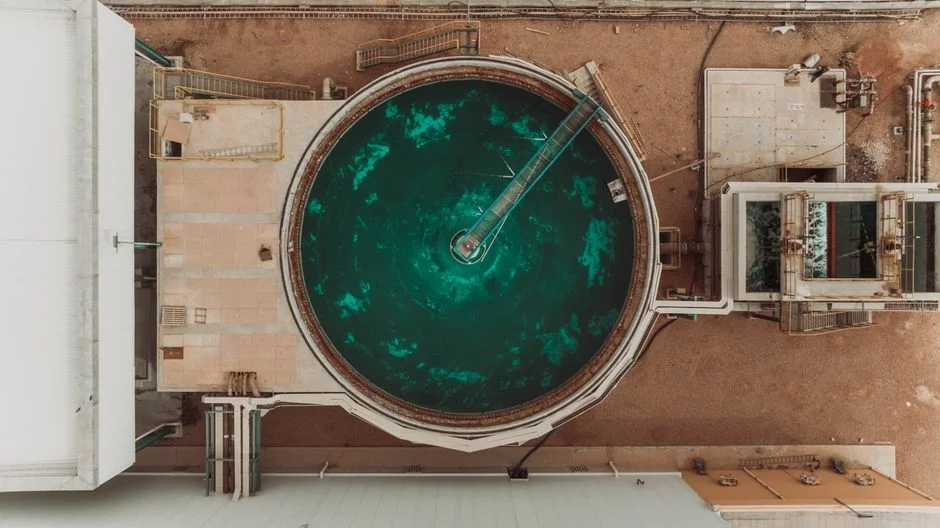
Conventional Activated Sludge (CAS) systems utilize an aeration tank where heterotrophic bacteria oxidize dissolved organics, followed by a secondary clarifier where biomass settles by gravity. Mixed liquor suspended solids (MLSS) typically run 2,000–4,000 mg/L, sludge return maintains biomass concentration, and clarified supernatant exits over a weir. The clarifier remains the system's primary vulnerability; when filaments proliferate, sludge bulking occurs, settling fails, and TSS excursions follow.
A Membrane Bioreactor (MBR) replaces the clarifier with a submerged ultrafiltration membrane, most commonly PVDF hollow-fiber or flat-sheet modules with 0.03–0.4 μm nominal pore size. The membrane physically retains biomass, allowing the reactor to operate at 8,000–15,000 mg/L MLSS, roughly 3–5× higher than CAS. This higher MLSS enables the longer SRT, smaller tankage, and the <1 μm effluent barrier that CAS cannot match (HydropureWater product specifications for submerged PVDF modules, 2026).
Fouling management is a non-negotiable requirement for MBR systems. These units require scheduled relaxation cycles (typically 8–12 minutes of permeate per 1–2 minutes of backflush), continuous coarse-bubble air scour beneath the modules, and periodic clean-in-place (CIP) with sodium hypochlorite (300–500 mg/L) and citric acid (1–2%). These routines increase energy demand and require operators with specific membrane-management discipline, which may limit MBR suitability for understaffed fab utility teams.
Flat-sheet modules (offered as the PVDF flat-sheet MBR module) tolerate higher MLSS and handle FOG fouling more robustly than hollow-fiber alternatives, offering simpler mechanical cleaning when the upstream feed includes SC1/SC2 residues or trace oils.
Head-to-Head Parameter Matrix for Semiconductor Duty
The table below consolidates the engineering parameters a Tullahoma project engineer needs for design. CAS values reflect typical municipal-industrial design ranges; MBR values reflect the literature and the submerged PVDF flat-sheet configuration (Mannina et al., 2020; HydropureWater field data, 2026).
| Parameter | Conventional Activated Sludge (CAS) | Membrane Bioreactor (MBR) |
|---|---|---|
| MLSS | 2,000–4,000 mg/L | 8,000–15,000 mg/L |
| SRT | 3–10 days | 20–60 days |
| Effluent TSS | 10–30 mg/L | <1 mg/L (sub-1 μm barrier) |
| Effluent COD | 40–80 mg/L | 20–40 mg/L |
| Footprint | Baseline | 30–50% smaller |
| CAPEX (relative) | Baseline | +20–50% |
| Energy demand | Baseline | +30–50% per m³ treated |
| Sludge yield | Higher | Lower (longer SRT, lower Y_obs) |
| Membrane replacement | N/A | Every 7–12 years |
| GHG (direct) | 0.85 kgCO₂eq/m³ | 0.91 kgCO₂eq/m³ |
| Fluoride/TMAH/Cu tolerance | Moderate; sensitive to shock loading | Higher; longer SRT buffers inhibitory spikes (qualitative; fab-specific removal must be confirmed via bench testing) |
The MBR's higher SRT is the primary factor in its resilience to inhibitory species. Slowly biodegradable solvents (TMAH, IPA) require extended contact time with acclimated biomass, and inhibitory species (F⁻, Cu²⁺) require a larger, more diverse population to maintain metabolic function under perturbation. CAS, with its 3–10 day SRT, does not retain enough specialized biomass to buffer the spikes routine in fab operations (Mannina et al., 2020). Source research does not provide quantitative fluoride or TMAH removal numbers for either technology on fab effluent; bench-scale treatability testing on the site feed is mandatory before final design.
Tullahoma Economics and Permitting: CAPEX, OPEX, and TDEC Reality
The following table pairs the engineering differences with the regulatory and economic framing required for CFO and TDEC review.
| Dimension | CAS | MBR |
|---|---|---|
| CAPEX premium | Baseline | +20–50% (membrane modules offset partially by eliminating large secondary clarifiers) |
| OPEX — energy | Baseline aeration | +30–50% per m³ (membrane air scour + higher MLSS oxygen demand) |
| OPEX — sludge handling | Higher excess sludge production | Lower yield; downstream dewatering press sees 20–40% less cake (paired with a sludge dewatering press) |
| Membrane replacement reserve | $0 | Capital reserve accrual: 7–12 year cycle |
| Permit pathway (TDEC NPDES) | Standard secondary limits; TSS 10–30 mg/L may require multimedia polish to meet site-specific Elk River/Woods Reservoir limits | Sub-1 μm effluent typically clears site-specific TSS limits without tertiary polish; simplifies reuse permit narrative |
| Reuse fit (UPW make-up) | Requires DAF + multimedia + RO polish; higher downstream fouling risk | RO polish train operates with lower SDI; direct feed to RO polish train is feasible |
| Long-horizon economics | Lower near-term | Per Karim & Mark (2017), MBR becomes lower-cost at >67 year amortized service life; most fabs are 20–30 year assets, so this is rarely the deciding factor |
For a 20–30 year fab asset, MBR requires higher upfront investment and energy costs, alongside disciplined operational oversight. The resulting effluent quality allows TDEC reviewers and internal UPW teams to approve designs without extensive polishing chains. CAS is the preferred solution when land is available, reuse targets are absent, and capital constraints dictate the use of conventional downstream polishing equipment.
Matching the Technology to the Tullahoma Site
The following logic applies to project reviews for site selection.
Select CAS when the site has available land (≥0.5 m² per m³/day treated), the discharge permit follows a standard secondary NPDES path without reuse targets, capital is constrained, and the downstream treatment train can accommodate a DAF and multimedia filter polishing step. CAS is also the correct choice when the operating team lacks membrane-management experience, as a 30–50% energy premium provides no benefit if membranes foul prematurely.
Select MBR when the fab targets UPW make-up reuse, site footprint is constrained, the effluent must feed a downstream RO/UF polish, or the feed contains inhibitory fluoride, copper, or TMAH spikes. This architecture typically involves an integrated MBR skid for fab wastewater preceded by a DAF pre-treatment upstream of MBR to strip FOG and dampen hydraulic surges, followed by an RO polish train. The MBR's compatibility with high-MLSS operation and shock loads aligns with industry preferences for centralized industrial wastewater plants (HydropureWater, 2026).
For mixed semiconductor duty, the pre-treatment chain is as critical as the biological process. A DAF or equalization basin upstream of the MBR is essential to ensure a 12-year membrane life rather than a 5-year life. For deeper CAPEX/OPEX context, the microelectronics wastewater treatment cost breakdown and the data-driven MBR vs alternatives comparison provide additional reference. For monocrystalline silicon specifically, the hybrid DAF-RO-MBR design for monocrystalline silicon wastewater details a similar architecture.
Frequently Asked Questions
Is MBR or CAS better for fluoride and TMAH removal in semiconductor fab wastewater?
MBR is the safer choice because it operates at 8,000–15,000 mg/L MLSS and 20–60 days SRT, compared to 2,000–4,000 mg/L and 3–10 days for CAS. The longer SRT retains a diverse, slower-growing biomass that tolerates inhibitory fluoride (50–500 mg/L) and copper spikes (1–20 mg/L) better than CAS. Bench-scale treatability testing on the actual feed is required before final design (HydropureWater field data, 2026).
What is the real CAPEX and energy penalty for MBR at a Tullahoma fab?
MBR CAPEX is 20–50% higher than CAS due to membrane modules and cassette framing, though this is partially offset by eliminating the secondary clarifier. Energy demand is 30–50% higher per cubic meter treated due to membrane air scour and higher MLSS oxygen demand. CAS remains cheaper on a 20–30 year fab asset life, as MBR only becomes cost-effective at >67 year amortized service lives, per Karim & Mark (2017).
How does TDEC permitting affect the MBR vs CAS decision in Tennessee?
TDEC NPDES industrial permits on the Elk River and Woods Reservoir watershed impose site-specific TSS and metals limits that MBR effluent (<1 μm) typically clears without tertiary polish. CAS effluent at 10–30 mg/L TSS often requires additional multimedia filtration to meet these limits, increasing CAPEX and OPEX.