Why Waterbury Fabricated Metals Plants Face a Real Choice in 2026
For Waterbury fabricated metals factories in 2026, dissolved air flotation (DAF) is the stronger primary clarifier when the wastewater stream carries free oils, cutting fluids, and emulsified FOG alongside TSS — common in stamping, machining, and screw machine operations. A conventional or lamella gravity clarifier becomes preferable when the stream is dominated by heavy settleable solids with low oil content and the site has floor space for a larger tank. Most Waterbury metal finishers handling 40 CFR Part 433 effluent ultimately run DAF as the primary step because it removes 90–95% of FOG and floated metals hydroxides in one pass.
Waterbury's manufacturing base is dominated by brass, copper, and fabricated metal products — screw machine shops, stamping, machining, and plating — each generating wastewater with oils, FOG, TSS, and dissolved metals. CT DEEP industrial discharge permits and EPA's 40 CFR Part 433 Metal Finishing categorical standard govern effluent limits; the standard covers 33+ process operations typical of fabricated metals, from electrolytic and electroless plating to chemical etching, anodizing, and machining rinse water. The daily maximums in 40 CFR Part 433 anchor every decision a Waterbury EHS manager makes: TSS at 52 mg/L, Cu at 4.1 mg/L, Ni at 4.1 mg/L, Zn at 4.2 mg/L, Pb at 0.69 mg/L, and oil & grease at 52 mg/L (per 40 CFR 433.102). Miss any one of those and the plant is in non-compliance with the local POTW's pretreatment program, which in Waterbury is administered by the Waterbury Water Pollution Control Authority.
The article's central tension: choosing the wrong primary clarifier forces extra chemical precipitation, polishing filtration, or sludge handling later in the train. A naive single-technology choice — a lamella clarifier on a high-FOG stamping line, or a DAF on a clean grinding-swarf rinse — burns capex on downstream polishing that a better-matched primary unit would have eliminated. The rest of this article lays out the process behavior, the side-by-side parameter comparison, and a Waterbury-specific decision rule a plant engineer can use to justify the spend against the 40 CFR 433 envelope.
How a DAF System Actually Treats Fabricated Metals Wastewater
A DAF unit does not float anything by itself. The mechanism is engineered microbubble attachment to chemically conditioned floc. A portion of clarified effluent — typically 20–30% of forward flow — is pressurized in a saturator vessel with compressed air at 4–6 bar, then released through a pressure-relief valve at the inlet of the flotation tank. The pressure drop nucleates a cloud of 30–50 micron microbubbles (per Clearwater/SigmaDAF 2026 spec) that attach to flocculated solids and oil droplets, lowering their effective density and lifting them to the surface in 3–5 minutes. A paddle skimmer scrapes the floated layer into a scum trough, while heavier settleable solids — grinding swarf, metallic fines, sand from lapping — drop into a bottom collection zone and are removed by an auger (Clearwater, 2026-04).
Chemical coagulation and flocculation are non-optional for fabricated metals streams. Emulsified synthetic cutting fluids and colloidal metal hydroxides carry near-neutral surface charge and will not attach to bubbles without charge neutralization (ferric chloride or alum at 50–150 mg/L) followed by anionic or cationic polymer bridging at 2–10 mg/L. Skipping this step is the single most common reason a DAF underperforms on a plating rinse line. The polymer dose for oil capture is typically lower than the coagulant dose a clarifier needs for TSS and metals co-removal, which is one of the operating-cost differentiators in the comparison below.
Standard builds use 304SS, with 316SS or polypropylene available for acidic plating rinses (per Clearwater 2026 spec). For Waterbury platers running nickel, chromic acid, or acid chloride zinc baths, the material upgrade is a line item worth budgeting in 2026, not an afterthought. The DAF system for industrial wastewater covers 4–300 m³/h, which brackets the vast majority of Brass City plant flow rates.
How a Gravity or Lamella Clarifier Handles the Same Stream
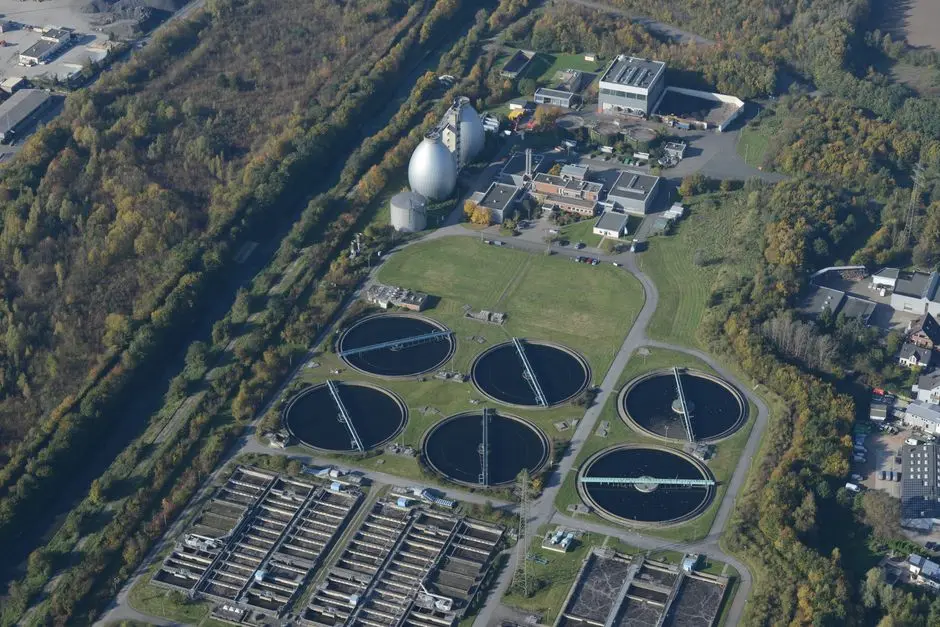
Clarifiers rely on gravity settling. A conventional circular or rectangular clarifier gives particles enough residence time — typically 2–4 hours — to settle under quiescent conditions. A lamella clarifier stacks inclined plates (55–60° angle) inside the tank, shortening the effective settling path so particles drop the short distance to a plate surface, slide down, and thicken into a hopper. Surface loading on a well-designed lamella reaches 20–40 m³/m²·h (per HydropureWater lamella spec, 2026), compared to 1–3 m³/m²·h on a conventional clarifier. That is why a lamella unit is often the right call when footprint matters and the pollutant is settleable, not floatable.
Chemical dosing follows the same logic as DAF: coagulant plus polymer to build a settleable floc. Many high-rate lamella designs recirculate a portion of thickened sludge back into the feed to act as a floc nucleus, raising solids contact and reducing total polymer demand by roughly 30% in optimized designs. The catch is footprint: a lamella clarifier needs 2–4× the floor area of a DAF of equal flow capacity, because plate area — not tank volume — sets the rating.
The failure mode on a fabricated metals stream is emulsified oil. Neutrally buoyant oil droplets in a synthetic cutting fluid or a stamping lubricant emulsion do not settle, do not coalesce on inclined plates, and do not report to the sludge hopper. They pass through, drift into the effluent, and breach the 52 mg/L oil & grease limit on the 40 CFR 433 daily maximum table. That single number — 52 mg/L — is the bright line that disqualifies a clarifier as a standalone primary for most Waterbury stamping and machining lines.
DAF vs Clarifier: Side-by-Side for Fabricated Metals Wastewater
| Parameter | DAF (primary) | Lamella / Conventional Clarifier (primary) |
|---|---|---|
| TSS removal | 70–90% on metalworking influent | 85–95% on particulate-heavy influent (90% benchmark, mining case per Ecologix 2026) |
| Oil / FOG removal | 90–95% with polymer conditioning (per Ecologix 2026) | ~70% on free oil; near 0% on emulsified oil |
| Emulsified cutting fluid handling | Effective after coagulant + polymer | Poor — droplets pass through |
| Dissolved metals (post-precipitation) | Captures floated metal hydroxide floc | Captures settled hydroxide floc, slower rise/spill risk on density inversion |
| Footprint at 50 m³/h | ~10–15 m² (rectangular skid) | ~30–50 m² (lamella basin + plate pack) |
| CapEx band, 2026 USD (50 m³/h, skid-mounted, no building) | $180k–$320k | $90k–$180k |
| Best-fit 40 CFR 433 subcategory | Stamping, machining, plating rinse, electroless Ni, anodizing rinse | Grinding swarf rinse, lapping, scale wash, dust-laden coolant blowdown (low oil) |
| Sludge consistency | 3–6% DS floated layer; auger-removed settled fraction | 2–4% DS hopper underflow; easier to pump, higher water content |
| Polymer demand | Lower (oil capture is the goal) | Higher (TSS and metals co-precipitation) |
| Footprint-constrained older building retrofit | Strong fit — compact skid | Difficult — basin and plate pack dominate floor area |
Hybrid DAF + lamella polish trains are common in larger Waterbury platers that must meet 40 CFR 433 daily maximums across Cu, Ni, Zn, Pb plus oil & grease in a single discharge. That configuration exceeds the single-equipment scope of this comparison, but it is the realistic answer for a 150–300 m³/h plater running mixed acid/alkaline rinses — and the upstream DAF system for industrial wastewater carries the FOG load while the downstream high-efficiency lamella clarifier polishes TSS and provides sludge thickening. For a deeper process walk-through of the plating side, see the electroplating wastewater treatment engineering guide.
Waterbury-Specific Selection Factors for 2026
| Factor | 2026 Waterbury Reality | Implication for Primary Clarifier Choice |
|---|---|---|
| Typical plant flow range | 5–80 m³/h (most shops), up to 300 m³/h for larger platers | Inside DAF envelope (4–300 m³/h) and lamella envelope alike — flow is not the deciding factor |
| Building type | Many multi-story older mill buildings; low floor-loading, limited craneway access | Skid-mounted DAF retrofits through standard doorways; cast-in lamella basins rarely feasible |
| Discharge permit pathway | CT DEEP IWWS general permit + Waterbury POTW pretreatment (40 CFR 433 categorical) | Both technologies work; DAF is the lower-risk path for FOG compliance |
| Pollutant cocktail | Oils + cutting fluids + plating rinse (Cu, Ni, Zn, Cr, Pb) in one plant | DAF handles the floatable fraction in one unit; lamella alone fails the oil & grease limit |
| CT PFAS rule trajectory | Tightening in 2026 (CT DEEP) | Post-clarifier polishing stage (GAC, ion exchange, RO) — not a DAF vs clarifier decision driver |
| Labor pool | Lean operator staffing typical | PLC-automated DAF skimmer and auger reduces operator hours vs manual lamella sludge blowdown |
For context on how a non-Connecticut metalworking hub frames the same decision, the DAF vs clarifier guide for mining and metals wastewater in Catlettsburg walks through the heavier settleable-solids end of the spectrum — useful counterpoint if your Waterbury stream is grinding-dominated rather than oil-dominated.
Decision Framework: Which System Should Your Waterbury Plant Choose?
Run the influent characterization first. The technology choice is pollutant-driven, not flow-driven.
- Choose DAF as primary clarifier when influent has any of: free or emulsified oil >50 mg/L, FOG from stamping lubricants, synthetic cutting fluids, or floated metal hydroxide sludge from alkaline precipitation of plating rinses. This is the default for stamping, machining, screw machine, and mixed plating lines — the dominant Waterbury effluent profiles.
- Choose lamella or conventional clarifier when influent is primarily particulate TSS (grinding swarf, lapping grit, scale, dust) with negligible oil — for example, a clean stamping rinse with no lubricant carryover, or a swarf washdown with no coolant. Confirm oil & grease <50 mg/L before committing.
- Choose DAF + lamella polish when the plant must meet 40 CFR 433 daily maximums across Cu (4.1), Ni (4.1), Zn (4.2), Pb (0.69) and oil & grease (52 mg/L) in a single discharge, and flow exceeds ~80 m³/h. The DAF handles floatables; the lamella polishes TSS and thickens sludge before dewatering.
- If unsure, request jar testing with both polymer-conditioned DAF and lamella settling on the actual stream. Measure supernatant turbidity, residual oil, and settled/floted sludge volume after 30 minutes. The numbers will pick the technology for you, and the test data also satisfies CT DEEP engineering report requirements for the permit application.
Capex framing for 2026: a skid-mounted 50 m³/h DAF typically lands at $180k–$320k installed depending on material upgrade (316SS for acid rinses) and controls scope. A lamella clarifier of equal duty runs $90k–$180k but demands the building space many older Waterbury shops cannot spare. The defensible 2026 decision is rarely the cheaper line item — it is the unit that avoids the downstream polishing the other one would force.
Frequently Asked Questions
Can a DAF system remove dissolved heavy metals?
Not by itself. DAF removes floated metal hydroxides after pH adjustment and precipitation — typically at pH 9–10 for Zn, pH 8–9 for Cu/Ni. Truly dissolved metals (e.g., complexed nickel, hexavalent chromium) require ion exchange, RO, or precipitation + filtration downstream of the DAF. For 40 CFR 433 compliance, DAF is the first stage; chemical precipitation and a polishing clarifier or multimedia filter do the dissolved-metals work.
What flow rate needs a DAF vs a clarifier?
Both technologies scale from pilot (1–5 m³/h) to over 300 m³/h in commercial equipment. Flow rate is not the deciding variable. A 200 m³/h DAF on a high-FOG stamping line is correct; a 200 m³/h lamella clarifier on the same line is not. The decision is pollutant-driven, and the DAF system for industrial wastewater covers the same 4–300 m³/h range that lamella clarifiers occupy.
How often does a DAF need sludge removal in a metal finishing plant?
Typically every 4–8 hours for a high-FOG line, automated with a timer-controlled skimmer and bottom auger. A high-plating line with hydroxide floc may need auger discharge every 2–4 hours to prevent sludge buildup in the collection zone. Set the cycle to scum hopper level, not the clock, if the line sees batch discharges from the plating bath.
Is DAF wastewater suitable for sewer discharge in Waterbury?
After chemical conditioning to 40 CFR 433 limits, DAF effluent can discharge to the Waterbury POTW under the industrial pretreatment program. Confirm local limits with the Waterbury Water Pollution Control Authority — they may set tighter metals limits than the federal categorical standard, and they will require a slug control plan for any batch discharge over 50 m³.
Can a lamella clarifier replace DAF in a fabricated metals plant?
Only if oils are removed upstream by an oil-water separator and the residual oil & grease is below ~30 mg/L going into the lamella. Otherwise emulsified oil will pass through and breach the 52 mg/L 40 CFR 433 daily maximum. A standalone lamella without upstream oil removal is the most common single-piece-of-equipment compliance failure we see in older Waterbury shops.