DAF vs Clarifier for Mining and Metals Wastewater in Chavies: The Short Answer
For most Chavies-area mining and metals plants in 2026, dissolved air flotation (DAF) outperforms a conventional clarifier on the streams that drive compliance: total suspended solids above ~500 mg/L, oil/grease from equipment washdown, and floatable metal-hydroxide flocs. A 2026 pilot study from Pol. J. Environ. Stud. (Ozturk, Canci, and Manav-Demir, DOI 10.15244/pjoes/214082) on a CF-DAF pilot treating real metal-plating wastewater reported 99% Cr+6, 99% Zn, 94% Ni, 90% sulfate, and 83% COD removal at 200 µm bubble size, 3–4 bar saturation, 53 min contact, and 2 m³/m²·h hydraulic loading. For pre-neutralized acid mine drainage polishing, high-flow low-TSS streams, or sites that cannot justify chemical dosing, a lamella clarifier is more economical. In practice, most coal-prep and quarry sites in the Perry County / Knott County corridor run a DAF upstream of a clarifier or settling pond — not an either/or. The binding compliance driver is 40 CFR Part 440 (Ore Mining and Dressing), with Subpart B and Subpart C governing coal preparation and acid/ferruginous mine drainage, and KPDES permits layered on top under 401 KAR 5:050.
Why the Decision Is Harder in Chavies: Coal, Metals, and Acid Mine Drainage
Chavies sits in the Perry County seam of eastern Kentucky coal country, where historic underground and surface mining shares a watershed with active clay/shale quarrying and a small but persistent metals-finishing and equipment-rebuild sector. The influent profile is not a single stream — it is a mix of three, and the right clarifier-vs-DAF call depends on which one is in front of you. Coal-prep wash water typically runs 200–4,000 mg/L TSS, 5–250 mg/L total iron, sulfate above 1,500 mg/L, and pH swings between 2.5 and 8.5 depending on whether alkaline process water meets an acidic seep. Quarry wash-down is closer to 500–2,000 mg/L TSS with low dissolved metals but high silt and clay fines that settle poorly without polymer. Metals-finishing rinsewater, where it exists in the region, lands in the 1–15 mg/L range for Cu, Ni, Zn, and Cr+6 with very low TSS but very high compliance risk.
Acid mine drainage (AMD) complicates everything because the iron is dissolved as Fe²⁺ at low pH — a gravity clarifier physically cannot remove it. DAF becomes the carrier for the oxidation chemistry (aeration + lime/caustic lift to pH 7–8.5) that converts Fe²⁺ to Fe³⁺ hydroxide floc, which then floats. This is why AMD overlap is the single biggest reason a generic "DAF vs settling pond" guide fails in eastern Kentucky. KPDES permits issued by the Kentucky Division of Water reference 40 CFR Part 440 effluent limits and the 401 KAR numeric standards together, so a discharge that meets Part 440 TSS but exceeds the state's iron or pH criteria is still a violation. Finally, the TCLP link matters: a metals-bearing DAF float that fails Toxicity Characteristic Leaching Procedure on chromium or lead classifies as a hazardous sludge under 40 CFR 261, and the plant then needs a plate-and-frame filter press to bring it to 25–35% DS before licensed haul-off.
How DAF and Clarifiers Actually Work in a Mining Stream
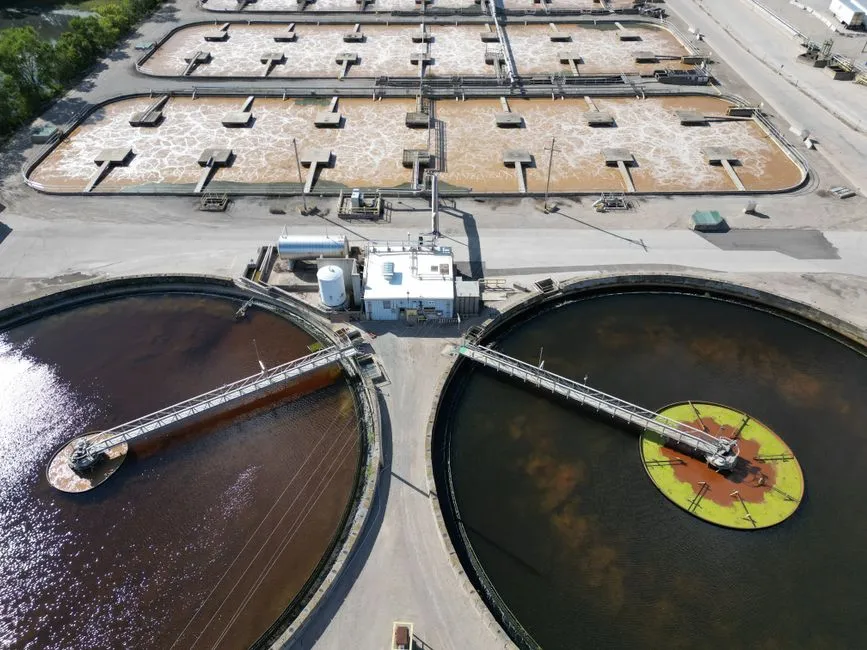
A conventional clarifier relies on gravity. Surface overflow rate sits at 1–2 m/h for a circular or rectangular basin, which is acceptable for coarse coal refuse and most grit. A lamella (inclined-plate) clarifier multiplies the effective settling area by stacking plates at 55–60°, which lifts the equivalent overflow rate to 20–40 m³/m²·h — roughly 10–20× the throughput per unit footprint. The catch is that lamella efficiency drops sharply on particles below ~20 µm and on anything with a specific gravity close to water, which is most coal fines and metal-hydroxide flocs.
DAF takes the opposite approach: it deliberately attaches air to particles so they rise instead of falling. A pressurized recycle of 20–40% of the clarified effluent is saturated with air at 3–6 bar in a packed saturator, then released through a needle-valve manifold into the contact zone. The pressure drop nucleates micro-bubbles under 100 µm in diameter (the 2026 Pol. J. study reports a 200 µm D50, which is the engineered design point; lab-DAF units run smaller). These bubbles attach to chemically conditioned floc and lift it to the surface in 5–15 minutes. Collision efficiency between bubble and particle is governed by zeta potential, and operators target ±5 mV through coagulant dosing — FeCl₃ at 150–280 mg/L paired with anionic polyelectrolyte at 0.5–1.5 mg/L worked in the Pol. J. pilot, though mining streams typically need 20–60 mg/L of FeCl₃ plus 1–3 mg/L of anionic polymer after jar testing. The bubble–floc aggregate is buoyant even when the underlying particle is heavy or colloidal, which is why DAF handles the fines a clarifier cannot.
Chemically conditioned floc is mandatory for either system to hit Part 440 metals targets. The difference is forgiveness: a clarifier will only remove floc that settles in 30–60 minutes, so dose errors and pH excursions show up as effluent spikes. DAF tolerates a wider floc-density window because the lifting force scales with bubble attachment, not Stokes' law. For a related regional comparison, see our DAF or Clarifier for Mining/Metals Wastewater in Whitesburg, US: 2026 Factory Guide.
| Parameter | Conventional Clarifier | Lamella Clarifier | DAF (CF-DAF) |
|---|---|---|---|
| Surface overflow / hydraulic loading | 1–2 m³/m²·h | 20–40 m³/m²·h | 2–5 m³/m²·h |
| Saturation pressure | — | — | 3–6 bar (Pol. J. 2026: 3–4 bar) |
| Bubble size (D50) | — | — | <100–200 µm |
| Contact / residence time | 60–180 min | 20–45 min | 5–15 min flotation; 53 min in Pol. J. pilot |
| Coagulant demand (FeCl₃) | 40–100 mg/L | 40–100 mg/L | 100–280 mg/L |
| Polymer demand (anionic) | 0.5–2 mg/L | 0.5–2 mg/L | 0.5–1.5 mg/L |
| Skim/underflow DS | 1–3% | 1–3% | 2–5% |
Head-to-Head: DAF vs Lamella Clarifier on Mining Effluent Parameters
For coal-prep and quarry effluent in the 1,000–5,000 mg/L TSS range, a CF-DAF system delivers 80–95% TSS removal; a lamella clarifier lands at 60–85% on the same feed; a conventional basin trails at 50–70%. The gap widens on the parameters that trigger enforcement: oil and grease from equipment wash, hydraulic fluid spills, and conveyor-belt lubricants. DAF routinely exceeds 95% on free and emulsified oil because the bubble-floc attachment captures droplets a clarifier lets pass. A lamella hits 30–40% on the same stream — enough to keep the clarifier from fouling, not enough to meet a 15 mg/L daily-max limit. For Cr+6, Zn, Ni, and Cu after chemical reduction and pH adjustment, the 2026 Pol. J. data show CF-DAF at 94–99% removal on real plating wastewater. A lamella or conventional clarifier pulls 40–70% on the suspended fraction but does almost nothing on residual dissolved metals, which is why a clarifier-only flowsheet cannot meet Part 440 Subpart B (Coal Mining) metal limits on a metals-bearing feed.
Footprint favors lamella by a wide margin at high flow: 0.03–0.06 m² per m³/h for inclined plates versus 0.05–0.1 m² per m³/h for DAF, and 0.2–0.4 m² per m³/h for a conventional basin. But the comparison is misleading without hydraulic loading in the picture — lamella's compact footprint depends on a 20–40 m³/m²·h loading that DAF cannot match because bubbles need residence time to attach. OPEX is the reverse story: a DAF unit draws 0.3–0.6 kWh/m³ for the saturator and recycle pump; a lamella is largely passive aside from the scraper drive. Sludge consistency is similar — DAF float at 2–5% DS, clarifier underflow at 1–3% — and both need mechanical dewatering before disposal.
| Parameter (1,000–5,000 mg/L TSS feed unless noted) | DAF (CF-DAF) | Lamella Clarifier | Conventional Clarifier |
|---|---|---|---|
| TSS removal | 80–95% | 60–85% | 50–70% |
| Heavy metals (post-CF, dissolved) | 90–99% (Pol. J. 2026) | 40–70% suspended only | 30–55% suspended only |
| Oil & grease removal | >95% | 30–40% | 15–30% |
| Hydraulic loading (m³/m²·h) | 2–5 | 20–40 | 1–2 |
| Footprint (m² per m³/h) | 0.05–0.1 | 0.03–0.06 | 0.2–0.4 |
| Sludge DS out of unit | 2–5% | 1–3% | 1–2% |
| Energy (kWh/m³ treated) | 0.3–0.6 | <0.05 | <0.05 |
| Cr+6 reduction (with prior Na₂S₂O₅) | 99% (Pol. J. 2026) | Limited; will not hit <0.1 mg/L | Limited |
When a Clarifier Is Still the Right Answer in 2026
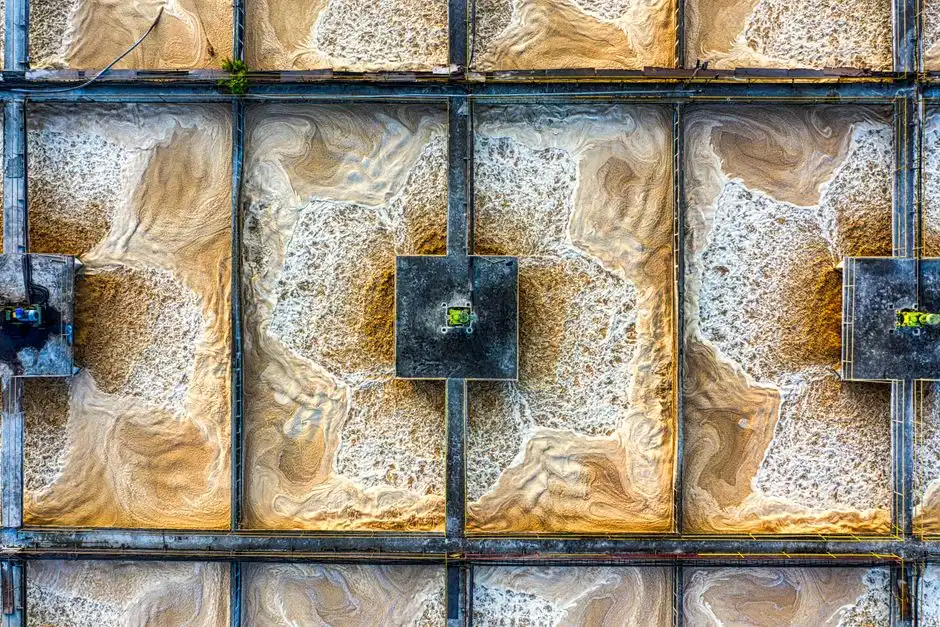
There are four realistic cases where a clarifier beats a DAF on a 2026 capex review. First, fully neutralized AMD after lime addition at pH 7–8.5, where most iron has already oxidized and settled, and the residual TSS is below 200 mg/L — a DAF wastes compressed-air energy on floatable material that gravity handles for free. Second, very high flow (>500 m³/h) with low TSS and no oil, where a lamella's 20–40 m³/m²·h loading makes the basin 5–10× smaller than the equivalent DAF contact zone. Third, sites that cannot fund chemical dosing, lack a trained operator, or need a 2-day install — a lamella package ships on a flatbed and ties into an existing sump with no saturator, no air compressor, and no recycle pump. Fourth, plants that route effluent to a settling pond or constructed wetland for final polishing, where the upstream load reduction needed is modest and a clarifier is the cheapest way to get there.
Decision Framework: Pick a DAF, a Clarifier, or Both
Run these three rules in order:
- If influent TSS >500 mg/L or oil/grease is present or dissolved metals >2 mg/L, a DAF is non-negotiable — start the design around a dissolved air flotation (DAF) system sized at 2–5 m³/m²·h.
- If flow >300 m³/h and TSS <300 mg/L and no oil, specify a HydropureWater high-efficiency lamella clarifier and skip flotation.
- Most Perry County coal-prep and quarry sites end up with both: coagulation + flotation → equalization → lamella polish → plate-and-frame filter press → discharge or reclaim. Add an automatic chemical dosing skid upstream of the DAF for Cr+6 reduction (Na₂S₂O₅ at pH 2–3) and pH lift (NaOH or lime) to 7–8.5 before the contact zone.
For a same-region benchmark, the DAF or Clarifier for Mining/Metals Wastewater in Hamilton, US: 2026 Factory Guide walks through an identical decision path with slightly different influent numbers. For chromium-specific flowsheets, the Best Technology for Chromium Removal: 2026 Engineering Buyer's Guide covers reduction chemistry and resin polishing in more depth than this article.
2026 Installed Cost, Footprint, and OPEX Benchmarks
For a 2026 budget envelope, turnkey DAF installs run $280–$520 per m³/h of design flow on a Chinese-engineered skid through a US integrator; stainless/Ecologix-class builds land at the top of that range. Lamella clarifier packages are $90–$180 per m³/h including the inclined-plate bundle, sludge hopper, and scraper. An automatic chemical dosing skid sized for two or three reagent streams (coagulant, polymer, pH) is $25,000–$90,000. OPEX is dominated by polymer at $1.20–$2.80 per m³ treated and saturated-air-pump electricity for DAF. Sludge disposal typically costs more than treatment once hauling is included, which is why a plate-and-frame filter press that cuts sludge volume 75–85% (lifting cake to 25–35% DS) is now a standard 2026 pairing rather than an optional add-on.
| Line item | 2026 installed range | Notes |
|---|---|---|
| DAF turnkey (per m³/h) | $280–$520 | Higher end = stainless/Ecologix-class builds |
| Lamella clarifier package (per m³/h) | $90–$180 | Includes plates, hopper, scraper |
| Auto chemical dosing skid | $25,000–$90,000 | Scales with number of reagent streams |
| Polymer OPEX | $1.20–$2.80 / m³ | Dominates DAF OPEX |
| Filter press volume reduction | 75–85% | Cake at 25–35% DS |
Frequently Asked Questions
Does a DAF always beat a clarifier for mining wastewater in Chavies?
No. A CF-DAF system wins on TSS above 500 mg/L, oil/grease, and dissolved metals (94–99% removal per the 2026 Pol. J. Environ. Stud. pilot, DOI 10.15244/pjoes/214082). For pre-neutralized AMD or low-TSS high-flow polishing, a lamella clarifier is cheaper to install and run, and most Perry County sites use both in series rather than picking one.
Can a lamella clarifier meet 40 CFR Part 440 effluent limits on its own?
Rarely. Part 440 Subpart B (Coal Mining) and Subpart C (Ore Mining) impose daily-max limits on TSS, iron, manganese, and (where applicable) trace metals. A lamella typically pulls 60–85% TSS and 40–70% of suspended metals but does not remove dissolved metals or oil, so most sites need a DAF or chemical precipitation step ahead of it.
How does AMD change the DAF vs clarifier decision?
AMD carries dissolved Fe²⁺ at low pH, which neither clarifier nor DAF can remove without first oxidizing it to Fe³⁺ and lifting pH to 7–8.5 with lime or caustic. Once oxidized, the ferric hydroxide floc floats readily in a DAF and settles in a clarifier, but DAF cuts residence time from 60–180 minutes to 5–15 and handles the colloidal manganese that follows.
What sludge-disposal step is standard for a 2026 mining DAF install?
A plate-and-frame filter press is now the default pairing. It dewaters the 2–5% DS float to 25–35% DS cake, cutting hauled volume 75–85%. If the feed carries chromium or lead, run TCLP on the cake before disposal — failure classifies the sludge as hazardous under 40 CFR 261 and forces licensed haul-off.